Wednesday, April 30, 2008
Miss Easy Tactics! with Justin VIII
Slip slidin' awayIn the end, it was one missed win too many.
Slip slidin' away
You know the nearer your destination
The more you keep slip slidin' away.

Horton v Cid Royo, Aragón Team Championship 2008, promotion/relegation play-off, Casino Jaque (Huesca) v Hermanos Cortes-Moog (Zaragoza): top board, position after Black's move 30...Ke7-f7.
It was the last day of the season, and everthing came down to this game and this position.
We had lost quickly on board four and we were losing on board two, but board three looked to be winning a bishop ending (which was, indeed, eventually won) so I needed to win this position to draw the match - and win it on tie-break.
All season I had created won positions and failed to win them: I had, I was sure, created another one. My opponent had played the weak 9...a6 in the opening and after that the story was all about an exposed Black king and an undeveloped kingside. I had played for the diagram position absolutely convinced that I would be winning, just looking for the final touch.
However, when I got there, despite having plenty of time (I'm not sure how much - I was sufficiently distracted, or distressed, at the end to pick up my opponent's scoresheet instead of mine, on which times are recorded) I couldn't see it.
I intended to play 31.Rd7+ - and did in fact do so - after which Black must play 31...Kg6 as if 31...Be7 32.Rxe7+. I then believed that the e-pawn, now abandoned by the king, would fall, and that would be the end of it. But in fact, on playing 31.Rd7+ Kg6 I couldn't find a way to get at the pawn, since if 32.Qc4 Kf6 and I couldn't see what to do next: whereas if I tried anything else, like 32.Rb7 or giving my king some air, Black would play 32...Qc5 exchanging queens, freeing his bishop, releasing his rook and saving his a-pawn.
I spent most of my remaining time trying to find something, failed, eventually played 32.Qc4 anyway and was surprised by 32...Qxb2! 33.Qxe6+ Qf6! which saves the game. I played on for almost thirty more futile moves but there was nothing doing and eventually I had to shake hands and accept relegation.
I looked at the game a little that evening and a little more the next morning: but it was only when I put it through the computer that I understood that much of the above is based on a disastrous misapprehension. Can you see the the simple tactical point which I had missed, and which, if I had seen it, would have meant I won the game, squared the match and kept Casino Jaque in the top division?
It is the most soul-destroying pattern there can be: always to be winning, and always not to see the win that is there. I am shattered.
[Miss Easy Tactics! Index] [Blog report in Spanish, local paper]
Tuesday, April 29, 2008
ECF Folk Quit
I've no idea about the ins and outs nor do I have a clue what it means for chess as a whole but I do know this...
When I started playing club chess in the 80s England were one of the world's leading chess nations. We got three consecutive silver medals at the chess olympiad and at one time had two of the top five rated players.
Now English chess is rubbish. I'm not sure the decline is entirely related to me taking up the game. Perhaps it's got something to do with the people who've been running things.
So what's going on at the ECF?
PS:
Thanks to Angus for the tip-off.
Monday, April 28, 2008
Club News Update
Two other bits of news. Firstly, a slightly under-strength S&BCC side faced Mushrooms I on 14th March in our final London League First Division match of the season, which we currently lead 6-5 with one game adjourned. This means we should finish in the top-half of the table: not quite as good as last year's fourth, but certainly respectable. Interestingly, last year we scored six match points and will at least do that again this year, but will certainly finish lower in the table. So in an already highly-competitive league, competition is hotting up even further...
Finally, we will be holding our club championship on Tuesday 6th May and Tuesday 13th May at Woodfield Grove Tennis Club. Entry is free to members of our club (it's never too late to join!) and to those of Streatham Library Chess Club. Each evening will see three rapid games, the first starting at 7.30pm, with first prize a year’s free membership, and the same prize going to the highest-finishing player from the second half of the draw. Further prizes are currently being arranged, and those wishing to enter should contact Club President Angus French.
Sunday, April 27, 2008
Sunday puzzle
Saturday, April 26, 2008
Bad book covers I
Friday, April 25, 2008
Things I Don't Like About Chess Books IV
I’ve played 20-odd games with 1. Nf3 so far this season and haven’t done too badly with it at all. I’ve won eight, drawn seven and lost five. That’s an overall percentage of 58% which is “above average” according to my Chess Base dossier since you ask.
Not bad wouldn't you say? NO – it’s total crap. I think I should be doing much better.
I’ve come to this conclusion after examining the results of the games in Nigel Davies’ The Dynamic Reti. Of the 65 complete games analysed White scores +55 =9 -1. That’s over 91% which rather exposes my shameful lack of success with the opening.
You may be interested to know the only player of the White pieces to lose a game in Davies’ book is a certain Mr. Plachetka who went down against Kestler at the Nice Olympiad in 1974. In fact, even in this game White was better throughout before making a rash 29th move that lost his advantage then blundering the game away entirely on move 32.

Black to play and force resignation
Why books with such an imbalance of scores get published? Is it because, as it appears to be, that chess book authors and publishers have an incredibly low opinion of their customer base? Their thought processes seem to run something like as follows:-
- We think you’re stupid.
- We think you don't understand that there are no easy solutions to improving at chess.
- We think you don't realise that you’ll have to put some effort in – that any book can only take you so far.
- We think you’ll see that all these games end up as wins for White and you’ll believe that all you have to do is play the opening yourself and then you’ll win all your games too.
- We think that thought will make you want to buy this book.
- We think that when you start playing this opening you’ll find out this is not what happens.
- We think you’ll become disillusioned with whole line and believe it to be crap after all.
- We think you’ll abandon it and go looking for some other opening that promises guaranteed success.
- We think you’ll want to buy another book from us at that point.
… and so on and on.
Not everybody takes this attitude of course. Consider Peter Wells' introduction to his book Chess Explained: The Queen's Indian, (Gambit, 2006):
"In general the selection of games has also been determined by considerations of strategic clarity and, I hope, entertainment. What was largely ignored was the result. Accidents happen even at a high level, and the reader is advised to use his own judgement in conjunction with the commentary rather than the less rigorous method of checking the result!"
If only all authors of chess books were like Peter Wells and actually interested in producing a quality product. Alas they are not and one of the things that follows from this basic starting point is that they churn out chess books that only contain games where one side wins. I do wish they’d stop. It’s embarrassing and it demeans us all … author, publisher and reader alike.
TIDLACB I
the omission of important lines
- Nigel Davies: The Dynamic Reti, Everyman 2004
TIDLACB II
[comment removed to keep Nigel Davies cheerful. Actually he hadn't asked us to do this (or threatened us with legal action if we didn't) but, hey, we want him to be happy so we did it anyway]
- Nigel Davies: The Dynamic Reti, Everyman 2004
TIDLACB III
lazy arses
- Ray Keene: Flank Openings (4th edition), BCM 1988
Thursday, April 24, 2008
Curiouser and Curiouser
Well, judging from his recent blog post, Tom Brown sees chess in a way so different to me it seems not only a different game, not only a different language, but a thing entirely alien - and all the more fascinating for it. He has created a frenetic animation of a chess game that includes "colored fields to highlight the relevant ranges and the changing relationships of the pieces as they move about the board..."Take a look at the changing colors and wonder how many relationships are established by moving the pieces about and also wonder at how the relationships change as pieces continue to develop...as they work with and against each other...here and there...near and far," he writes, going on to ask: "Now, where is your relevant range in life? and what color do you give off??"
Some questions have no answers, we can but mouth their mysterious words.
It is no new secret of course that chess is a grand, vast game that welcomes on to its boards all kinds of players with all kinds of thinking from all kinds of backgrounds - and the internet is the perfect vehicle for meeting more of them. On which note, allow me to introduce to you WuChess, a new website set up by RZA, a rapper best known for being the "de facto leader of the [famous American] hip hop group Wu-Tang Clan". WuChess is currently registering members before launching properly - and according to its blog numbers over 3,000 already. I'm one of them, and looking forward to playing new opponents there. How about you?
Wednesday, April 23, 2008
What happened next

Jonathan Penrose v Olaf Ulvestad, Siegen Olympiad 1970: Preliminary Group Two, round eight, England v Andorra, top board. Position after Black's 46th move.
In those days there was a two-stage Olympiad, rather than a long Swiss: teams were divided up into Preliminary Groups and according to their final positions were be placed in an appropriate final group. Two teams qualified from each group to the top section in the second stage - and while the easy and predictable winners of the group were Yugoslavia, England started well and looked likely challengers for the second spot: particularly with weak sides Andorra and Luxembourg to come in the final two rounds. However, in the seventh round they lost badly to Canada and really needed maximum scores against the back-markers in the eighth and ninth.
This shouldn't have been so hard against Andorra, but on top board Penrose was faced with Olaf Ulvestad, a Norwegian emigré. White is surely better in the diagram position, with bishop against knight and Black's pawns vulnerable to attack, but Penrose wrongly thought he saw a way to win the d-pawn immediately with 47.Rxd6??. Presumably he'd just assumed the immediate capture 47...fxe3 which puts White a pawn up after 48.Rxe6, but in fact it loses to 47...Re5 which is the move Ulvestad played.

There followed 48.Ra6, a doomed attempt to get two connected passed pawns for the piece he'd lost, which was met by 48...Re4, denying Penrose even that small chance, since if 49.Kd3 fxe3 50.fxe3 Nc5+. Thus the game reached the following position:

Ray Keene (modestly underplaying his own role in the drama) takes up the story:
At the Siegen Olympiad England was (sic) in the same Prelim section as Yugoslavia and Andorra. We were heading for the B Group, i.e. coming third, when disaster struck in the game Penrose-Ulvestad from (the) England v Andorra match.Still, nobody actually chinned anybody.
Penrose had been winning but had a mental blackout during the game and made a weak move. He turned to me and said he had probably lost a piece and then - suddenly - in mid game he fainted and fell to the floor. I grabbed him - I am quite big, he is tiny - dragged him to a chair and positioned him there bolt upright. I was puzzled that his face appeared to be turning dark green to black.
Recognising that first aid was at the outer limits of my competence I decided to use what skills I did possess and called out in loud German - for Siegen is in Germany -"gibts vielleicht ein Arzt hier oder jemand der First Aid versteht?"
At this moment a polite young man leapt out of the audience and said - "Vat your are doingk eez keeling heem!" I asked why and he said that by making him sit upright I was draining the blood from his head: indeed, Penrose had now turned an alarming shade of black. The German continued, "ve must lay him down on ze floor zen he vil be ok ja!"
So we picked him up from the chair and put him flat on the ground, at which point colour returned to his face and he eventually recovered. The game with Ulvestad was discontinued and resigned. Penrose went home and England ended up in - and won - the C group, our worst ever Olympiad result until Calvia.
In truth Ray's memory is slightly at fault since Penrose's disaster cost England their chance at the A group rather than the B group, which only disappeared when Andrew Whiteley lost to Weber of Luxembourg in the last round. I don't know, from the crosstable, whether a draw would have been enough: either way, Black won easily from the following position to render the question academic.

Subsequently Penrose turned to correspondence chess (although he did play the Olympiad again, in Nice in 1974). Ulvestad remains best-known for his variation (4.Ng5 d5 exd5 b5!?) in the Two Knights' Game. And Ray Keene - whatever happened to him?
Tuesday, April 22, 2008
What happened next?
Monday, April 21, 2008
Paperweight
Stephen Fry,
Paperweight
I came across this passage while I was clearing out a bunch of old books to take to the charity shop on the High Road.
Mr. Fry's getting himself a bit carried away there don't you think? I mean, I know chess is supposed to be pretty inexhaustable but that doesn't mean there aren't countless short draws that finish in the same way. The 10. ... Re8, 11. Ng5 Rf8, 12. Nf3 Re8 line in the Zaitsev played many times by A. Karpov and even once by myself springs to mind.
Anyhoo, it got me wondering if we were to limit our search only to games between grandmasters, what would be the longest pair of identical games that we could find? I don't mean doubles like these two that are kinda, sorta alike but a pair that are exactly the same.
Does anybody know? Like Justin's puzzle yesterday, I haven't a clue.
Sunday, April 20, 2008
Sunday puzzle
Saturday, April 19, 2008
You'll answer to me
Friday, April 18, 2008
Things I Don't Like About Chess Books III
R.D. Keene,
Flank Openings
British Chess Magazine 1988
Page 104:
"In this section I examine a few lines of the English which were not included in the scheme of the first edition, and were only touched on lightly in the supplement to the second ...
Perhaps a 4th edition of 'Flank Openings' will include all lines of the English in detail, but if it does, I fear 'Flank Openings' will have to divide amoeba-like into two volumes!"
I wouldn't have minded were it not for the fact that I was reading the effing 4th edition. Obviously RDK was far too busy to get off his capacious backside and give the text even the most cursory of once-overs to see if anything might need changing. And, by the way, no it hadn't divided, 'amoeba-like' or otherwise.
There's another curiosity on page xiii:-
"Games extracts (sic) are not listed in the following index. Readers who wish to add further references will find a blank Index on pages xv and xvi as well as space for notes at the end of the book."
Translation:-
We can't be bothered but you can do it if you like.
By the way, regular visitors of the blog may or may have not have noticed that there has not actually been a 'Things I Don't Like About Chess Books' I or II yet. Very true - but I've decided to consider the following articles the opening brace of the series.
TIDLACB I
the omission of important lines
- Nigel Davies: The Dynamic Reti, Everyman 2004
TIDLACB II
[comment removed to keep Nigel Davies cheerful. Actually he hadn't asked us to do this (or threatened us with legal action if we didn't) but, hey, we want him to be happy so we did it anyway]
- Nigel Davies: The Dynamic Reti, Everyman 2004
Thursday, April 17, 2008
A Marshall Gambit refutation?
I subscribe to the section on 1.e4 e5, the one on 1.d4 d5, and the one on Flank Openings - which may not seem entirely consistent but I take a different view of classical openings when I'm on the White side of the board. The 1.d4 d5 section is written by Ruslan Scherbakov: I have a lot of time for Scherbakov, who seems to put a lot of work in when considering and evaluating both the openings and new games which develop the theory. All right, that sounds like a blurb from a mediocre openings book, but trust me. If I didn't think it was good I wouldn't pay to read it.
To my mind Scherbakov not only puts the work in, but gives us the benefit of his own study in having relied on, and therefore studied, certain lines during his own professional career. So, for instance, there is a surprisingly long section - which, I'm afraid, you can't read unless you're a subscriber - on the Marshall Gambit, which he has defended, from the Black side, for a number of years. Given the absence of any specialist books on the opening, I imagine this is the most substantial contemporary source for Marshall Gambit theory, in English anyway.
I'm not referring to the famous line in the Spanish, but White's gambit response to a Black triangle pawn formation. 1.d5 d5 2.d4 e6 3.Nc3 c6 and now, rather than play 4.e3 or 4.Nf3, White can try 4.e4.

Black plays this way in order to avoid the Exchange Variation of the Slav, on the one hand, and on the other, the necessity to learn a second opening, the Nimzo-Indian, which arises if Black begins instead with 1.d4 Nf6 2.c4 e6 and then White plays 3.Nc3 - making the desired Semi-Slav unlikely. Mind you, Sadler (Queen's Gambit Declined, Everyman, 2000) warns "do you want to spend a lifetime learning the 4.e4 Marshall Gambit?" indicating that not a lot of work will necessarily be saved by making this choice.
Still, in The Complete Semi-Slav (Batsford, 1994) Peter Wells says that "personally, I enjoy playing both sides of this fascinating gambit" and it was recommended, for instance, in Larry Kaufman's well-received repertoire book The Chess Openings In Black And White (Random House, 2004). It's one of those openings that you feel you'd like to avoid when playing on the other side, but seem somehow not quite entirely trustworthy as a part of one's own repertoire: Kaufman considers his opening recommendations to be "fully respectable among strong grandmasters" but it certainly doesn't seem to crop up very much above 2650 level. Never mind, that's a higher rating than any opponent I've ever played (or so I believe - what was Tony Miles' rating when I played him in Wolverhampton about twenty years ago?) but even so, I do get the feeling, as with the Benko Gambit or the Chigorin, that one day somebody, or something, is going to find a clear-cut refutation.
Often, when White goes 4.e4 and thus takes up the gauntlet, play continues 4...dxe4 5.Nxe4 Bb4+ 6.Bd2 Qxd4 7.Bxb4 Qxe4+ 8.Be2 Na6 9.Bc3 and now it used to be standard to play 9...Ne7 which was considered absolutely fine for Black until a 1993 last-round interzonal game Lautier v M.Gurevich, given below, in which Black was dramatically demolished. (It's still played, but 9...f6 has attracted some attention given that Lautier's plan still seems strong.)

Lautier-Gurevich now continued 10.Bxg7 Rg8 11.Bf6 and now 11...Qf4, which used to be thought good, was burned up after 12.Bc3! Rxg2 13.Nf3 f6 14.Qd2! when the exchange benefitted White as the queen's absence made it hard for Black to defend his many weaknesses.
I'm not going to swamp this post with theory - Wells is a good place to look it up and if you do, you'll see he doesn't rate the alternative 11..Rg6 very highly. But Scherbakov thinks it's playable and follows a 1995 game he played against Berg which went 12.Bc3 Qxg2 13.Qd2 Qxh1 14.O-O-O Nd5 (not my normal style, this line) 15.Nf3 Qg2 16.cxd5 cxd5 17.Ne5 Bd7 18.Qf4 Rg7 19.Nxd7
and now instead of 19...Kxd7, which he played, he recommends 19...Qg5 20.Nf6+ Ke7 21.Qxg5 Rxg5 and claims that"Black's position is quite acceptable..."

"...since after 22.Nxh7 Rf5 23.Bd4 f6..."

"...White should be careful about his knight."
As I say, I like Scherbakov's work, but in this instance I wonder how far he's gone to check his conclusion: if there was an Informator symbol for "Jimmy Hill" I'd insert one here. I don't believe it and neither does Rybka, which likes 24.Rg1! and likes it a lot.
The point is that if the king is driven away from the f6 pawn then the knight can take it with impunity and doesn't have to be careful at all. Black's obvious response is 24...e5 which shields the pawn from the bishop and therefore allows the rook to defend it, but after 25.Rg7+ Kd6 it turns out that White's bishops drive the rook away: 26.Bg4 Rf4 27.Be3 and it has to move from the f-file. So 27...Rc4+ 28.Kd2:
and the best I can produce on Black's behalf is "fighting for a draw". Those bishops are really pretty good.That's not a forced line but I've been unable to find any deviations which help the Black cause - Black can take a queenside pawn, or play an early ...Rc8+, or try ...Rh8 attempting to tie up the White pieces a little, but in every case it looks like Black's position is under too much pressure to be held.
Now it's true that this is Rybka-led analysis and that computers aren't always the best judges of positions in the Marshall - as you'll see if you use one to play through the earlier moves and watch the evaluation swing about. But still: in the absence of any contradictory evidence the position after 23...f6 (though not the Gambit as such, of course) looks like a busted line to me. And I do wonder - given that the computer comes up with 24.Rg1+ immediately, was the original conclusion, that "Black's position is quite acceptable", put to any real test?
Wednesday, April 16, 2008
Classical Opening Principles
Occupy the centre with pawns

Kernazhitsky-Wiley, Olomouc 2000
I came across this position last night. I can't recall ever seeing anything quite like it before.
Would anybody care to,
(a) guess the opening
(b) evaluate the position [it's White to move]
Tuesday, April 15, 2008
Chess? Chess is Chess...
But now New in Chess announce the arrival of Football & Chess: Space, Timing and the Similarities Between Cruyff and Capablanca, by Adam Wells. Here's the top and tail of the editorial description:
Why are football and chess 'beautiful games'?
Why do football commentators use so often chess terms to describe a football match?
Do top football coaches read the pitch as a chess player reads the board?
What is the connection between Jose Mourinho's defensive cunning and Grandmaster Wilhelm Steinitz's 'principles of defence'?
... Readers will see how chess can be a pulsating, dynamic game, whilst appreciating that football shares much of the mystery and structural beauty of the world's greatest board game.
Well, I told you right at the kick-off of this post that I just don't buy it, and my initial position remains - I'm just not going to buy it; to me, the very idea is as much an own goal as Fool's Mate is. Or, I wonder, do readers think that am I blowing the whistle too early on this idea, prematurely resigning myself to dismissing it? After all, the two played together on this very blog ever so recently...
Maybe, maybe not. Anyone tempted to take a long-shot and gambit their cash on the book?
PS. Connoisseurs of publishing industry intrigues will note that the book is published by Hardinge Simpole, yet their website currently seems to deny all knowledge.
Monday, April 14, 2008
Miss Easy Tactics! with Justin VII
Last week I watched one of the most dramatic and traumatic football matches I have seen in years, a UEFA Cup quarter-final, second leg, between Getafe and Bayern Munich. Bayern are, of course, world famous and multiple European champions: Getafe are a small town south of Madrid. If you've never heard of them, that's forgiveable - less forgiveable to actually say so just before playing them, as Franz Beckenbauer did, making it a grudge match when there had been no grudge before.
The first leg was thrilling enough, with Getafe equalising at the death to make themselves favourites to go through: but they ceased to be favourites a few minutes into the second leg when they had a man sent off for a professional foul. Shortly afterwards, their striker, Uche, was taken off injured, and it looked like a long defensive struggle to try and hold Bayern 0-0 and go through on away goals. But shortly before half-time (the highlights are here) Contra, against the run of play, stumbled through half the Bayern team before rocketing past Kahn to put Getafe ahead. They looked like they'd won it for sure when their man rounded Kahn deep into the second half - only to fall over with an open goal in front of him. A minute before full-time Ribery, last seen scoring a penalty for France to beat England, volleyed an equaliser and that looked like the end for Getafe, with their exhausted ten men facing extra-time.
But no sooner had the half-hour begun when they scored, again from distance - and added to it a couple of minutes later. Three-one and Bayern seemed to have nothing left, though some of us were thinking back to 1982 and a German comeback from 3-1 down in extra-time. Bayern, however, offered no threat until, with five minutes to go, the Getafe keeper, Pato (which means duck) who had already made a grotesque error in the first leg, unaccountably dropped a harmless long ball and Toni rushed in to score. Everybody was stunned: even the TV, which never got round to showing an action replay until the news the following morning.
But even now, Getafe were ahead, and time was almost up. Kahn was forced to rush forward to join his teammates around to the Getafe area. A long ball was headed away and had it fallen to a Getafe player, that would have been the end: but with Kahn stranded, Bayern recovered the ball, a cross came in, Toni got his head to it, the ball bounced beyond Pato - and Getafe, having been ahead practically all the match, having played way above themselves, having had the match in their hands, had thrown it away, and with it, a chance they may never get again.

Anyway, the chess. It's Saturday afternoon, the last round of the Aragón Team Championship and Casino Jaque of Huesca are playing in Zaragoza against the ONCE Aragón side. I am Black on top board against Luis Laliena Solanes (FIDE 2166) and the situation is this. If we win the match, we evade the relegation play-offs. If we draw or lose, we do not, although drawing should get us a slightly better seeding than losing would. Two games of the four have finished: we have lost on board two and drawn on board three. I think we may be winning on board four but I am short of time and cannot get up and look. Either way it is probable that I need to win.
However, I have played, so far, quite splendidly, outplaying my opponent on the queenside, though as usual I have used up too much time in doing so. Meanwhile, in bringing his f3 knight over for support, he's left his king short of defenders. But his last move, 23.Nd4-c6, forks my queen and rook.

I knew I had at least a draw here, with 23...Bxh2+, but I didn't think I could take the draw, with the match situation and the league situation as they were. I had seen the game continuation already, but although I thought it ought to give me a technically winning game I was far from sure that it was the best course in practice, and so I looked for more with 23...Qh4 with the idea of 24.g3 Nxg3 25.hxg3 Bxg3 26.fxg3 Qxg3+ 27.Kf1 Be4! winning. Unfortunately there was a hitch, which is that White has the zwischenzug 26.Ne7+! when after 26...Kf8 27.Nxg6+ there is no bishop left to finish off the combination.
So, with about a minute left on my Fischer clock, I played 23...Rxc6 24.Nxc6 Bxa3 25.Nxe7+ Bxe7 which gained me two pieces for a rook and which may be winning, and may not. But with a rook on the seventh after 26.Rd7, the back rank weak, the b5 pawn likely to fall and themes of Rb7xb6 if the bishop settles on that square, it's far from ideal with only a couple of minutes on the clock and never mind the extra thirty seconds a move. Sure enough, after 26...Bc5 27.Rc1 h6 28.Rb7 I played the blunder 28...Rc8??? and that was it. I was lost, so was the match, and so was our chance of escaping the relegation play-offs, which had been in my hands (we did in fact win on board four) just as victory at Getafe had been in Pato's hands. I resigned very shortly. It was rather longer before my head stopped buzzing and longer still before I could actually speak. And if I get a full night's sleep tonight it will be the first one I have had since then.
You will gather that there was a win there, and not such a hard one to find (if, indeed, there is only "one"). What did I miss?
Sunday, April 13, 2008
On the box
Now, of course it's not the case that a fledgling chessboxing club doesn't deserve to be reported. It's that since it definitely does, then surely it follows that the serious, significant and pure chess news out there ought to be reported too - whether, say, England number one Michael Adams's recent tournament win, or the Chess for Schools project. And it doesn't require a great leap of the imagination to see the connection between all this and the well-known fact that in medialand, All Serial Killers Play Chess. That, in other words, nearly all chess stories must be filed under "Oddball" in order to feature.The first UK chessboxing club has begun at Islington Boxing Club in Archway ... [the] club opened last Saturday with seven members, aged between 24 and 37, and [founder] Mr Woolgar hopes to hold the first UK championship this summer.
"At the moment we are attracting boxers who want to play chess, but chess players who want to learn to box are also showing an interest," he said.
Still, best of luck to the new chessboxing club, a new and interesting addition to the London chess scene. For the Great Britain ChessBoxing Organisation's website click here.
Saturday, April 12, 2008
An invitation to Benasque 2008

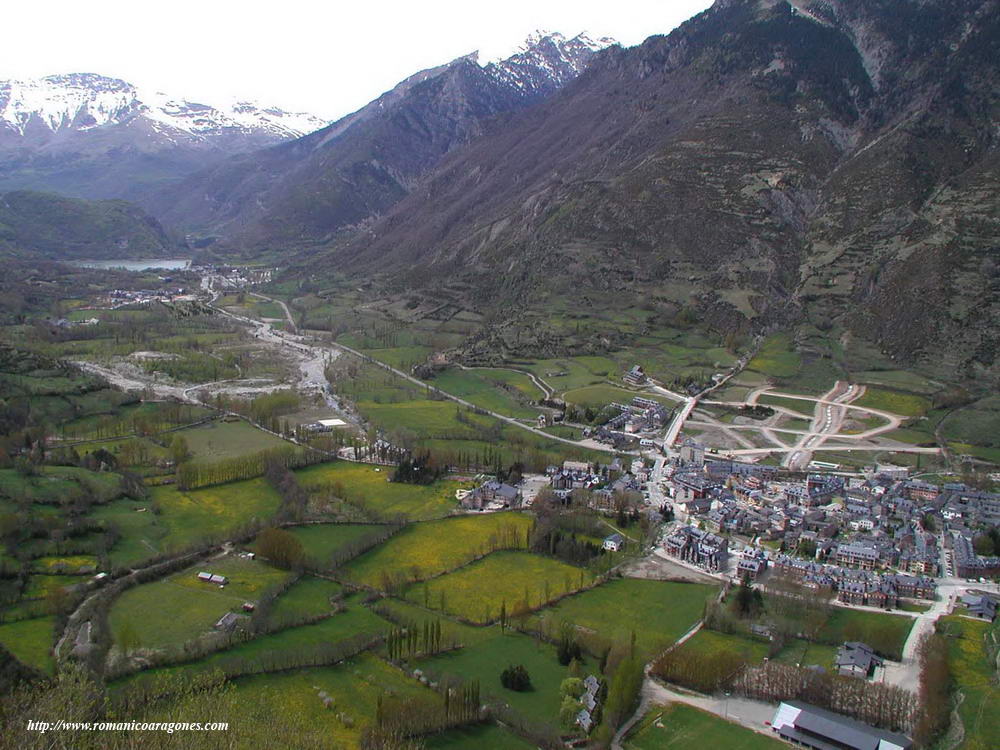
Today, my annual invitation to play chess in the Spanish Pyrenees in the summer. As I said last year, Benasque is a very small town high up in the mountains, just a couple of kilometres from the border, not that you can get to France from there except by walking over the mountains. The playing hall can be seen in the photo above, in the bottom right-hand corner.
This year the tournament runs from 3-12 July. It's extremely popular - last year there were, I believe, over 400 competitors, and while most of them were from Spain, there were a number of top masters and grandmasters from all over Europe and from further afield. (I was lucky enough to play against Ulf Anderssen last year. I suppose I should have asked him what he felt about the world correspondence number one, what with him being the number two.) Although the hoi polloi are mostly Spanish, there's a fair sprinkling of foreigners all the way down the field. Last year, though, there were only two English players: myself and Lawrence Trent, and as I'm resident in Spain and Lawrence was studying here at the time, neither of us really count as an overseas visitor.
So if anybody, from England, Spain or anywhere else, wishes to enjoy chess in the Pyrenees this July, there is an entry form here including details of hotels and so on. I shall, as usual, be staying at a campsite about a couple of kilometres up the hill beyond the town, where I shall wear earplugs, at night, to sleep through the babble of the nearby river.
Friday, April 11, 2008
The Games of Greco
Part 1: Greco for his own sake.
Before the talk started, I set up the following position on the demonstration board, where it is black to play and win:
By the time the talk started, several of the audience had spotted the smothered mate that begins with 1...Nf2+ etc. Greco seemed particularly beloved of smothered mates, and the moves he contrived to reach the diagram above would be rather bizarre were it not for the finish. Of course it helps us understand this when we remember that Greco's opponent in all these games was Nomen nescio, which is Latin for "No named person" or similar, thus accounting for Greco's unrivaled 100% record. We should not really accuse Greco of arrogance here: he made his living traveling the courts of Europe playing noblemen; his books (from which we know his games and his travels) were parting gifts to his benefactors, rather than vanity projects.
Next I presented the audience with a more consistent game from Greco, but one which also features a delightful finish after 1. e4 e5 2. Nf3 d6 3. Bc4 Bg4 4. h3 Bh5 5. c3 Nf6 6. d3 Be7 7. Be3 O-O 8. g4 Bg6 9. Nh4 c6 10. Nxg6 hxg6 11. h4 b5 12. Bb3 a5 13. a4 b4 14. h5 gxh5 15. g5 Ng4 16. Rxh5 Nxe3:
White's move: is there something better than recapturing the knight?
The finish is: 17. Rh8+ Kxh8 18. Qh5+ Kg8 19. g6 Re8 20. Qh7+ Kf8 21. Qh8, mate.
Finally, I presented a good Greco counterattack, asking the audience after 1. e4 e5 2. Nf3 Nc6 3. Bc4 Bc5 4. O-O Nf6 5. Re1 O-O 6. c3 Qe7 7. d4 exd4 8. e5 Ng4 9.cxd4,
It turns out that white's best bet is 11.Be3, because 11.Nf3 - as played - allows black's already vicious attack a devastating coup:
This proved harder to spot for many of the audience than the previous smothered mate, especially when I asked them to decide for white between 11.Be3 and 11.Nf3. The finish from this diagram is, 11... Qxf2+ 12. Kh1 Qg1+ 13. Nxg1 Nf2#.
I hoped that from this one fragment and two games, the audience would be intrigued by Greco's play. In the second part of the talk I turned to opening traps - I had been invited especially to talk about openings - but probably if I did the talk again, I would either scrap or reduce this part of the talk. Nonetheless...
Part 2: Traps
#1 The Open e-file
White continues with 4.Qe2, obliging 4...Qe7, when black soon has to go through all sorts of contortions to stay in the game. To try to demonstrate the relevance of understanding this sort of thing, I next presented this similar loss by current World Champion and World number 1 Viswanathan Anand from 1988 against Alonso Zapata in six moves: 1.e4 e5 2.Nf3 Nf6 3.Nxe5 d6 4.Nf3 Nxe4 5.Nc3 Bf5?? 6.Qe2, and white black resigned. After 6...d5 7.d3 or 6... Qe7 7.Nd5 Qd8 8.d3 black is losing a piece. (See also this post.)
#2 The Side-Check
can black play 5...Nxe4?
White to play and win.
#3 The Queen's unGambit
I briefly outlined why the Queen's Gambit is not in fact a true gambit: because at the very least, white wins his pawn back after 1. d4 d5 2. c4 dxc4 3. e3#4 The dangers of the moved f-pawn
Firstly, after 1. e4 b6 2. d4 Bb7 3. Bd3 f5 4. exf5 Bxg2 5. Qh5+ g6 6. fxg6 Nf6, I asked the audience...
how did white win?
With 3.Nxe5 white instantly exploits the weakening of the black king's position by the move of the f-pawn. I next told the audience that black played 3... fxe5? and after 4.Qh5+ was in deep trouble, but asked them to consider before I showed them the rest of the game whether 4.Qh5+ would also have been the right move against 3...Qe7. A surprising number thought that yes, this was the correct move, but of course in fact after 4...g6 it is black who is winning (5.Nxg6 Qe4+ etc.) Greco faced no such trap, and instead the game finished straightforwardly: 4.Qh5+ Ke7 5.Qxe5+ Kf7 6.Bc4+ Kg6 7.Qf5+ Kh6 8.d4+ g5 9.h4 Kg7 10.Qf7+ Kh6 11.hxg5, mate.
#5 The danger spot on f7
I am not sure what proportion of Greco's games feature action on the f7 square, but a lot certainly do. If black gets his queen out early or is too materialistic, the punishment is likely to involve something on that square. For instance after 1.e4 e5 2.f4 exf4 3.Bc4 Qh4+ 4.Kf1 Bc5 5.d4 Bb6 6.Nf3 Qh6 7.g3 Qh3+ 8.Kf2 fxg3+ 9.hxg3 Qg4,
Greco wins with 10.Bxf7+ Kf8 11.Rh4, 1-0. Or after 1. e4 e5 2. Nf3 Nc6 3. Bc4 Bc5 4. c3 Nf6 5. d4 Bb6 6. dxe5 Nxe4,
the brutal 7. Qd5 forces black's resignation. Greco also demonstrates how capturing on f7 can leave a fatal weakness in the black kingside even if it doesn't win immediately. For instance after 1.e4 e5 2.f4 exf4 3.Bc4 Qh4+ 4.Kf1 Bc5 5.d4 Bb6 6.Nf3 Qe7 7.Bxf4 Qxe4,
8.Bxf7+ ruins the black king position. Two Greco games continue from this point with 8... Kf8 and now 9.Bg3 Nh6 10.Nc3 Qe7 11.Bb3 c6 12.Qd3 d5 13.Re1 Qf6 {and now here game 35 instead continues, 13... Qf7 14. Bd6+ Kg8 15. Re7 Qf6 16. Nxd5 Qxd6 17. Nf6+ Kf8 18. Re8 mate} 14.Bh4 Qg6 15.Be7+ Kg8 16.Qxg6 hxg6 17.Nxd5 cxd5 18.Bxd5+ Kh7 19.Ng5+, mate. Oddly, Greco rarely demonstrates that f2 can similarly prove to be a sore spot in the white position, even in his explorations of the King's Gambit.
Part 3: Making Contemporary Connections
The final part of my talk was also the most testing. In this part, I tried to show how in Greco's games we can find very simple formulations of ideas that crop in today's game, but in much more complicated circumstances. So, I planned to show a Greco game, and then show more modern games that are comparable but more complex. Were I to repeat the talk, I would probably just do this kind of thing. The first idea I showed was,
#1 The Greek Gift
This appears in Greco's games after 1. e4 e6 2. d4 Nf6 3. Bd3 Nc6 4. Nf3 Be7 5. h4 O-O 6. e5 Nd5,
Next I demonstrated a famous mutation of this idea, from the classic Lasker - Bauer, Amsterdam, 1889. After 1.f4 d5 2.e3 Nf6 3.b3 e6 4.Bb2 Be7 5.Bd3 b6 6.Nc3 Bb7 7.Nf3 Nbd7 8.O-O O-O 9.Ne2 c5 10.Ng3 Qc7 11.Ne5 Nxe5 12.Bxe5 Qc6 13.Qe2 a6 14.Nh5 Nxh5
Lasker unleased a double bishop sacrifice with 15.Bxh7+!! Kxh7 16.Qxh5+ Kg8 17.Bxg7! Kxg7 18.Qg4+ Kh7 19.Rf3 e5 20.Rh3+ Qh6 21.Rxh6+ Kxh6 22.Qd7!, and went on to win. Lasker's sacrifice relies on the fork of the two bishops at its end, as well as an extra bishop sacrifice, but nonetheless the basic idea of ripping open the black kingside is comparable to Greco's game.
Next I showed an extremely complicated example from the 20th Century and another classic, Polugaevsky-Tal, 1969. After, 1. c4 Nf6 2. Nc3 e6 3. Nf3 d5 4. d4 c5 5. cxd5 Nxd5 6. e4 Nxc3 7. bxc3 cxd4 8. cxd4 Bb4+ 9. Bd2 Bxd2+ 10. Qxd2 O-O 11. Bc4 Nc6 12. O-O b6 13. Rad1 Bb7 14. Rfe1 Na5 15. Bd3 Rc8 16. d5 exd5 17. e5 Nc4 18. Qf4 Nb2,#2 Attacking the Fianchetto
After 1. e4 b6 2. d4 Bb7 3. Bd3 g6 4. f4 Bg7 5. Be3 Nc6 6. Nf3 Nf6 7. c4 O-O 8. Nc3 e6
When it comes to attacking the fianchetto, that's probably about as simple as it gets. This game from the Karpov - Korchnoi match in 1974 is, however, about as complex as it gets. Still, after 1. e4 c5 2. Nf3 d6 3. d4 cxd4 4. Nxd4 Nf6 5. Nc3 g6 6. Be3 Bg7 7. f3 Nc6 8. Qd2 O-O 9. Bc4 Bd7 10. h4
we can see white initiating the second part of Greco's plan: attack down the h-file. And after, 10... Rc8 11. Bb3 Ne5 12. O-O-O Nc4 13. Bxc4 Rxc4 14. h5 Nxh5 15. g4 Nf6 16. Nde2 Qa5 17. Bh6 Bxh6 18. Qxh6 Rfc8 19. Rd3 R4c5, we see a far more complex demonstration of one way to dislodge the f6 knight.
In fact it's more complicated than that. Black has defended against Nxf6+ followed by Nd5, because he can capture the new d5 knight with his c6 bishop. Then the black king can escape the white attack via e7, which is no longer under white's control. White has a second way to target the black kingside, however, which is 24.Nxf6+ exf6 25.Nh5. But this fails to 25...Qg5+. But were a pawn was in the way on the fifth rank, the black queen would not have this resource. So Karpov plays, 24. e5!! and won after 24... Bxd5 25. exf6 exf6 26. Qxh7+ Kf8 27. Qh8+ 1-0.
And that was where my talk finished, because I had run out of time. I had hoped to further demonstrate one of Greco's Fried Liver games and compare it to Topalov's 12.Nxf7!? against Kramnik in Corus this year (possibly a bit of a stretch) and also to demonstrate a couple of Greco's games that feature a couple of motifs found later in this classic.
I thoroughly enjoyed preparing and presenting the talk, and I hope my audience enjoyed it too and learnt something. It is particularly interesting to have played through every one of a player's recorded games - to really get a feel for how they played, what they liked to do - and having a talk to work towards really helped with my focus too. I hope this rather long blog article helps recommend Greco too, and most of his games can of course be found over at chessgames.
Thursday, April 10, 2008
Morphy plays the French
I was going to write about King's Head today but, aside from the fact I haven't quite got around to it yet, I thought we really ought to do something in honour of Martin's talk on the Advance French for the library players last night. It was a fine event enjoyed by all with Martin explaining the strategic themes of the opening while demonstrating some entertaining games by such illustrious names as Kasparov, Tal and others.
At one stage Martin mentioned a line where White plays an early f2-f4 pawn advance to the support his centre and pointed out that Black can get a knight to f5 in response and can be very happy. As it happens it was precisely this line that occurred the only time Paul Morphy played the French defence. The American was evidently extremely cheerful and won in short order. One wonders, incidentally, quite what Paul Morphy expected of his chess openings if he thought that a win with Black in just 14 moves wasn't worth repeating but that's another matter.
Aside from the entertaining finish, the position above is just after White's 11th so it's Black to play and force resignation in just four more moves, I think in many ways the Morphy game demonstrates an ideal model for Black when White pushes his e-pawn on move three. Black's pieces come easily to the squares he wants them to be on - knights and queen hitting d4, bishop on d7 stopping any possibility of a check from b5, rook to the c-file - and when White responds weakly his game collapses.
Certainly White won't often be so obliging but when you're learning an opening it's always worth opening what it is you're aiming for. As Neil McDonald says, in Starting Out: The Dutch Defence,
"A good way to improve your feel for an opening is to play through so-called model or textbook games. In these games a well-informed player uses the laws of positional chess to outplay an opponent who puts up little resistance.
There are seldom such one-sided encounters between modern grandmasters: a strong player will do all he can to muddy the waters with complications if he sees that the logical course of the game will lead to his defeat.
The games of yesteryear are a very fruitful field for model games ...
Don't neglect to study the games of the past!"
Wednesday, April 09, 2008
Sonic Oosterom Boy

A couple of weeks ago, the latest correspondence chess ratings were published and the world number one is, as before, Joop van Oosterom, the billionaire sponsor of the annual Melody Amber tournaments - which curiously take place in the tax haven of Monaco rather than in his native Holland - and twice World Correspondence Chess Champion.
It's a triumph of will over adversity: a man who suffered a stroke a few years past nevertheless goes on to win the world championship, in a mind sport, not only once, but twice. Or, possibly, a triumph of reality over appearances, since it has been alleged, by people more knowledgeable than I, that Mr Van Oosterom's success is connected to his hiring the services of supergrandmaster Jeroen Piket as a secretary, at the time he was playing in the first of these world championships.
Van Oosterom was, in his youth, a strong OTB player, and many top correspondence players have been short of grandmaster strength outside their specialist form of the game: nevertheless the coincidence is not a happy one and no particular effort seems to have been made to deny the claims. Which makes it all the more odd that no particular effort seems to have been made to confirm them.Perhaps it doesn't matter. It's not all that easy to read the playing rules on the ICCF website but as far as I can see they make no specific reference to a player seeking or receiving assistance from another person: perhaps because it can't be avoided, although I'm sure it was prohibited when I first played correspondence chess, albeit in rather less exalted competitions, nearly twenty-five years ago. Oddly (it is all oddities, this matter) the Guidelines make reference to a Code of Conduct, but I can find it nowhere on the ICCF site - yet I can find it in a websearch. The pertinent passage is this:
It is expected that players will decide the moves for themselves. It is unacceptable behaviour to have someone else play your games. The whole ICCF ratings and titles system relies on the assumption that games are played by the players named in the starting lists (or approved substitutes).Now, either this expectation is being ignored in the the van Oosterom/Piket case, or it is not. But either way, given that this is the world number one and double World Champion, how can it be acceptable that claims of assistance are made and yet neither accepted nor dismissed? Normally, when there are accusations of outside assistance in matches and tournaments involving world champions and world championships - Kramnik v Topalov, San Luis, even Kasparov v Deep Blue - they are taken very seriously indeed. Yet here, when they're made, everybody seems to pretend that nothing's going on. Chess Today, reporting on the new rating list, said nothing. Chessbase, normally terribly hot under the collar over ethical issues in chess (or at least when FIDE are involved) are silent.
One suspects that there are two main reasons for this silence. One is the Melody Amber tournaments: nobody wants to offend a sponsor. Or, as Dennis Monokroussos put it when Van Oosterom first won the world title:
Congratulations to Joop van Oosterom! It's nice to see someone who has given to our great game (he's the sponsor of the famous annual Melody Amber tournaments) have success as a player as wellWhich is understandable. But not really acceptable, unless one takes the view that ethical issues do not occur if the people concerned are giving you money.
The other reason is simply general embarrassment that these questions are being asked and nobody is answering them. What can one do, in these circumstances, except briefly report the rating list and swiftly move on - or not mention it all? That, too, is understandable. But that, too, isn't entirely acceptable. We are talking about the world championship, and about the reputations of two major figures in chess. That the questions just sit there, that is the real embarassment. And while this is so, it seems to me that to complain about other ethical issues in contemporary chess - which happens all the time - is little better than humbug.
[As with all postings on this site, the views expressed herein are those solely of the author and do not represent the official or corporate views of the blog or of Streatham and Brixton Chess Club, even if such things were to exist.]
Tuesday, April 08, 2008
The Interesting French Exchange V
In the past couple of installments of the series we looked at some examples taken from the games of that master of the French, Viktor Korchoi (winning quickly twice in TIFE IV, just failing to beat Tal in TIFE III). Today I want to examine an old game from Hastings where another of the most faithful Grand Master exponents of 1. ... e6, Wolfgang Uhlmann, gives a slow but sure tonking to notorious kiddie fiddler Brian Eley.
The East German's victory, very much in the style of the better known Gurevich-Short, was cited by Simon Webb in his excellent Chess for Tigers as an example of the ideal way for a stronger player to approach a game against a lower rated opponent. Win on technique and avoid getting sucked into unclear tactical slug fests was Webb's advice - and it's well worth remembering if you're put off playing the French because you fear the Exchange Variation.
OK, this game is not as flashy as either of the Korchnoi games or Nimzowitch's castling long hack from TIFE II. Some might even say this kind of game, just as much as the quick draws seen in TIFE I is exactly the sort of thing that leads to the Exchange Variation's reputation for dullness.
Still, to my eyes learning how to actually win those games that you have reasonable grounds to expect to end up victorious - and to do so without allowing a sniff of a chance of the result going the other way - is very interesting indeed.
If you disagree you probably won't want to bother playing through another example from Uhlmann, also taken from his book, "Winning with the French".
Monday, April 07, 2008
Essex, Maybe?
In short, I would recommend this Essex-organised event, and the details of this year's competition are now on-line. The 2008 event will run 24–26th May, again at the Redbridge Institute in Gants Hill, Ilford, with entry fees effectively ranging from £21 to £30. First Prize in the Open is £300, relatively generous compared to most similar events. Click here for more details and a link to the entry form.
To the left is my favourite moment from last year's competition. In this position I had the white pieces and it is my move; my opponent is FM Mark Lyell. The position is slightly better for black, in that, despite the fact it is undoubtedly a draw objectively, only black's pawns have real practical chances to promote or win material. After a long think I was pleased to find a clear way to sacrifice almost everything for a quick draw. 38. g6! Kf6 39. e4 ! Bxg6 Or 39...Bxe4 40.g7 etc. The black pieces cannot control enough squares to stop the knight penetrating once distracted by white's kingside pawns. 40. Nd5+ Ke5 41. Nc7 Were the bishop on f5, ..Bd7 would be possible here. 41... a6 42. Nxa6 Kd6 43. a4 bxa4 44. Nxc5 Kxc5 45. Kb2, and here I took out my earplugs. My opponent took this as a draw offer, and without saying a word stopped the clocks and held out his hand.See also this, and this.
Sunday, April 06, 2008
72 again
Normally I prefer to use embedded videos but am willing to make an exception if it's worth it. Dr. Who, for example, was always going to make the cut regardless of the format and this time around we have a really good documentary on Fischer - Spassky, 1972. It's obviously a few years old (Fischer is reported to be living in Hungary) and you might not learn anything you didn't already know but there's some incredible archive and some people who were around at the time, Spassky, Krogius, Baturinsky and others, telling it how it was.
Saturday, April 05, 2008
I dreamed I saw St Augustine
Quiz question: Which British chessplayer once organised an expedition to Bermuda to try and film the legendary and entirely non-existent giant octopus known as the St Augustine Monster?
Friday, April 04, 2008
Tom Chivers Unplugged
Afterward I tried this and that on the way to the tube - pinching at it with my fingers, holding my nose and blowing, hoping the pressure would force it back up - but to no avail, and in the end I decided to go to A&E at UCL in Gower Street, where I arrived at 10.45pm to find a crowded waiting room. At 11.30pm a nurse in a blank sort of mood saw me, and said I would have to join the queue to see the Doctor who would try to take it out with tweezers. And if that didn't work, suction. I asked her if she might try herself there and then, but apparently not.Two hours later another nurse saw me - Gary who stank of cigarettes and who looked like he'd started to withdraw from nicotine the moment he last stopped chaining - and he took it out in about a minute, and then got a Dr who looked about twelve years old to check my ears. Said Dr looked at the ear-inspecting-device (later, I found out, called an Otoscope) like he'd never seen one before, and possibly he hadn't. He looked in my left ear, manoeuvering the thing this way and that, issuing sighs like a child confused in junior school at his first trigonometry lesson. Finally it struck him to look into my right ear to check how an undamaged ear should actually look, and he swapped the Otoscope back and forth comparing them, concluding that no damage had in fact been done on the left, on the basis of symmetry.
It was 1.30am then, or so, and I jogged the mile or so across town from Euston to Holborn to just catch a night bus, getting back around 2.30am to the flat and a wide-awake and instantly-relieved Sarah (my girlfriend) who'd got my message explaining I'd be late and why ... a voicemail that nonetheless failed to save her from a long, worried wait. Still - aside from my survivial with hearing intact - the silver lining from her point of view is yet another arrow in her quiver of arguments in favour of me getting myself a mobile phone (I phoned from the hospital reception) but, I digress.Of course it was a shame that the first blank nurse couldn't have just plucked the thing out there and then. When the second nurse did so two or so hours later, nurse number one actually popped her head in as he held the tweezers in hand (longing for them to be a cigarette, no doubt) and stated in a blank, indifferent sort of way, that she was surprised to learn the earplug was still visible, i.e. reachable by tweezers and not in need of suction, and hadn't fallen further in due to my long wait. Caused, of course, by the fact she wasn't willing to take it out herself two hours earlier.
Still, given how busy and in some cases unpleasant the waiting room was, it is not hard to understand why they don't make cheerful individual decisions, why they have a system they
stick to, why I didn't get rushed through, why they all looked rather frazzled. (Except for the twelve year old Dr, who looked extremely excited - a shiny device there, the inside of an ear here! - as if he was off seeing brand new things on a school day trip. Perhaps he was.)Drunks, you're probably thinking, and indeed there were three drunks, each unpleasant in their own way. One plonked in a wheelchair in the centre of the room, snoring away, eventually wetting himself massively without noticing. Another came in, cornered a confused family and their distressed daughter (younger even than the Dr; ten years old maybe) whom he started lecturing incoherently on the dangers of smoking. Finally one had obviously fallen down or been in a minor fight, but his injuries didn't amount to much... yet he refused to leave the waiting room and go away after having been seen, despite repeated requests to do so. "Give me ten minutes, wankers... I need to get my stuff from over there, wankers..." Two security guards eventually did a good job of manhandling him out of the building.
Of the many other unfortunates that night, the one I felt worst for was a guy who came in about an hour after I'd been there. Mid-twenties, effete, quietly spoken, a few cuts around his face, shaking a little, I heard him tell reception how he'd been beaten up by somebody he knew - but he didn't want to go into more details about that, he really didn't, except that the person had repeatedly stamped on his ribs and he was struggling to breathe as a result... Despite trying to hold himself together mentally and physically, despite trembling on the edge of tears, despite the wincing and the wheezing, there he was, determined to protect the person who did this to him. Pretty tragic and upsetting to witness, of course a million times worse for him. Still, they rushed him through, and I didn't resent my wait (as I mentioned before) but nonetheless, I digress.
And so, in conclusion, my experience has at last convinced me that chess is a highly physical sport, replete with the potential for injury that proves it.
Thanks to Martin Smith for the title of this post. For another late night after-the-games adventure, see this post too.
Thursday, April 03, 2008
Out of order
The first time I missed a win against an International Master, my opponent was Jacob Aagaard. The second time, it was Vlastmil Babula. To be honest it wouldn't much surprise me if I missed twenty-six wins against International Masters, working my way right through the alphabet, and never ever won one. However, I may have to chalk them off out of sequence, like a trainspotter does, since I have leapt over the next four letters of the alphabet and landed on G. G for Sergio Garza, the IM who I played, and should have beaten, in Zaragoza on Saturday.

20...c4! ,which I played, was a good move. 20...Qxe3+!?, which I did not, may or may not win, but after 21.Qxe3 Nxe3 22.Rd7 Bd5! 23.Rxe7 Bxb3 24.Rxc5 White has a certain amount of play for the lost pawn.

A certain amount, although of course Black is better (the strong square on d5 as well as the pawn) and of course White is fighting for a draw. However, it wasn't the compensation that led me to reject this line - it was that I overlooked the 22...Bd5! idea, saving the piece that 22.Rd7 seeks to win.
I did spot that 20..Nxe3?? loses to 21.Bg3, and that's how, looking around for a way to strengthen the capture on e3, I found 20...c4! which seeks to create a fork when the knight lands on e3. It also, as it happens, blocks the c-file, which is a big advantage after 21.Bxc4 Qxe3+ 22.Qxe3 Nxe3 23.Rd7 Bd5! and now if 24.Rxe7 Nxc4!

This is a better version, for Black, of the previous diagram, with White's c-rook in a weaker position and Black's pieces in stronger ones. It would still take some winning, of course, but I think it is a won position.
It's not what I played: having missed the ...Bd5 theme, I didn't see how good the queen capture was for me. Why, however, I played the knight capture instead, 21...Nxe3?? losing for exactly the same reasons as 20...Nxe3 - reasons which I had already seen - I don't know. "Time-trouble", said my opponent after the game, but it wasn't. I had eleven minutes left after 20...c4. Time enough, I think. Time enough to see something that I had seen already.
Thnking about it while writing this, I suppose that if I'd seen the ...Bd5 theme, I'd have played it the first time round, rather than looking around for something else and finding the ...c4 idea. The discovery was the consequence of missing the very idea that makes that discovery strong. Still, the fact remains - the idea was there, and I could have seen it, and I didn't.
So another one passes me by: that's three, or four if we count the slightly different case of the man I beat who should have had his IM title but did not.
Oddly, I've had the black pieces in all three games where the wins have passed me by. Perhaps, though, not so oddly. I think masters generally play within themselves when they meet club players, not taking tactical risks, expecting the club player to play unsoundly, to expose their lack of opening knowledge, to make it relatively easy for them. But, with the black pieces at least, I don't often do that - I tend to know what I'm doing in the opening and I tend to play with a degree of self-discipline against a stronger player. (It's different with White, partly because I know and understand less about the opening, partly because the game is less amenable to following your opponent's ideas and aiming for equality. The pieces are, in a sense, set up differently.)
So I tend to get a decent position and sometimes - sometimes - that makes the opponent nervous, or impatient, and then they take the risk and try to force an advantage where there's none to be had. Which is our opportunity: like a football team choosing to defend, withstand the pressure and wait for their chance on the counter-attack.
But you have to take your chances - and I don't. Because when the time comes there are complications, and I don't play the complications at all well. (In truth I play them not only badly but, as I did on Saturday, irrationally.) So we have a pattern: if not an alphabetical pattern then a thematic one. Self-discipline, good position, good chance, good chance not taken, blunder. It's going to keep me awake at night. It's going to keep me awake at night until I win one.
Wednesday, April 02, 2008
Miss Easy Tactics! with Justin VI

IM Sergio Garza v Justin Horton, Aragón Team Championship 2008, position after White's 20.Bd2-e1. Black's nineteenth captured a pawn on e5 and White had overlooked that after 20.Nxc5 Bxc5 21.Rxc5 his b2 pawn would be hanging. But now, of course, the e3 pawn is hanging.
Question 1. What happens after:
(a) 20...Qxe3+ ?Question 2. The game actually proceeded 20...c4 21.Bxc4. Now, what happens after:
(b) 20...Nxe3 ?
(a) 21...Qxe3+ ?(The game and some comments will appear tomorrow. Quite likely there will also be remarks in the comments box today. You may take it that at least one wrong choice was made by the author and that his quest to beat an International Master remains unfulfilled.)
(b) 21...Nxe3 ?
Tuesday, April 01, 2008
White to Play ...

Alternatively, you may prefer our effort from last year.
* From:
Raymond Smullyan's The Chess Mysteries of Sherlock Holmes
[edit 2/4/08: The Diagram is now, finally, correct - with thanks to SwissGambit of RHP.
This work is licensed under a Creative Commons Attribution-Noncommercial 3.0 License. Please note all opinions expressed are solely the responsibility of the individual writing them. The blog does not have an editor or someone with overarching responsibility. But you can email us here.