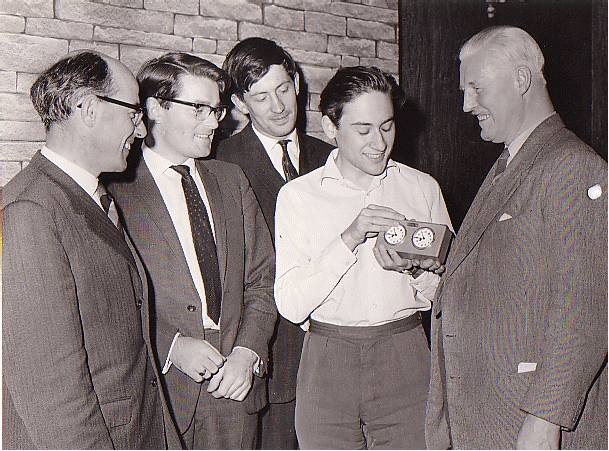
Sunday, August 31, 2008
Tick Tick Tick ... V
Every beginner knows that rapid development is crucial at the start of a game of chess. The opening is all about time isn't it? White moves then Black moves then White then Black and so on and on and on with each side trying to get their pieces out ahead of the other. Whoever's in front in the race has the advantage.
Niggling away at the back of my mind, though, there's a vaguely remembered snippet of a conversation involving some Grand Master or other (Gurevich? Malaniuk?) who when asked something along the lines of,
If you like the Dutch Defence so much why don't you play 1. f4 as White?
That extra tempo is going to hurt me.
* Haruki Murakami, The Wind-up Bird Chronicle Vintage Books 2003
Saturday, August 30, 2008
Chess in Art XII

Le chevalier Cifar observe le camp ennemi jouer aux échecs
de Carrion (14th cent.)
[BNF Paris]

Croisés refusant de combattre
de Tyr (attr, 14th cent.)
[BNF Paris]
[Chess in Art index]
[Chess in Art collected]
Friday, August 29, 2008
That Friday Feeling . . .
Thursday, August 28, 2008
Name the guilty men
I still have the book and still like it: but wasn't his most famous book of the era. That was How To Cheat At Chess, a book written so long ago I can't find a decent image of the cover to post on here. Indeed, younger readers - or indeed half the authors of this blog - may never have heard of it and may not even know who Bill Hartston is, let alone recall when "are you playing for a win?" was a favoured method of almost-offering a draw.
Well, he said, settling down in his armchair, Hartston was a strong international master who was an early favourite to become the first English grandmaster, a title, however, that he never ultimately obtained.He was also perhaps the first English chess professional to find that writing about the game was rather more lucrative than playing it, not least as a result of the publication of How To Cheat At Chess in 1976. I was fortunate enough to be given a copy a few days ago when I was back in England. It's quite dated now, in a number of respects (notably as regards women) but it's still an amusing read, not least because it retails several entertaining anecdotes involving skullduggery in international chess events, often Student Olympiads which Hartston attended. Some of these may have been embroidered a little for publication (his recollection of this episode, for instance, differs a little from David Levy's) and real names are omitted, but when, after our game, I asked Hartston who was the opponent who asked him "you vant draw at moof tventy?" - after fifteen moves, the extra five moves being "for the spectators" when there were none - he was quite happy to tell me it was Florin Gheorghiu.
Anyway, rereading the book the other night, I wondered if it was not time,that I found out who the other masters of sharp practice were, more than thirty years after Hartston wrote about them. So I thought I'd ask. If you can convincingly identify any of the subjects below, can you tell us in the comments box?
- The Belgian player "languishing in a continental prison for illicit currency dealings".
- The Swedish player who conned his English opponent into agreeing a draw after having sealed a blunder, and the Englishman concerned.
- The American player who invited his teammates to laugh at the poor sealed move of his English opponent (and that opponent).
- The Hungarian and Yugoslavian masters who complete their scoresheets inaccurately in order to deceive their opponents into thinking that the time control has (or has not) been reached
- The player who won a county championship by falsely informing his last-round opponent that he had lost his penultimate game, thus making his opponent think that he was half a point ahead - rather than behind - and that a quick draw would therefore suffice for the title.
- The Yugoslav who in a lost position loudly accepted Gheorghiu's draw offer (which the latter had promised to make, a promise he had not honoured).
Wednesday, August 27, 2008
Tick Tick Tick ... IV
As I prepare for my imminent arrival at life's first time control I find my thoughts have also turned to the question of how I’ve been spending my time when seated at a chess board.
As SonofPearl rightly said in the comments box to my post on Peter Wells' difficulties at the Staunton Memorial,
"You don't need to be a great player to know that time management is as important a feature of the game as accurate calculation, opening preparation, intuition etc."
Strange, then, that of the countless books, magazine articles and blog posts the game generates hardly anything is written about how to make the best use of the clock during a game. Indeed, amongst the far too many books I’ve bought over the years I can only think of two - Simon Webb’s Chess for Tigers and John Nunn’s Secrets of Practical Chess - that actually address this area in any depth.
Webb’s chapter on clock control suggests that the best way of finding out where your time is going is to make a note of the clock times after every move. This quickly becomes second nature*, the difficult part being rembering to take the trouble to review the game at some later date**. It takes a little bit of work but it's almost certainly going to help your chess more than another hour or two spent reading some new openings book.
I played this game …
… for the Other Club midway through last season. It has the rather pleasing attributes of being (a) an interesting Interesting French Exchange
and (b) a win for me but more importantly for today's purposes it demonstrates rather clearly many of the problems I have with time management when playing chess.
All the moves were to be played in an hour and a quarter. I ended up using 72 of those 75 minutes but taking a second look at it I have to admit that an alarming proportion of the time I spent "thinking" was at best wasted and even counter productive in some cases.
1. e4 e6, 2. d4 d5, 3. exd5 exd5, 4. Nf3 Bg4, 5. c4 Bb4+

TIME SPENT ON MOVE: 5 minutes
I was still within my opening knowledge at this point but nevertheless I think the pause for thought was quite appropriate.
I’ve faced lines with an early c2-c4 a bunch of times over the years and until this game had always played set-ups based on … Nf6, … Be7 and … Nb8-d7-b6-d5. This time, however, I wanted to try out John Watson's suggestion from Play the French 3. As I was about to head into positions I hadn’t actually played before spending a little time reviewing the main plans and whether or not there were any particular tactics to look out for seems time well spent. That said, given the short time control for the game taking 5 minutes for this is probably a little indulgent.
TOTAL TIME SO FAR: 6 minutes
POSSIBLE SAVING: 2 minutes
6. Nc3 Ne7, 7. Be2 dxc4, 8. 0-0 0-0, 9. Bxc4 Nc6,
It's not until White's next that I ran out of 'automatic' moves so I'm at a loss to explain why it was that I spent two minutes each on moves seven, eight and nine. It might have been justified had I not just had a decent think on move five but to do both is just ridiculous.
With the contest just leaving the opening stages I'd already managed to dither away 8 minutes of the game. Proportionately I'd already given away just as much time as Peter Wells lost against Smeets by failing to turn up on time.
TOTAL TIME SO FAR: 12 minutes
POSSIBLE SAVING: 8 minutes
10. Be3 Bxf3

TIME SPENT ON MOVE: 14 minutes
Oh dear.
My idea was to exchange on f3, take on d4 then after White replies Qxb7 gain some time by knocking the queen around or perhaps even trap her. In fact this is just a bad plan but that's not relevant in terms of clock management. More to the point ... Bxf3 is a classic case of Don't Analyse Unnecessary Tactics (DAUT).
Even if it works it’s obvious that after … Bxf3, Qxf3 Nxd4, Qxb7 there will be a lot of variations to consider. Had I thought sensibly it would have occurred to me that I should hold this line back to analyse only if I could not find anything better. Perhaps then I might have chosen … Rb8 (setting up the idea of taking on f3) or more likely … Nf5 (simply adding to the pressure on d4 with no difficult tactics to analyse). As it happens both of these moves can be found in Watson's book. In any event, a different thinking process would perhaps have taken three or four minutes at most to produce a move. Not only would I have saved ten minutes I would probably have played better too.
TOTAL TIME SO FAR: 26 minutes
POSSIBLE SAVING: 18 minutes
11. Qxf3 Nxd4,
I took two minutes on this which would seem to indicate that I lacked confidence in my plan. In fact it's not too late to back out and find a different way to play. The trouble is, as John Nunn pointed out, after a very long think it can be psychologically difficult to choose a different path and admit the time has simply been lost. Of course the worst of all possible worlds is to worry about things for two more minutes then play the move anyway.
At this stage although I've already used up over a third of my time for the entire game and yet I'm only just out of book.
TOTAL TIME SO FAR: 28 minutes
POSSIBLE SAVING: 20 minutes
12. Qg4 Bxc3

TIME SPENT ON MOVE: 1 minute
I hadn’t considered that White might simply sacrifice the pawn and go for a direct attack. Without much thought at all I gave up my bishop to stop the knight bouncing over to the king side. This was definitely an occasion where I'd have benefited from a couple of extra minutes to weigh the benefits of eliminating an attacking piece against handing White a pair of unopposed bishops on an open board.
Of course having used up so much time on move ten I was now in a position where I'd have to cut down on the analysis and hope for the best to a certain extent.
TOTAL TIME SO FAR: 29 minutes
POSSIBLE SAVING: 18 minutes
13. bxc3 Nf5, 14. Rad1 Qc8, 15. Bg5 Nd6, 16. Qxc8 Nexc8, 17. Bd5 Re8, 18. Rfe1 Nb6, 19. Bf3 Nbc4, 20. Bf4 Rad8

TIME SPENT ON MOVE: 5 minutes
John Nunn:
“Chess is all about making decisions. Postponing a decision doesn’t improve it. Try to get into the habit of asking yourself: is further thought actually going to be beneficial?”
So what to do? Bring my last piece into the game or play ... Kf8 before or after swapping rooks on the e-file. At the time I wasn't clear whether exchanging rooks would help me or merely emphasise the strength of his bishops. In fact after a few months to think about it I'm still not clear what's best. I frittered away a few more minutes here simply because I couldn't decide on what course to take.
Sometimes you've just got to choose one plan or the other
TOTAL TIME SO FAR: 43 minutes
POSSIBLE SAVING: 21 minutes
21. Kf1 Rxe1,
TIME SPENT ON MOVE: 5 minutes
Unfortunately I chose one plan then the other and worse still spent ten minutes doing it.
TOTAL TIME SO FAR: 48 minutes
POSSIBLE SAVING: 26 minutes
22. Rxe1 Kf8, 23. h3 h6, 24. g4 g5, 25. Bc1 c6, 26. h4 f6, 27. hxg5 hxg5, 28. Be2 Kf7, 29. f4 gxf4, 30. Bxf4 Re8, 31. g5 Rh8, 32. Bxc4 Nxc4, 33. Re4 b5, 34. gxf6 Kxf6, 35. Be3

An interesting moment. I'd already seen his rook was vulnerable to a knight fork but on the other hand his bishop attacks my a-pawn. With a bit more time to think I might have put these two ideas together and realised the a-pawn can't yet be taken without allowing a knight check on d2.
My dawdling earlier had left me with little more than a quarter of an hour to finish the game by this point. The rook ending is obviously much better for me but is it winning? With pawns on one side of the board general principles suggest my knight should be better than his bishop so perhaps I want to keep minor pieces on the board anyway. Pressed for time I made the exchange after less than a minute's thought. It worked out well in the end but in less favourable circumstances this could have been the point where I let the game slip away.
Needless to say, had I not haemorrhaged the minutes away earlier in the game I would have had plenty of time for a proper think here.
35. ... Nxe3, 36. Rxe3 Rh2, 37. a3 Ra2, 38. c4 bxc4, 39. Rc3 Ke5, 40. Rxc4 Kd5, 41. Ra4 c5
I hadn’t foreseen that he might go after my a-pawn but when he played Ra5 it occurred to me that he might not actually have the time to take it anyway. Since there’s nothing to be gained by worrying about this, since there’s nothing I can actually do to stop him capturing the pawn even if I’d wanted to, I just pushed … c6-c5 instantly and hoped for the best. Normally I'd have lost some time to self-recrimination and worries that I'd thrown the win away but I'd finally woken up and actually started to play sensibly (timewise at least).
Incidentally, throughout this ending I was plagued by the recurring thought that it would be an awful lot easier had I actually read some of the rook endgames book (John Emms’) that has been sitting on my shelf for many years. Things turn out pretty well - though your guess is as good as mine as to why I moved my king in front of the pawn on move 51 - but in a less straightforward position my lack of basic endgame knowledge could have cost me a lot of time which in turn might have made the difference between winning and drawing the game.
42. Rxa7 Kc4, 43. Ke1 Kb3, 44. Kd1 c4, 45. Rb7+ Kc3, 46. Ra7 Ra1+, 47. Ke2 Rxa3, 48. Rd7 Kc2, 49. Rd2+ Kb3, 50. Rd1 Ra2, 51. Kd1 Kc3, 52. Rd8 Ra1+, 53. Ke2 Kc2, 54. Rb8 Rd1, 55. Ra8 Rd2+, 56. Ke1 c3, 57. Ra2+ Kd3, 58. Ra1 Re2+, 59. Kf1 c2, 60. Ra3+ Kd2, 61. Ra2 Re8, 62. Kf2 Kd1, 63. Ra2 Rf1+, 64. Kg2 c1=Q, 65. Rd7+ Qd2+ 0-1
There’s no need to do this of course, Fritz takes just a few moments to find mates in 9 after both Ke2 and Ke1, but with my nerves shredded and just three minutes to go I wanted to be able to stop thinking and ensure there was absolutely no way I could lose. White resigned at this point but I think I might have been tempted to make him actually mate me. It shouldn’t go wrong of course but Black is close enough to flag fall to make playing on justified.
So happily enough it all worked out in the end but it could easily have been very different. With a better clock handling I would have been able to play the opening and early middlegame much quicker and saved the time for critical moments later on.
I found the very similar problems in many of my games last year. Just as I said of Peter Wells, it leaves me wondering how many ECF grading points I chuck away every year through poor time management
* I've been following Webb's advice religiously ever since I bought the second edition of his book in the early 90s.
** Sadly Webb neglects to mention simply recording the move times alone will not be of much use to you. After more than a decade of painstakingly keeping track of the time taken for each chess move I made in serious games it was only earlier this summer that I actually got around to making any attempt to systematically analyse the data I'd been gathering. This is a pathetically embarrassing state of affairs, the only possible benefit of which is that it's led to this aside - and I do love a good footnote.
Tuesday, August 26, 2008
Surprise, a prize
Normally I never win anything: even if I'm in the running, there's always a last round in which I throw it all away. One of the virtues of correspondence play - and indeed, of Best Game Prizes - is that there's no last round for me to face.
The game, in which I beat Lorin D'Costa, is here. (I am of course not Rafa Tymrakiewicz, you need to scroll down in the menu box until you reach the appropriate entry.) You can also find it here. So good, he blogged it twice.
Oh, a diagram? Well, I can't really show you the position before a decisive coup, because there weren't any: I don't win that sort of game. But I'll give you the position before Black's 12...Be7. Quite likely he should have preferred 12...Nc6 instead, but either way, it wasn't until I started constructing the diagram that I really noticed what had been going on: I chose to use the set pieces up in start position function, because, looking at Black's first rank, they're practically all still there.

Monday, August 25, 2008
Improve Your Chess VIII: Improve Your Chess!?
The final installment of the series next week, incidentally, may well include the most important single thing I did to improve my chess. But first, something else, or maybe nothing . . .
Winning Ugly
I've not played a game I've been really proud of for quite some time. Comfortably over a season, at least. Instead, most of my wins from the season just gone have to me seemed bitty, inconsistent, lop-sided, or boring. Yet in the years where I didn't improve, I played many games I was chuffed to pieces over.
Now, I've not read John Watson's famous books, but friends who have say one thing he emphasizes is that in modern chess winning is ugly. I think what he means is the grand plans of the past, the positionally perfect games, logical as clockwork - games won in such ways are gone, at least between players of equal strength. The reason? I'm not sure, maybe the way computers have shown how chess is far more tactically random than previously realised, maybe that Kasparov's reign demonstated how pieces were far more dynamic than previously understood; that pawns are less the souls of chess than ever before.
Whatever the case, I think being psychologically contented to win ugly might help improve your chess, because it brings your way of thinking closer to the reality of the game itself. Here is an example from a game I played in February. I am white and it's my move:
This position is the outcome of successful opening preparation. I'd realised who I'd likely face before the game, and noticed he always played the Open Ruy Lopez as black. So I'd prepared 5.d3 for this encounter, which rules that out. Visibly flustered, he'd gone into a version of the Closed Spanish where he managed to lose two (!) tempi and then misplay the resultant position anyway. Clearly, in the diagram, there is a lot of wind gusting around his king, and this spells trouble.After I won the game, a spectator I knew was blinking at the final position, so I said hello. He couldn't believe it was the final position, because my knight was still on g3, black's pawn on h5. How had I not played Nxh5 at some point? He was incredulous - and indeed, Nxh5!? was a plausible move many times, not least in the diagram position. But, I said, it was never clear, and anyway, winning material was a cleaner solution. "Yes, but . . ." he mumbled, infatuated with the glamour of sacrifice. But in the diagram position there is no need. Exchanging material, releasing some of the tension and surrendering a part of the centre with the positionally-ugly 23.axb5 axb5 24.Rxa8 Bxa8 25.dxc5! just wins material, thanks to the threat of Bb3 combined with the pin on the d-pawn. I won eleven moves later.
Conclusion? Chess demands ugly play, so be ready to win ugly. Maybe.
The Sicilian is Different
Each of the last five undisputed World Champions have, at one stage of their career or another, played a substantial number of games on both sides of the Sicilian. I'm not sure, but I don't think the same has always been true of their challengers. I think that the Sicilian - I mean, the open Sicilians, the complex mainlines, where a simple pawn exchange in the opening unbalances the position fundamentally, where all other material is left on the board - is different to all other openings. Maybe it's the degree of difficulty, maybe the direct blending of tactical and positional phases, maybe that attack and defence are routinely combined, often on the same sector of the board - I'm not sure. But I am sure it's different.
The Sicilian is something else. And I think it helps improve our chess if, for a certain period of time at least, we commit to playing it with both colours in the mainlines. Why? I'm not really sure. The Sicilian forces us to think. The Sicilian forces us to be constantly alert to shifting strategical feature and an array of tactical opportunities. The Sicilian reminds us how difficult chess is. That kind of thing. Perhaps it's rather like, if you want to be good at pool - practice snooker.
The Sicilian puts us in our place: players struggling very hard with some very difficult things. Now, of course, the results won't necessarily be pretty, but maybe this teaches us a lesson too. For instance, here are the evaluations only of the last 8 moves of a recently friendly game I played as black against a strong opponent in an Open Sicilian. Exclamation marks correspond to moves which are Fritz's first choice, ?! to moves suboptimal by at least a pawn; other marks to the shifts in evaluation given with varying severity. We left theory on move 14 when the position was already =+:
My conclusion? If you've not before, then commit to playing the mainline Sicilians with both colours for a significant period of time. The Sicilian is different, and forces us to be different players. This whole experience helps us improve. Maybe.
14. ? ! ( -/+) 15. ?? (-+) ?! 16. ?! ?! 17. ?! ?? (=+) 18. ! ? (=) 19. ?? (-+) ?? (=) 20. ! ! 21. ?? (-/+) ! 22. ?! ! 23. Resigns?? (-/+ of about 1 pawn, says Fritz).
Your Own Chess Language
Chess has a language: "plus-equals", "passed pawn", "middlegame", "attack", and so on. However, chess itself is a wordless game, not an argument couched in certain key terms. Finding the right balance between thinking in words and analyzing positions and sequences is not an easy thing to do. Too much wordage and we risk confusing ourselves, talking ourselves around in circles; too little, and we don't grasp the fundamentals of the position, instead spend all our time looking for fleeting tactics that are never there.
Being aware of this is one thing. Possibly another, is to develop our own chess language, prioritizing certain terms to ourselves when they reflect problems we regularly face more often than others. For instance, a few years ago I had a spate of games where I got pieces trapped. I realized that there was no neat term for "piece-trapping tactic" like pin, fork, etc. So I made myself consciously check for "piece traps" in every game I played, and increasingly this kind of mistake has left my play.
Or more recently, reviewing some games with the computer, I realized that whilst I was playing many stages of the game reasonably, I was handling the part when the position explodes - when all plans come to fruition, where threats are made each move, when three different unclear endgames are available with every second exchange - particularly badly. In short, I was playing the complications badly. Having realised that, I now try to recognize complications when they occur, calm myself down, remind myself it's meant to be a struggle, and compose myself. My new awareness of the word complications also helps in not thinking for too long in positions that aren't, well, complications.
Now, complications isn't a word that one sees in the book titles of chess literature. There isn't an Informator symbol for it, either. Nonetheless, for me it's become at the centre of my chess vocabulary - the intersection of one of my main problems with the game and the reality of the game itself.
Does developing your own chess vocabulary help you improve? Maybe!
Player Types
"I don't really know this stuff," I said in our second post-mortem in a month, sat on the black side of the position after 1.e4 e5, "but I thought I'd vary. I figured you'd have come up with an improvement in that Sicilian line you lost in last time."
"No."
"No ? ? ? . . . ! ! !"
"No."
What was strange about this was that in our first game, I'd found a very simple improvement for him, but still hadn't fixed the line from my point of view. However, the improvement was an unthematic move (punting e4-e5 in a Closed Sicilian, rather than the usual f4-f5, as he had unsuccessfully tried.) And in our second game? It had been a Closed Spanish, and when I'd prevented him from making the usual kingside manouvers for white by breaking first on the queenside - he'd swapped off as many pieces as possible and offered a draw. I had no reason not to accept.
On the way home I was puzzled. The whole thing in some way reminded me of the second game here, against a different opponent, where white in a Closed Sicilian had been prevented from playing the thematic f4-f5, and so instead had exchanged material into a totally lost endgame. Compare white's pawn structure on move 20 to that on move 25 in that game, and you'll see what I mean.
From this, I speculated that there is a certain type of player who always wants to play the same game. Each game they want to execute the same thematic same plan (usually a kingside attack in a closed position - a King's Indian or Stonewall being typical; maybe it's the "safety" of the closed position mixed with the single-minded simplicity of purpose - mate - that attracts) and if they can't . . . they instead exchange pieces and hope the endgame is drawn.
Conclusion? Players who try to play the same game each time can't improve their chess, so stop doing so if you are one and wish to improve. Also, such players are relatively easy targets if you can recognize them as such, susceptible to severe misjudgements in the transition to the endgame as well as confusion in middlegames that do not follow the pattern they know. In general, recognizing and understanding such "player-types" and their limiations help us improve our chess by overcoming our own limitations, and exploiting the weaknesses of others more clearly. Maybe.
Reading with Empathy?
In my advice about simulating over-the-board chess in training, I briefly discuss trying to read chess books with the ethos of simulation in mind. This involves only reading chess books with a proper set, and being willing to put the book aside and study the positions and games in it without the actual book to hand. That is, on our own - like during an actual game. I admit there that I find this a difficult thing to do, especially with opening books.
When we read this way we are fundamentally trying to objectively understand what's going on on the board in a situation close to otb; typically this involves an expert usually of Grandmaster strength explaining the position and the game. Often the explanations of the game itself will include interesting asides about what the players were feeling, what the tournament context was (last-round must-win, etc) and so on. In the past I've tended to filter this stuff out as "entertaining but irrelevant" in an attempt to come closer to the "objective truth" and "Grandmaster understanding" I assume is on offer.
But maybe this is a mistake. Maybe it is better to "read with empathy" - to try to think about what it's like from an annotations for a top player to be at the board. A position I previously used before in the series can serve again as an example:
Reading the whole of his annotations with empathy (for the rest of which see Secrets of Practical Chess) we see his mood change from complete surprise, to sudden realisation of the unfortunate truth, to grim determination. We also see how quickly he manages to analyze a hidden tactic six moves and five captures from the diagram position: "several minutes".
So what? Well, my feeling is that reading such annotations with empathy, we develop a much more involved intuition for what it is really possible to do in chess. That is, for that we can expect human beings to do at a chess board - and what is hard to do. Not only that, we can relate it to how they are feeling during the game: whether dumbfounded, excited, caught-up, or grimly determined. And in doing so, we open ourselves up for thinking differently at the chess board. In particular if we read the annotations of stronger players this way, perhaps we come to understand how they are at the chess board better, which enables us to be more like that ourselves.
Now, I don't know if this is true or not. But I think we see something comparable in the history of our game and other games. Once Steinitz had demonstrated a defensive technique that made the romantic openings more or less obsolete at the highest level, other leading players followed. Once the hypermodernists had shown the centre needn't be occupied, players at all levels were able to follow their lead. Or in football, when total football changed the way teams approached the whole game. I believe something similar also happened in snooker, when Alex Higgins showed it possible to open the reds in more positions than previously thought possible.
Conclusion? Try reading annotations with emapthy, rather than just the search for objectivity and understanding. Maybe it will help you be more in tune with the experience of playing chess, which will have a useful practical effect.
Overall Conclusion?
Maybe, that because we can't know in advance what will help our chess, we should leave ourselves open to all sorts of changes, always ready to reject, rethink, revise, or alter what we are doing or think we know. Embracing such uncertainty is not easy, but there are a lot of different and confusing things involved in trying to improve your chess. Or, maybe not.
Sunday, August 24, 2008
Tick Tick Tick ... III
One of the things about the approach of a big birthday is that it inevitably leads to a review of life so far and thoughts of what might have been.
Chesswise, at least, for me this process could be worse. I've lost any number of games in any number of stupid ways (e.g. here) but I can't say I regret any really important losses if only because I've never been in a position where winning or losing really mattered. Sure I've sulked for the rest of the night and even into the following morning but that's about it. I wonder what it would be like to recall winning positions against, say, Ivanchuk and Anand but on both occasions I'd missed the simple tactical sequence that secured the win. That, I rather think, would tend to keep me up at night from time to time.
A hundred years ago such was the fate of one S. Lipschuetz who must have spent much of the rest of his life kicking himself after failing to beat Zukertort and Lasker.
White to play
Lipschuetz-Zukertort
White to play
Lipschuetz-Lasker
NB:
today's positions have been taken from Geoff Chandler's Contribution to Master Chess: A course in 21 Lessons, Pergammon Press 1985. My database suggests in the second position there was a Black pawn on c5 and the White rook was on f4 not d4.
Saturday, August 23, 2008
Chess in Art XI
Friday, August 22, 2008
My Eye, My Eye
- First up, you might not think that a blog called USCL news and gossip would promise much entertainment, but don't let the name fool you. Recent articles have featured: a T-shirt with the slogan Thou Shall Blunder on it - imagine facing that over the board; a report on how chess in the US is exploding with lawsuits - on which note, see also; entertaining and honest annotations to an interesting game; a humorous post comparing Susan Polgar's husband Paul Truong with Sam Sloan, now accompanied by a poll in the side bar; testosterone; and, well, much else besides. Definitely worth keeping an eye on the whole thing, and I've added it to our sidebar.
Secondly, ever wondered what would happen if you crossed a chess board with a subway map? Tom Brown has, in multiple posts across his blog. In fact he's constructed such a map showing every move for every piece on every square of the board, in subway map style. To the right is d5. If you explore his blog you'll find the rest.- Next stop is Grandpatzer who seems to have answered the question Was Alekhine Unaware of the Noah's Ark Trap? with the surprising: yes, he was.
- Finally, The World Team has been winning against high-class opposition again. This time they beat 15th World Correspondence Chess Champion Gert Jan Timmerman at the website Chess Games in a complex struggle. From the looks of the website's newsletter 31.b4!! was the key move, a move with thousands of hours of computer analysis behind it no doubt. The World's next game is against well-known correspondence Grandmaster Arno Nickel, who's out for revenge with the white pieces after a previous loss with black, and you can find out more as well as how to join in the fun here.
Thursday, August 21, 2008
Tick Tick Tick ... II
"Chess", Morgan argued yesterday, "is a carnal, primitive 'hobby' that satisfies bloodlust ...."
I think I have to agree although I'd probably insert "and stimulates" in between those last two words. Every time I see Peter Wells, for example, I get an almost overwhelming urge to give him a slap and yell "SORT IT OUT FOR CHUFF'S SAKE" into his nearest available ear.
I should perhaps explain such an extreme reaction so let's take a look at Wells' performance at the recent Staunton Memorial. The comments that follow are taken from the round-by-round reports on the Staunton website.
Round One:
“Sokolov-Wells saw the Englishman outplay his formidable opponent, but agree a draw in a position where he stood substantially better, but had little time on the clock”
Round Five:
“Peter Wells gained a dangerous-looking attack against Smeets' king, but used a huge amount of time on the clock. A massive time-scramble saw Peter finally lose the thread at move 34, and when his flag fell three moves later, he was already losing on the board as well.”
Round Six:
“Peter Wells played the sharpest game of the day, against Cherniaev, and should certainly have won against the latter's extremely optimistic play. However, the clock was again Peter's great enemy, and he repeated moves in a position where he was objectively winning”
*
"Feck me Alexander. Now I'm going to end up on some blog with an eejit 1000 elo points my inferior telling me how I should play chess."
Round Nine:
“L'Ami-Wells … White maintained the initiative, but went astray around move 25, and when he offered the draw a couple of moves later, it was doubtful whether he really had enough for his two pawn deficit. However, Peter's clock was doing its usual nasty things to him”
All these favourable positions and not a single win to show for them. Yet Steve Giddens is too kind to Wells I think. In reality it’s Peter who is “Peter’s great enemy” and it’s Peter who “was doing [his] usual nasty things to him[self].” If we ignore his short draws in rounds 4, 8, 10 and 11** and easy win against Bob Wade in round 2 then we can see Wells actually found himself in severe time trouble in two-thirds of the half dozen games he actually played out.
Wells' performance for the tournament was just two elo points less than his current rating so finishing with five points from eleven games is far from a disgraceful outcome. Nevertheless the fact remains that had he taken full advantage of his opportunities he could potentially have wound up the tournament amongst the leaders. It leaves me wondering how many elo points he chucks away every year through poor time management.
Wells, of course, is a notorious time trouble addict and seems totally unable (or is that unwilling?) to cure the problem but that isn't what drives me potty. Not exactly. It's not just the fact that an extremely strong player could be even stronger, it's that an extremely strong player seems to be going out of his way to avoid fullfilling the potential of his natural talent.
I went to Simpsons-in-the-Strand for six of the eleven rounds and Wells was late every single time I visited. Just a minute tardy for the final round it’s true but usually it was about five minutes. Are you thinking that's not a big deal? Perhaps not but it if he could have added the lost time to his clock at the end of his game against Cherniaev it would have been enough to allow him to play on for a possible win. Probably this applies to the other games too and of course Wells could have put the missing minutes on his clock if he'd wanted to, albeit at the start of the game rather than the finish.
For his defeat on time against Smeets Wells actually turned up something like ten to fifteen minutes after the round began. He simply gave away ten percent of all the time he had at his disposal for the first session. That's a reckless indulgence for anybody it seems to me but for a person who routinely ends up playing their last several moves with their flag hanging it’s just positively idiotic.
I guess after a career spanning two or three decades Peter Wells is not going to change his habits now and I suppose you could argue that it's his attitude towards the ticking clock, both at the board and in life in general, that helps to make him the player that he is. I'm not sure I really believe that to be true though. I certainly don't understand why it should be true. I really don't see why Peter Wells can't be a talented Grand Master and turn up for games on time. For my blood pressure, if not for his rating, I really wish he'd sort it out.
* Photo (click it for a closer look), as before, by Vad. He neatly caught the bald patch on the back of my head as I leaned in to find out how close Peter Wells was to losing on time for the second successive round.
** against Short (25 moves), Adams (23 moves), Speelman (15 moves) and Timman (17 moves) respectively.
Wednesday, August 20, 2008
Britain's inaugural chessboxing event

I like to tell myself that I am not a violent person. The feebleness
of my right hook is matched only by the lack of dignity I display upon
being assaulted myself. My knees go weak at the sight of blood. I
don't like war (controversial, I know) and when I recently stubbed my
toe on the District Line down to Kew I felt the tiniest tear begin to
form in the corner of my left eye. It is beyond me why I don't wear
glasses, just to officially consummate my weediness. And yet, I could
never honestly describe myself as a full-blown pacifist, and nor could anybody
reading this blog. Why? For the simple reason that we are chess
players.
Violence, in its crudest form, can be imagined as something requiring
body contact: fisticuffs, muggings, taekwondo. But when one brings an
adversary to the ground with a single punch it is not the crack of the
skull in itself that is thrilling but the knowing fact that you are,
for the time being at least, superior. Quite apart from its vulgar
military overtones ('how warmakers love to play games!' screams
Bronowski in The Ascent of Man) chess is a violent pursuit. In
competitive play we exert huge energies on a weekly basis in order to
destroy the morale of people who are more often than not complete
strangers. The very best of us, like Bobby Fischer, take great
pleasure in 'the moment when I break a man's ego.' Delivering checkmate is
just as satisfactory as battering an opponent senseless with the fist,
only far more damaging. At least a knockout punch gets things over
with quickly.
And so the relatively recent marriage of chess and boxing – as
mentioned previously on the blog here and here – only makes explicit
what anyone who has played the former long enough knows too well: that
it is a carnal, primitive 'hobby' that satisfies bloodlust in a
superficially unobvious way. It is as if some passer-by in The Sixth
Sense had shouted 'oi, Bruce! You've got a bloody great hole in yer
chest!' But this does not mean that chessboxing – which made its
debut on British soil five days ago at Bethnal Green Working Man's
Club – is pointless or doomed to failure.

There is one obvious appeal to chessboxing. If one were normally to
ask a decent, upstanding, non-chess playing member of society to come
with you to a chess event, they would rightly tell you to take a
running jump. If you mention, however, that the chess will be
interspersed with people punching each other, and that there will be
both a bar and an after party, then you may have more success. I
certainly found this to be the case on Friday, when I was joined by two
'decent', 'upstanding', non-chess playing chums. In fact the biggest
surprise was just how few chess players there were in attendance: not
once did I see the familiar bearded face of an habitual 170-er or an
unpleasant junior with an inversely proportionate knowledge of opening
theory and the real world. Instead, the Bethnal Green crowd was
comprised mostly of casual boxing fans attending for the sheer novelty
value. 'Take his bishop!' yelled one jack-the-lad before a single
move had been played in the evening's first bout between 'German chessboxing
sensation' Sascha Wandkowsky and Holland's Hubert Van Melick.
It is probably for the best that there were none too many ECF points
floating around in the audience. Play was not of a high standard
(1.e4 c5 2.Nc3 Nc6 3.d3 e6 4.Be3 was Van Melick's botched attempt at a
Closed Sicilian, for example) and there were repeated technical
difficulties with the relay software that ensured we lost track of the
position every five moves or so. This might not have been so much an
issue if the 'commentator' had had the slightest clue as to what was
going on over the board, but his kibitzing was inane and free from
analysis (think David Pleat, but without the dark past). He also took
at least thirty seconds to realise that Wandkowsky had delivered mate
in round 7 of his contest. And this was all capped off by the
organisers inexplicably managing at first to have a light square in
the left hand corner of a computer generated display board. Truly,
this was not one for the purists.

I rather feel that these quibbles are beside the point, however. This
was not a quirky attempt to popularise chess (as Justin complained of
the Britain-Russia ice chess game two years ago) but an exhibition of
a fledgling hybrid sport, one that has every much to do with boxing as
it has with the Royal Game. I was informed by a charming lunatic in
the lav that the boxing was far from impressive too, and I have no
reason to doubt him. But from a position of ignorance I was able to
find it curious and exciting; with any luck, this is what Bethnal
Green's non-chess playing fraternity thought about the chess, too.
Chess and boxing are natural bedfellows, and certainly the evening's
main event between Stewart Telford and Tim Woolgar proved to be a much better
demonstration of both. Woolgar, London chessboxing's head honcho, at
least seemed vaguely au fait with the black side of a Philidor. For
the sport to succeed, however, stronger competitors from both chess
and boxing shall need to be found. As such it is the duty of Woolgar
et al to ensure that their next event shows both sports in their true
glory. In chess terms this means making sure the bloody display board
works and finding a commentator capable of providing simple yet
accurate analysis for the baying masses.

But it is a highly promising start: as we were dutifully reminded by
our compere on Friday night, the 100-strong crowd in Bethnal Green did
mark the largest paying audience for a chess match in Britain since
Kramnik beat Kasparov in Hammersmith back in 2000…
Tuesday, August 19, 2008
Adams Wins
I'll be coming back to the Staunton on Thursday but for today since Adams-van Wely wasn't much of a final game ...
... take a look at a position Morgan acquired during a casual encounter played in the bar the day before.
Black's managed to get just about everything en prise but was still able to find a very pleasing combination to win the game.
Monday, August 18, 2008
Improve Your Chess VII: The Habits of Talent
"Darling, just give me the damned pen."
"What pen?" she says, so innocent. "You don't have time to look for it now. Just take that one instead," she goes on, wafting me toward some grotty biro.
"What pen? The lucky pen. The black one. The one I told you about. The one I won with last Tuesday. I left it on the table this morning."
"The sleek-looking one? That writes so nicely? Not seen it. It's probably in your bag."
"It's not - I -" and then, I see it.
There on the bookshelf, tucked inside one of her folders.
She knows I know, she sees I see.
Across the table we eye each other.
Who's closest?
Who'll get their first?
A mad dash and . . . I grab it first. Lucky, I say to myself, scampering toward the door, feeling ready at last for the game tonight.
"You know it makes no difference," she says glumly. "It's just a pen. But good luck!"
. . . and, yes, of course I still know now what I also knew then. The pen was not a lucky pen, invested with magic properties. It was just a pen, black ink, available from a newsagent around the corner, along with dozens like it. So what that I had won with it the week before? I also won wearing a certain pair of socks, having washed my hair with a certain shampoo, having been a certain number of minutes early or late, having had a certain sandwich for lunch, and none of these things I thought of as lucky. And I know they make no difference. Not like my lucky pen.
What was I thinking? I had never been a superstitious person, after all. But as I strolled relaxed and confident to the club, I wasn't thinking about much at all apart from getting to the game along with my lucky pen.
Trying to understand superstition
But a few weeks before, I'd been thinking a lot about superstition, luck, the little acts of ritual top players acquire, their odd beliefs. Like seventh World Champion Vassily Smyslov's belief he was kept alive after his eyesight failed for some divine purpose, related in some unknown way to harmony and endgame studies. Like twelfth World Champion Anatoly Karpov only washing his hair after defeats. Like thirteenth World Champion Garry Kasparov's belief that his lucky number was, well, number thirteen. Like Grandmaster James Plaskett's beliefs that coincidences weren't just coincidences, something suggested too by Grandmaster Jonathan Rowson in the Acknowledgments to one of his books. Like . . . the list could go on and on.
I'd been thinking how these little beliefs must have some benefit to the players who employed them. Something along these lines: what's the point of worrying about the result of your next game, if you've managed to convince yourself it's particularly related to a certain pair of gloves? Then all your anxiety, all your nerves - all these little things that punch around before your games like little fists in your stomachs - could simply be smoothly tucked away by use of superstition - in a favourite pair of gloves.
Or, you're at the board itself, and you start to lose track of the position, miscalculate, and suddenly all your doubts balloon up - wouldn't it be nice to puncture them by tapping on a favourite tie-pin? That is, your lucky tie-pin, the one you always fiddle with when calculating clearly? I'd been thinking that if I could really get myself to believe something like that, then maybe I would be able to arrive at the board itself in a better state of mind. How about a lucky pen? Then I could look at my pen as though it determined all the luck in the world, and so concentrate fully only on the board itself.
Would I try it? Maybe. After all, one thing that improving at chess had taught me, was that I wouldn't know in advance what would work, what would not work. Maybe superstition would work, maybe it wouldn't. Who knew? But I wanted to work one thing out first. Why were more talented players frequently more superstitious than less talented players? My guess was as follows in the next three paragraphs.
Why are strong players superstitious? Why aren't weaker ones?
The way I guessed it was that for the most talented players, the world outside of chess is never demystified. No nihilist biology teacher ever convinces them that all their actions and feelings and thoughts are nothing but confused ciphers for the brutal and basic wishes of their genes - they are too busy playing around with the chess set in their desk draw, coming to terms with the passed pawn's lust to expand. They are never disappointed to find out there is no tooth fairy swapping their milk teeth for coins, or no Santa delivering gifts, or no real Lord of the Rings - because last weekend some company magicked them off to Moscow, where an ancient white-bearded creature - just like Gandalf in fact - clarified for them what black gets in return for the Sicilian ..Rxc3 exchange sacrifice. Meanwhile, because of their talent, the world on the chess board becomes increasingly demystified as they grow-up. Maybe there are dragons in the real world, maybe not - but certainly not in the Sicilian, because they have mastered the logic of this oddly-named variation by the age of ten, and all the intricacies follow by their late teens. For the talented chess player, the world is thoroughly mystical, enchanted with irrational forces, the whims of the goddess Caissa wafting around arbitrarily: but the chess board is the one objective plane of cause-and-effect. The phrase fire on the board is just an advertiser's mystical metaphor for dynamics.
For the less talented player, like myself, things are the other way around. The chess board remains a mystical place, full of impossible goings-on: Grandmasters perform incredible feats of calculation, make the International Master who creamed me look like an idiot - what . . . ! ! ! And positions we are sure are winning turn out dead-lost, and we practice against computer programmes three-pieces up and they magically turn it around, random combinations appearing out of nothing, like a sky of crows flung from a magician's hat, and all the remarkable improbabilities the world would never allow come alive. The great players of the past aren't just great players - they're titans, or magicians, or whirlwinds, or pythons. Elsewhere, we've already learnt otherwise, learnt the world's cruel lessons. That the world is not flat, as our childhood feelings tell us. That the horizon not infinite, that the stars are there all the time, that the sun does not rotate around us. And so, thanks to this disenchantment, this initiation into the dry factual state of being called adulthood, we've already learnt to dismiss our innermost feelings as fabrications, our fundamental intuitions as idiocies - already learnt that the miraculous is impossible amidst the deterministic routines of the real world. Impossible. Impossible anywhere, that is, but amidst the beautiful unpredictability of the chess board, where all laws come undone.
What does all this mean? The talented chess player benefits from living amidst a highly-subjective world, whilst the chess board for him remains solely the realm of objectivity. All the strange habits of talent acquired in the real world - all the superstitions, the lucky objects, the little rituals - make perfect sense to the talented chess player, who does not know he is constructing totem poles in his shirt pockets. The less talented player scoffs at these habits, because he has never had cause to create them for himself. But for the talented player, these little acts of madness, the momentary subjective nothings, function to keep the world as crazy it is, so they can come to the chess board and once again find it the zone of crystalline truth and artistic clarity, and meet the facts of the fight with as much objectivity humanly possible.
Or something like that. Out of all this thought, anyway, came the following basic reasoning: talented players acquire, by accident, strangely-subjective habits in the real world. These paradoxically function to keep their thoughts at the chess board itself as objective as possible. But whilst less talented players such as myself do not acquire such habits as a matter of course, there was no reason not to choose to develop them consciously and deliberately. That way we can make use of the various functions of superstition and ritual, such as concentration, calmness, focus, and so on.
And so, I bought myself a lucky pen.
Conclusion
No-one knows in advance what will help improve their chess, what not. However, there are reasons to believe that superstitions or similar based in the real world and off the chess board help talented players achieve their full potential at the chess board itself. Paradoxically, this is because they allow the talented player to be more objective at the chess board. Less-talented players do not acquire such superstitions normally, but can acquire them by choice. However, this should all be kept in perspective. Whilst I did acquire myself a lucky pen, and whilst my chess did improve, I think the majority of the improvement came from more direct methods such as those previously discussed.
Note
The final round of the Staunton Memorial starts today at 12noon at Simpson's-in-the-Strand, and will probably finish between 5 and 6pm. So several of us are going along after work at 5pm to see the games, and we plan to go out after, have a drink or two, and so on. All are invited to join us.
Sunday, August 17, 2008
Tick Tick Tick ...
I must confess I'm not hugely keen on growing older but at least up to now I've been able to comfort myself with the widely held notion that the 17th of September will bring a re-energized fresh start for me. Unfortunately this morning during an ill-advised googling expedition I found an old article in the Daily Telegraph that began,
The belief that life begins at 40 is a myth. Research has found that the fourth decade heralds the beginning of the end.Bugger.
Time, I think, to get few a easy chuckles by mocking those less fortunate than myself. Normally of course that would mean a visit to Chess Now* but today I'll go the other route and take a look at a choice example of the embarrassing resignation.
The position below is taken from Geoff Chandler's chapter on Tactics and Combinations in Master Chess: A course in 21 Lessons, Pergammon Press 1985**.
White is threatening 1. Rxh7+ Kxh7, 2. Rh1+ Bh6, 3. Qxh6 mate.
Although Black threw in the towel here he has a move that not only saves the game but even wins if White tries to force a mate by sacrificing the rook on h7. You work out what it is while I spend the day getting ready for my impending doom.
* e.g. I, II or III
** a book I have mentioned several times before (an endgame study, an endgame technique and a double bishop sacrifice)
Saturday, August 16, 2008
Chess in Art X

Hans Muelich (1552)
frontispiece to The Book of Jewels of the Duchess Anne of Bavaria
[Bayerische Staatsbibliothek, Munich]

Sofonisba Anguissola (1555)
[Muzeum Narodowe, Poznan, The Raczynski Foundation]
Friday, August 15, 2008
When Termites Attack

Judging by the overflowing crowd at the venue last night, or by the Grandmasters merrily analyzing away in the bar after their games, or purely by the entertaining chess being played, one would think this year's Staunton Memorial Tournament another unqualified success.
Yet organizer and arbiter Eric Schiller's interesting Behind The Scenes article suggest a problem with certain metaphorical termites: a problem which threatens the very future of the event. These termites, says Schiller, are people who complain on the internet about certain aspects of the event - such as the inclusion of underdog Bob Wade - whilst attacking the organizers personally.
"The foundations of the event are ... being undermined by a tiny minority of “termites”," writes Schiller, going on:
The organizers are subjected to abuse for many decisions, often under circumstances beyond their control, as the termites would know if they had ever in their lives attempted to put on a Grandmaster chess event ...Indeed, it would be a real shame for London to lose the Staunton Memorial, and I've often wondered why Dutch sponsor Jan Mol hasn't considered moving the event to Holland.
Termites have an affect. They nibble away and cause the true chess workers endless grief, and organizers and staff grow tired of it and become less enthusiastic about repeating the experience. We have lost many good organizers and staff because of this. None of us are making any money on this ...
The termites threaten to destroy the Staunton, as they have destroyed many fine tournaments in the past. Keep in mind the hard work required to put on a major chess event and don’t become a termite! I hope we’ll have another fine event next year, but the insidious insects try to make this less likely.
Still, the negative comments on the internet are clearly in the minority, and it's usually best not to engage in such squabbles anyway. On which note, the tournament website has today introduced a positive response, in the form of a new page called Quotes. In fact already there's two enthusiastic comments there to read - one from Shaun Taulbut and one from Andrew Martin - and there is also an email address provided for fans to send in comments. Will local chess-loving Londoners - who perhaps feel lucky to have this tournament held here each year - follow suit and email in their support to help bolster this event?
Or will this summer see the last Staunton Memorial - with all that remains a dust-pile at the centre of our city, the termites scuttling off in search of fresh wood for next summer?
Thursday, August 14, 2008
England's Number One?
At the halfway point, van Wely is in second place with 4/6 closely followed by Smeets, Timman, Short and Speelman on 3.5/6. Of these five Smeets and van Wely have the advantage of not yet having played either Cherniev or Bob Wade. The latter pair are the tournament back markers and by some margin the lowest rated in the event, so the two dutchmen should probably be considered as having their noses some way in front of the three former candidates.
Out ahead of everybody, however, sits Michael Adams who has a very perky 5/6. Handing out spankings to Werle, Timman, Smeets and Wade has given him a rating performance for the first half of the tournament that works out to a shade over 2800 and he's looked almost totally invincible so far.
Almost.
Adams was fortunate to survive a dodgy moment against Nigel Short on Tuesday. If my database's memory serves this was the the first time England's top two have faced each other for seven years* and Nosher thought it worth wheeling out Alekhine's Defence for the occasion. Rumours that he was briefed on the finer points of 1. ... Nf6 by our own Angus French have yet to be confirmed but in any event Short obtained a fine game and at move fifteen reached this position ...

Black to play
Adams-Short, Staunton Memorial (6) 2008
Adams played 15. Bd2 apparently totally missing Black's idea. It could have been a lot worse but as it turned all he suffered for the oversight was the loss of any possibility of playing for an advantage. The game burned out to a completely level position and was agreed drawn five moves later. Who was it who said the good player is always lucky?
Curiously the day before his encounter with Short, Adams had missed another simple (by his standards) tactic.

Black to play
Wade-Adams, Staunton Memorial (5) 2008
Wade had just retreated his queen from c2 to d1 in response to the capture of a pawn on c4. After a few minutes thought Adams played 35. ... Nd5. It's certainly an attractive move since it leaves Black a pawn up with a knight blockading the isolated queen's pawn which is infinitely superior to White's horrible bishop on e3. It's difficult to imagine anybody surving this against Adams, least of all a semi-inactive opponent several hundred rating points out of his depth.
Wade did indeed resign a few moves later but just like Nigel Short it seems Mickey Adams doesn't always pay attention to Tuesday's second aphorism. It may be slightly harsh to point this out since he is winning anyway but in the diagram above Black has a neat tactical sequence that ends the game at once. I realised this while I was watching the game waiting for Black to play. Not that I'm a tactical genius you understand. Andrew Stone pointed the key move out to me no more than five nanoseconds after Wade had retreated his queen.
Adams is obviously one of the greatest chess players the country has ever seen. According to chessliverating.org his performance during the first half of the Stauton Memorial has lifted him back into the world's top 10. Doesn't that illustrate the underlying attractions and frustrations of chess?
If a player of Adams' class can make such simple mistakes what chance do the rest of us have? Chess is just impossibly difficult. Though not, it would seem, too difficult for Andrew Stone.
* Not quite their first game this century as we'd thought yesterday. It seems they played three games in 2001, the last being a 33 move draw in the 4NCL in May of that year.
Wednesday, August 13, 2008
Staunton Memorial: Photograph Report


. . . who'd know it was hosting a chess tournament?

But inside things are getting ready.

Nigel Short waits for Michael Adams, looking fully concentrated . . .


The games begin. Arbiter Eric Schiller stands behind the two players.

Meanwhile, Short has surprised Adams on move 1, playing the Alekhine with the black pieces . . .

. . . but the game soon peters out to a twenty-move draw. Looks like the fianchetto variation, where with white against Timman back in 1991, Short won a well-remembered classic.


Thanks again to Vad for these great photographs. The homepage for the tournament is here. Today is a rest day, but the tournament continues from Thursday until Monday from 2pm each day (except on the final day, when they start at noon.) Entry to the venue on the Strand is free and highly recommended.
Tuesday, August 12, 2008
Three Aphorisms and an Explanation
I've been spending a fair amount of time at the 6th Staunton Memorial over the past few days.
Bughouse may be the least spectator friendly game known to humanity but classical chess tournaments can't be much better. At Simpsons-in-the-Strand the demonstration boards are too small/too far away, it's frequently not possible to see through the thicket of players and arbiters to see the boards at all and even when it is without any kind of commentary patzers such as myself are left largely clueless as to what's going on*. Still, perverse as it may be, I have to say I'm enjoying it hugely.
My favourite game so far was the latest installment in the decades long Short - Timman rivalry. Nosher surprised the Dutchman in the opening with an unusual queen manoeuvre then sacrificed the exchange for long-term compensation eventually reaching this position at move 19 ...
White to Play
Short-Timman, Staunton Memorial (2) 2008
... at which point he blundered.
"Nigel, alas, had neither computer chip nor soothsayer to prompt him, but it is still a little surprising that he should have missed such a tactical blow"
So says the official tournament website but I think I can explain.
Aphorism One:
When exchanging pieces it's what remains on the board that matters.**
First let's take a look at what actually happened.
Short chose 19. Qb3. I remember being quite impressed at the time. With White material down and Black suffering from a king stuck in the centre and poor development it had not occurred to me to look at lines where the White queen leaves the board.
Once played, though, it was not to difficult for me to understand why Short had chosen this path. (More or less) forcing the queen trade gives White an open a-file and allows him to regain his material as Black spends a tempo avoiding the knight fork. Moreover, getting rid of Black's queen leaves his minor pieces gummed up while White's knights dominate the board.
19. Qb3 is obviously a good move in that it increases White's advantage and leaves him clearly better. Still it deserves a "?" because there's an even better move available that kills Black stone dead instantly.
Aphorism Two:
When you find a good move look for a better one.
Now this is all very well on paper but applying it at the board with the clock ticking is a different matter entirely. After lobbing in the exchange Short had used up a lot of time, particularly on moves 14, 15 and 16, trying to figure out how best to place his pieces to take advantage of Black's temporary difficulties. It seems that at the critical moment he chose to make up some time by playing a good move quickly.
It was Short's great misfortune to have two promising ways to proceed. One good move and one extremely good move. I'm sure that if Timman had a better way to defend against 19. Qb3 Nosher would have looked deeper into the position and found the winning idea.
A surprise he missed it? Perhaps, but understandable I think. What I find harder to fathom is how a player of Short's experience allowed himself to lose the game on time - but that's another story.
Perhaps you've already seen this position and know how Short could have won. If not, today's final maxim may help you.
Aphorism Three:
Loose Pieces Drop Off.
* Although it was a different story yesterday when Andrew Stone, having watched England polish off South Africa at the Oval, turned up and helped me get a grip on Short-Cherniev and Wade-Adams in particular.
** As T.C. is fond of saying
Monday, August 11, 2008
Improve Your Chess VI: Join a Club!
However, being a part of a club offers unique opportunities for chess improvement unavailable elsewhere. Today's piece is about what these opportunities are, and the overarching advice is simple: join a club suited to your chess improvement. Or if you're already in a club, orientate your club-based activities toward chess improvement. And finally, if it's impossible for you to join a club because the nearest one is too far away, then why not start yourself up a chess club closer to home?
Practical opportunities to play more
There might be some players who play too much chess, but not many. Regularly playing over-the-board (otb) chess in serious competitive games - rated games under reasonable time-controls - is one key way to improve. It is the only way we really test ourselves, the only way we really come to feel how real our limitations are - and more importantly what they are, the only way we start to look the reality of chess in the face - the difficulty, the confusion, the practicality of the thing. Tal put it succinctly: “Minutes of play and years of analysis are not the same thing.”
And joining a club will always provide more opportunities to play than not. Many clubs have internal competitions (I played 12 rapid-play games in ours this year.) Many clubs are members of several leagues. For our part, for instance, we have a twelve-board team in the London League Division 1, a ten-board team in the London League Division 3, and an eight board team in the London League Division 3; four-board teams in each of the three Croydon Leagues; a four-board team in the Stoneleigh Trophy (although admittedly this is a rapid-play league); a team in the Lauder Trophy; and, an eight-board team in the Surrey League. We also frequently enter teams in Cup Competitions, that is, knock-outs - and we also have links to the Surrey County sides and the 4NCL team the Celtic Tigers. I myself played around 30 games this last season for my club. Not only that, via your club you might hear news of upcoming individual tournaments, get offers of lifts to venues, and so forth.
In short: joining a club should enable you to play more chess; playing chess regularly is important for improvement.
Chess events
Sometimes clubs will arrange events directed toward chess improvement. For instance, a few years ago we held a day of talks about openings. Several strong players each researched a different variation, and each gave talks on their findings. After each talk we played practice games in the variations given. I vividly recall being intrigued that day by the Hedgehog, whilst also being appalled at my lack of comprehension of the mainline of the Scotch. The contrast was confirmed by my results in the practice games and subsequently the former has joined my repertoire, the latter left it.
Of course one shouldn't be merely a passive recipient in these kinds of activities. This is just not for reasons of fairness, although I myself gave a talk about the games of Greco a while back. It's that in getting ready to talk about chess to others, we have to really be sure we know what we're talking about. Often our chess studies aren't like this: we think we've prepared some super-sharp line, we sit down at an actual game and half-way along our opponent varies, disorientated we blunder and bang we're mated five moves later. Back we go to our private preparation, telling ourselves we'll be really sure we've learnt it for next time . . . but not so when you're talking in front of people. You really have to know you know what you're talking about - else the humiliation isn't just a loss under twenty moves, but a flustered silence and red cheeks in front of twenty bemused friends from your club. This is different to putting a chess video on-line, when you can answer any critical questions via Fritz. (There is some overlap here with my advice to coach others.)
In conclusion, at chess clubs you can both organize chess events that force you to work on your chess, and learn from those that others put together.
Chess buddies
There are some people who learn best entirely on their own, but even amongst chess players not many. Most top Grandmasters have seconds, and during top one-on-one matches both competitors will often have teams of players assisting and advising them. And even in this computerized age, some top players even play training matches against human opposition. For instance, Grandmaster Morozevich recently played GM Navarra in an unrated match, the moves of which have been kept secret. (And not over the internet either, but face to face.)
It is unlikely that you and members of your chess club will be quite able to emulate all that. However, even tiny things can help - like extended postmortems with your club-mates after in the pub. However, there is more than that that club mates can do together. I regularly have lunch with team-mate and fellow-blogger Jonathan B, for instance, and we've recently decided to work through the exercises in Jacob Aagard's Excelling at Chess. We take it in turn to set out the pieces, and after some thought talk about how we think about the position. Then we come to a decision: a move and the idea behind it. Sometimes we're bang on, sometimes close but no cigar, sometimes only vaguely thinking about the positions in the right way. Having someone else there helps in several ways: the focus, the impossibility of cheating, and the sheer competitiveness! Although there is a loss in realism due to talking, there is a corresponding gain in tension which brings the experience closer to the ideal of simulating otb chess. (As an aside, I should add that I think the positions in Aagard's book are appropriate for the kind of simulation exercises I talked about previously.) I certainly feel a flutter of nerves much closer to otb chess as we reach for the solutions than I do when, say, playing a few games on www.chesscube.com at lunch.
Personal advice
Shared activity is one thing. However, for all-but-one member of every chess club, there will always be at least one stronger player, and usually stronger players prove good sources of advice. In fact I would say the ideal person to give a player chess advice is a person who (1) is a stronger player and (2) knows the player and their play personally. I don't think that (1) is a particularly controversial claim, but I think that (2) is. I am saying that it is better to follow chess advice from someone who knows you and your play personally than from any other expert - even Grandmasters who write books, even World Champions who produce DVDs, even from the works of undoubted world-class trainers. Indeed, I have benefited this way myself, following advice from club-mate and fellow-blogger ejh about my opening repertoire, that I detailed here. ejh knew me and my play, and knew my openings needed fixing, and went about it in a way that worked for me. No book has had anything like as powerful effect on my repertoire or indeed my overall attitude to the opening in chess.
Having said that, I do still stand my advice to read Rowson. There is not really a contradiction here. As I explained in my previous article, I find Jonathan Rowson's two books about chess improvement confusing and badly-written - but because of this, they are hugely provocative, shake up our assumptions, and are a stimulus to change. And they contain only one or two pieces of truly direct advice anyhow - practice concentration, simulate otb chess - so they hardly can be considered a surrogate for the personal touch.
On which note, in my article on Rowson I compared his work favourably with Nunn's Secrets of Practical Chess. Again Nunn's book provides a contrasting example to the kind of thing I'm talking about here. One piece of advice Nunn gives is "DAUT" which stands for "Don't Analyze Unnecessary Tactics". Undoubtedly true, good advice, and when we have a clear-cut positional option we should not plunge headlong into muddy tactical waters for the sake of it.
One question Nunn doesn't ask, though, is: what's a necessary tactic to analyze? Instead he assumes the reader errs on the side of tactical analysis. I think it's fair to say this preference for tactics is a part of Nunn-the-chess-player, but there is a tacit assumption it is part of his readership too. This makes him a bad source of advice for players not like him.
Let me make this concrete for anyone not convinced. Even if you've read the book, try this test. The test is: come to a conclusion about the tactics in the diagram position after 16...Nxe4, analyzing for several minutes at most.
Several minutes to see 22...Rxh4 at move 16?
Frankly, I can barely visualize the variation and resultant position now, despite having played over the line several times. DAUT is all very good advice - provided you're at the level where you can see sequences like the above after several minutes; that is, provided you're a Grandmaster with excellent tactical vision, or at least a player with a far superior command of tactics compared than your positional sense. Incidentally, I think it's rather a shame Secrets of Practical Chess wasn't written twice: once in its current form by Nunn - a Grandmaster with strong tactical leanings - and once with the same chapters but by a positionally-orientated GM with relatively weak tactical abilities. It would be interesting to see the overlaps, more interesting to see the potential inversions.
Anyway. My points is that Nunn's advice is going to be a poor-fit for some players, because he doesn't know them personally and so his advice is not tailored to them. A team-mate who knows you well will certainly not advice you to analyze less tactics if they watch you blundering into two-movers every other week!
Which club is right for you?
Obviously, you can't just roll up to a chess club and demand free lessons. That's not how the world works. My point is more than many chess clubs are conducive environments for learning, especially through the friendships you make there, which often prove mutually-beneficial from a chess point of view.
Sometimes whether a chess club is likely to be right for you is pretty obvious from just the name of the club. The membership of London Deaf is self-explanatory, whilst teetotalers might feel somewhat out of place at Drunken Knights. Other times it's not so obvious, so the best thing to do is find out. Nowadays, first contact is frequently through the web:
View Larger Map
For our part for instance, we're on google maps as you can see. However geography nowadays isn't as crucial as it might seem: our teams in the London League play in central, not south London; our team in the Surrey League plays as far away as Guildford. We also have a website with the essential facts about our club here. Forty members is a healthy number, and it should be clear from the ECF grades that we have players of widely varying strengths. After that, second contact might be in person on a club night, or phoning or emailing a club official. For instance, the contact details of our captains are available on our website who can be contacted as appropriate. Incidentally, if you're not improving, want to improve, and are a member of a club - I don't mean to imply this is the club's "fault"! More, that being in a club is an opportunity to set-up situations suitable for improving, even if this kind of thing is directly structured into the goings on of the club itself.
Conclusion
There are lots of reasons to join a chess club not related to chess improvement. However, there are several ways to improve your chess from within a chess club that are not readily available elsewhere. One is that they increase the opportunities for you to play competitive chess. Also, you can be involved in chess events orientated around improving. Less formally, you can make chess friends who can help you train and vice versa. A special example of that is the situation where stronger players give weaker players advice. I argue this advice is more likely to be apt than that found in books. Finally, it's not necessarily obvious what the right club will be for a player, so it's worth exploring the options. (And do drop us a note if you think Streatham & Brixton Chess Club might be the place for you!)
Sunday, August 10, 2008
And so it ends
White to play and win the British Championship
So the British is now over and regardless of whether you consider him to be 'Champion' or strongest-amongst-those-who-bothered-their-arses-to-turn-up it would take a particularly curmudgeonly fellow to deny Stuart Conquest praise for winning the thing. You can only beat the guy in front of you after all and to remain unbeaten after facing seven GMs and an IM (Conquest's 11 opponents elo average was 2457) is a pretty special feat that few could match.
As EJH predicted on Friday, a play-off was eventually required to establish the winner. While this is never truly satisfactory justice was done when Conquest overcame Keith Arkell in a pair of rapid games played on Saturday morning. I've nothing against the latter but he'd only played a couple of GMs on his way to 8/11 and his opponents elo average (2403) was notably lower than Conquest's. Conquest, moreover, had been at the head of the field from round 4* while Arkell took the swiss gambit approach and was always just off the pace and only hit the front at the very end. The reason why Arkell spent the tournament just behind the leaders? That would be his loss to Conquest himself in round 4.
Conquest was a worthy winner then, and this morning you can see for yourself how he did it. The position above is from the second Conquest-Arkell play-off game. It's move 17 and although Arkell, playing black, won't resign for another 30 moves or so, it's here that Conquest gained a decisive advantage.
White to play and win the British Championship.
* the sole exception being round seven which Conquest ended a half point behind EJH's beau Bogdan Lalic.
Saturday, August 09, 2008
Chess in Art IX
Friday, August 08, 2008
Whither the British?
The British used to attract, as a matter of course, pretty much every top player eligible to enter: but now, by my count, we're down to two of the top ten - and maybe half of the top thirty. Given that the top echelon of British chess is not what it used to be either, we're talking about a smaller selection from a weaker pool.
The long-term reasons for this decline have been discussed elsewhere: they exist and they're not anybody's fault. Chess is short of cash in a world where money matters: chess is never going to pay, say, Luke McShane what Goldman Sachs are paying him. Besides, the world has changed from the days when every leading British player could be counted on to turn up at a seaside resort for two weeks to enjoy the company of the rest of the chess community (as they would not have called it then). Most of our leading players are professionals: people say, quite rightly, that Short and Adams would be expensive, but even below their level there are plenty of players who expect to receive "conditions" and can quite likely get better conditions elsewhere. London, for instance.
The world has changed in other ways. A number of our leading players live abroad, and can get to a international open with attractive prizes as easily as they can get to Liverpool: indeed, even for the rank-and-file it's no novelty any more to go abroad to play in a strong open tournament. Not so long ago the British used to be the strongest tournament most people were likely to see, let alone play in, all year: but now, it seems like just another open tournament, and not as strong, by a long chalk, as many. And this is the problem. The British is no longer special.
It needs to be special: it's our championship. It needs to be the best we can make it. Something is badly wrong when a player of my strength can find twenty players in the tournament lower-graded than myself. I'm a decent enough player sometimes, but I shouldn't be playing in a national championship. It's reaching the point of absurdity and I think there is a strong case for a drastic change.
I want to make a proposal here for how I think the British could be revamped. As with all proposals, it'll have strengths and weaknesses. As with all proposals, there will be much that I have overlooked. And as with all proposals, it is easier to make than to put into practice. Nevertheless, easy as it is to say it, I think that from 2010 onwards the open, Swiss format for the British Championships should be dropped.
I think instead that
- the tournament should be an elite one, a twelve player all-play-all.
- the top eligible players should be invited, in order of strength, and places filled on that basis until all were filled.
- it should continue to be a part of a wider festival of British chess, with other tournaments running alongside, most significantly what would, hopefully, be a strong Major Open.
(a) I think the national championship needs to be an elite event. When all the top players played, it didn't matter if a few weaker players took part and scored 2.5/11: no problem, the best players were all there fighting for the title. This no longer applies. So if we're going to pretend that it's anything more than just another open, much more than a weekend tournament, we have to select the best of those who enter and show that to the world.
If we can't get Short and Adams, well, that's something we can live with. The top ten (I'll explain later why I say ten rather than twelve) at Liverpool are Jones, Nick Pert, Conquest, Bogdan Lalic, Hebden, Haslinger, Gordon, Arkell, Gormally and Williams: that's a good tournament. But it's a far better tournament if there's only two players weaker than Williams than if there's sixty. And I think that an elite tournament might well, even if gradually, attract the stronger players.
(b) The top ten would be picked in grading order: from which particular list, I care not, whether it be ECF or FIDE, so long as the rules are set out clearly and stuck to. Players 1-10 invited, made an offer. Then number 11, and so on until ten places were filled.
I am aware that this is a complex and difficult process. Inevitably some players will ask for more than can be offered: inevitably some players will be offered more than others. Inevitably there will be accusations of favouritism.
Moreover I have said nothing about where the money is to come from: and this is plainly a difficult problem, since if you do not know what your budget is, you cannot make a firm offer, while sponsors are unwilling to commit sizeable sums until they know who is likely to be playing.
People who know far more than I about these things, and who have experience in the field, would have to manage the process. But I hope it could be done.
(c) My proposal would be to allow two other places: one for the winner of the Major Open and one wild card, to be used as the ECF saw fit: perhaps a promising junior, perhaps a popular veteran, perhaps a player who's no longer active enough to have a rating, perhaps a player of notably interesting or aggressive style, perhaps a strong local player. I know that this, too, is fraught with difficulty (as anybody who follows golf will know) but it does provide the organisers with some genuine discretion to make the tournament even more attractive.
The qualifying place from the Major Open is an old tradition and a good one: it should be maintained. Other than that, I've made no provision whatsoever for qualifying. I know this goes against what many people want. I'm sorry about that. I like the idea in principle. But I also like the idea of an elite tournament and the two conceptions are simply not compatible. Qualifying belongs to the era of a strong open British, when it was hard to get into and you were playing for a once-in-a-lifetime chance. If the open goes, I believe qualifying, the single Major Open place apart, has to go too. (I hope, in fact, that qualifying through the Major Open would be much more difficult than it is now: because it would be a much stronger tournament.)
(d) If elitism is in some ways important, so is inclusivity. It's crucial that it should be part of a chess festival and not a single tournament, held on its own with the rest of us only attending as spectators. All that would achieve would be to replace "just another open tournament" with "just another all-play-all".
I believe this proposal is worth thinking about: thinking about hard. I love watching the British Championships. But they're not, really, the British Championships. I don't believe, in the current format, they can ever properly claim that title again. The world has changed, the world of chess has changed, and I think the British needs to change with it. Is it not, manifestly, time for a rethink?
Thursday, August 07, 2008
The Real British Championship?
Bronstein describes it as an "International Tournament". That's pushing things a bit but I suppose technically his presence alone makes it true. The organisers, however, really went for broke and declared their event to be The British Isles Open. I suspect it was the desire to attract sponsorship (at which they'd been pretty successful if memory serves) rather than delusions of grandeur that was the motivation behind their decision. Either way in reality a provincial weekend five round swiss remains exactly that whatever you choose to call it - a point, I'm quite sure, that was not lost on a single one of the participants.
I'm taking this stroll down memory lane because the start of the sixth Staunton Memorial at Simpsons in the Strand this afternoon has me wondering whether the event going into its penultimate round in Liverpool today is anything other than a two week tournament with a poncey name.
Certainly nobody will claim whoever it is that ends up crowned as 'champion' is the best player in the country this year or even the strongest player active this week. The Staunton Memorial alone has snaffled four leading English GMs who would have expected to have done well in the Championship had they chosen to play there. Mickey Adams and Nigel Short share a ratings superiority over the leading competitors in Liverpool that runs into 100s of elo points while Peter Wells and Jon Speelman, ranked in the bottom third of those playing in London, would have been seeded fifth and sixth respectively had they preferred to head North.
Last year (see the comments box here) EJH noted the clash between the Staunton Memorial and the British Championship and implicitly, it seeemed to me at least, raised the question of whether this was deliberate. True or not the juxtaposition of the two events does rather underline the fact that the tournament to determine the official champion of our country is simply not an attractive proposition for the leading players. I know this is not an original observation and I know, as I mentioned in last year's comments box, that this problem is not unique to chess, but still I think it's a great shame.
Turning things around is no doubt not an easy matter but I'd start by working towards making the championship a twelve participant all-play-all. In the meantime I'd stop calling the winner 'British Champion'. It might not be as pretty but 'Strongest-amongst-those-who-bothered-their-arses-to-turn-up' would at least be more honest.
PS:
Not that winning the whole thing is the only reason to enter a tournament. Congratulations to Jack Rudd who, EJH tells me, achieved an IM norm with his victory over Yang Fan Zhou yesterday. I wonder if he'll go on to match the exploits of my other hero of the week Phillippe Petit. Perhaps a tight-rope walk between the two towers of the Royal Liver Building is in order Jack?
Wednesday, August 06, 2008
Half forgotten
A few weeks ago I wrote this posting concerning a blunder - or a pair of them - made during the last round of the 4NCL in my game against Philip Bonafont. In a completely won position, I missed a simple reply - also unseen by my opponent - which would have forced a draw.
I say completely won - perhaps that underestimates just how "won" it was. At the time, I wrote:
Had my opponent seen it, it might have beaten all previous contenders for the most completely won position I had ever failed to win.The previous contenders are pretty strong, good competitors in almost any field for won games that were not won: and yet they may not be the best, or worst, in my chess career.
A couple of days ago I was looking through some old scorebooks and noticed a game from Ilford in 2002, the score of which I'd failed to copy up correctly, there being a move missing in the early middlegame. So I played through the game to find out what the move played must have been, in order to enter it. And I was horrified to find, when I reached the end, that I had agreed a draw, inexplicably, in a position where I was overwhelmingly winning. The draw was agreed in the position given below, which shows the state of play after Black's 37...Kg7-g8 (which position had already been reached once before, on move 35).

It's a real shocker. Astonishingly (or not) we were past the time control, which came on move 36: missing the win on move 35 or 36 with seconds to go is one thing, missing it again on move 37 absolutely unforgiveable. Black is winning, easily, with 37...Kh8 (or 35...Kh8) and would also be winning if the game continued from the diagram position, since 38.Qd7+ is met by 38...Kh7 and if 39.dxe6, Black mates in two. (36...Kh7 would of course have been the same position and the same win.)
Other than that, the two lines come to the same thing, since if, after 37...Kh8, White continues 38.Qe8+ then Black plays 38...Kh7: whereas if 37...Kg8 (as in the game) then 38.Qe8+ Kh7 and we are in the same position, shown below.

So what on Earth happened there? I can only speculate that I thought it was a forced perpetual, since if 39.Qd7+ Qg7 White has 40.dxe6 with a frightening passed pawn. It is, however, nothing: Black could easily win with 40...Ra8 (41.Bb6 is no threat) but in fact has a much faster win - and not one hard to find - with 40...Rd3!

since now if 41.e7 (or indeed nearly anything else) Black wins very easily with 41...d5!
Of course if I really started looking there might be worse still (this, for instance, comes to mind). Odd, though, that I should have failed to remember this game when writing about a blunder against Philip Bonafont. Because - as you will already know if you've scrolled to the bottom to play through the game - my opponent, at Ilford in 2002, was also Philip Bonafont.
Tuesday, August 05, 2008
Stones
May I respectfully nominate Phillippe Petit? He must have nadgers the size of space hoppers. 35 years ago he decided to run a wire between the towers of the World Trade Centre and do a tight-rope act 110 floors off the ground. I saw Man On Wire, the story of that little caper, last Sunday and I have to say it's a great film ...
... but anyhoo, let's get back to chess and return once more to the British Championship.
In the fifth round, as you may have seen in the comments to this thread, Jack Rudd turned down a draw against Boggie Lalic on move 29. He had the chance of a half point against a Grand Master rated 200 points higher than himself but rather than bank it he played on for the win against a guy whose last defeat in the tournament came at the hands of Julian Hodgson in 1999. OK, Jack got beaten in the end but at least he died with his boots on.
There have been all too many examples of the bigger cheeses not showing quite the same spirit. It's easy to criticise from the sidelines of course but sometimes it seems that several of the guys who are close to the top of the pile don't actually want to win the thing.
On the other hand, it can't be easy playing eleven games in a row with one solitary rest day in the middle. Perhaps a quick draw here and there helps to save energy for later rounds? Ultimately, it's hard to argue with the fact that with four rounds to play it's the Bogster who's wearing the yellow jersey.
Short draws then ... indicative of a lack of balls amongst some of the leading challengers or a legitimate tournament strategy.
The choice is yours.
Monday, August 04, 2008
Improve Your Chess V: Annotations versus Statistics?
A considerable part in chess coaching in the USSR is played by writing notes to games. The best notes are published in magazines and newspapers, but this is not the main aim. A developing player has to write notes to his games in order to develop the habit of having a self-critical approach to his play. By spotting the flaws in his play, he will more easily eradicate them.Similarly Kasparov in his Preface to his first book The Test of Time:
My chess philosophy has largely developed under the influence of Ex-World Champion Mikhail Moiseevich Botvinnik . . . Especially important, in my opinion, was the assimilation of Mikahil Moiseevich's main "axiom" regarding the necessity for constant analytical work, in particular the thorough analysis of one's own games. By strictly observing this rule, with the years I have come to realize distinctly that this provides the foundation for the continuous development of chess mastery.The point is that annotating your games isn't meant to be an end in itself, but that it should function as a means for improvement. Annotating your games should mean that a "self-critical approach" becomes a "habit" whereby "flaws" are identified in order to "eradicate" them; thus there can be "continuous development".
Unfortunately, I myself have never been able to satisfactorily annotate my own games, something I will discuss further later on. But I have found that studying them using basic statistics via a spreadsheet extremely useful. Today's article, then, is about two things. Firstly, I describe my use of a results spreadsheet integrated with advice to those wishing to employ similar. Secondly, I discuss my problems with annotations with the hope of opening the subject up for debate in the comments. For clarity's sake there are two large-font subheadings to separate these two things out, and a number of other subheadings in the first section. Those not interested in reading about how to use a spreadsheet to study their own chess results might skip to the section on Annotations, which can be read independently.
Statistics
I first discussed my use of statistics here and today I want to expand on that and say how my use of statistics has changed. However the basic set up is essentially till the same today. I have a spreadsheet,
and after each game I add the information required for each column. I then analyse these results for information that may or may not be hidden there. Before that though there are some basics to establish.The Essential Columns
The following columns are essential: opponent's name and grade; the date (including round if appropriate), venue, opening and result of the game; your colour. Why? Your opponent's name is important because you may have cause to recall them and the game for future use. For instance, early this season I lost a game to a William Linton. Then looking at a match fixture ahead toward the end of the season I realised from previous team-sheets that I was likely to face on board 1 a certain Mr. Linton again. Thanks to the spreadsheet I was able to recall who he was and how the game went. I drew the second game but had chances to win it; an improvement. It's also useful to place your results in a fuller context later. How you feel about surprise wins against higher-graded players or bad results against lower-rated players might be modified a year later if you choose to look up their new grade the next season and find it's radically different.
Date and venue are both important because there may be patterns in your results linked to them. For instance if you lost all your games in January, it's a good bet you were suffering from post-Christmas rustiness. The season after you might then choose to play some practice games in the New Year, for instance, to try to resharpen. Or if your grade turns out much higher at home venues than away, you might try arriving at away venues earlier in future so you can get used to them and "settle in" before the game starts.
Result, colour and opening are all important for far more obvious reasons. You need to study how you do as black, as white, and in different openings, and if there are radical differences this will give a good indication of where your strengths and weaknesses are. For instance, if you do very well in the Sicilian with both colours, but poorly as black when you defend the Stonewall, it's a good bet you need to either focus on your understanding of closed positions, or change your repertoire against 1.d4 to something more dynamic.
The Openings Column
How you fill in the Openings column needs some thought, however. For instance, if you always reply to 1.e4 with the Sicilian and play it yourself as black, there is not much point merely recording those openings as just "The Sicilian", because this will cover 75% of the games you play in a season and so you won't be able to slice the data in a very meaningful way. You would be better off writing the variation, or ECO code, or even sub-variation. However, if you never open 1.e4 and only play 1...c5 against much weaker players, who you rarely get to face anyway, you might as well record each game of yours that you start with 1.e4 c5 as "The Sicilian" and nothing else, since it will only account for a handful of games so any further subdivision would be meaningless.
Which Games?
You should only in your spreadsheet record rated games played at a slow-play time-limit over-the-board (otb). This is partly because of the ethos of centring your training around otb-simulation, but there are other reasons, specific to the alternative forms of the game.
For instance, my last tournament was in the Surrey 125th Birthday Celebrations, a rapid-play event, and I have not recorded the results of this tournament in my spreadsheet. A description of each game should make it clear why. In the first game my opponent was sixty or so points rated lower than me and playing black, but he held his own in a slightly-off-beat Sveshnikov Sicilian amidst enormous complications to reach a position where I had a passed pawn that he was firmly blockading. By rights it was either a difficult win for me or a difficult draw for him; despite matching me blow-for-blow in the most complex parts of the game, he then blundered into a basic back-rank tactic. My second game against FM Steve Berry graded 16 points higher than me you can play through here and so judge for yourself whether or not I deserved the full-point. My third round victory versus a 182 was certainly not deserved, however, because I blundered a piece for a pawn with no real compensation and had it not been a rapid game I should have resigned - yet I kept it tense, he defended poorly, and eventually he fell apart in chronic time-trouble.
My fourth round game, by contrast, was against an IM rated much higher than myself, and shortly out the opening we reached the position to the left. I have the white pieces, and it's my move, and your computer can tell you just how winning this should be - but if you've seen 17.fxe5 dxe5 18.Be3! then you probably don't need it to. I hadn't and despite winning a mere pawn with 18.Bxe5 and maintaining various advantages, I was still completely outplayed in the subsequent position and I think lost around move 30. My final round game was against someone rated forty-four points lower than me, and somewhat dejected and distracted we reached an approximately even middle-game. I then launched an unsound attack which he promptly refuted outright to reach a won endgame, where he immediately offered me a draw. I accepted, of course.In short, the games were all odd, higgledy piggledy affairs, frequently with quite random results unrelated to large stretches of the game itself. Such is the nature of rapid-play chess, and there's not much point subjecting these games to statistical scrutiny, or polluting the pool of games played at slow-time limits, where there's a lot less randomness involved.
When to analyze?
You should analyze your results when you have enough of them to do so, is the simple message. There is no point doing so after just, say, two games. I have tended to analyze mine after around thirty games, a little less than I play in one season (a season being approximately nine months followed by a summer break.) Another factor to remember is time-span. It might be more meaningful to analyze your performance over six months than six years, or, indeed, six days.
What to analyze?
This is the crunch question. In my spreadsheet, I have a column called "gpg" which stands for "grade per game". So, for victories I have my opponent's grade plus fifty, draws their grade, losses their grade minus fifty (with appropriate adjustments made for the forty-point rule.) I then sort the spreadsheet according to different criteria to see how my average grade varies according to each subset of the data. For instance, I compare things like black with white, Sicilian versus non-Sicilian (irrespective of colour), results against stronger opponents versus results against weaker opponents, and so forth.
Generally it turns out my intuition about my results is not wholly accurate. For instance, I always enjoy playing either side of the Sicilian, but statistically it is my weakest opening with either colour (albeit not by much.) This surprising finding indicates which opening I should seek to improve most urgently, contrary to my belief that it's in fact my defences to 1.d4, which statistically have been holding up really rather well, it turns out. Who knows what similar secrets lurk in your results?
One final thing to remember is that when understanding your results, grade is not everything. There is also your win:draw:loss ratio. It is worth calculating your average score between 0 and 1, because sometimes this sheds a different light on your results. For instance, last season my average grade with white was 190, and with black 181. This seems reasonable given that black begins the game with a slight disadvantage, but my average score with black was 0.75 (13W, 3D, 3L) compared with 0.68 (9W, 8D, 2L) with white! In other words, I actually scored better with black, but I faced significantly stronger opposition when I had the white pieces.
So, the main technique is to "slice" your gpgs in various ways, to look for surprises in the averages that result. With enough games you should be able to find out basic things like which openings are your weakest, to things like whether you prefer evening league matches to weekend tournaments. You can then factor these findings back into your training and approach to individual games.
The Meaningful Column
My spreadsheet has gone through several generations of columns, and one column in particular has proved particularly difficult to get right. This is the "meaningful" column where I type in some kind of summary or statement about the game, and I really don't know what to advise about it. The first such column I had was called "At what stage was the game decided?" and I thought that if I had a preponderance of things like "Endgame" crop up against my losses or "Time scramble" against my victories then I would be able to work out my strengths and weaknesses accordingly. I did learn from this that most of my games weren't decided in the opening, but little else. Chess games aren't similar enough for them all to be decided in simple and linked ways.
The second iteration of the meaningful column saw it renamed as "Summary". I've had many problems keeping this convincing, because I state details I can't remember, use it to attribute blame, boast, and generally just blurt stuff. Here is a concise example: "I positionally outplayed him I thought (Crafty is less convinced but I think I am right) only to blunder a pawn into a lost position." Pretty useless. Compare it to this, a summary of a victory: "Move order nuance and transposition confusion, messy middlegame, he blunders/sacrifices a pawn to try escape the pressure, gets a lot of compensation (at least cheapos) but eventually I am two pawns up in a BOC endgame I contrive to almost lose in a mad time scramble." Also pretty useless, but in fact the two games were thematically similar - Kings Indian type games, where I set about undermining the queenside pawn structure in the usual fashion. This isn't something my spreadsheet tells me.
This season I've divided the meaningful column into two: "Strengths" and "Weaknesses". My hope is that if I frequently see things like "calculation" or "composure" cropping up in one column and not the other, I'll get a clearer sense of what I should work on, what not. I'm not crossing my fingers, probably because the "The Meaningful Column" is really just a poor man's version of . . .
Annotations
I started this long article with advice from Kotov, Kasparov and via him Botvinnik about annotating your own games. Once I'd gotten over my own resistance to advice, I then decided annotating my own games was a good idea. I did this via a diary initially, but when that became little more than an exercise in gloating or self-laceration, as per the result of the game, I gave it up. Next I tried maintaining a file called My Chess Games, and got as far as game 1. And looking over the annotations again, I can openly admit now what I secretly felt then: I didn't do a good job, and was in some way deceiving myself.
For instance, here is the position after 11... Nc6 12. Nb3:
I annotated it as follows:The point of 11...Nc6 is that 12.g5 can be met with 12...Nxd4 13.Qxd4 hxg5 (the order of these captures is important, it took me an age to realise, because if they are inverted with 12...hxg5 13.fxg5 Nxd4, 14.gxf6 Bxf6 15.Rxf6! wins for white) 14.fxg5 d5 and the threats of ..Qxh2+ and ..Bc5 oblige white to search for ways to bail out.Here, I fall into two psychological traps. Firstly, there's implicit boasting about calculating a somewhat-complex sequence, and the implication I should have done it quicker ("it took me an age..."). But in fact this sort of complexity does take me time, and is probably close to the threshold of complexity that I can be confident dealing with. Secondly, the second paragraph is long-winded and over-elaborated. All that happened in this game is that white punted g3-g4 in the opening without having waited for me to castle kingside. As a result, I got to castle queenside and prize his own king open with a well-time ..g7-g5 break. However, I annotated g3-g4 earlier with a !? rather than the ? it deserved, and what I'm trying to do in the second paragraph is imply I out-thought my opponent over a number of moves based on a deeper understanding of the opening, rather than just admit the fact he muddled his move-order and I exploited it.
I had not realised, however, that my opponent would play the retreat 12.Nb3 automatically. Indeed it is consistent to avoid the knight exchange, thus leavning the bishop rather roleless on d7, and making sense of a4 by supporting a5. However, such subtle queenside concerns are not consistent with the shape of white's kingside pawns, as 12.Nb3 is hardly an all-out attacking move. White's inconsistency soon starts to tell, especially as he eschews g5 now entirely on move 13 and 14, allowing me time to organise my own break.
One final problem I have with annotations is using the computer effectively. I don't always feel confident enough to argue with it, and don't always understand what it's telling me, especially when its evaluations don't tend to settle but bob around uncertainly. Also, when staring into a position with a computer one is usually reminded of how vast and unknowable chess really is, how little we grasp of it. That the computer suffers similar problems unaware, especially to do with positional understanding, is scant consolation when you're trying to improve your chess. Nowadays, I just shrug my shoulders, make light notes in a Chessbase file, and put it on blunder-check in Fritz.
So, I know what Kotov, Kasparov and Botvinnik think about annotations. I just don't know how to do it. Any advice?
Sunday, August 03, 2008
Caption Competition

If you can't bother your arse to come up with a witty and amusing caption for this photograph you may wish to take a punt at:-
1. Which of the two participants is intimately associated with the S&BCC blog?
2. Which of us is it?
Saturday, August 02, 2008
Chess in Art VIII
Friday, August 01, 2008
The Pen Is Mightier Than The Pin . . .
And now, here in the quiet holiday month of August, courtesy of Chessvine - along comes just such a competition, uniquely for chess writers on the internet.
And of course, almost anyone can write about chess on the internet, so almost anyone can enter!The details? September the first is the deadline, you must submit your entry via a blog, and the prizes are three accounts on the website organizing the competition. And it doesn't matter if you don't have a blog already, because setting one up is almost as easy as clicking here.
Good luck and get scribbling! I mean, typing . . .
This work is licensed under a Creative Commons Attribution-Noncommercial 3.0 License. Please note all opinions expressed are solely the responsibility of the individual writing them. The blog does not have an editor or someone with overarching responsibility. But you can email us here.