Saturday, October 08, 2011

Every Picture Tells A Story: The End, Part 1.

Blog 19 in the series. This one mainly by Richard Tillett

We are nearing the end of our story. And what a story it has been. Our research has taken us far and wide - to the V&A archives, the Courtauld Institute Library, assorted Hereford galleries, libraries and archives, the National Chess Library in Hastings, Westminster City Archives and the London Metropolitan Archives… till our wallets bulged with reader cards.

It’s been, for both of us, an extraordinary journey during which we’ve developed some (rudimentary) skills in historical research, met engaging and knowledgeable people, and experienced at first hand the excitement of historical discovery.

It was almost a year ago when our first blog appeared, when we described how we got so absorbed in the mysteries surrounding this picture of the gentlemen of the Hereford Chess Club, previously obscure but now better known (at least to readers of this blog):


We researched its background and ownership in blogs 2 and 15, and we discovered not one but three versions of the picture (blogs 3 and 4). We established the identities of the figures depicted in the painting, and that the artist, a little-known London painter called Thomas Leeming, included himself in the picture as the standing figure (blogs 4, 5, 11 and 12). We uncovered much previously unknown information about his short life and close links with Hereford society in the second decade of the nineteenth century (blogs 6 and 7). We looked at a later generation of Hereford chessers, the gents who organised the 1885 international tournament (blog 16). We found out more about Thomas Leeming’s art from a contemporary obituary, and discovered that he painted an altarpiece for Hereford Cathedral (blogs 8 and 10). We took a magnifying glass (literally) to the detail in the pictures, including the chess position in the foreground of the picture and the paintings on the walls (blogs 9 and 13).

We found many fascinating side turnings along our journey. We stumbled upon chess paintings we didn’t know about (blogs 17 and 18). And in blog 14 we started to explore the early history of chess clubs. It seems that the Hereford Chess Club depicted in the painting, founded in 1812, is the earliest known provincial chess club in England bar one – the short-lived Brasen Nose Chess Club in Oxford which was founded two years earlier. This blog has recently attracted some interest on the English Chess Forum, where Knowledgeable Chess Gent (KCG) Ray Collett started a lively thread. A further KCG, Tim Harding, has added to the discussion on his blog. With the help of yet another KCG, Brian Denman, we’ve tracked down some early records relating to the Brasen Nose Chess Club and we will be inspecting them soon. If we find anything of interest there, readers of this blog will be first to know.

Our research into the life and works of Thomas Leeming continues. We haven’t yet tracked down his Lancashire origins and we are trying to identify and attribute his surviving paintings. The latter task took us to Oxford in September and the unlikely location of the John Radcliffe Hospital, following Martin’s discovery that the hospital trust owns this portrait of John Grosvenor (1742-1823), surgeon and publisher of Jackson's Oxford Journal.

The picture hangs in a public corridor at the hospital alongside other portraits of figures from the hospital’s past together with more recent artworks, curated by the very helpful Ruth Charity, arts coordinator for the Radcliffe group of hospitals. Ruth told us what was known of the painting’s history and its recent restoration. It is unsigned and the artist was previously unknown but we are confident it was painted by Thomas Leeming and is the “Mr Grosvenor” that he exhibited at the Royal Academy in 1812. As we noted in blog 6, Leeming co-published a mezzotint print of the same sitter executed by Charles Turner in the same year:

The two images are similar enough for us to be confident that the painting was the inspiration for the print. The main difference is the amputation of the eminent surgeon’s legs below the knees in the painting, which we think unbalances the composition. We have a possible explanation: at some point in its history a strip may have been cut off the bottom of the canvas so that it could hang in a confined space (it being a large and imposing painting), losing not only the doctor’s lower legs but possibly also the artist’s signature.

In the next and final blog in this series, we assess Thomas Leeming, the artist and the man.

Every Picture Tells a Story index

Friday, October 07, 2011

Spirit of 76

This is the sort of thing I mean.


Castillo Sanjuan v Horton, Aragón Championship 2011, round six, position after 76. Rh1-h3

When I wrote last week about giving myself a break - a temporary one - from chess, I didn't give any games to illuminate my decision, partly because I didn't want to give the impression that any one game had particularly influenced me, still less that it might be possible to inspect any given game and make, from that inspection, some kind of diagnosis. It's not like that: the process has been a long one and its causes difficult to identify and harder to address.

Still, everybody likes to see a nice disaster, so just to be a sport, here's one of many, this one played in the sixth round of the recent Aragon Individual Championship, against a youth graded just a tad below 2000. It wasn't my first disaster of the tournament, as it happens, though it was the last, since I withdrew from the tournament immediately the game ended.

I live almost exactly 100 kilometres from Zaragoza, and to play in the championship I was driving there every day, parking in the outskirts and walking for about half-an-hour to get to the venue: then, obviously, walking back to the car and driving home each night. You can do that, for a while. But not necessarily keep doing it, not if the game starts getting to you.

Black is much better out of the opening and is doing well enough to drop a piece without giving White more than a draw. Subsequently I'm winning, I don't know, maybe four or five times - and I give it back each time.

But that's not so important. It's more important that - having passed up a lot of opportunities to draw - I'm not actually losing, or even particularly worse, at any point until (as far as I can see) move 76. And even afterwards I had a couple of chances to get my draw.

This is when playing chess becomes soul-destroying. I mean, I've only played a couple of games that lasted longer than move 76: so how many times can I have played for so long without being worse? Yet I lost this one, all the same.

I didn't feel like coming back the next day. Come to that, I didn't feel like getting out of bed the next day. Or the day after.

There's been others, just as bad.

Wednesday, October 05, 2011

Nor is this

[All images are clickable, should you fancy a closer look - JMGB]

Wed Oct 06, 2010 6:15pm


Nigel Short will be touring England, Wales and Scotland between 13th and 19th February 2011.


Sat Jan 29, 2011 10:27pm


... full accounts will be available for perusal upon completion.


Sun Jan 30, 2011 9:42am


The accounts will be available at the beginning of March ....


Sun Jan 30, 2011 10:10pm


I appreciate people's interest or comment as to the privacy of the venture but as I've said, the accounts will be published upon completion.


Sat Feb 19, 2011 9:00pm


Nigel played 29 games in his final simul of the tour ... That means he finishes on +168 =9 ....


Wed Mar 30, 2011 9:12 am


Sounds like the tour was very popular. Are the accounts now available? (an agitator asks)

Not quite yet as I'm still waiting for payment from one of the venues. Once that comes through, I'll know the final figures and put them up.


Fri Apr 08, 2011 10:43am


I'll have the final payment in 3 weeks so will put up details then.


Mon May 23, 2011 7:36pm


"May I provide another gentle nudge in this direction? Thanks." (our agitator, once again)

Sorry, I forgot - I received the final payment 3 weeks ago so the figures are below.

Donation for British Championships - £1500
Travel and accommodation expenses - £837.40
Books and prizes expenses - £138.00
DVDs - £1446
Donation to Shelter - £116.31
CJ's fee - £0
Nigel's fee - undisclosed


Opinions are welcome in the comments box as to whether the final post constitutes the publication of accounts ("full" or otherwise).


Monday, October 03, 2011

This is not a blog post

Sat Jan 29, 2011 10:27pm


All money raised is distributed in 4 ways-
1. Nigel's fee
2. Travel and accommodation expenses
3. Charity donation (probably an HIV or homelessness charity - I'll let the juniors at one of the simuls decide)
4. The remainder to be donated to the British Championships 2011 to help with reduced entry fees for juniors

(my emphasis - JMGB)


Wed Mar 30, 2011 9:12 am


... I can say that £1500 was raised for the British Champs ....


Mon May 23, 2011 7:36pm


Donation for British Championships - £1500


Tue Jul 12, 2011 10:17 am


The income I was able to secure [for the British Championship - JMGB] was -

£1500 - Staunton Memorial Dinner
£15000 - Sponsorship
£1000 - JRT
£16835 - Donation

I believe there was about a £4000 surplus from last year's tournament which was also used


Tue Jul 12, 2011 12:39 pm


There was £500 from the simul tour but I instead gave that to Women's Chess instead


Sat Aug 06, 2011 10:17pm


I hope everyone has enjoyed this year's tournament [The British Championships - JMGB] which I, and others, have been working to support financially for a long time (both the Staunton Dinner and Nigel tour made significant contributions to both the Championships and charity)


Saturday, October 01, 2011

They Have Designs On Us

The London Design Festival and the Royal Academy Summer Exhibition are the last places you’d expect to see the chess set as the vehicle for contemporary design, but your blogger wants to keep you astride the cutting edge of the arts scene, so here's the heads up.

Remember Jaime Hayón’s neo-baroque creation a couple of summers ago? It aimed to please the eye; didn't need to know the moves to enjoy the spectacle.


This photo, and below, from Jaime Hayón's website
His set, a grand installation referred to as "the Tournament", the centre-piece of the 2009 London Design Festival, was staged knowingly in that über-celebration of 19th Century national bombast: Trafalgar Square. Your critic had a ring side seat, and then some; no turning a blind eye here - ho, ho!


A year later we spied this at the Royal Academy Summer Exhibition, by Chee-Kit and the team at the Mobile Studio.


Mobile Studio ©
Like Jaime Hayón, and indeed rather more obviously so, the reference is to London's landmark buildings. But here there's no play today; just a metaphor on view.

The parties are the traditionalists and the modernists. It’s "Style Wars" and it’s a white-out (although for their camp the traditionalists might have favoured a hint of Royal Purple). No victors are envisaged. This set teased the mind; no need to know the moves to relish the argument.

Another year on, and at the London Design Festival 2011 "Style Wars" is/are here again – The Next Generation, maybe…


Mobile Studio © September 2011
…but now saturated colour floods the set, and as before, both sides get equal treatment.

The Mobile Studio says….
"There are nine new sets - this time in full colour. The uniqueness of this series is that it uses full-colour 3D printing which is commercially relatively new. And the boards are colour matched and have a new trompe l'oeil effect too using multi-layered printed acrylic. All the sets are still in the spirit of mono-colour in game playing (not taking sides) like the Yoko Ono piece.....


Mobile Studio © September 2011
…….and we also made one in multi-colours which is a nod to pop artist Michael Craig-Martin's work.”


Mobile Studio © September 2011
Stunning sets, with all that juicy colour (though the cool grey does it for me). And there's no getting away from it: the contemporary London skyline does look like one big game of chess...


Compared with which Paris, for example, she of the regulated roof-line and les grands boulevards...


Photo from existentialist hero on flickr
... evokes another vertically-challenged near-neighbour of ours:


Suggesting the Mobile Studio’s next project, perhaps?

We have games for them.

The chess sets were on display last weekend here. No Chess Club in London should be without one. Hurry while stocks last. POA!

Friday, September 30, 2011

Ceasefire

Nothing depressed him more than the moments in which he contrasted his current mental powers with what he had formerly possessed. Every day he declined in sagacity and vigour.

- Philip K Dick, Do Androids Dream of Electric Sheep?


I'm stopping for a bit.

After changing my mind every thirty minutes or so, over a period of several weeks, I finally decided not to enter the Huesca Provincial championship this year. A particular shame, since I won it last year, and I would have liked to defend that title for all sorts of reasons. But chess has been getting to me, and I decided it was better to stop for a bit. So while I haven't played my last game of chess, I've probably played my last game of chess this year.

To stop for a bit, and then, perhaps, when I start again, to pick up in a different place, and in a different way, from where I left off.

When I say "chess has been getting to me" I mean of course that losing at chess has been getting to me, since I've been losing a lot, to the extent that I've slung away something in the region of eighty Elo points in a couple of years. The Elo points don't matter in themselves, of course, not that I would say so if I'd been gaining rather than losing them, and it seems only recently that I was fantasising about getting close to 2200 rather than wondering if I'd ever see 2100 again. (Losing the game described here might have marked the end of that particular mirage.)

But it's how and why the points have been lost, rather than the fact of losing them, that matters, and it seems to me that over the past three or fours years, but increasingly so more recently, two patterns have become prominent in my chess which were not at all prominent beforehand. One is losing games to players a couple of classes of strength, or more, weaker than me. The other is a pronounced tendency to lose games after holding a large advantage early on.

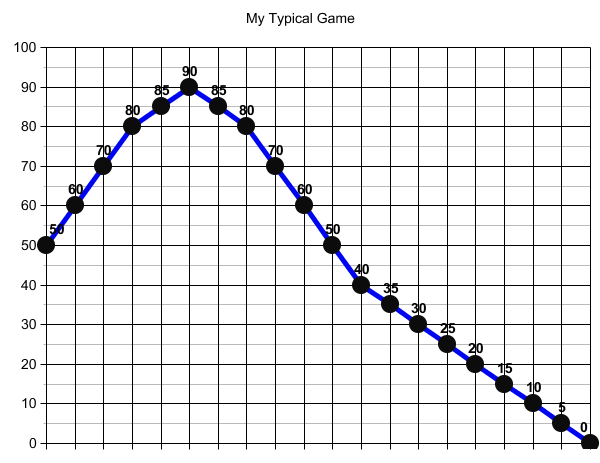
Sure, everybody loses games to weaker players, even much weaker players, from time to time. I used to do so occasionally. Now it's regularly. Everybody loses games from positions where they're winning. But they also do the opposite, which I do but rarely - while the trajectory of my games is so often like that, we might as well depict it on a graph and title it My Typical Game. (I've not titled the axes: I'm sure it's self-explanatory.)


It's a hard way to lose, I think, and familiarity makes it no easier: rather the contrary. It's a lot harder to accept as a pattern than it is as an occasional hazard.

Why this has happened to my chess, over this period, I don't precisely know, and you can be sure that I don't have the time, nor do I have the inclination, to carry out the sort of exhaustive self-analysis that would likely be required, nor the extensive course of improvement that would likely have to follow. No thank you: I am forty-six years old and my future in chess is mostly behind me, and there are many better things to which I could devote my time.

Of course, being in my forties, I also recognise that Anno Domini is friend to no chessplayer, and I notice little things, outside chess, that indicate a tiny loss of focus: lapses of memory, confusion of words, a difficulty in processing and understanding statistics, a problem in grasping the logic of an argument with which I am not already familiar. In truth, I've always been better at generalities than specifics, and if the mental machinery is not working quite as well as it used to, then that tendency can, only be accentuated. And it's a fatal tendency when it comes to the point of the game at which exact calculation is required.

Presumably tiredness plays its part, too, exacerbated by working round the country and sometimes travelling for hundreds of kilometres on the day of a game, or the evening before: maybe the mind, in those circumstances, can only maintain proper levels of concentration for so long, and that length of time time not quite enough to win a hard-fought game of chess. Maybe. Maybe it plays a role. But probably not the major one.

Whatever the causes, all this leads to stress, from which I've suffered, to one degree or another, for quite a long time, presumably much longer than I really know, since there must have been symptoms of stress long before I knew them for what they were. Anyway, that stress has gradually whittled away my capacity to play, and cope with, chess.

About a decade ago, I found myself unable to complete a British weekend tournament. Instead of playing five rounds, or six, I would habitually find myself missing at least the Saturday afternoon, and the final, Sunday afternoon round. Maybe more than those: a particularly difficult-to-take defeat would normally send me home earlier than that. I've entirely cut out rapidplay, blitz, lightning: I've also cut out correspondence chess (far less enjoyable than it used to be, anyway). As for internet chess, I never took to it in the first place.

Now I'm taking a rest from club and tournament play, too: as it stands, chess isn't good for me. Better to give it a rest until such time as I know I'm missing it- and when I start playing again, to play a little less. So that I am less tried when I play. But more importantly, so that when I lose, it matters less. And so that when I play, I'm looking forward to it.

I look forward to that, at any rate. I like chess, in principle. I don't think this is where I stop playing chess competitively. But I think it might be where I stop playing regularly. To play chess less, to appreciate it more.

[Dinky graph: National Centre For Education Services Create A Graph]

Wednesday, September 28, 2011

Blue or Red Pill XII


White to play
JMGB v AN Other, Sunningdale Open September 2011


White, your humble scribe, to play. It's a real life BORP moment.

My pieces are looking menacing. How about I loosen up Black’s king a little with 26 e6? Something like 26 … Qb3, 27 exf7+ Qxf7, 28 Bxg6 will follow


and after Black moves his queen to cover the bishop so a discovered check won’t just win I’ll have an extra pawn as well as attacking chances. That looks pretty good.

What about 26 Bxg6, though? If Black takes on g6 he’ll drop all his kingside pawns and then his own bishop too so he only has one move. 26 … Qxg2+, 27 Qxg2 Bxg2, 28 Bxf7+


After the bishops come off, I’ll be a pawn up here too, this time with a pair of connected passers in a rook ending. That looks pretty good too.

It seems like a straight choice ...


Keep the queens on and go for an attack.


Swap them off and head for an ending.


The choice was mine. Now it’s yours.


Blue or Red Pill Index

Monday, September 26, 2011

WwwK XX: The Knights of Merano

A Candidates' Final in 1974, a World Championship match in Baguio in 1978 and a World Championship match in Merano in 1981: Korchnoi's highest achievements started at forty-three. As Mihail Marin points out in Learn from the Legends, this might have been long before the average age of elite chessers plummeted, but Old Vik was very much the exception even in his own time.

Aside from the end of Korchnoi's career at the very peak of the chess world, Merano marks the last days of the When we were Kings era (see WwwK XIX). It is, therefore, the last World Championship match in which the newspapers truly took an interest.

Actually, if you compare the reporting of the 1979-1981 Candidates' matches with that of previous cycles you can see that our favourite game's position in popular culture was already slipping. Even so, the coverage was monumental compared to what we get today. Here's how the mainstream press previewed the fight for the greatest prize in chess back when they still gave a shit.


WwwK Index


The Times
Saturday September 26th, 1981
George Steiner
Page 13


THE KNIGHTS OF MERANO
Next Thursday in Merano, high in the Italian Tyrol, the first pawn will be moved in the contest between Karpov, the holder, and Viktor Korchnoi, the challenger, for the title of world champion of chess. George Steiner considers the nature of an event in which a game of obsession irrelevance becomes the subject of grotesque politics.


In essence, of course, chess is trivial. Whatever the aesthetic delights, mental stimulus and emotional tension or release which it provides, the activity of moving thirty-two counters across sixty-four alternately coloured squares cannot be construed to possess moral, civic or directly creative values. Chess is a game – and I shall never forget with what lucid sadness Boris Spassky stated this fact when he realised that to Bobby Fischer, his implacable, triumphant opponent in the World Championship at Reykjavik in 1972, it was not a game, but the universe, the sum of reality.

Now Fischer’s view can, in fact, be argued. If it is, in ethical or social substance trivial, chess is also inexhaustibly profound. After the first few moves, the number of possible variants is of the order of the estimated number of atoms in the universe. Though played since the seventh or eighth centuries A.D., if not earlier, it is a game in which millions of particular confrontations lead only very rarely or only by intent, to a configuration which has already occurred before.

Absolutely fundamental elements, such as the advantage – ought it not to be formally decisive? – which White enjoys because he/she makes the first move, continue to be a matter of intuition, not of proof. Not even the supreme masters – a Capablanca, a Lasker, a Botvinnik, a Tal, a Fischer – can perceive, let alone calculate all the available choices and lines of further play which spring from a relatively straightforward position.

This inexhaustible depth can generate in a human being what Captain Cousteau and his divers call le vertige des grandes profondeurs, “the dizziness of the great deeps”. At certain depths divers experience an almost irresistible desire to take off their masks, to plunge to some final centre in an ecstasy of self negation. Precisely the same vertigo, the same perhaps suicidal addiction to the absolute, can take hold of a chess player.

Chess will fill his waking thoughts and obsess his dreams. Chess theory, openings, the cold magic of the end-game, will enlist his powers of memory. He will play lightning-chess (no pause between moves) to keep eye and hand in practice. He will carry his miniature set in his pocket wherever he goes, analyzing, re-playing with and within himself the games of the masters and his own.

Chess will become the logic of the world, as it was to Marcel Duchamp, when he gave up art in order to deepen his game, as it was to Fischer. The price can be steep. The history of the game is strewn with nervous and cerebral ruin, with the advance into madness recounted in the finest of all chess-fictions, Vladimir Nabokov’s The Defence.

Take two cardinal points: “triviality” – in the “humane” and social sense – and inexhaustible depth in the formal, structural, aesthetic senses. Seen together, they make of chess one apex of a fascinating triangle. It is in pure mathematic, in music and in chess that this singular duality of playful autonomous profundity is vital.

Pure mathematics constructs its own rules, its own conventions of beauty and rigour. Its theorems may turn out to have some application to vulgar reality. But such application is a contingent almost embarrassing by-product.

There is, to be sure, plenty of music which accompanies mimes or evokes human activities. But the greater the music, the more integral its self-containment, its plenitude to itself. A Bach partite is of no use; it does not picture anything in the world; it is not to be marched to or danced by. It simply is, in an existential necessity and totality which constitutes the world.

So it is with a great chess game, indeed with a single supreme move (Rook takes on h7 in Botvinnik’s epic draw with Fischer at Golden Sands in 1962). In short: there is literally infinite “matter” in pure mathematics, in music, and in chess. But its relation to common reality is, to borrow from the physicists, that of “anti-matter”.

This may provide the clue to a well-known psychological conundrum. Pure mathematics, musical composition and chess are the only three human pursuits in which we have reliable evidence of creative achievements (even of major creative achievements) before puberty. Pascal and Gauss were rediscovering for themselves, or proposing, important theorems in earliest boyhood. Games which Samuel Reshevsky played before his teens retain their classic authority. Mazart (sic), Rossini and other composers produced flawless inspired music in pre-adolescence.

This suggests the possibility that these three “autistic” activities are fuelled by neuro-physiological and cerebral centres which are independent of general, and particularly, of sexual maturity. One can be a mathematical prodigy, a musical genius, a chess master before becoming a “normal” human being; one can continue to be so without ever achieving, or achieving fully, such “normality”.

And the deep structural link may be this: in ways which we intuit but cannot yet analyse or transcribe, pure mathematics, music and chess are “internal spaces”, and configurations of energy across and within special “mappings” – the algebraic field, the acoustic sphere, the chess-board. Mastery in each of the three somehow depends on the ability to sense – at some highly abstract level of inward sight or hearing – the right configuration (figura) of symbols, notes or pieces, and to leap towards this “figure” across the intervening, plodding, step-by-step stages which separate you and me from the flash of right vision (the solution to the equation, the musical resolution, the mating position).

If such “leaps across inner space” are indeed the key to greatness in chess, and if highly specialised neurophysiological agencies lie at their base, we may have a clue to certain other aspects of the game. It has, certainly in modern times, been dominated by Jews. The rancorous embarrassment this causes in the Soviet Union, the super-power in world chess, is manifest in Botvinnik’s slippery, manifestly uncomfortable memoirs (Achieving the Aim, Pergamon Press, 1981). Such domination by a numerically insignificant, harried ethnic group may well point to a strong genetic factor.

The crucial zone of interaction between neurophysiology and “brain” may be crucial with regard also, to a second historical fact. Just as in higher mathematics or musical creation, the contribution of women to chess has, till (sic) now, been slight. There has been a handful of very strong women players. But even at the championship level, they rank well below male grand masters.

Because they rear boys, women have an unsparing eye for the strain of infantilism in even the most obsessive of “hobbies”. Because they bear life, women seem to find it difficult to deny reality, to banish the world. In number theory, in a fugue, in a great chess game, such banishment of the world and of oneself from the world, is the opening move.

It is this ideal of irrelevance, this almost crazy divorcement from mundanity in chess, which makes so grotesque the politics of the Karpov-Korchnoi match. It may well be that chess was initially conceived as a war-game (though this is by no means certain). And there can be no doubt as to the aggressions, as to the pulse of violence, which a hard-fought game can provoke. But it is an altogether different and sordid matter when chess becomes enmeshed with chauvinism and national propaganda.

The chronicle of world championships is a brief one. The title was first devised and won by the Austrian master Wilhelm Steinitz in 1886. Emmanuel Lasker, one of the most attractive and rounded human beings ever to achieve chess supremacy, ruled from 1894 to 1921. The next six years were dominated by the genius of Capablanca, a virtuoso whose technical insight and exactitude of judgement continue to stun as one replays his famous wins.

Except for two years, 1935-1937, when Dr Max Euwe of Holland wore the crown, supremacy belonged to Alexander Alekhine. Here was an incomparable poet of the game, a player the sheer beauty and depths of whose combinations have not been surpassed. But Alekhine as a bitterly anti-Soviet Russian who made his home, mainly, in France and who, during the second world war, lent something of his genius and titular prestige to the Nazi order. And this is where the Karpov-Korchnoi saga really begins.

With Alekhine’s providential death in 1946, the International Chess Federation (FIDE) organised a tournament in which the five top players in the post-war world each played each other five times. The victor and new world champion was the Russian grandmaster and electrical engineer, M. M. Botvinnik. Behind his victory lay not only exceptional personal gifts – Botvinnik is one of the supreme “all-rounders” in the history of the game – but a formidable bureaucratic-political endeavour.

Chess had long been immensely popular in Russia (Tolstoy and Lenin found it equally irresistible). But Russians had not figured prominently in international encounters. Alekhine’s career and political views made this situation intolerable. Using the financial, educational, mass-media resources of a totalitarian centralized regime, the Sports Committee, with such figures the Colonel-General Apollonov, the Minister for Physical Culture, the Central Committee itself, determined to make the Soviet Union the dominant power in world chess.

Botvinnik’s memoirs give a sense of the investment of menace and reward which went into this cause. He himself seems – or pretends to be – unaware of the elephantine brutality and opportunism with which Stalinist and post-Stalinist officialdom has pre-empted the personal lives of gifted chess-players. But the programme paid off magnificently. With one meteoric exception in 1972-1975 all world champions since 1946 have been citizens of the USSR.

This exception was, of course, Bobby Fischer, very possibly the strongest player of all times. With Fischer’s abandonment of world chess and personal self-burial, the title again fell vacant. In 1975, the challenger, Anatoly Karpov of the USSR, was awarded the title by default. Among Soviet masters, no one was more bitterly sceptical of Karpov’s claims to official supremacy than Viktor Korchnoi (the score between them in the Moscow Candidates’ Tournament of 1974 reads Karpov 3, Korchnoi 2, and 19 draws).

Korchnoi’s stance towards the Soviet chess establishment soon became a matter of public notoriety. He was fortunate in being able to reach asylum in Amsterdam in 1976. Here, suddenly, was the Alekhine nightmare all over again: a fiercely dissident Russian (a half-Jew, to boot) was attacking the juggernaut of Soviet pre-eminence.

What ensued at Baguio City in the Philippines, in the sweltering summer of 1978, was one of the saddest circuses in the millennial records of a wholly abstruse and quintessentially disinterested game. It took Karpov thirty-two games to obtain a one-point victory over an opponent twenty years his senior. The quality of play only rarely surpassed doggedness. The drama lay with the political propagandists on both sides, with alleged KGB hypnotists and imported counter-gurus.

If Merano proves to be a repetition of Baguio City, chess will suffer. Fischer’s high noon brought a drastic economic change: he made of chess success (relatively) big money. Add to this the more and more rancid politics of the USSR contra mundum and you have a snake-pit of motives and styles profoundly inimical to the wonder of the game.

Behind Karpov broods an entire panoply of technical advice – invaluable when positions are adjourned -, of ideological surveillance, of patriotic acclaim. Korchnoi has cast himself dramatically in the role of hunted exile (the Soviets have refused to release his family), of the quixotic representative of the free world. What has this to do with his fineness in the Open Variation of the Ruy Lopez or with Karpov’s uncanny ability to perceive and exploit minute advantages in the control of space?

In fact, a subtler but more significant shadow lies over Merano. The concept of chess-machines goes back at least as far as the late eighteenth century. It has inspired science-fiction and fantasy from Edgar Allan Poe to the present. With the development of cybernetics and high-speed computers during the second world war, the notion of “artificial play” took on reality. Charles E. Shannon’s classical paper, “Programming a Computer for Playing Chess,” was published in 1949. Only thirty years later, computer-chess had become a busy field of research and experiment. Matches between computers and players of known strengths, are now frequent.

The difficulties involved in programming a chess algorithm, this is to say a structure of decision procedures whereby a machine can register, internalize and examine a position in which every main variation can entail some dozen choices will involve the scrutiny of some seventy million positions.

The human player will calculate main variations to a depth of five or six moves. It is the virtue of the human brain to discard as much or even far more than it ponders. We have only vague, metaphoric notions as to how these intuitive preferences and economies of effort are achieved.

Yet for all the complexities inherent in the enterprise, chess computers have involved formidably. Their “memory banks,” their capacity to review and compare positions at speeds unattainable to man, the rigour with which they can be programmed to aim for simplified, and hence formally “surveyable,” configurations, have exceeded the expectations of the Fifties and Sixties.

The layman can only cite expert opinion. It is now held by a number of master-players that computers are in sight of forcing a draw against even the best of human adversaries. Botvinnik, who has devoted his energies to computer-chess since the early Sixties, puts it this way: “If a human being is really clever, then his automaton should be more intelligent than its creator.”

If the day does come when a computer can defeat or, indeed, draw against the world champion, the history of chess will enter a bizarre zone of separate lives. It will, at some levels at least, be the very first human intellectual and aesthetic activity end-stopped by artificial intelligence. This might be a sad but not altogether inappropriate finale to what is, perhaps, the most enigmatically obsessive and impertinently beautiful of contrivances.

Saturday, September 24, 2011

Cover version: Kings of Convenience


Kings Of Convenience, Riot On An Empty Street (Astralwerks, 2004)

[Thanks to Morgan]
[First in an occasional series]

Friday, September 23, 2011

Causing Offence


Black to not screw it up
AN Other v JMGB, Sunningdale Open 2011


It's a one time thing. It just happens a lot. It's not usually this extreme though.

My opponent had taken something like a quarter of an hour over 35 b6. He was busted. I knew it and I could tell that he knew it too ... and yet ten minutes later I was the one resigning.

Geller lectured me after I had lost to Jansa in Amsterdam in 1974. 'You stood better. Where? Well, show me the game, show me. I feel offended for the position.'
Genna Sosonko, Russian Silhouettes

Offended for the position, Efim? Me too, comrade, me too.


Wednesday, September 21, 2011

Sing a Song of Chess VI

About birthdays, this much I know: there's a downside and an upside to ageing.

Birthday cons:-
  • they come around sooner and sooner. I refuse to believe that three years have passed since I turned forty;
  • their importance varies in direct proportion to the number of young folk who have birthdays around the same time. My nephew Nathanial's birthday is a few days after my birthday and ever since he arrived my family have - rightly - regarded 17th September as nothing more than a preamble to the main event;
  • they expand sideways. At some point the hyper importance of a party on the exact date melts into 'nearest weekend is probably best' and by the time you hit forty-three any date in the right month will do.

Birthday pros:-
  • they multiply. Getting everybody together at the same time becomes a logistical nightmare so you can legitimately give up and have many events in many locations;
  • it becomes acceptable to buy yourself presents. Over-priced and completely unnecessary for preference, naturally.


Anyhoo, back to Nathanial. Indoctrination can't start too early, wouldn't you agree?


Cheesy

One rook and one knight
One bishop too
One queen and one king
Another bishop true


Sing a song of chess Index


Monday, September 19, 2011

Seinfeld, muffins and last days


Who was it who said you shouldn't play chess on your birthday? Korchnoi? Botvinnik? Bronstein perhaps? Whoever it was, the idea, as I recall, was that chessers who are in the middle of celebrating getting another year older are simply not in the right frame of mind for a tough struggle over the board.

My experience at Sunningdale at the weekend rather makes it look like our mystery man might have been on to something. A loss and a draw on the Saturday was not at all a great return and certainly compares unfavourably with my win and a draw against stronger opposition the day after.

Perhaps it had nothing to do with my birthday, though, because I seem to have developed a bit of a history of doing well at the end of tournaments. In the five events I've played in this summer (Sunningdale Major; Gatwick Open; Benasque; Twyford Challengers A; Sunningdale Open) my final day scores amount to +4 =5 -0 at an ECF of 194 (that's equivalent to around 2200 elo) - 20 points higher than my published grade.


There was an episode of Seinfeld - series 8, number 21 I believe - when Elaine suggested that since it's the top bit of a muffin that people most like to eat, somebody should start a business baking muffins that are only the top part. I wonder if, likewise, somebody could see their way clear to organising a chess tournament that is entirely made up of last days.


Seinfeld consultant: Peter Lalic
baked goods: RAW Baking

Saturday, September 17, 2011

Forty-three

... at forty-three, you don't make plans to dabble in different lives. At forty-three, what you are, what you know, is about as far as you're going to go in this life; about the most you can hope for is a little fine tuning and a pay hike or two.

Richard Price, Clockers

Try reading that when you’re a few months shy of your forty-third birthday. Try reading it when you’re just short of the point at which it becomes impossible to deny that you are nearer to fifty than thirty-five.


RP: Look around you BloggerBoy.

JB: And …?

RP: This is all you’ll amount to.

JB: Really?

RP: Ever.

JB: I’m not so sure I like the sound of that.

RP: You don’t get a vote.


It’s May. I’m forty-two. I’ll hit the wall on 17th September.

I look around. I think about chess.


Prophet of doom


Time ago.

Being forty-three isn’t at all bad for chessing. At forty-three you are in your prime.

Time passes.

Kasparov takes the World Championship aged twenty-two. He rocks the chess world then quits just before he reaches the Ominous Age.

Gazza's legacy?  A new narrative. Forty-three means French-fried. Forty-three means fucked. Forty-three means f.i.n.i.s.h.e.d.

Forties are favourite becomes a chessboard non sequitur. Kids dominate chess now.


Which way for quitters?


I look around. I think about my chess.

Twenty-five years in. Moderate results on permanent loop.

I start hearing “All you can hope for …” everywhere I go. Destiny denial doubles. I engage in clutching practice. I keep my eye out for straw.


Role model


Until Kazan.

The average age of the Candidates who contested the right to challenge for the World Championship between '66 and '69 was touching 40. The average age at Kazan is barely more than 30 and would be lower still if Carlsen had shown. Still, Boris Gelfand, the oldest man, wins.

Righteous redemption rules. Boris has a World Championship match coming and will be forty-three when he plays Vishy Anand.

The Gelfand riff: shitcan fine tuning.

The Gelfand vibe: different-life dabble delirious.


It’s September 17th. I’m forty-three.

Richard Price redux:

RP: This is the most you can hope for Bloggerboy.

JB: Really?

BG: I’m not so sure.

JB: I like the sound of that.

BG: You get a vote.


I have tournaments coming. Maybe I'll finish them frayed, frazzled and forked or maybe I won't, but, either way, Price's providence will be paid no heed. I'll choose Gelfand's gift instead. Maybe a different chess life is out there. Maybe one day I'll get to dabble.

Sunningdale here I come.


Photographs:
Richard Price from nytimes.com
Kasparov from theipinionsjournal.com
Gelfand from susanpolgar.blogspot.com
Cake from RAW Baking

Friday, September 16, 2011

Bad book covers XXI


The Gruenfeld Defence, Shamkovich and Cartier, Hays, 2001


[Bad book covers index]

Wednesday, September 14, 2011

Pinteresting?!

I've often wondered why chess isn't more photogenic: geeky practioners with an interest in technology, the parallel lines of tournament tables meeting at infinity, the basic black and whiteness of the game, the pseudo-symmetries on the board building and breaking, not to mention the thousand micro-expressions of shock and heart-ache that each overlooked move makes; surely the sheer visual richness the game unintentionally generates should be splashed on the front pages every day, with technically superb photographs the norm in the specialist circles.

But, no. Take Pinterest - a nice newish website dedicated to sharing photographs. Very few chess photographs, and even the good ones don't really capture much about the game. As evidence here's two of the better photographs:

Monday, September 12, 2011

Killer Endgames - A Review

Part two: DVD II - contents and coverage of king, rook & bishop v king & rook

Why study the endgame? I've asked this questions a few times before. The other day EJH suggested an answer that until he mentioned it had never occurred to me: learning curves.

For many (most?) of us, studying the opening will mostly be a case of adding a little knowledge to a large amount. Studying the ending, however, will be the reverse. Gustafsson and Svidler might not agree, but, looking at it in terms of learning curves, switching our attention to endings could actually be a very efficient way to spend our chessic training time.

In that light, perhaps it's about time to get back to my review of Killer Endgames - the two-part DVD set presented by GM Nick Pert under the GingerGM banner. For those who haven't already seen it, review part one can be found here.


Killer Endgames volume II is very like KE volume I in many ways. It can be watched on a standard TV/DVD player, runs for around four and a half hours, divides the material by rating category rather than ending type and concludes each of its sections with a series of puzzles for the viewer to solve.

In contrast to the first DVD, however, the test positions are much less likely to relate to the endings that have just been taught. Also, while on volume I the allotment of the material to the various rating categories is a pretty good indication of what chessers of different standards can handle/need to know, here the structure is more a narrative device than something to be taken literally. Well, you can wait until you are challenging for the World Championship before you watch the video on rook plus f & h pawns against rook if you want to, but I'm not sure that it's absolutely necessary! KEII is definitely much more demanding than KEI, but I doubt that chessers around my level (172 ECF; 2049 Elo) or a few notches below will find that there's anything on the DVD that's beyond them.


One of the Pert twins. Hopefully the right one.


KEII has a total of 21 video lessons and 16 puzzles, the lessons covering the following topics:-

1800 – 2200
  • rook & pawn v rook – checks from the side
  • bishop and knight v king
  • bishop, knight & pawn v rook
  • Lucena
  • rook & knight v rook
  • queen v rook
  • king and pawn

2200 – 2400
  • queen v rook & pawn
  • rook & 4 v rook & 3 – pawns on the same side
  • rook & 4 v rook & 3 – distant passed pawn, attacking rook behind the pawn
  • rook & pawns v rook & pawns – distant passed pawn, attacking rook in front of the pawn
  • rook & 4 v rook & 3 – distant passed pawn, attacking rook in front of the pawn
  • rook & 3 v rook & 2 – pawns on the same side
  • rook ending – rook v pawn

2400 – 2600
  • rook & bishop v rook – practical example
  • rook & bishop v rook – 2nd rank defence & Philidor position
  • rook & bishop v rook – king in the centre
  • queen & pawn v queen

World Championship
  • Rook + f & h pawns v rook
  • two knights v pawn
  • rook & pawn v rook


While KEI spent the biggest chunk of its time on king and pawn positions, here, as you can see, attention shifts to rook and pawn endings. These are frequently said to be the most common endings in practice so the focus is in no way excessive, but it does inevitably mean that other areas are given less consideration. There are no lessons and just one puzzle devoted to bishop endings, for example.

As with the first DVD , the material is taught well. In fact, my only quibble with the presentation - the only thing that I've ever disliked about a GingerGM production, actually - is the onscreen chessboard: it's upside down. For reasons that are completely lost on your humble scribe, it's the black pieces that are shown playing from the bottom of the board upwards. I’ll have more to say about this in part III of this review, but for now I'll give you my speed conclusion: this ‘feature’ of the DVD is more than somewhat annoying, but although it certainly detracts from the presentation I did find myself getting used to it. I wish it wasn't there, but I wouldn't avoid this DVD simply because it is.

For the remainder of this part of the review I'll take a closer look at how KEII teaches the (in)famous rook and bishop against rook endgame. Doubtless Keith Arkell – 18/18 and counting with this allegedly drawish ending – has little to learn from the DVD. For those of us who have been adopting the ‘cross fingers and hope it doesn’t come up’ approach, though, a little study of KRB v KR is unlikely to go amiss.


Pert covers the rook and bishop against rook ending in three separate video segments which run for a combined total of 32 minutes.

VIDEO ONE: features the conclusion of Nick Pert v Nigel Povah, Sunningdale 2010, Pert demonstrating how an initially drawn position turned into a win and then back again before a final slip by Black handed him victory.

VIDEO TWO: is also a game fragment, Hawkins – Gormally from the 2008 British Championships, but is a much more technical lesson. Here Pert explains the second-rank defence and the Philidor Position – a set-up from which the rook and bishop can force a win.

VIDEO THREE: Pert uses another of his games (against Efimenko, Hastings 2004) to show the defender trying to keep his king in the centre for as long as possible. This is a key defensive technique because, as John Nunn observed in Secrets of Pawnless Endings, if you drag things out as long as you can, even if something goes wrong later on your opponent may run out of moves before s/he can deliver mate.

Upside down board aside, the material is well presented and clearly explained. One of things I particularly like about these DVDs is that Pert often starts the lessson before the technical phase begins. The first KRB v KR video commences from the following position, for example:-


This gives the viewer some hints about general endgame play as well as teaching them the specific techniques that it is necessary to master to be able to play the various endings correctly.

It is also very much to KEII's credit that KRB v KR video one shows the two players getting it wrong. If former prodigy and later super-GM Judit Polgar can balls it up - witness how she struggled to find the right plan against Dominquez Perez at the World Cup last week (Nalimov says it's mate in 15 from the starting position) and had to resign just a few moves after achieving a standard drawing position when on the weaker side of KRB v KR in a game from 1990 - the objective assessment of this ending is clearly only half the story. For most of us in most circumstances this ending is simply too hard to play correctly, and it's helpful that KEII reflects that.

In contrast to the messy practical reality of KRB v KR shown in the first video, the second demonstrates  some specific attacking and defensive techniques that the endgame student can, and perhaps should, learn by heart.


White to play +-
Black to play =
Philidor 1749


This is the famous Philidor position. Pert analyses something that is very close to it - the differences are entirely inconsequential - as part of his coverage of Hawkins-Gormally. Although he doesn’t say so, the winning method given is essentially that published by the old Frenchie two and a half centuries ago. I think it’s probably a mistake not to have drawn attention to this. Aside from the general principle of credit where it’s due, giving a position a name is a good way of assisting the viewer recall that it is this particular set up that they are aiming for (or trying to avoid if they are defending) should they reach rook and bishop against rook in their own games.

Pert demonstrates the win clearly enough – no mean feat considering that the correct strategy is virtually indistinguishable from random shuffling about – but what those new to KRB v KR will not learn from the DVD is that if you shift the position left or right things begin to change.


With White to play one of these positions - initially published by Lolli (1763) and von der Lasa (1843) - is drawn and while the other two are still winning, the lack of width means that the weaker side has defensive resources that are not available when the pieces are set up on one of the central files.

In terms of defensive technique, KEII teaches the second-rank method as employed by Luke McShane when he held Vlad Kramnik to a draw at the London Chess Classic last year. The other standard drawing scheme, the Cochrane defence, is not mentioned. In fact, at one stage Pert comments,

As soon as you start moving your rook behind the bishop and the king, normally you allow White to win.

and while this makes sense in context, it is nevertheless rather misleading. True, Judit Polgar lost in the game above, but she botched it on move 81 instead of following Cochrane's drawing method. Folk who know nothing of this ending other than what they learn here will be rather surprised when they find out that many many games have ended in draws after the defender uses this strategy.


Transparently made up fact of the day:
Nick Pert and Simon Williams do backing vocals on this album.


So Killer Endgames II is not comprehensive, but then it's a DVD so it's not going to be is it? I wouldn’t expect a DVD - any DVD - to cover both of the usual methods for defending KR against KRB nor that an outline of all the Philidor-like set ups mention earlier would be given. There simply isn’t time for such material to be included.

What the DVD format loses in detail, however, it gains in accessibility and for the person who is new to KRB v KR in particular, and endings in general, Nick Pert makes the material very accessible indeed. Those who have an unshakeable preference for the printed word will probably not be converted by this disc, but anybody who would rather watch rather than read, or who finds books like Secrets of Pawnless Endgames comprehensive but intimidating and difficult to learn from, will want to consider adding Killer Endgames II to their list of future purchases.


Killer Endgames is available direct from the GingerGM
and Malc's Chess & Bridge shop