Saturday, March 24, 2012

Bad book covers XXV


Horse Laffs: the humor of chess, Tykodi and Gufeld, Thinkers' Press, 2005


[Bad book covers index]

Friday, March 23, 2012

Rather late in the day

SPONSORSHIP OF THE 2011 BRITISH CHAMPIONSHIPS

My overall conclusion is that controls over sponsorship-related income and expenditure for the 2011 British Championships were wholly inadequate …

The ECF President submitted an invoice for £12,600 in respect of sponsorship expenses paid directly by him. No documentation was provided with this invoice to support this invoice, nor was the invoice reviewed and countersigned by another ECF director. Nonetheless the invoice was paid without question. As well as the wholly inadequate financial governance over this transaction, the invoice was submitted without any VAT. Consequently the ECF has not had the opportunity to reclaim from HMRC any of the VAT that might have attached to any supporting documentation (for example hotel bills). Although it is now rather late in the day, I recommend that the requisite supporting documentation be provided if available both to provide an adequate audit trail and to enable VAT to be reclaimed if appropriate.


It’s nigh on six months since concerns around the funding of Sheffield 2011 and the ECF President’s lackadaisical approach to accounting led to questions being raised at the AGM. Although it is now rather late in the day, I wonder whether those who believed that English chess shouldn’t look a gift-horse in the mouth might now be asked if they've changed their minds.


BONUS ITEM:-
… failure to draw a clear line between sponsorship arrangements that are managed and accounted for by the ECF and sponsorship arranged on a private basis with which the ECF has no involvement.
Report of the Chairman of the ECF Finance Committee, March 2012

The ECF President fails to distinguish between private activity and his public position; the ECF fails to notice.
S&B Chess Blog, July 2010


Wednesday, March 21, 2012

Chess opening leads to blocked position

What, another chess-on-Twitter post? Not at all. Or not entirely. For this post is about the Chinese version - or if I understand it accurately, versions - of Twitter. These services are known as Weibo.

Apparently these services suffer a certain amount of censorship, since China remains a heavily repressive and unfree society. (Probably considerably more than even Russia, though one might not think so to read the chess press, for reasons which are a digression for another day.) There are many words which, at one time or another, are censored: posts which employ them will be automatically moderated and are likely to be deleted.

Now of course internet moderation exists everywhere, as does censorship of one sort or another, but not only is Chinese censorship rather more drastic than most of us are accustomed to, but it has the curious aspect that the Weibo user does not appear to know which words are actually subject to censorship, and this therefore has to be inferred. Nor, obviously, is any explanation given, so that has to be inferred as well .Which is not always simple to do. An English-language website, Blocked On Weibo, exists to try and establish which terms are at any given time blocked on Weibo, and why.

Recently (on 24 February, to be precise) this site analysed a number of terms that were blocked on Weibo as of December 2011, these terms all consisting of three or fewer Chinese characters, and in the course of doing so produced a list of 219 censored terms.

Of course reading such lists is always a joy. You may choose to snicker your way through the list yourself, but I provide a small selection below:

Fifty cents (sic)
Sex
Communist bandit
Marijuana
Vulva
Foot Fetish
Protests
Fuck me
Shanghai Gang
Three-colour cat
Homosexuality
Moaning language
The Exorcist
Tiananmen Square
Flash mob
Political prisoner
Forget-me-not
Muslim
Three different versions of "bestiality"

and....

布局

which, you may be interested to learn, means chess opening.

Why this largely harmless term, largely used by largely harmless people, should be blocked* is a mystery, not only to me but to the Blocked On Weibo site, which is unable to provide any explanation, speculative or otherwise. Nor can I, although naturally I am concerned about it, since I know a number of people who if they were not allowed to discuss chess openings online, would have next to no social life at all.

I do however note that the term 64 also appears on the list. Perhaps this provides a clue, though no more than that. My knowledge of chess openings is, unfortunately, quite extensive: my knowledge of Chinese, unfortunately, rather less so. I can scarcely even speculate. Is there anybody out there who can do better?

(* or have been blocked: it's not clear to me whether it remains so)

[via Blood And Treasure]

Monday, March 19, 2012

Saturday, March 17, 2012

The Other Talent of Léonardus Nardus

This is another in a series of occasional posts on artists-cum-chess players (or vice versa). “Two-Talents” in other words, except that in the present case our subject had many more; possibly too many for his own good.

The story of Léonardus Nardus (1868 -1955) - and it is some story - has been told here and there in the chess press, yet it deserves to be still more widely known (by coincidence, he gets a passing mention on page 51 of the latest issue of Chess Magazine, March 2012). His escapades in the art world, where too he is a well-nigh forgotten figure, are also documented in a few places. This post relies, almost entirely, on these accounts. My thanks to those, and also a couple of correspondents. They are all acknowledged at the end.

In all things Nardus you have to be wary of appearances; and the pretentious “Léonardus Nardus” was not his original name. He legally adopted it in 1911, having used it as a flag of convenience in earlier adventures. He was initially Salomonson Leonard Solomon, born in Utrecht. He studied at the Academy of Beaux-Arts in Amsterdam, and when a young man was to be found in Paris, and then in Argentina in 1889 seeking his fortune in gold exploration. In this he failed, but in 1894 he mined a richer seam: wealthy Americans eager to spend freely, even incautiously, to indulge their taste for fine art as a display of their nouveau richesse.

“Caveat emptor” might have been Nardus’s mission statement and he was happy to allow his clients to think his wares were the real-deal, when many (though to be fair, not all) were just second-rate, if not downright fakes. Let’s not beat about the bush: “fabulously dishonest” is how he was described by art scholar Jonathan Lopez in 2008.

Among his victims was Philadelphian Peter Widener, who made his money from tramcars. Not short of a buck or two he built this modest pile, Lynnewood Hall, to house his art collection.

Widener was himself taken for a merry ride, though Nardus never admitted fraud (a position loyally endorsed by his grandson, to this day). On the warpath in 1907/8 Widener was persuaded by wiser counsel not to expose his gullibility to public ridicule, and experts were discreetly called in to confront Nardus and settle matters behind closed doors (even so, the scandal found its way into the press). Nardus agreed to take back, and replace, some of his dodgy merchandise, which he later auctioned off.

By now “l’homme aux cinquante millions” had made his fortune from his scheming – straight and crooked - and back in Europe cut a swathe through polite society, including marriage in London in 1904 (producing two daughters), living in the manner to which he had become accustomed in Suresnes, just across the Seine from the Bois de Boulogne. As if not to be outdone by the conspicuous display of wealth in the upstart New World, this was his Old World abode:

Le Château d'Arnouville-les-Gonesses,
with an Orangerie behind the tree.

He spoke four languages, and travelled prodigiously, notching up London, Amsterdam, Barcelona, Egypt, Algeria, and Tunisia where he settled in 1921 joined by his daughters and their governess, having decoupled from his first wife in the mean time.

He was an able artist in his own right, with an apparently effortless facility in a John Singer Sargent sort of way, with the same aptitude for portraiture. Here he paints himself, and succumbs to the besetting temptation of all portraitists: that of showing their subject from their best angle.

Nardus par lui-même

He was clearly a sure-footed talent. One can imagine him casually dashing-off this, and others like it, while skipping one step ahead of his pursuers.

Nardus also played a decent game of chess. Even while otherwise up to no-good in the States he frequented the Manhattan Chess Club, as this press cutting from 1906 mentions. It shows him disposing of a strong French player, with complimentary notes by Frank Marshall no less.

Brooklyn Daily Eagle, 30 Sept 1906.
See historical footnote for game-player, and correction.

No doubt a chess/art synergy was at work in his relationship with fellow art collector, pioneer reconstructive surgeon and strong amateur Johannes Esser, also a Dutchman, who secured a match with sometime world champion hopeful David Janowski in 1910 through the mediation of Nardus – it was even played at Suresnes. Nardus had manoeuvred himself into the role of de facto agent and gate-keeper for Janowski, and Frank Marshall while the latter was in Europe.

He and Marshall had a relationship spread over several decades. There’s the press cutting above where Nardus is described as Marshall’s second in a match against Janowski in 1905, and then there's a game from 1910 where Nardus actually mates him (though Marshall gives the appearance of having been asleep on the job). Marshall included Nardus’ photograph in the frontispiece of Marshall’s Chess Swindles of 1914…


…and dedicates the book to his “dear and steadfast friend”. Perhaps Marshall was, say, returning the favour of financial sponsorship from Nardus. Who knows. But: Nardus featured in a book on “swindles”? That sounds too much like a knowing tease. Anyway, their relationship extended at least until 1930 or so, when Marshall spent six weeks in Tunisia chez Nardus, and wrote a personal commendation of Nardus’s encouragement of local chess.

Our, ahem, hero provided financial support to David Janowski (for which, as a compulsive gambler, he was no doubt grateful) putting up the money to enable him to play Lasker in 1910. There is even a recorded position of a Nardus victory over his client/protégé played in Biarritz in 1912.

Nardus (black) to play and win v Janowski, Biarritz 1912.
The position has been given with a white pawn on h4.

Nardus called a halt to his generosity (or self-interest) toward Janowski when in 1915 he publicly, and ill-advisedly, declared Nardus to be “an idiot” for an uninvited suggestion in a post-mortem.

Amid all this wheeling and dealing Nardus had found time to compete in the 1912 Stockholm Olympics winning a bronze medal with the Dutch épée team (some achievement, though tempered by the refusal of top-dogs France and Italy to compete). Chess and art combine again in Nardus’s 1912 portraits of chess players, including Frank Marshall (later sold in 1917, as this sale catalogue shows)…

...and lightning sketches of Hoffer and some of the players at the Scheveningen tournament of 1913, where Janowski finished second behind Alekhine. The Field was impressed enough to print his lively studies on two occasions, but embedded this set, unaccountably, within an in-depth analysis of the scoring system of tennis.

From The Field 2 August 1913.
Top: L. Hoffer and R.J. Loman "In difficult positions he does not smoke!" Middle: J.Mieses. Bottom: C.
(sic) J. Breyer and Dr. Olland.

Another side of Nardus is revealed in his generous gift of paintings (including the portrait of Marshall shown above), sold in Amsterdam in 1917, to raise money for the Belgian Red Cross in the depths of the First War – though, as nothing is straightforward with Nardus, maybe it also served his purpose to wrap himself in the mantle of saintly benevolence.

But the Second War played havoc, even though he was in Tunisia. As slippery as ever, and to avoid legal problems with his ex-wife over title to his substantial art collection, he had, in 1928, set up a joint ownership arrangement with his friend Arnold van Burren in Haarlem, to whom the collection was entrusted. However, it was confiscated by the Nazis in 1941 and sold off. Van Burren sadly perished in an extermination camp. Nardus’s heirs succeeded in 2007 in gaining restitution of some of the looted artworks: two 15th Century Florentine paintings.

At the end of his larger-than-life Nardus died in straightened circumstances in 1955, but was honoured by an exhibition of his own works in Tunisia in 2007. This ravishing picture shows the sort of thing he was capable of at the top of his game:

La Bedouine

We’ll take it on trust that the pieces in the retrospective were painted by Nardus himself. By contrast, suggestions that he had himself occasionally passed off his own handiwork as that of more illustrious artists - that he was therefore himself a forger - continue to surface, suspicions encouraged by his having painted, in 1916, the portrait of (and therefore having associated with) master forger Theo van Wijngaarden. The latest accusation is that back in 1917 he knocked out a “Van Gogh” or two, and successfully sold them as such.

So, that was the story of Léo Nardus who, like another - Da Vinci - was of many talents, in no particular order: artist, swordsman, swindler, linguist, philanthropist, benefactor, fixer, forger, and last but not least, chess-player.

Historical Footnote

It is possible that this post provides the first published outing of the Nardus-Gromer (sic) game since it appeared, in relative obscurity, in the Brooklyn Daily Eagle back in 1906. It also seems likely that his opponent was in fact Jacques Grommer (it is not often that our humble blog gets the chance to offer a correction one hundred and five years later) who was successful in tournaments at the café de la Régence in Paris, earning him the unofficial sobriquet of French champion as given in the clipping. Grommer emigrated to the States, but not until 1912, so for that reason it seems probable that the game was played in Paris.


Acknowledgements (but any errors in this post are down to its author)

Thanks to Olimpiu Urcan, and also to Dominique Thimognier of Héritage Echecs Français, for their generous assistance.
Edward Winter's Chess Notes compilation on Nardus provides the most substantial and comprehensive documentation.
Wikipedia has an article on Nardus, in Dutch.
You can find Marshall's Chess Swindles here.
Two Tunisian sites show a nice selection of Nardus artwork: Tunis Art Gallery and Harissa.
Antonio De Robertis' article, in Italian, discusses the likely Van Gogh forgeries.
Jonathan Lopez writing on Nardus in the art world in Apollo 2007 can be accessed via his website
The finding of the Restitution Committee, in the Hague, on Nardus is here.

A problem with Nardus's paintings on the internet is that most are undated. The Marshall portrait however (along with companion portraits of Taubenhaus, Lasker, and Janowsky) is actually signed and dated 1912. A copy of the catalogue for the 1917 sale showing all these, in black and white, is in the V&A's National Art Library.

The Other Talent of Philip Poyser
The Other Talent of Bill Hook
The Other Talent of Bill Hook's Friend
Chess in Art Index


Friday, March 16, 2012

On the cutting room floor


INT. SQUASH COURT - EVENING 
In a sports centre Juliet sits outside a glass-walled squash court. She is ready to play, but at present is watching Alex and David, who are inside the court.

INT. SQUASH COURT - EVENING 
Inside the squash court, Alex is about to serve. 

ALEX 
Squash is often used as a metaphor to represent a struggle for personal domination.

DAVID
Serve.

ALEX
I was trying to educate you.

DAVID
Just serve.

ALEX
In the same fashion as chess.

DAVID
What?

ALEX
Chess. Chess is often used as well.

DAVID
Will you shut up and play?

ALEX
You're a bad loser. 
DAVID
I haven't lost yet.

Alex serves.

INT. SQUASH COURT - EVENING 
The squash-court door opens and David walks out past Juliet as Alex stands behind, jabbing his finger at him.

ALEX
Defeat, defeat, defeat-- sporting,personal, financial, professional, sexual, everything. Next.

Juliet walks in and closes the door.

INT. SQUASH COURT - EVENING 
Inside the squash court Alex is about to serve.

ALEX
Did you know -- 

JULIET
Just serve.

Alex serves. 

INT. JULIET'S CAR (A MINI) - NIGHT 
Alex sits in the back, drinking. Juliet is driving. David sits beside her.


ALEX

I wasn't trying to win.


It's a pity, but that bit between the first "Just serve" and "Will you shut up and play?" didn't make it into Shallow Grave in the end.

Wednesday, March 14, 2012

The Great Chessboxing Swindle: The Famous Five

Talking, as we were, of jokers, the latest Chessboxing night will have been and gone by the time you read this. And what a night I'm sure it was. Among the most exciting nights out in Europe. Apparently.


Well, if we are to wade through every mound of bullshit that Tim Woolgar and his cronies have left for us, we will certainly need Wellington boots, so let us content ourselves with a look at last Saturday's line-up.


Costello and Sazhin, who were due to meet last Saturday, have both been in the chessboxing racket for quite a while now, and Costello was in Wired magazine last year telling yet another gullible hack the usual cobblers:
Lennox Lewis is a great chess player; the Klitschko brothers are even better.
How good you have to be, to be "even better" than "great", perhaps only Mr Costello can tell us: perhaps he could tell us how good "highly-rated" is, too, since we are told that both he and Mr Sazhin are "highly-rated chess players in their own right".

Maybe, maybe not: indeed "how highly-rated?" is not a more pertinent question than "rated
by whom?" since Mr Costello does not appear to presently have either an English or an international rating.

Nor can I find an international rating for Mr Sazhin although remarkably enough he does possess a Wikipedia page which gives his Elo rating as 1911. Source unknown.

Perhaps Mr Sazhin's page requires updating, since 1911 is a good deal less than 2000, which is a shame since the press release claims that
with five fighters rated above 2000 Elo this is the highest quality chesboxing (sic) line-up ever assembled
making it hard for us to include Mr S among that famous five.

So who can they be? I seem to have played this particular course at least once before but if you will indulge me on this additional occasion, I have to inform you that having run the players' names through the appropriate resource, I have found, not five, but only one meeting the aforementioned description.


We got the numbers

Where the other four are to come from, Lord only knows: even the ECF database (a resource with which Tim Woolgar is presumably familiar, being, ludicrously, Marketing Director of that organisation) offers us only Mike Botteley as a plausible candidate, his ECF of 170 just making it above 2000 if we convert to Elo. Not that that actually makes it an Elo grade, of course, but as it doubles our score, who's quibbling?

Mike Botteley is a master of calculation


Who knows? Maybe they play chess under other names. Or maybe their rankings come from some other source that I'm unaware of. Or maybe, like so much else about the chessboxing circus, some clown just made them up.

One assumes that this circus will carry on a while yet, as there is never likely to be any shortage of hacks of dubious reputation to give it publicity. And naturally this writer is not under the impression that the general public gives a monkey's about Elo ratings - either what they are, or whether or not some impresario wants to make them up.

But it is curious, is it not, that this fast-growing sport, this potential candidate for Olympic status, does not in fact grow more quickly? Not that the hacks notice this, but it's basically the same people, in the same places, with the same old cobblers accompanying it. Only the names of the hacks sometimes change.

Chessboxing: it's a bit of a dog


Not that having the same old characters and the same old story is an impediment to success. Sometimes it can be quite the opposite. Until we grow up.


[Mike Botteley photo: Ray Morris-Hill]
[Famous Five photo: Daily Vile]
[Chessboxing index]

Monday, March 12, 2012

Does It Float?: Johnnie Walker Scotch

It is the most shattering experience of a young man's life when one morning he awakes and quite reasonably says to himself, 'I will never play the Dane.'

Montague H. Withnail


I will never be 2600.


I've given up. It's time to stop hiding my ideas and expose myself to the world. Now that I've retired from the 4NCL, I have no regular chess where preparation could be a factor.

So this series is designed to share some opening innovations that I've tried out a few times. I'm not going to expand massively on each suggestion - instead, I encourage you to have a look and draw your own conclusions. Try them yourself and buy me a pint next time our paths cross.

We start with one I've coined the Johnnie Walker. For reasons that will become obvious.


1. e4 e5 2. Nf3 Nc6 3. d4 exd4 4. Nxd4 Bc5 5. Be3 Qf6 6. c3 Nge7 7. g4!?


After my epic game against Tony Kosten at the 2007 British Championship, my esteemed opponent commented that most of my repertoire seemed "to involve playing g4". I imagine that was aimed in particular at this, which attempts to take black totally out of their comfort zone.

At my level, such attempts to worry an opponent with an aggressive early shove are perhaps more effective than they would otherwise be. And it follows that my only loss with this innovation came in the only game I've tried it against titled opposition, where my play was pretty poor. 7... d5 is probably best, though I was unable to find a good reply to 7... Ng6 over the board. Though I managed to draw, 10. f3 is appalling. 10. Qa4 might have been decent.

Chess should be fun. Give the Johnnie Walker a go and feel the glee. 


Does It Float? Index

Saturday, March 10, 2012

Cover version: Gruppo di Improvvisazione di Nuova Consonanza


Gruppo di Improvvisazione di Nuova Consonanza, Nuova Consonanza (Cramps Records, 1976)

[Thanks to Richard]
[Previously]

Friday, March 09, 2012

While he had the money to pay

A Story in Ten Pictures:-


and finally, just a few days ago,


We've had Allen Stanford once or twice before. Forgive me.  Yes, I know there is an awful lot else going on in the world, but I'm a chess player and therefore I have no sense of proportion: Fuck with cricket and I. Will. Be. Cross.

A Story in Ten Pictures. It's a good story - well it's got a good ending - even if the title could do with some work.  I'm not sure The Guardian have done any better with Allen Stanford: From Billionaire Businessman to Convicted Fraudster.  From Fraudster to Convicted Fraudster seems infinitely more accurate to me.

Again with the cricket on a chess blog?  Do I really have to explain the relevance of this tale to the chess world, though?  Kirsan; FIDE's flogging of commercial rights ("sold more often than London Bridge" according to Malc Pein) to Agon; other examples rather closer to home?  Is there really anyone amongst our esteemed and valued readership who can read about the Stanford story and not hear bells ringing?

Let's be clear, Allen Stanford, Kirsan and the current President of the ECF are not cast from the same mould. You might agree with your humble scribe that de Mooi is what would have been called in days of yore, a bit of a wally, but that doesn't make him a criminal.  Sure there are similarities - the tawdry embarrassments, the big noise about money brought to the table followed by questions around to whom the cash actually belonged - but equivalence?  Not by the longest of chalks.

Bottom line, this story is not about Stanford or Kirsan or de Mooi. It's about organisations that are overly keen to take the cash that some folk, crims or otherwise, like to be seen throwing around. It's about the fact that concerns being raised about Stanford a good two years before he got anywhere near Lords didn't prevent the ECB from holding its hand out. Above all else, it's about the final paragraph of The Guardian's story.

While he had the money to pay, it seems few people asked him any tough questions. Now they can ask all they like but Stanford won't be answering.


The material for A Story in Ten Pictures mostly borrowed from The Guardian
White  & Black  pawn image from clker.com

Wednesday, March 07, 2012

Night Train to Lisbon

There was a pause.
'Gregorius?' Doxiades asked at last.
'Yes?'
'How do you say chess in Portuguese?'
Gregorius could have hugged him for the question. 'Xadrez,' he said and the dryness in his mouth had disappeared.


p.97


I'll let you read the novel for yourself, but rest assured that that isn't the only chess reference. I enjoyed it irrespective of the chess content, even if the translation from the original German was patchy in places, and I'm looking forward to the screen adaptation.

Gregorius is an introspective soul and he derives a lot of pleasure from the narrative of a game of chess. I think a lot of players would relate to his desire for life to mirror art; for risk-taking to be rewarded and for winning the battles with yourself. I found him very reminiscent of Colin Dexter's Inspector Morse.


Gregorius waited. One wrong word, one wrong gesture, and Eça wouldn't say another word. He went to the chessboard and looked at the game in progress. He had to risk it. 'Hastings 1922. Alekhine beats Bogolyubov,' he said.

Eça opened his eyes and looked at him in amazement. 'Tartakower was once asked whom he considered the greatest chess player. He said: "If chess is a battle - Lasker; if it's a science, Capablanca; if it's an art: Alekhine."'

'Yes,' said Gregorius. 'The sacrifice of both rooks reveals the imagination of an artist.'

p. 132


 Position after 29. Rxa5


 Position after 32. Rxf8+


It's hard to look past the beauty of this position. Black plays 32... Kh7 and basks in the inadequacy of white's material advantage. Art doesn't have to be striking; it can sneak up on you. In 4 moves, Alekhine turns something everyday into something immortal. That's the mark of a true artist.


A Literary Reference Index

Monday, March 05, 2012

Considering the possibility

Anybody who's read The Adventures Of Huckleberry Finn, as I did recently, will recall the Duke and the King, the pair of chancers who hitch up with Huck and Jim on their trip down the Mississippi, stopping off at every small town on the way to try out some scheme or other with the intention of relieving the inhabitants of their money.


These schemes tended, of course, to the illegal, and one can never imagine either Ray Keene or CJ de Mooi doing anything so improper. Nevertheless, with the book so fresh in my mind, I was curiously reminded of Twain's two characters when I came across the latest nonsense from my favourite Twitter account.


Uh huh. Ray is a working journalist and he likes to be the first to break big news. And news it certainly will have been, to the ECF at any rate. Or at least any member of the ECF other than the organisation's President.

So what's Ray's response? He's thinking it over, so he tells us. He's considering the possibility.


Considering the possibility. What "possibility" means, precisely, is not entirely clear, since the post is not actually in Mr de Mooi's gift. So Ray may as well consider the possibility of being offered the presidency of the World Bank. Or the possibility of playing in the Olympiad team. Or the possibility of faster-than-light travel.

Which does raise the question of what CJ and Ray were up to. Testing the water? Just a joke? Well, just a couple of jokers at any rate, since one of them has not been a member of the ECF for more than twenty years, after being accused of misappropriating that organisation's funds, while the other has rather more recently been accused of mispresenting his personal contribution to the 2011 British Championships and of organising financial support for players in such a way that a proper accounting of the tournament's funds cannot be made.

We seem to have hitched up, one way or another, with CJ de Mooi and Ray Keene. Or at least we hitched up with CJ and he hitched up with Ray. And as Huckleberry Finn found out, once you're hitched up with them, it's not so easy to shake them off.


Huck, in the novel, is finally liberated from the Duke and the King when one set of townsfolk, tipped off about them in advance, tar and feather them both and run them out of town on a rail. We do things, usually, in a more civilised way now. But what to do about our two jokers? Seeing as Ray is already, as it were, out of town, might it be best if he stayed there? And as for CJ - is it not time he were thanked for his services and asked if he would prefer to pursue his interests somewhere else?


[LATE SQUIRMING NEWS: Ray blames readers' "inability to read" what he did not write.]


[Huckleberry Finn illustrations: The Children's Nursery, Wikipedia]

[Ray Keene index]
[CJ index]

Saturday, March 03, 2012

Chess in Art Postscript: There's Nothing Like Gérôme Cooking

Over the last two Saturdays we have been tucking into Thomas Eakins' masterpiece The Chess Players of 1876, now in New York's Museum of Modern Art.

A number of observers have commented that its compositional arrangement owes a lot to Jean-Léon Gérôme's 1859 work showing Arnauts at recreation, also with a board game, which is in the Wallace Collection in London.
Maybe the similarity is not too surprising as Eakins was Gérôme's pupil in Paris for two years in the late 1860s. Gérôme's influence on Eakins composition is clear to see.

Last week we left this question bubbling away: what exactly are those Arnauts up to? What's their game?
The Wallace Collection - where the Arnauts can be seen in the flesh - label it "Arnauts Playing Draughts". Now, far be it from me, your humble S&BCBlogger, to question the conclusions of such an illustrious institution, but that didn't seem quite right.

So, two years ago (sorry, it has taken so long to get round to reporting this; I got blogged down in other things, but that's another story) I asked the Wallace Collection what made them think it was draughts, and they referred me to the authoritative catalogue of their collection by John Ingamells which says:
"The game [in the painting] is played with cylindrical pieces of various heights and shapes; the related drawing...appears to show counters. Gérôme also painted oriental figures playing chess with European pieces."
Which naturally leads us to ask to see the "related drawing", please. Well here it is; from the Sterling and Francine Clark Institute of Williamstown, Massachusetts.

Obviously that is two of the three Arnauts in the Wallace Collection painting, the two necessary for a successful game of...well, something or other...and as Ingamells says, they appear to be using counters.

Yes, apparently so, but does that mean the "counters" were "draught counters"? They could be "chess counters" couldn't they? For example, just look at this chess set from the 11th Century Middle East, in the British Museum, with its "cylindrical pieces of various heights and shapes":

So I asked again, and the Wallace acknowledged that "there certainly seems to have been some debate over the years over whether they are playing chess or draughts", and kindly sent me a JPEG of the Gérôme...(for which, thanks)...as if that settled the matter.

What's odd about this is that all the other authorities refer to the Wallace Collection painting as "Arnauts jouant aux échecs" in spite of what the Wallace says, for example Gerard Ackerman in his authoritative Gerome's Life and Work (2000). And what is even odder is that Ackerman also refers to the Clark drawing, where he says "ils jouent aux dames (i.e. draughts) et non aux échecs". So the Gérôme expert agrees with the Wallace on one hand (about the drawing)...but disagrees on the other (about the picture). There's not much hope for the rest of us.

Anyway, Ackerman is extremely helpful in listing the other three chess paintings that Gérôme executed, some of which he describes as pastiches - not pejoratively, but only to indicate that while they are not exact copies, they are derivative.

So here it is: the full-on Gérôme Échecs Éxperience. Jean-Léon is cooking with gas. Enjoy!

We start with the most sumptuous, and perhaps the most startling: both players are women. It was painted when Gérôme was in London around 1870, and is pretty much modelled compositionally on the Wallace Arnauts. The chess set is suspiciously counter-like.


Almées jouant aux échecs (1870)
Private Collection
Almehs it seems, were a superior class of female singer, dancer and entertainer (I suppose that means in the widest sense) in Egypt, but disinclined, I'll wager, to let some tooled-up Albanian chancer make an easy score.

The next one is almost a bit too small in this image to see clearly, but the chess is over there in the right-hand corner, with usual trio of players, though this time Gérôme seems more interested in the townscape.

Une Partie d'échecs (1870-3)
Davison Art Center, Wesleyan University, Connecticut.
Finally, another re-working of the principal composition, with the squatting white-skirted figure making his customary appearance:


Une Partie d'échecs (1870)
Isaac Delgado Museum. New Orleans
Of all the four Gérôme chess paintings this is perhaps the most claustrophobic in atmosphere; the most hermetic and secretive; the most sinister. Another Arnaud has joined the gang - maybe they aren't playing a game at all, but are using the board to plan a bit of random mayhem.

And that, (in case you missed it, there was a clear sighting in the last one of a familiar chess set, the "European pieces" mentioned by the Wallace) would seem to be that.

But not quite. I recently stumbled on this:

...with not one, but two standard-issue chess sets in play (is he giving a simul?). It is by another French "Orientalist", Alexandre Bida (1813-1895), a member of the prestigious Salon and fêted in his time. It was reproduced in the Illustrated London News in 1859, which commented that Bida produced "the effect of colour with colourless materials" - it's in black crayon. Exquisite.
Like Gérôme, Bida travelled widely in the Middle East and North Africa recording the locals with scrupulous ethnographic zeal. If he shows them playing with European pieces, you can be sure that is what they were using.

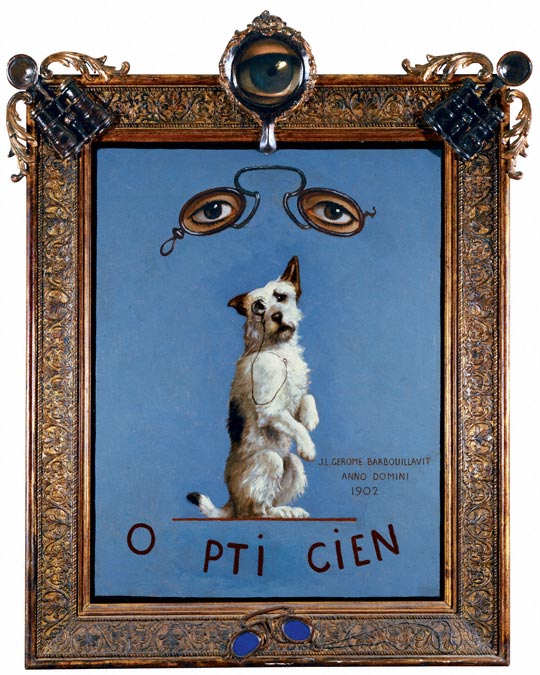
And finally, a bonbon to round off this three part Eakins/Gérôme sequence: it shows that crusty old Gérôme, pillar of the French art establishment, opponent of Impressionism, had a soft centre. Here is his entry in a competition for advertising signs.

Optician's Sign (1902)
Private collection
Fin.

Acknowledgements etc
Gerard Ackerman. Vie et l'oeuvre de Jean-Léon Gérôme. Courbevoie (2000)
Wallace Collection/John Ingamells. European Painting Catalogue (1985)
BM chess set picture © British Museum.
Belated thanks to the curatorial staff at the Wallace Collection; and once again to Peter Mason for the J-L G tips.

Friday, March 02, 2012

Blue is not the colour

The Varsity Match takes place tomorrow, or so I'm given to understand. If you're into that stuff. Personally, when it comes to Varsity Matches I always recall Danny Baker's comment on the Boat Race - that it was as if the Cup Final was the same two teams every year.

I never played in it myself, what with not being good enough and all, since back in the early Eighties there were really quite a lot of good players about. Though I did play in the Freshers' Varsity Match. I'd probably show you the game, too, were it not for

(a) my presently being several hundred kilometres away from my old scorebooks; and
(b) the fact that I got a pasting.

Chess evidently didn't count for very much in the University scheme of things, anyway, since you didn't get a Blue for playing in the Varsity Match, as you did for most other sports. Saying so inevitably raises the question "what's a Blue?" to which the answer is that I've never quite been sure, although I believe it entitled one to go to Vincent's and behave like an arse. There was also something called a half-Blue, which possibly entitled one to go to Vincent's and behave like half an arse. You got one for ballroom dancing, I seem to remember, though not for chess, something which rankled with chessplayers back in the days when there was more chess than ballroom dancing on the television.

You got nothing for playing in the Freshers' match, of course. Except a pasting.

The best of Britain (seen here with the Oxford and Cambridge teams)

Well, without meaning any offence to anybody playing, it's hard to see that the match merits a great deal of attention now that it's basically a fixture between two reasonably good club sides, such as can be seen regularly in the 4NCL (and not necessarily in the top division) or in more than one provincial league. I'd probably get in the team myself, these days, and a working definition of a match not meriting special media attention would be "any match I'm good enough to play in".

Nobody really pretends that the Varsity cricket match is any big deal any more: and to the corresponding fixture in our game, the same surely applies. Perhaps very little in British chess is a big deal any more. But the Varsity Match, nice though it no doubt is to play in, really isn't. It has some historical significance, of course. But perhaps not quite enough.

So, getting back to the Sage of Deptford, it's as if the Cup Final were the same two teams every year - and those same two teams weren't actually that good. Pfft, say I. I can see the point of elitism, sure. But what's the point of elitism where there isn't any elite?

[Photo: John Saunders]