Wednesday, March 16, 2011

Indecisions, indecisions . . .

Back in January I wrote a post about getting into time-trouble, and afterwards I decided to manage my clock more circumspectly. The result? Less time-trouble, but terrible results: my average grade for the season before the decision was 207, afterwards 188. For our international readers, that's about the same as a loss of 150 Elo points in form.

Brilliant! Now, yes, it's only been half a dozen or so games since The Decision, and since 207 represents an over-performance maybe there's just some averaging going on; on the other hand, when I look over my games I start scratching my head, wondering what was I thinking. Or rather, what wasn't I thinking, and how did I miss that.

But judge for yourself. Here are three examples given in the form of puzzles, all taken from a recent game (the one game which I actually managed to win, incidentally!) Solutions follow after the jump. I had the black pieces.

Position 1:


A who's-move-ordering-who open Sicilian, and I've just played 9... b5-b4. The position is known to theory and my opponent played 10.Nc2, one of two normal moves. But the other I had not remotely considered. Can you see it?


Position 2: 


White's sacrificed a pawn for a bit of pressure on the h1 to a8 diagonal, and the position is quite complicated too. Now, I was pretty convinced that after the forced sequence 19...Nxd4 20. Bxa8 Nf5 21.Rxf5 exf5 22.Bd5+ the position would be close to equal, with white's better pieces compensating for his pawn minus. But I decided I wanted more and played 19...Qd7 instead. Had I analyzed the position correctly?

Position 3: 


Black's extra pawn is looking better and better, and I've just played 22...Nf3+ to simplify matters. 23.Qxf3 loses, 23.gxf3 is ugly, and I wasn't sure which of the other two captures to worry about most. What should have I worried about most?

Solutions after the jump!

Monday, March 14, 2011

Letter to the editor

From last Friday's interview with Richard James:-


ejh: What encouragement and support do you think they could receive that they presently don't?

RJ: I'm not involved in this side of things at the moment so I can't really comment very much. From some of the posts by parents on the English Chess Forum there are those who think that there should be more coaching sessions, perhaps more places available in the World and European Junior Championships, that the selection policy should be improved and so on. But all this costs money and the money probably isn't there.


As it happens a few hours after reading this I came across a letter in an old Chess Monthly:-


B.C.F AN INTANGIBLE ENTITY

This is a serious letter on my part to enquire exactly who is The British Chess Federation and what is it exactly that they do for British chess generally.

My reason for asking both these questions is that as a mother of an up and coming junior - and a non-playing mother at that - I am seriously wondering why the B.C.F. do not play any part in the training of our talented youngsters and also why it seems to be left to various other people to arrange chess activities of a more visionary nature - thus providing conditions in which I feel that chess should be played.

I really hardly need mention the names of any of these people. But without them Julian's progress would certainly have not been so pronounced in the last few years. But I will name them as they deserve most of the credit for our recent successes in the international field. (That is my view anyway). They are of course - Jim Slater who seems to provide quite a bit of money required, Leonard Barden whose efforts on behalf of juniors in general seem to be pretty endless, Eddy Penn and Peter Morrish who probably know more about hard work than most of us. And Stewart Reuben. Even though the latter never eats anything I give him when he comes round to dine with us!

I was staggered to learn that the B.C.F. registration fee is only 50p. Is that really true? It hardly seems worth collecting in my opinion. Perhaps if they were a little bit more realistic in this direction they would have a little more money to promote British chess more fittingly. Also I feel that the prize money at the British Championship is pitiful. And why could not genuine discussion take place with a view to investigating the possibility of opening a Chess Centre in London. But with 50p's darting about I can see that it might be rather beyond their means.

However, I must not sound too carping. Chess has given Julian so much and I hope that he will be able to repay the game and its followers in the years to come. I just wish someone would wake the B.C.F up.

JOHANNA HODGSON
London W14


Plus ca change, I suppose, but which was the year of publication?


Saturday, March 12, 2011

A Literary Reference : The Name Of The Rose


If something new had not occurred, I would still be wondering where the story of Adso of Melk originated; but then, in 1970, in Buenos Aires, as I was browsing among the shelves of a little antiquarian bookseller on Corrientes, not far from the more illustrious Patio del Tango of that great street, I came across the Castilian version of a little work by Milo Temesvar, On The Use Of Mirrors In The Game Of Chess.
Umberto Eco, The Name Of The Rose, Vintage, 1998, p.3. Translated by William Weaver. (Original date of publication 1980.)
[A Literary Reference index]

Friday, March 11, 2011

Open The Door, Richard

[Richard James, well-known in English chess for his work teaching children, has written a book, Chess For Kids, published by Right Way towards the end of last year. I interviewed him, via Facebook, on 9 February.]

ejh: Hello Richard. On your website you describe yourself as "chess teacher": and then, under that, "tutor". Is there a difference?

RJ: Hi Justin. I would define a teacher as someone who teaches a class and a tutor as someone who teaches an individual pupil, so I guess I'm both, but at present more of a tutor than a teacher.

ejh: What actually do you do - in either capacity?

RJ: At present I'm based at Hampton Court House, a small independent school for children aged 3-16 in, amazingly enough, Hampton Court. I provide individual chess tuition there as well as running a chess club and organising other chess activities. I also do a small amount of non-chess teaching there.

Outside school, I have a few private pupils whom I teach after school, and at weekends and holidays. I was involved with a lot of lunchtime and after-school chess clubs between 1993 and 2008 but gradually wound them down.

I'm also working at the moment for Chess in Schools and Communities as their curriculum consultant, so I'm getting back into school chess clubs in a very small way in order to test my CSC materials.

ejh: If I understand what you've written on your site, you're somewhat sceptical as to the value of after-school chess clubs.

RJ: The way we're running after-school chess clubs in primary schools at the moment, yes, which is why I stopped doing them and went away to learn how to do things better.

I have no problem with after-school clubs in secondary schools except that it's often hard, especially in non-selective schools, to generate interest. I also have no problem with schools in which the after-school club is just one part of the chess culture within the school, which is what we're trying to do at Hampton Court House.

What I have a problem with, for many reasons, is when a primary school has no real interest in chess but decides that a chess club would be a Good Thing so employs a professional chess coach to run it. Up to a point it works because the children - or most of them - have a good time and enjoy their games, but this will only be a short-term interest and will not lead to continuing participation in chess.

What I'm also sceptical about is the whole issue of encouraging mass participation in competitive chess by very young children.

ejh: Is this because of the unpleasant aspects of competitiveness at an early age, or because to actually play well enough for competition to be meaningful, most children need to be a little older?

RJ: A bit of both, but more the latter than the former, I think. A recent German book (the title, translated into English, is "Help! My child plays chess") makes a big thing of not putting young children into competitions because they may not be able to cope emotionally.


I'm not sure how much I agree with this. In my experience over many years at Richmond Junior Club most children are able to cope, and a bad experience, if it is handled sympathetically by parents and teachers, could actually be something they could learn from.

My problem is more your second option. We're putting kids into national competitions when they hardly know how all the pieces move let alone all the rules. Then we expect them to play with clocks because they might play too slowly. The only kids who play too slowly are those who have to stop and think how the pieces move every time. Then we give them grades and tell them (and their parents and teachers) that they're real serious chess players. This really does them no favours at all, nor does it do any favours to the more serious players who have to waste their time playing them in the early rounds of tournaments.

ejh: What should we do? Is there a way to teach kids non-competitively? Teach them problems, puzzles?

RJ: I think there's a lot we could do - and this is something we're looking at in CSC. What I think we need is a three-pronged approach to junior chess.

Firstly, encourage the use of chess (and other games) as a learning tool in primary schools, with possibly some low-level competition like inter-school matches: this is something that could be taught by schoolteachers, not necessarily by professional chess teachers. Chess, by its very nature, and because kids are enthusiastic about playing, can be a very powerful learning tool. There are enormous possibilites for developing a wide range of cognitive skills through mini-games and puzzles as well as providing cross-curricular links to any other subject. Alexey Root has done a lot of work on this in the States, although much of her material is geared more to secondary school age rather than primary school age children.

A rabbit. And...

Secondly, set up a network of junior chess clubs along the lines of RJCC for those children who want to take chess seriously. Children who are doing chess at home with knowledgeable parents would come straight here and schools would also be encouraged to feed players through to their local junior chess club.

Thirdly, encourage competitive chess among children of secondary school age, possibly by setting up some sort of qualification which would be recognised by universities and employers, or by having attractive prizes for both individual players and schools.

ejh: Does the last of these strike you as optimistic?

RJ: All three of them strike me as being extremely optimistic. But we have to realise that the system we have in this country doesn't work. A simple statistic: there are 18 English players born in 1993 with an active FIDE rating, 7 of whom are over 2000. By comparison there are 202 French players born in 1993 with an active FIDE rating, 22 of whom are over 2000.

Yes, I know that much of our chess is not FIDE rated but even in the ECF grading list (I'm no longer a grader so I don't have access to the current master list) there are not many more than those 18 playing more than a handful of school games. While some of the reasons for this are beyond our control, others are not. And, despite what the ECF might have thought, throwing free chess sets at schools will have little or no effect.

The problem is not the numbers learning chess but the way we teach, organise and promote chess. Not so much in terms of strength at the top, but in strength in depth, we're a very long way behind the rest of Western Europe, not to mention the rest of the world.

ejh: Is part of the difference the way junior ches is organised elsewhere? Where I live in Spain, for instance, my club has a thriving junior section, but I'm pretty sure that to a large extent it's funded by the town hall, and is close to free for participants. I like this way of doing things, but it's not exactly the Anglo-American economic model...

RJ: Yes, from what I understand this is very similar in France, Germany and the Netherlands. Government funding clearly works in a very different way and local government receives a lot of money from central government for activities such as chess. I don't know about Spain, but in other countries inter-club matches take place at weekends and the midweek leagues we have here, which are too late for most juniors and often in unsuitable venues, are unknown. This was one of the things I had in mind when talking about reasons being out of our control.

ejh: Yes, we have matches at weekends, for all sorts of reasons.

I wanted to ask about something else you wrote on your site. You felt that kids in (if I understood right) primary schools will take up chess, enjoy it for a while, then pack it in. Why is this? And would it actually matter very much if they do pack it in, if opportunity were given for them to come back to it later?


RJ: Well, most of them will pack it in, and that is inevitable. Most parents use the primary school years to give their children a taster of a wide range of different activities. At secondary school age they will choose to concentrate on one or two of them. But most children become disillusioned with chess before that point.

My experience of primary school chess in Richmond (which admittedly is an atypical area) is that the kids who don't play chess at home will drop out pretty quickly because they just won't be able to cope with those who can play. The kids who are playing at home with their parents will improve quite fast for 18 months or so, then stop making progress and eventually get frustrated. The only kids who will continue are those who are doing serious chess outside the school: playing in tournaments, going to RJCC and so on. And because they give up out of frustration it's very rare that any of them do come back to it later.

They call him Mellow Yellow

My experience is that, with the exception of the really serious kids, those who start competitive chess in their teens are much more likely to continue playing as adults than those who start at 7 or 8.

If you look at educational theory you start to understand what's happening. To play 'real' chess requires complex cognitive skills which, according to Piaget, children only develop at about 11 or 12. Of course we now know that some children, under specific circumstances, can develop these skills much earlier, but his basic point still stands.

The number of children able to play 'real' chess at primary school age has also declined dramatically in the last 30 years or so. The research carried out by Michael Shayer's team at London University is interesting in this respect. While the Flynn effect demonstrates a gradual rise in IQ scores, Shayer and his team reported in 2006 that 11- and 12-year-old children in year 7 were "now on average between two and three years behind where they were 15 years ago", in terms of cognitive and conceptual development.

In other words, children are getting better at tasks which require quick answers but correspondingly worse at problem solving, which is essentially what 'real' chess is. This ties in very much with what I and others have experienced during that period.

ejh: What do you think the purpose of teaching kids chess is? I think in the minds of much of the chess community, it probably involves "trying to produce new Nigel Shorts". Without neglecting that question - we'll get back to it - why do you teach chess? What are you trying to achieve?

I wonder what happened to him?

RJ: I guess the reason why all teachers work with children is essentially because they want to change children's lives for the better. I think I was doing that through RJCC and perhaps I'm doing it now, sometimes in ways other than through chess, at Hampton Court House. I didn't see that I was doing it through school chess clubs, though. I suppose it might have been different if I'd been working in a less affluent area than Richmond.

ejh: Why would you say so?

RJ: In Richmond most of the kids are doing lots of after-school activities and are probably playing in football teams, rugby teams, cricket teams, orchestras or whatever. Chess, for those who are not really serious about it is just another part of their lives: gym club on Mondays, violin lesson on Tuesdays, chess club on Wednesdays and so on.

If you're in a deprived area, and this is exactly what CSC is trying to do, and children don't have a lot of extra-curricular activities, chess could, I guess, be something special. But so could music, sport, art or anything else.

ejh: Ah, I see what you mean. Yes. That might very well be right. I don't know though whether poorer parents would actually have the disposable income to give their kids the support a promising junior wants.

I'm not thinking of the expense of coaching - I'm thinking of all the travel to tournaments, having to find accommodation and so on. It strikes me as an expensive business for what is, paradoxically, just about the cheapest of all games to play.


RJ: True - but a kid from a deprived area might get much more of a kick from playing in a chess match against another school than a kid from Richmond who is probably in lots of other teams.

I rather suspect, though, that kids would actually derive more benefit from games such as draughts, Connect 4 or Mancala. Because chess is so complex and there are so many choices each move they end up just playing random moves. While chess might be 'good for you' there is no research to demonstrate whether it is better for you than draughts, or Scrabble, or Monopoly, or bridge, or poker. I don't see why schools couldn't play matches against each other at other games than chess which might be more age appropriate.

As to your other point, yes the expense is also an issue for those who are serious about chess. A bigger problem for many families here in Richmond is when there are other children who don't play chess - they can't really spend every weekend going round chess tournaments just for the one child. What children don't understand (and I suspect many parents and teachers don't understand as well) is that how well you do is much more about how much you play seriously rather than how talented you are. Many of us are now aware of the concept of requiring 10,000 hours of deep practice over 10 years to excel at something like chess.

ejh: Yes, I saw Jonathan Rowson writing about this in New in Chess.

That reminds me - what about the encouragement of prodigies? How important is this? Is it actually a good idea, or is there a cost in blighted youths and disappointed ambitions that outweighs it? And is it a case of looking for those who develop their gifts very early, or more a case of the more young chessplayers you make, the higher your chances that some of them may go on to greatness?


RJ: First of all, I dislike very much the word 'prodigy'. It is important that our most talented players should be given every encouragement and support by the national federation, and there are many who think that this is not happening at the moment. These players, though, are produced by parents, not by schools.

I think we tend to go into schools looking for the next Nigel Short, but that is surely the wrong approach. If you have a good environment and infrastructure the really talented players will come through without your having to look for them, which is exactly what happened at RJCC. In Richmond we were very lucky with our parents, almost all of whom were extremely supportive to their children and to us.

We had two genuine 'prodigies' in the sense of children breaking many age-group records, at RJCC: Luke McShane and Murugan Thiruchelvam. Luke you know about, and I was thrilled to see how well he did at the London Chess Classic and the Tata Steel tournament (as I think we are now supposed to call Wijk Aan Zee).

Red and green...

Murugan decided to do other things with his life, but his parents always made it clear that it would be his choice whether or not he continued with chess, and they were also extremely grateful to us for helping him. The aforementioned Jonathan Rowson was also a member while he lived in London (200 yards down the road from me) for a couple of years between the ages of 10 and 12. He was strong but not outstanding: it was only when he returned to Scotland that he decided to take chess seriously.

ejh: What encouragement and support do you think they could receive that they presently don't?

RJ: I'm not involved in this side of things at the moment so I can't really comment very much. From some of the posts by parents on the English Chess Forum there are those who think that there should be more coaching sessions, perhaps more places available in the World and European Junior Championships, that the selection policy should be improved and so on. But all this costs money and the money probably isn't there.

ejh: Anyway, I gather you have written a book. To my eyes, the cover looks very Bott and Morrison. Is this my imagination?


RJ: That hadn't occurred to me, but now you say so, perhaps yes. My copies of the Bott and Morrison books are, along with the rest of my library, packed away in boxes while the painting of the new Chess Palace is being completed so I can't compare them at the moment.

I tested the cover and the cartoons in the book with the kids at HCH before publication and they were all very positive about them. The cartoonist was a guy my publishers knew because he'd written a book about how to draw cartoons for them.

ejh: So tell us about the book. Who in particular does it seek to teach, and how does it seek to do so?

RJ: It's a book for young beginners, written as a story about Sam and Alice, a boy and girl who join the army to fight the aliens in a battle of living chess. Lots of cartoons and subversive humour. It will be hard for most young children to read on their own, deliberately so to make sure the parents are part of the learning process.


It uses essentially the same material as in the new version of my website chessKIDS academy and the course I'm writing for CSC. The idea is that children learn one piece at a time, and, at the same time one specific cognitive skill, and only move onto the next piece when they are fluent with that piece.

The second part of the book uses very short games to demonstrate basic tactics. The book focuses in particular on the three things you need to do every move: look for good moves for yourself, look for good moves for your opponent and make sure your move is safe before playing it. (My own chess would be a lot better if I could remember to do these myself!)

Most chess books for beginners just provide chess information without really touching on the cognitive skills you need to process that information efficiently. I found, both with the original chessKIDS academy and through school chess clubs, that children can pick up the basics quickly but cannot improve beyond a certain point because they are unable to put into practice what they've learnt: the neural connections just haven't been made at that point, which is, I suspect, Piaget again. In addition, the narrative structure of the book enables children to learn life lessons from the adventures of Sam and Alice as well as chess lessons.

ejh: So does it differ significantly from other learn-chess books for children, do you think?

(And what's a Chess Palace? Is that like a Pioneers Palace?)


RJ: I think it's very different from other books. Firstly, the narrative format is unusual, but not unknown, but the subversive humour is certainly different. Secondly, it attempts, as I mentioned in my previous answer, to teach cognitive and life skills as well as chess skills. I think this is how we should be approaching chess in primary schools. The reactions I've had so far from both parents and children has been highly favourable.

It probably is like a Pioneers Palace, yes. The Chess Palace is a large outbuilding at the bottom of my garden which houses my chess library and equipment. The original structure was wooden and built by the previous occupants over 30 years ago, but it had developed dry rot, so, as part of a major renovation programme, it has been replaced by a brick and concrete structure. It's got lots of kings and queens in it, so it must be a palace! (It was also used as my office and for chess and other lessons but since my mother's death in November these functions are now carried out in the house itself.)

ejh: I wanted to deal with one last subject area before we finish. You mention specifically that you're interested in autism-spectrum people, high AQ scores, Asperger's and so on. Do you think chess helps those of us who are in that category in any way, or is it something we do because we're not very good at other things?

RJ: In answer to your question, in my case, both. But first, while some autistic spectrum people are good at chess, others have problems in terms of learning or executive function or elsewhere that make chess very difficult for them.

And while some chess players have strong autistic traits, others do not. A few years ago I ran the AQ test through some of the older chess pupils at Hampton Court House. One had an AS diagnosis and scored appropriately: the others scored in the 20s, above average but below the diagnostic point. I suspect this would be a fairly average score for chess players.

I got obsessed with chess in my teens, I suppose because I was no good at anything else. Not that I'm very good at chess, though. I was always completely useless at anything involving any sort of physical skill and being the worst in the school at every possible sport is not a lot of fun! Through chess, and more through organizing and teaching than through playing, I was put in a position where I had to communicate with other people and they had to communicate with me. I also discovered skills (teaching and writing) which I had no idea I possessed.

Going back to what we were discussing earlier, I think that one of the ways we could be using chess in primary schools is to work with SENCOs to identify children who might have problems elsewhere but be particularly suited to chess. These could be Autistic Spectrum children who have communication problems but may excel at maths and logic, but also dyslexic children whose strong visual awareness might help them do well at chess, dyspraxic children who are eager to compete but have problems with sports, or even ADHD children who are capable of intense focus on something that interests them. All of these might think, or their parents might think, that chess isn't for them. In many primary schools the football team and the chess team comprise very much the same kids, but it could well be the non-joiners who will get the most benefit from chess in the long run. There's a short article on this on chessKIDS.com.

I mentioned in answer to an earlier question that most of us go into teaching because we want to change children's lives, and by taking this approach we might do just that.

[Nosher photo: Chessbase]
[Richard James photo: Adam Raoof]
[Alexey Root photo: University of Dallas in Texas, School of Interdisciplinary Studies]

[Interview index]

Wednesday, March 09, 2011

Twin Peaks versus Chess

Lauded by critics, loved by fans, the first sixteen episodes of TV classic Twin Peaks see FBI Agent Dale Cooper and viewers alike gripped by the question: who killed Laura Palmer? Case solved, Cooper soon faces a new challenge: a correspondence chess game with Windom Earle, his ex-partner turned madman and murderer - each piece captured in the game resulting not only in a fresh murder, but also in a complete loss of dramatic tension and the cancellation of the series a dozen or so episodes later.

Pity! And if the brilliant Twin Peaks can't make chess on TV any good, then what possibly might? Nonetheless, you can find a snipper after the jump . . .

Monday, March 07, 2011

Ray Could Soothsay

oracle noun

1 one of the places where the ancient Greeks consulted their gods for advice or prophecy
2 the reply given
3 a person or thing regarded as a source of great wisdom or knowledge

To start our week here at the S&BC Blog we return, briefly, to EJH's post last Wednesday.  My interest today is not so much in Ken Rogoff, but Bankers Trust. Specifically, its attempt to find staff by placing adverts with New in Chess.

Might a mastery of the 64 squares indicate a potential for success in other fields?  Are the very best chessers under-exploited by society? It's an interesting concept, don't you think.  When was it, though, that the Bankers were trying to recruit Grandmasters? The mid or early 1990s perhaps? Could it be that with regard to the notion that the potential of the strongest chess players was being overlooked, as with much else in the chess world, a certain Raymond Dennis Keene got there first?


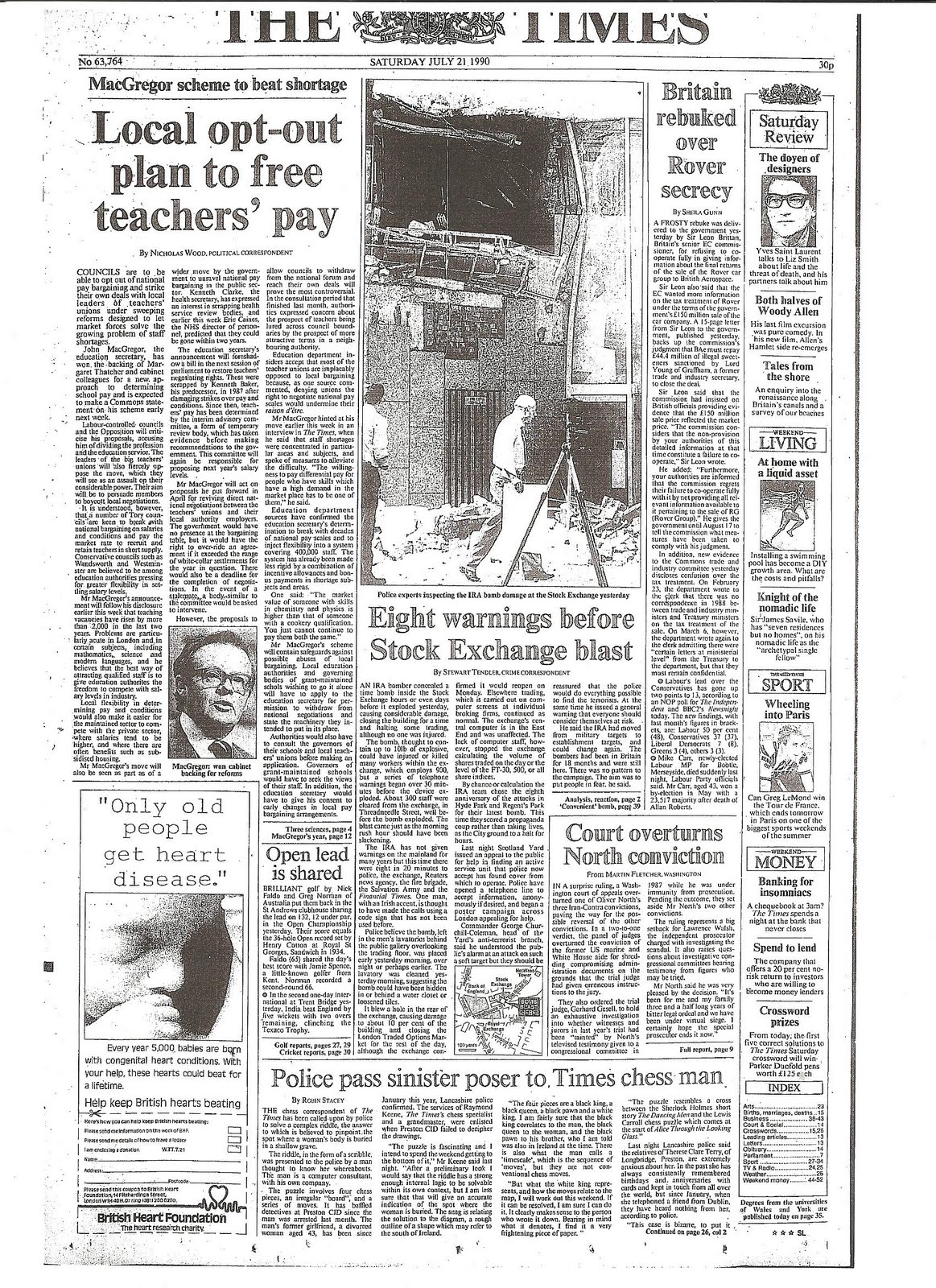
Let's take a trip back to the summer of 1990 where we'll find my occasional fellow blogger having just hit the high-water mark of a 2700+ elo equivalent career in personal publicity. Coincidentally or otherwise, he is also just a few months away from what will be his very lowest ebb (all that unpleasantness in The Sunday Times), but neither he, nor anybody else could have known it then.  As we join our friend Raymondo he is blissfully unaware of his fate and still basking in the aftermath of four consecutive frontpage appearances in The Times, a big article about him in The Sun and, aside from other coverage in Britain, dozens of appearances in newspapers and television programmes around the world.

As July turns into August Keene is truly a global phenomenon.  And why?  Because he has, as his own CV's sole entry for the year puts it,  "Dramatically solve[d] the Black Queen Murder Mystery for Lancashire Police".

Regular visitors to our humble blog may remember our post from last July which outlines the details of the case so we won't review the story again today.  Neither will we lose any time comparing what  RDK actually did with what he was supposed to have done.  That's a question we will return to on a later date (27th November, 2011 to be precise).

No, for now, all we need to know is that our man is enjoying coverage such as this,


click to enlarge; click again for a really close look
(and the same goes for all the images that follow)


this,


this,


this,


and this,


I thank the reader who kindly sent me this cutting


Keene, then, is surfing the wave of interest in him and, his involvement with the "sinister poser" now at an end, he begins to turn his mind to the question of what he might do next.

... the kind of brain that can play chess well in early youth is also supremely well equipped to act as a commentator, editor, thinker, about political, social, national and international issues.

he tells Cathy Forbes in an interview that will appear in the November 1990 edition of Chess Monthly (Vol. 55 No. 8). Does the erstwhile British under 18 Champion and World Junior silver medalist have anybody particular in mind? I'm afraid he seems to be too modest  to say.

The conversation moves swiftly on.  Might Mrs Thatcher employ a few chessers in her government? Yes, our man agrees, she should.


There are certain problems that a think-tank of Grandmasters might attack ...


Oh yes?


... like economics ...


Tell me more.


... trends in crime ...


Hmmm. Perhaps best not go there.


... global problems requiring strategic thinking ...


That sounds much more promising. Any particular area suggest itself to you?


... countering terrorism perhaps ....


Now you're talking. RDK going mano a mano with Osama bin Laden?  That's what the public want to see.  It would be like Ronnie Reagan's scrap with Chernenko in Frankie Goes to Hollywood's Two Tribes video.

How can we make this happen?


Grandmasters have pretty devious minds


So very true.

I'm not saying we'd come up with the right answers but I think such a team might well come up with interesting answers if asked by governments ....

So all that needs to happen is for a political leader to recognise RDK's mastery of The Vision Thing and we're in business?  Truly 1990 must have been a year for rejoicing and optimism.


Ask not what your country can do for chessers ...


Sadly, it is at precisely this point that we must return to our own time. On our arrival back home, and with the benefit of hindsight, we can only ignore naysayers who try to tell us that Raymondo might just have got a teensy bit carried away with himself and lament that Number Ten never made that call.

That's the trouble with being ahead of your time, though, isn't it?  The people around you aren't always ready to hear what you've got to say.  Still, Keene had seen the future, and if it didn't exactly work out swimmingly for Bankers Trust that was hardly his fault.  Twenty years on, is it too much to hope that the world might finally catch up with RDK?  How much longer, do you think, before Dave and Nick realise it's time to consult The Oracle?


Super Ray from comics.gearlive.com

Ray Keene Index

Saturday, March 05, 2011

Probably Got Nothing to do with chess VIII


... the stakes have never been higher. Agent Bowers is used to tracking the country's most dangerous killers, but now it looks like a killer is tracking him. When he realizes the murderer is using clues from an ancient manuscript as a blueprint for his crimes, Bowers faces a race against time to decipher who the next victim will be and to stop the final shocking murder - which he's beginning to believe might be his own.


Or so it says here.


Also by Steven James:
The Rook (Probably Got Nothing ... V)
The Pawn (Possibly Got Something)


... to do with chess Index


Friday, March 04, 2011

An Invitation To Benasque 2011

Poster posts poster in post

It's time for my annual invitation to play chess in the Spanish Pyrenees, at one of the strongest open tournaments in Spain.


Benasque, as it will not look in July

The tournament takes place from 7 to 16 July: entry will cost you 40€ (free to players with Elo above 2350, conditions available for titled players). For more information, the tournament page is here: click on FOLLETO OPEN 2011 (or here) for the tournament information leaflet.


That's more like it

The tournament takes place in the building at the bottom of the photo above. I look forward to seeing some of you there.

[Benasque in summer photo: University of Leeds, Quantum Information]

Wednesday, March 02, 2011

Get Yer Rogoff

Much later in my career, when I became Chief Economist at the International Monetary Fund, I again found chess very useful.

Ken Rogoff, interview in New In Chess 2011/1, p. 33

The IMF attack gave those who were there a chance to see firsthand the IMF's arrogance and disdain for people who disagree with its perspectives. The IMF's unwillingness to engage in meaningful discussions is something many people in developing countries have seen. For those involved in making the arrangements for the forum - in which the IMF had repeatedly given the assurance that it was to be a discussion of substance - it provided another instance of that institution's duplicity. So did its approach to the press: after asking that the discussion be off the record (I believe that such meetings should be on the record, but in the hope that it might facilitate greater openness, I deferred to their conditions), the minute the session was over, the IMF faxed and e-mailed the remarks of their chief economist, Kenneth Rogoff, to the press. They chose to include neither my remarks, those of the World Bank's chief economist, nor those of the commentators who followed. Rogoff's remarks were described by the IMF as an "open letter", which was itself a sham: the letter was certainly never received by me and almost surely was never sent to me.

Joseph Stiglitz, Globalization And Its Discontents, Afterword to the Penguin Edition, Penguin, 2003, p. 272-3.

It was Denis Healey who once likened being attacked by Geoffrey Howe to being savaged by a dead sheep. I often feel the same about Dirk Jan ten Geuzendam's interviews, which occasionally stray closer to "O Great One, tell us what makes you so great" than one might like. One such occasion was the interview with Ken Rogoff in the latest New In Chess.

It's some years since I saw JFK, but I have a recollection of Kevin Costner, as Jim Garrison, reading the Report of the Warren Commssion and saying to himself "ask the question! ask the question!" whenever something that should have been challenged goes unchallenged. Reading Dirk's Rogoff interview was something like that.

Ask the question, Dirk!

Actually, reading anything by Dirk is something like that: you could write a piece like this about almost any interview of his. Rare is the answer that fails to stroll, unmolested, past Dirk's respectful baa.

It's not as if an interview has to be an interrogation: it's just that when an interviewee's answers beg a further question, it's going to be a better, more searching interview if you ask it. So, for instance, when Rogoff tells Dirk:
there's an area of economics called game theory, and some of my work makes use of it.
This, of course, is true. But it like game theory itself, it's not so simple: one's inner Costner starts muttering "ask the question!". What sort of question? Perhaps something like this:
"Is that actually a good thing? Isn't there a strong critique of modern economics which criticises the influence of game theory? Not least because it it's alleged to have led to a over-reliance on theoretical, rather than real-life models of economic behaviour?"
Rogoff might well have replied "no, I don't think so". Or he might have said "yes, but I don't agree". Or he might have offered us some kind of "maybe". The precise answer is not the point. The point is that at least the question would have been asked.

As it might have been a short while later, when Rogoff says:
I also do a lot of work on financial crises and that too involves game theory. Because when countries default on their debt, it's almost never because they can't repay it, it's because they don't feel like it.
Well, maybe. But I cannot have been the only reader to have wondered which countries Rogoff was thinking of. Or what exactly he meant by "can't" - and for that matter, by "don't feel like it". (Or, indeed, if Rogoff knew what he sounded like when he talked like that. He reminded me of the time I was in a pub with a chap from the IMF who described Albanians as "the most ungrateful people in Europe". But I digress. Or perhaps I don't.) Dirk, however, didn't wonder. He doesn't wonder often.

Now at this point you might be inclined to defend Dirk, on at least three possible grounds. One, that Dirk is not understood to be knowledgeable about economics, and hence couldn't reasonably be expected to know what, in Rogoff's answers, might have invited a second bite. Two, that it might not actually be Dirk's job to do this - that there's different ways of interviewing a subject, not all of them resembling an interrogation, and it might not be such a bad thing to ask some questions and let the interviewee set out his stall. Three, that New In Chess is a chess magazine, and discussing controversies in economics is not its primary job.

Don't ask me!

Which would be fair observations - up to a point. But there's another view, which is that if an interviewer doesn't ask the questions that occur to the moderately knowledgeable reader, then the reader is surely not going to be well served by the interview. An interview is not a questionnaire: some answers do need to be followed up, to flesh out the subject's opinion as well as to satisfy the attentive reader. Dirk may be easily satisfied, but his readers, perhaps less so.

But as for Dirk's knowledge of economics - the introduction to the interview (which, as Editor-in-Chief, we can assume Dirk either wrote, or approved) reads, in part, like this.
His recent bestseller,This Time Is Different: Eight Centuries of Financial Folly....makes it clear why Rogoff is consulted by political leaders and policy makers all over the world.
To my eyes, it's hard to see how it could "make it clear" unless Dirk had read the book and been impressed by its learning and analysis. Now this judgement wouldn't be worth very much, unless Dirk has at least a layman's knowledge of the subject area with which it deals - otherwise, on what basis is he impressed? (Of course it's possible that Dirk either hasn't read it, or has read it but doesn't know enough to judge whether it's good or bad, and the comment is in fact no more than a genuflection. But I would hope we can rule out both possibilities.)

As far as whether or not readers of a chess magazine are interested in economics per se, one answer is that if we're not, why is Rogoff being asked about it in the first place? But more than it's possible that these questions might still interest us, precisely because Rogoff's invocation of game theory, and his insistence of the insincerity of debt default, are linked, by Rogoff himself, to his experience as a chess player.

So possibly a more assiduous interviewer, if we can imagine such a person, might have used the opportunity to turn some assumptions on their head. They might have asked whether a background in chess might be altogether a good thing, whether it might bring with it handicaps as well as advantages, whether it might bring a problematic perspective rather than a beneficial one, whether it encourages people to think in terms of games and strategies rather than in terms of people and the effect on them of IMF recovery programmes. That might have been interesting: it might have been a fruitful discussion. But Dirk lets it pass, and misses the opportunity.

He also lets pass the major controversy of Ken Rogoff's career, the one to which the quote from Joseph Stiglitz, above, refers. Stiglitz, holder of a Nobel Prize for Economics, wrote a powerful critique of the International Monetary Fund, attacking its policies and modus operandi in a number of countries, but particularly Russia. I refer the interested reader to his book, but a summary might be: the IMF go to a country, stay in the most expensive hotels, operate in conditions of secrecy, treat with contempt local knowledge, experience, opinion and conditions, impose the same one-size-fits-all package on that country that they favour everywhere else, cause great damage in doing so, and then treat critics with arrogance and contempt.

Now it would be unfair to Rogoff, and for that matter to Stiglitz, to characterise Stiglitz's attack as being one on Rogoff personally, rather than the institution which he served as Chief Economist. Moreover Rogoff was actually prepared to debate openly with Stiglitz, rather than behave as the IMF had done. Nevertheless it was an attack on an institution to which Rogoff's contribution was a central one, and hence a crucial moment in Rogoff's career, if not a career-defining one. Either Dirk doesn't know about it, in which case he should, or he does, but chooses to let it go unmentioned. Which is a bit like interviewing Tony Blair without mentioning Iraq.

Dirk at work

The point I'm trying to make is that if you're going to interview somebody, even on a subject outside chess, and they say things like
I like to study the international financial crises, I don't like to cause them
then the response "but didn't Joseph Stiglitz accuse you of doing very much that?" is pretty much called for - if you're seeking to provide the public with a proper interview. Similarly, if Rogoff says
there are certainly principles we have that we know, and economics is always advancing
you really want somebody to say "but didn't mainstream economics just suffer an enormous intellectual and practical disaster? Isn't that widely agreed to have been down to 'groupthink'? Wasn't that groupthink very much the assumption by everybody concerned that they "knew" certain principles? Wasn't in fact Ken Rogoff's old employer very much guilty in precisely that way?"

You want somebody to say this, because those are things that a well-informed reader must be thinking. Or, if they're not thinking them (or you don't think they are, because this is a chess magazine) then, again, one asks - why, actually, in a chess magazine, are you asking an economist questions about economics?

The thing is, New In Chess, as far as its interviews are concerned, is no better than Hello! magazine, possessing neither the capacity nor the will to do anything quite so daring as ask a difficult question. But if you're not going to ask properly, why ask at all? What is the point of asking people about their careers without even mentioning the controversies in which they have been involved, or of inviting them to comment on a subject and then moving on whenever they say something that's problematic - which is to say, whenever they say something that's genuinely interesting? Nobody's expecting blood on the carpet, but is there really no middle ground between that, and rolling out the red carpet like Dirk does?

I could probably choose almost any Dirk Jan ten Geuzendam interview to make this point. It happened to be this one that caught my eye, probably because (as will be obvious) I don't like Kenneth Rogoff or the IMF very much, and because I happen to know just enough - not a vast amount, but just enough - about the subjects involved to know where some follow-up questions could usefully have been asked. But Dirk Jan ten Geuzendam won't ever ask them. I like his magazine, much of the time, but he's not so much an interviewer as a courtier, and all he's really interested in doing is asking chess celebrities to show us round their homes, their trophy cabinets and their wonderful intellects, and inviting the rest of us to gawp at how clever and wonderful and rich they are.

There's a particularly dim example of the practice quite early in the interview, where Dirk invokes the American bank Bankers Trust, which, Dirk says
"tried to recruit employees among chess grandmasters"
and even put
"adverts on the back cover of New In Chess aimed specifically (at) top-level players.
"Wow", says Rogoff. Dirk continues:
"Would you say this was a successful campaign?"
Well it depends on what you mean by "successful", Dirk, or put another way, "successful for who?".

The thing about Bankers Trust, you see, is that they fulfilled the first half of their name rather more completely than the second, as the relevant sections in the Wikipedia entry tell us. These are not difficult to look up, though it's too difficult for Dirk Jan ten Geuzendam. Though he might not know that something bad happened at Bankers Trust. In which case, for somebody who's asking questions about them, he doesn't know very much.

What precisely happened at Bankers Trust remains unclear to this day: murky, might be another word for it. What is reasonably clear is that it some of the themes (notably impenetrably-complex trading in derivatives) which were later to be crucial to the crash of 2008, were played out at Bankers Trust a decade and a half earlier.

These things may be too complex for most of us to fully understand, let alone to satisfactorily summarise or paraphrase. Still, the matter is simply and abruptly put by Karen Ho. ("Situating Global Capitalisms: A view from Wall Street Investment Banks", in Inda and Rosaldo, "The Anthropology Of Globalization: A Reader", Wiley-Blackwell, 2008, p.147.)
At the height of its success, it was caught swindling Proctor and Gamble, one of its corporate clients.
So, Dirk and Rogoff are discussing Bankers Trust, and their recruitment of chessplayers, without either of them alluding to the fact that shortly after this occurred, the bank involved found themselves on the wrong end of racketeering charges as the result of a major fraud.

Now nobody has suggested that the former chessplayers were involved in the fraud. But they might very well suggest that given the nature of the fraud (in part, the construction of instruments too complex for the clients to understand) it is at very least tendentious to discuss the bank's recruiting policy, during that very era, without asking whether the bank were, actually, looking for the right people, for the right reasons.

But Dirk doesn't give a stuff about this: all he cares about is that they were recruiting chessplayers, in New In Chess. So they must be brilliant.

Dirk might at least have the excuse of ignorance. Rogoff, however, does not: he knows what went on at Bankers Trust and what that organisation's business ethics were like in the early Nineties. But he - the great Ken Rogoff, this great and influential economist - has nothing more searching to say than "wow".

Which - like the interview itself - is a very long way away from good enough.


[Rogoff picture: Pasívne Investovanie.]
[Dirk picture: Chessbase]

[Thanks to Matthew Turner - not the GM! - and Andrew McGettigan.]

Monday, February 28, 2011

This is the end II


JB v A.N. Other, January 2011

HIM: "Draw?" 

It wasn't an unreasonable offer from Black.  His flag was hanging and the position which we'd reached was, after all, drawn.

ME: "Let's play it out."

Usually I'd have agreed to split the point straight away, but this was the last round of the tournament and ours was the only game still to finish.  The final game of the final round going all the way to stalemate seemed rather appealing from an aesthetic point of view so I decided to play it all the way to the end.  As it happens, though, and somewhat to my embarrassment, the game did not in fact finish in a draw.  I hadn't even remotely been trying to win, and yet win I did.

I think I'll be playing this ending out next time, draw offer or not!  Anyhoo, this game, played just three days after the ending that I'd seen at Golders Green which had inspired the original post in this series, rather goes to show that I'm not the only one who can manage to come up short when only rather basic endgame technique is required.


Desperately in need of some stranger's hand


Was our man (rated in the 170s ECF - that's 2000+ elo equivalent) unlucky?  Yes, absolutely.  Rushing to beat the fall of his flag, and at the end of a long night, he simply put his king on the wrong square when faced with a choice of two.  In the heat of battle it could have happened to anybody.

On the other hand, as Jesus de la Villa writes in the introduction to his book,


... if you intend to reach a certain rating, I will not say that a good command of the endgame is essential ...

Nevertheless,

...if you neglect this part of the game, many half points, or even full points, will now and then elude you.

pdf sample from 100 Endgames You Must Know


Or, to put it another way, it's not enough to know that the position at the head of today's blog is drawn.  We must also know how to draw it and be able to put that knowledge into practice when the time comes.  Perhaps, then, it would be more accurate to say that when we end up losing positions such as these it is partly due to bad luck and partly what we call 'playing chess'.

So we can conclude that these basic, easily studied, positions deserve our respect and attention?  OK, but which are the fundamental positions that we need to know if we are to avoid coming a cropper?  I guess Jesus de la Villa gives one answer to that one, but since I haven't read his book I've had to make up my own - much shorter - list.

I wonder who amongst our esteemed readership,
(a) knows the theoretical evaluation of each position;
(b) knows how to proceed;
(c) has had such a position before in a game (blitz/rapidplay/otb/correspondence) before? 
Personally, I can say yes to (a) for most of the 19 but, the king and pawn positions aside, I do considerably less well with (b). I guess, then, I've got a bit of work to do or I'm going to end up rather embarrassed should I start get to say 'yes' a few more times for (c).


1


2


3

White to play


4

Black to play


5

White to play


6

Black to play


7


8

White to play


9

White to play


10


11


12


13


14

White to play


15

Black to play


16

White to play


17


18

White to play


19

White to play


Positions taken from/inspired by:-
Bruce Pandolfini: Pandolfini's Endgame Course
John Emms: The Survival Guide to Rook Endings
Ian Mullen et al: Master Chess: A Course in 21 Lessons


Previously:-
This is the end