Saturday, July 21, 2012

A Literary Reference : Z For Zachariah


Suddenly I had a feeling he knew I was watching. Or, worse, that he hoped I was. Along with it came another feeling which made me slightly sick again: that I was in a game of move-counter-move, like a chess game, a game I did not want to be in at all. Only Mr Loomis wanted to be in it, and only he could win it.

...

Yet there was one thing that was on my side. I remember when I was a little girl, on Sunday afternoons my father and I would sit at the kitchen table playing chess. Usually my father won: he had been playing the game for many years, and had the benefit of experience. But there were a few times when I mounted an attack in such a way that every move my father made was in his own defence, so that he did not have time to effect any organized plan against me. My father called this 'taking the offensive', and he said it was the way to win. It seemed to me that in my relationship with Mr Loomis I had finally reached the point where I could 'take the offensive'. I had caught him off guard, and frightened him. I had to take advantage of that.

Robert O'Brien, Z For Zachariah, Fontana Lions, 1976. p.140-1, p.180. (Original date of publication 1975.)

[A Literary Reference index]

Friday, July 20, 2012

Sixty Memorable Annotations

#8: The Dutch Defence


If you play the Dutch you have to accept the element of risk. Some years ago I heard a young player moaning to British GM Jonathan Mestel that he had played the risky Sicilian Dragon and been wiped off the board. Mestel, himself a Dragon aficionado replied calmly ‘think of all the draws you have avoided by playing the Dragon’

Neil McDonald, Starting Out: The Dutch Defence (Everyman Chess 2004)


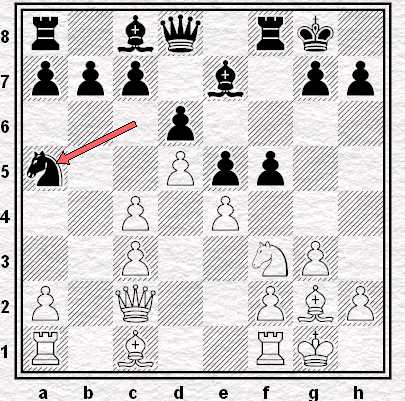
I've been playing 1 ... f5 as my answer to queen's pawn openings for about four-and-a-half years now, but never has Neil McDonald's warning to prospective Dutch Defenders meant more to me than it did in Penarth. In South Wales I had a complete crisis of faith. What the hell was I doing playing such trash?


A fine place to jettison chess books on ropey openings


It all started well enough. Little more than ten minutes after the start of the first round I was playing 11 ... Na5 and reaching a position from which I had previously scored +2 =0 -0. I won it in Penarth too, although certainly not because of the opening (some time in the future we shall be debating whether or not I was lucky) but, still, a point is a point and it's always pleasant to kick-off a tournament on familiar ground.

In the middle rounds, though, the wheels came well and truly off. I've faced 1 d4 e6, 2 Nf3 f5 dozens of times so I was happy enough when Jeremy Menadue played it against me on Tuesday afternoon. And yet just six (yes six, that's not a typo) moves later, White was ready to throw the knock-out punch.


White to play and win


I was only marginally less incompetent two games later when I 'achieved' this position against Tom Brown after 16 moves.


Black to play and lose


Time to go back to the Queen's Gambit Declined where I belong?


I'd lost with the Dutch before, of course, any number of times. To be so quickly and comprehensively clattered in back-to-back games, however? That sort of thing is enough to make you want to stop playing even your most favourite opening. In fact, I did pack it in. Not for long. Just for one night. Just for long enough to remember that McDonald quote, in fact.


Sixty Memorable Annotations Index

Wednesday, July 18, 2012

Sixty Memorable Annotations

#7: Shliperman - Yermolinsky, Philadelphia 1997


4 Nbd2

This is probably the best move in the position if you are of equal strength to your opponent but ... it is often in the stronger player's interest to exchange bishop for knight ....

Jacob Aagaard, Excelling at Chess (Everyman Chess 2001)


Today is Wednesday. I mention that as a service for anybody who happens to be playing in a chess tournament and who therefore, if my experience is anything to go by at least, might not have known.

This time last week EJH, Angus French and I were in Penarth and up to our necks in the South Wales International. Just like Benasque a year ago, I lost the ability to recall the day of the week pretty much from the pushing of the first pawn. Occasionally I found myself thinking something like, "Well, we arrived on Friday and the next day I played him and him and the day afterwards it was that guy so today must be ....", but mostly I didn't even bother with that. There didn't seem much point really.

Time disorientation notwithstanding, it was a highly enjoyable week, not to mention a rich source of material for chess bloggers. No doubt EJH will be along shortly with his traditional ... against the grandmasters post. Usually this is an event for which I can do nothing more than spectate from the sidelines and feel envious, but at Penarth, thanks to a pairing system I do not pretend to understand and a first round victory against a guy rated roughly equivalent to 140 ECF, I finally got to play my first ever game against one of the game's bigger cheeses.

Round 2, 5:30pm Saturday 8th of July
JMGB (1908) v Marijan Petrov (GM, 2522)

A pairing, I rather suspect, that will live a shade longer in my memory than it will in his.


A fine place for a pre-game cup of tea


"Someone who isn't a strong chessplayer will lack the feel for when bishop takes knight is the correct decision", Phil wrote on Monday. It's hard not to agree, especially if, as Aagaard believes, the definition of 'correct' varies according to who is playing.

The Vowelled One's idea - he attributes the original thought to Smyslov - is simply that,

when the pieces in the two armies have different properties the outcome is less likely to be a draw.

so for him, it doesn't have to be BxN. The other way around would be just as good.

NxB is much easier to understand, though, isn't it? That way you unbalance the game and get the bishop pair. Bishop takes knight, however? That's a completely different kettle of minor pieces.


Marijan Petrov:
Not thought to have been bricking it prior to the commencement of round 2


Of course, regardless of who is playing, the inherent superiority of bishop over knight is one of those 'rules' the existence or otherwise of which sparked a falling-out between Aagaard and Watson a few years back. These days, could we even talk of a mini-fashion for playing BxN early doors in chess games? I'm not so sure, although I do know that,

  • in this month's New in Chess Peter Heine Nielsen points out that his boss handed Gelfand the bishop pair in more than half the games of their World Championship match, often, if not always, for "structural compensation";
  • when Black was by far the stronger player and had the chance to bust up White's pawns, it took him no more than a second to decide on ... Bxc3+ here:-


Either way, we have reached the boundaries of your humble scribe's technical competence and it's probably best that we move on. If the fact that I ended my twenty-five year wait to play one-on-one with a grandmaster is a good thing, I'm afraid our Penarth Diaries must continue on Friday with games that are both bad and ugly. I should warn readers of a squeamish disposition that they may wish to stay away at least until the weekend.

As for the result of my game with Petrov, well, formally you'll have to wait for Justin's post for that. Let's be honest, though. If the game had ended with any result other than the thousand-to-one-odds-on one, do you really think I'd not have mentioned it before now???


Sixty Memorable Annotations Index

Monday, July 16, 2012

Chess Is Like... Tennis?

'[Murray] and Federer are in love with the art of the rally. They adore long, subtle, clever points, prolonged discussion, the searching out of weaknesses and then the kill-shot or the shot that draws the error. Sometimes I felt as if my notes should not "forehand down line" but "bishop takes knight".'

Simon Barnes, The Times, 09/07/2012


Simon Barnes is my favourite sports writer. He writes about the human side of sport and isn't afraid to reference anything, from Keats to Duran Duran, or Star Trek to the Somme. You know, as long as it's relevant. He's who I aspire to in my nonsense on these pages and others; you won't find much raw chess analysis in my material, that's for sure. I leave that to the professionals.

A few years ago, he wrote a wonderful piece detailing exactly why he considered chess not to be a sport. It was wonderful precisely because it was also an impassioned defence of the game, contrary to many of the thoughtless and derogatory detractors of the argument that are perpetually receiving copy. For now, the article appears to be behind The Times' paywall, but I'll find an archive print copy and properly address it soon.

A recent return to the issue would suggest that chess is indeed a sport. After all, how many ridiculous and magnificent time scrambles have occurred at the top level? Please don't tell me that this crescendo from Karpov - Kasparov '87 doesn't qualify.


Returning to the opening quote, I've spent all week trying to work out if the analogy makes sense. It sounds almost Orwellian. Or Rowsonian, depending on your background. And, if he means what I think he means, I don't think he goes far enough. Though I suppose it's sufficient for a non-chess playing audience. 

It must have something to do with what he says later on:

'Small margins, small margins, but that's the way it is when you play sport at this dizzying level of brilliance.'

I think he's arguing that it's unimportant for us to understand exactly why somebody has won, just as long as we can follow the ebb and flow. It's more akin to an emotional involvement, something that the Wimbledon final undoubtedly offered.

Someone who isn't a strong chessplayer will lack the feel for when bishop takes knight is the correct decision. Just like how someone who isn't a proficient tennis player won't know when a forehand down the line is the value shot. But everyone can see the eventual result and respond to it. It's the result that will live long in the memory, not the detail.


Chess Is Like... Index

Saturday, July 14, 2012

Saturday puzzle


White to play and mate in two


Here's a puzzle for you this weekend: I came across it some weeks ago when somebody, not a regular player, mentioned on Facebook that they'd got this puzzle they couldn't solve.

If I can solve it, which I did, then so can you. Answers in the comments box, and no computers please. But once you've solved it, if you have a database that'll tell us the composer and origin, do tell us.

[Thanks to Chris Fyfe]

Friday, July 13, 2012

Once was enough VI : Marshall Attack


1.e4 e5 2.Nf3 Nc6 3.Bb5 a6 4.Ba4 Nf6 5.O-O Be7 6.Re1 b5 7.Bb3 O-O 8.c3 d5

The Marshall Attack. Very big deal in English chess in the 1990s. Nigel Short would have played it against Kasparov, if Kasparov had let him. Michael Adams became - and possibly, remains - the all-time world authority on the opening.

In fact it was such a big deal I even played it myself. Once. Some distance from the standards of Short and Adams, I confess: it was in the first leg of a county championship quarter-final, a tie in which I was the favourite but nevertheless lost. Naturally, I blamed the opening, or at least my choice to play it, which, as we will see, was true up to a point. Even if it was not the entire truth.


Second leg: White to play and draw

WHY I PLAYED IT:

Until 1994, I'd generally been playing the openings I remembered from my schooldays, mostly the Scheveningen with the occasional Petroff thrown in against stronger players. But at some point that year I lost confidence in all of this, stopped playing the Sicilian, stopped playing the Petroff - for that matter, I also stopped playing 1.e4, which I've never gone back to - and started looking around for a Lopez that would work. It took me about ten years.

In fact I started by playing the Fianchetto, 3...g6 (a line I found in Ray's The Openings In Modern Theory And Practice, which I happen to have seen again, and bought secondhand, just this week) and played against Harriet Hunt. That game that ended in a fairly short draw, with Harriet, on receiving my offer, accepting and then saying "but aren't you doing rather well?". Despite this promising start I decided (with reason - 4.d4 exd4 5.Bg5!) that it probably wouldn't stand the test of time. Matter of fact it'd be appearing in this series if I hadn't played it once more, in 1997, on a whim.

So I had to find another Lopez, and I found the Marshall. It took me quite a long time to get round to playing it, because at club level, 1.e4 e5 doesn't often get you the Lopez, and even when it does, it doesn't often get you the main lines. It was my ninth 1.e4 e5 since playing Harriet before I got as far as 7...O-O and even then (against, coincidence fans, Adam Hunt) I got an Anti-Marshall instead. All told it took seventeen open games, two years and eight days to get myself an actual Marshall. Beware of getting what you want, because once I did, I was lost, in one sense or another, as soon as we were out of theory.

In some ways, I think it's ideal: instead of tough defence, which is almost always the way Black has it in the Lopez, Black attacks. It's quite a scary position for White after 17 moves or so, with all of Black's pieces piling in against the kingside. Easy to see how attractive it is. You look at the positions, they feel good.

WHERE I FOUND IT:

That's easily established: there's only one Marshall book on my shelves, and that's the one by Nunn and Harding, published by Batsford in 1989 towards the end of the best years of that publishing house, as least as far as chess is concerned.


My copy has a Chess Direct label inside, though I'm sure I actually got it cheap and secondhand, probably at one of the rapidplays that used to run at Imperial College London.

WHY I STOPPED PLAYING IT:

I was put off not just by losing, but the way in which I lost: I didn't really seem to understand what was going on. In fact I still don't.

We'd followed theory, by which I meant something I could find in the Nunn/Harding book, until Black's 21st.


In this position, in the year of the book's publication, Andrei Sokolov had played 22.Qxd5 against John Nunn in Rotterdam. He didn't choose to play 22.fxg5, nor did either Nunn or Harding choose to analyse it in the subsequent book. But White did against me, and it looks just as reasonable to me now, with more than twenty years elapsed and all the time I want to look at it on a computer, as it did back then.

Where there's an obvious capture, that appears to win a pawn, and the book doesn't say anything about it, you'd assume you were missing something: something, now, that a computer would find for you, but something even back then that you could work out easily enough. But I couldn't work it out then and the computer can't work it out now.

So what's Black got? Obviously he shouldn't have continued 22...f4? - though it's an idea which obviously comes to mind, since what else has Black gained from White's f-pawn moving? - as 23.Bxf4 just seems to leave White two pawns up and Black with no attacking chances, but the alternative 22...Rxe3 just transposes into the game after 23.Rxe3 f4 24.gxf4 Bxf4 25.Rg3, as after 24.Qxd5 fxe3 25.Qxd6 Rf2! looks to be enough for a draw. Not that I saw that at the time, mind.


My great old Russian 1.e4 e5 Encyclopaedia throws in the suggestion 22...Re4!? but I'm not about to believe that one either, so until somebody puts me right I'm inclined to think Black had no better than to play into the game continuation, which looks forced, for Black at any rate, until 28.dxe5.


I thought Black might just scrape a draw here if he was lucky (and if I'd played 33...Bg6, which White had luckily allowed me, I might well have got it). But the whole experience put me off. Not going wrong once out of theory, but having no clue and being given no clue how I could have done better. Put me off irrevocably. And probably rightly.

Six months later I had my next 1.e4 e5 and by then, thanks not least to Mikhail Yudovich,


I was playing the Berlin Classical with 2.Nf3 Nc6 3.Bb5 Nf6 4.O-O Bc5. That didn't last for very long either. But I had a lot more fun playing it.

CHANCES OF MY PLAYING IT AGAIN:

Nil. It's just not suitable.

Not because of that one defeat. (I said above that I gave up 1.e4 around then. I lost the first three games I played with 1.c4, its replacement.) Nor because of that one variation. Theory changes. Nor even because I prefer (from Black's perspective) the sidelines that White can play against 7...d6 to those which he has in the various Anti-Marshalls.

But it was obvious to me, struggling without the slightest success to see what I might have done better, that I was out of my depth. I just didn't understand what was going on.

But I was also out of my depth in terms of the sheer amount of analysis that seemed to be involved. There's lots and lots and lots of it.

Of course there is in many openings, or arguably in any opening if it becomes popular enough. (In 1996 there wasn't too much theory in the Berlin Wall. That's far from the case now.) But in some openings - the Najdorf and others come to mind - it's more crucial than it is in others. The Marshall is, I think, one of these.

Thing is, too, you're only ever likely to get to employ that analysis against players who know it better than you. Everybody else avoids it. (Think of those seventeen games with 1.e4 e5 that went by before I actually got the chance to play it.) And it's an unhappy fact that too many of those long and complicated lines end in draws. Which to me, means it's an opening for professionals. Players who are not just in a position to learn large amounts of analysis (and are capable of doing so, and retaining it, and for that matter working on it and improving it) but who are happy to do so if a forced draw lies at the end of it.

But not at club level. You can play drawing lines and you can play highly-theoretical lines, but you don't really want to play something that's both. Nor do you want to play twenty moves of theory, and then find yourself lost almost straight away. Why not just cut out the twenty moves?

All too difficult on several fronts. Wrong opening for the wrong player. Never again.


[Once was enough index]

Wednesday, July 11, 2012

Set In Stone

On Saturday, Middlesex won the English County Championship for the 29th time. Here's Streatham club member Andrew Stone posing with the Lowenthal Trophy.


A behemoth of a structure. And a trophy.


Worryingly, that's not his hand on the adjacent beer. That belongs to Nevil Chan, who was forced to sit on the floor after losing his individual game. Fortunately, it was irrelevant to the match score.

But yet I wasn't there for this momentous occasion. In May I briefly elaborated on how I was streamlining my chess playing and, on this occasion, I did indeed choose Middlesex League cricket over playing the final in Leicester.


 Like Andrew, nurdling my way to (the) point.


However, that's not why I didn't play.

At about 9:20am one sunny Thursday morning, I got on a bus at Baker Street station. Within half an hour it was no longer a bus. Seven years later, I still wouldn't have been in the right frame of mind to play in such an important match.

Remember the date. Remember the 52.


Monday, July 09, 2012

PJM's Favourite Moves II

I had a particularly chessy summer in 2011. The Czech Open led into Dublin, but it was the Big Slick IM Norm event that kicked it all off, finishing on the Sunday of the Wimbledon final. The previous Tuesday, the venue in Croydon, not far from SW19, had some teething problems with their roofing and Round 4 was halted. It was Ladies' Quarter-Final day and you can read some weathered hyperbole about it here


As you can see, Dave Ledger and Keith Arkell decided to continue playing outside. Everyone else either had a little break or tried to bail out the casino, with little success.

I'd survived the worst against Bob Eames but still had a scary position.


 25... Na8


Obviously, there's nothing else. But playing such a ridiculous forced move after an hour's interruption took the edge off its psychological impact, especially given I'd mainly been worrying about the structural integrity of the playing hall. And I'm no architect. 

The break had cleansed me of my negative mindset and deprived Bob of his positive one. He now erred with 26. e6? and my h pawn proved decisive shortly afterwards.

A heavy rain shower has altered many a sporting contest, from Interlagos 2008 to Donetsk 2012. But I bet it hasn't happened much in the world of international chess.


 Ledger - Arkell photo by Simon Williams (www.gingergm.com)

Friday, July 06, 2012

Something's gone wrong again

The game is over and it's Kirsan, unfortunately, who won.


I don't propose to drone on about the case again. I've said what I've got to say more than once.

I don't even propose to discuss the merits of the case. I'm fairly sure I've not said anything about that either way until now - certainly that has been my intention - so I don't intend to make any comment now, other than to observe that to bring a case that fails in part because it is deemed not to have been submitted in time is disappointing in more senses than one.

There is a view that to pursue this case wasn't really something that fell within the objects of the organisation as set out by the Memorandum and Articles. Maybe so, and I've not seen the argument properly rebutted. However, I have not made it, so again, I won't make it here. What I will say is that if I were ever to be persuaded that the real purpose of the action was simply to bleed FIDE of money, as some have alleged, then I would take a very hostile view of the action and the people involved.

Out in the cold, or should be

So, very briefly to reiterate, my objection has always been, largely, to the secretive - and in some ways deceptive - way in which the action was organised, an approach which was not only wrong in principle, but had the effect of arousing hostility among those from whom the campaigners should have been seeking support.

As it is, the action now lacks even the justification that at least they won. Instead we have a campaign that looks more like a cock-up from start to finish - and not even an honest cock-up at that.

Never again, that's clear: the ECF should not be involved in this kind of thing in the future. In the meantime, two things.

  • We must have an immediate statement from the ECF assuring us that costs will be met by other parties, as we have been assured they would.
  • There should, regrettably, be resignations among those who were most central to this farce and hence are most responsible for it.

I am thinking specifically of the ECF President, CJ de Mooi, and the FIDE Delegate, Nigel Short.

[CJ index]
[Nigel Short index]

[Short image via]

Wednesday, July 04, 2012

What a coup

The final stage of the National Schools Championships takes place tomorrow and Friday. Takes me back. My school used to play in it.

I went to St Michael's, in Stevenage, a comprehensive albeit a somewhat unusual one, being a Catholic boys' school which took pupils from across North Hertfordshire. As is nearly always the case, the school was interested in chess because there happened to be a teacher who liked to play, in this instance Ron Hollins, who was Head of Maths.


St Mick's

We didn't play a lot of serious chess before 1979, by which time I was in my fourth year, though we did have a lunchtime chess club. But by then several players had come to St Michael's from the same primary school in Royston, which also happened to have a teacher keen on chess. (He organised the Bill Hartston simultaneous mentioned here.)

There were four of them. There was me. And my brother arrived, which made six, enough for a team in the the National Schools Championships, which we therefore entered. As far as I recall the existence of the competition had previously been entirely unknown to me.

If we knew little about it, we expected not much more. We were a very young team - I was the oldest, and only fourteen at that. However, this turned out to be to our advantage, since an age-handicapping system was in place, meaning that a much younger team could lose narrowly to a much older one, and still go through.

So off we went, average age maybe twelve, seeing how we got on against the big boys, though our first match was actually against the primary school that most of my teammates had attended. Our second was against the B team of Bedford Modern, alma mater of Monty Panesar and others. My opponent was graded 109 which doesn't sound much but, in retrospect, can't have been too shabby for board two or three of a school B team. My grade back then eludes me, but whatever it was, I won, and we progressed. We then played a school called Holy Trinity, which I would link to if I had a clue which of the many schools of that name it actually was. Wherever it was, or is, we got through that as well, and then played Bedford Modern's A team.

My distinct memory of our visit to that school is of seeing a notice advertising photos of the First XI's recent trip to the West Indies. Their chess team were no slouches, either, and this time my opponent, one Potter, was graded 148. I note that my game was adjudicated a draw and that, amusingly, I wrote the moves in green ink. My obsessiveness doesn't seem to have extended to actually recording the opponent's initial, or the match result, but we must have scored enough points to get through, since we met Netherhall in the regional final. I drew again, but this time recorded the result. 4-2 to us, "with age 4½-1½" - and we were in the national stages, the last 32.

There we played Guthlaxton College (Garner, 123) and although once again I don't have the match score, I believe we won easily enough. (I played the Sokolsky, which I had only just taken up but which served me rather well for about a year, before I realised it probably wasn't much good.)

Not everything in those days was produced to Batsford standards

That put us through to the last 16, where we were drawn against rather tougher opposition: the reigning champions, St Paul's. I see that they'd beaten Bolton School in the final, which presumably involved a top board meeting between England's two strongest juniors, since Bolton had a young Nigel Short playing for them, while St Paul's had Julian Hodgson.


Nigel and Julian on the same side of the table

So the winnners in three out the last four years came to our school, in our very first year of competition. We played them in the library. Hodgson had the black pieces and our top board, Michael Leahy, played 1.d4. Then followed 1...d6 2.c4 e5 and after 3.dxe5 dxe5 4.Qxd8+ Kxd8 Michael lost quite easily without, I think, ever really understanding what he'd done wrong.

Our second board, though, Robert Lee, got what must have been a very creditable draw. On boards three to six we had two sets of brothers. On four and five, Peter and Paul Sanders, who both lost. On three and six, we had respectively me, and my brother.

I can't claim to remember in which order the games finished, but if you've been counting, you'll have noticed that we'd scored one draw from four games. Hence the best we could do was a score of 2½-3½. But you'll also remember that there was an age handicap, which meant that we only needed those 2½ points to go through. On board six, my brother won his game. Did his, or our second board's, finish before mine? I don't recall. But I recall winning my game.


Of course I should never have got away with that one - when he played the disastrous 25...Re6?? he had forty minutes left to my two as well as a winning position - and there were further blunders on both sides after that. But I did. I got away with quite a lot, and then he threw his queen at me. My last move before the time control was queen takes queen. And after that it was over.

We did it. We took on the multiple champions, one of the top public schools in the country, and we put them out of the competition. I can still recall a physics teacher, a Maltese called Joe Camilleri, next day, calling it "a coup". I remember this because he pronounced the p. But I also remember it because it was. A coup. And what a coup.

In the next round we played Watford Grammar. I drew with John Sachs (this one, I suspect) but we went down 5-1. They went on to lose the final. St Paul's won the next two years, and another six times since. We never got as far as the last eight again.

I particularly remember the last match in which I played, at Wymondham, which I remember because of the Nissen huts, but also because Peter, in the last game to finish, needing just a draw, was a piece up with one move and a couple of spare minutes to go before the time control. But he forgot about the clock, and lost on time. Nobody said a word for a long time until finally, in the minibus on the way home, he burst out "I didn't do it deliberately!" It was a long trip back to Hertfordshire.

Next year I was at university. I played a couple of games for my college, but other than that, although I was playing postal chess, I didn't play OTB for about six years.

The school is houses now. They merged with the local Catholic girls', St Angela's, to form John Henry Newman, on the St Angela's site. Lorin D'Costa went there. So did Ashley Young. So did Lewis Hamilton, though the school tried, ultimately unsuccessully, to expel him. I seached their website for chess. My search returned 0 results.


Pergamon were good though

I have an old copy of Vukovic's The Art Of Attack In Chess - so old it has a 9-digit ISBN - which I got off Michael. On the back flap is written:
M LEAHY
Future-GM

He wasn't, though. Last I knew, about a dozen years ago, he was a missionary in Malaysia. I don't think he plays any more. I can find no trace of Robert, or the Sanders brothers. My brother plays occasionally in the London League. I play a little, and write a lot.

Will Burt, who used to be my clubmate at Oxford City, went to St Paul's. During the Oxford tournament of 1998, of which Julian Hodgson was joint winner, we mentioned the match to Julian, who recalled that William Watson had been missing from the team. It might have been a different story if he'd played.

But he didn't. If he had, I assume I'd have played somebody other than my actual opponent, Ken Shovel. We never met over the chessboard again. But we were on opposite sides in the Oxford University Doubles Pool semi-finals of 1986. He won that time.

That's OK. Because I won the time it really mattered. What a coup. I'll never forget.

[Short/Hodgson image via Dr Mark Ginsburg]

Monday, July 02, 2012

Not Batman


I'm not sure if it was because I played chess, but the Dark Knight terrified me as a child. Does anyone else remember the show

Here are the titles, featuring Trellick Tower, not far from where I live. Indeed, walking past it the other week was what prompted this sojourn into nostalgia.


[Today's planned Part II of The Fake Sound of Progress will appear at a later date.]

Saturday, June 30, 2012

A Literary Reference : A Portrait Of The Artist As A Young Man


A sudden swift hiss fell from the windows above him and he knew that the electric lamps had been switched on in the readers' room. He turned into the pillared hall, now calmly lit, went up the staircase and passed in through the clicking turnstile.

Cranly was sitting over near the dictionaries. A thick book, opened at the frontispiece, lay before him on the wooden rest. He leaned back in his chair, inclining his ear like that of a confessor to the face of the medical student who was reading to him a problem from the chess page of a journal. Stephen sat down at his right and the priest at the other side of the table closed his copy of The Tablet with an angry snap and stood up.

Cranly gazed after him blandly and vaguely. The medical student went on in a softer voice:

—Pawn to king's fourth.

—We had better go, Dixon, said Stephen in warning. He has gone to complain.

Dixon folded the journal and rose with dignity, saying:

—Our men retired in good order.

—With guns and cattle, added Stephen, pointing to the titlepage of Cranly's book on which was printed Diseases of the Ox.

As they passed through a lane of the tables Stephen said:

—Cranly, I want to speak to you.

Cranly did not answer or turn. He laid his book on the counter and passed out, his well-shod feet sounding flatly on the floor. On the staircase he paused and gazing absently at Dixon repeated:

—Pawn to king's bloody fourth.

—Put it that way if you like, Dixon said.
James Joyce, Portrait Of The Artist As A Young Man, Penguin, p.246-7. (Original date of publication 1914-15.)

[A Literary reference index]
[Thanks to Tom]

Friday, June 29, 2012

Improvement Manual I: Beginner - Intermediate

Don't expect much actual chess in this series. It's intended as quite a sweeping look at the reasons why players of differing standards reach the next level. And particularly how conscious a process that actually is. We'll cover nearly 2,000 ELO points worth of progress over the next few weeks.


"How did I beat you?"


Beginner to intermediate, that's rather a large leap. I've skipped a few stages, haven't I? Well, possibly. However, to become a better than average player within 2 years is worthy of our attention. Such steep progress is more commonly seen amongst children or those who are coached. Our case study for Part I learned at university and didn't have any formal coaching until very recently. I've been speaking to John-Paul Taylor.

Ta-da!
Let's look at some stats. Here is the list of rated games JP played in the 2007/08 season during his first year of university. His poor run of results saw him get an initial English rating of 29, which equates to approximately 900 ELO. Even FIDE haven't lowered the rating threshold to that yet, and he was considered a bit of a laughing stock in the Warwick University chess society for allegedly being so terrible. JP remembers things a little differently though.


JPT: Well, to be fair, I was never 29 grade. I played like 11 [sic] games that season and just kept blundering a queen in good positions all the time.

PJM: Sure. But why were you blundering? And what stopped that happening?

JPT:  I probably just got more careful. Also, living with Chris [Russell] and [Alex] Mapletoft helped a decent amount too.


So we're back to the notion of environment. Richard's said it all there, but I'll broaden his words on keeping beginners motivated to the situation JP found himself in. Chris Russell is a former British Under 16 champion, and is clearly very decent. However, I reckon that, had he been any stronger, the level he played at may have been intimidating. Just how many children of Grandmasters have become Grandmasters themselves? In other words, can the quality of a learning environment simply be too rich? I think JP was very lucky to live with two players whose level was attainable, over time. Indeed, he has now overtaken Alex Mapletoft in the January 2012 rating list.


PJM: Was the improvement conscious?

JPT: How do you mean?

PJM: Well, going from beginner to about 150 [1800 ELO] in such a short space of time must've felt like an achievement. Or was it just a really easy process because you found you had a reasonable amount of natural talent?

JPT: Well, I just enjoyed playing; I was putting in the hours for fun more than anything. And I suppose the improvement added to the fun. I mean, I bought some books and videos and stuff while I was at Uni, so I was definitely trying to get better. I found studying some positional stuff - good vs bad pawn structures etc. - helped me get past the 120s [1600-1700 ELO]. It got harder and harder to put in the hours though, especially when I started my job.

PJM: Do you feel you'd be 180+ [2100 ELO+] by now if you'd been able to commit more?

JPT: I guess my improvement is more down to natural talent than real grinding. I was just naturally better than most of the people I was playing while at Uni. I think I'm slowing down anyway so no, I don't think so. Most of my hours came through playing blitz on ChessCube; not sure how much that helped my game.


Having played many games of Fischerandom on ChessCube with JP, I can vouch for his natural aptitude to the game. A lack of correlation between prowess at Fischerandom and at standard chess may suggest a lack of a theoretical basis, something that's taught rather than assimilated.

JP also said that simply playing lots helped massively, particularly in the 4NCL. I suppose if you really enjoy it, there's no better practice. I wonder whether the recent lowering of the standard in the bottom division of the 4NCL helps or hinders the weakest players. And that's something I'll address in Part II.

Wednesday, June 27, 2012

Just Barely Got Something to do with chess VI


Max Maven


This is an area that I have explored in a number of different ways over the years, but rarely have I ever done a full blown set of pieces that explore this in a deliberately progressive, structured way. And I think it's a good theme.

We all have this sense that life is so crazed and if we could only just step back and get a little better vantage point we could, as J. Robert Oppenheimer put it, "make partial sense out of this total chaos". I think we have that feeling and we all know what it's like when someone looks at something and sees more than we do.

If we look at the sky and see clouds - unless they're, like, dark rain clouds - we don't necessarily know what the weather's going to be, whereas a meteorologist can look at those same clouds and have a good chance at being right about what's coming. Or a chess guy who plays chess well can look at a board and see many moves ahead. I look at a chessboard and try to remember, "how does a rook move?" We all have something like that.

This notion that it is possible to build a vantage point - you build a ladder so you can look down and see how the whole layout is - I think it's something that people can grab on to.


... to do with chess Index


Monday, June 25, 2012

Penarth for your thoughts

It's nine months and more since I last looked at a chessboard. A real one, that is, tangible, three-dimensional, with pieces on it, in play or ready for a game.

I've not much missed it, to be honest. As I wrote a couple of weeks ago, I've had time for other, more rewarding things, not least trying to catch up on some of the reading I seem to have laid aside twenty or so years ago and never properly picked up again. I am sure more than a quarter of the books I own are chess books. I am equally sure they shouldn't be.

But it doesn't succeed in getting me away from chess. After reading The Mill On The Floss, and coming across the passage involving chess which I linked to above, I read JP Donleavy's The Ginger Man - it must have knocked people backwards in its time, and it's still funny if at least a little dubious today - and came across another couple of references to chess, including the recollection of one character that while under arrest at a police station he beat various people "in chess".


Immediately after that I read the book that will be the subject of Saturday's A Literary Reference and which, you can therefore assume, also contained at least one reference to chess. Coincidence, presumably. Doesn't help you feel, though, that you have escaped the grasp of chess, that it is no longer dominating your life.

For the record, this is the last game I played, in the final round of the Ciudad de Huesca tournament played last summer. (Don't be fooled by the board number, I was upfloated.) You can see why I've packed in playing seriously. Each side takes turns to throw the game to the other. I've played far too many games identical in trajectory to this.

[Event "Ciudad de Huesca"] [Date "19 September 2011"] [Round "sixth and final"] [Site "board 1"] [White "Simon Roche, Manuel"] [Black "Horton, Justin"] [Result "1-0"] [WhiteElo "2156"] 1. e4 e5 2. Nf3 Nc6 3. d4 exd4 4. Nxd4 Bc5 5. Nb3 Bb6 6. Nc3 Nf6 7. Qe2 d6 8. Be3 Qe7 9. Bxb6 axb6 10. O-O-O O-O 11. f3 Be6 12. g4 Bxb3 13. cxb3 Ra5 14. Kb1 Rfa8 15. a3 Qe5 16. Qd2 b5 17. b4 Rxa3 18. bxa3 Rxa3 19. Kb2 Ra4 20. Bxb5 Rxb4 21. Kc1 Nd4 22. Qa2 Nxb5 23. Nd5 Nc3 24. Qa8 Ne8 25. Nxb4 Ne2 26. Kd2 Qb2 27. Ke3 1-0

Horrid. Yet what is this? It is a list of entrants to the South Wales International Open, taking place early next month, in Penarth, South Glamorgan, and that definitely seems to be my name on it.

It's just a holiday. Is my claim. Not serious chess. No really. No preparation will be involved. Well hardly any. I hope.


Just my little bit of chess for the year, just as I make sure I go to at least one football match every season. A nice game of chess. First and quite likely only games of the year. First games, on reflection, I've played in Wales since the last round of the tournament in Monmouth in July 1993.

And how did that one go?

[Event "Monmouth"] [Date "July 1993"] [Round "fifth and final"] [White "Bacon"] [Black "Horton"] [Result "1-0"] [WhiteElo "160"] 1. e4 c5 2. d4 cxd4 3. c3 Nf6 4. e5 Nd5 5. Nf3 Nc6 6. Nxd4 Nxd4 7. Qxd4 e6 8. Nd2 b6 9. Ne4 f5 10. Bg5 Qc7 11. Nd6 Bxd6 12. exd6 Qxd6 13.c4 1-0

Here we go again.

Saturday, June 23, 2012

What's it like to be a chess player?

Literature is the knowledge of how it is to be a person other than yourself, made compelling through story-telling and the artistry of the writing. Amidst the many riveting characters and fascinating works this creative endeavour has produced, chess players occasionally feature. But how successfully? And here's a question: is literature the right medium to understand The Chess Player anyway?

Nabokov's Luzhin is a certain recognizable type, it is true: awkward, introverted, obsessed - but is it convincing that such types see chess boards everywhere; in ceilings, floors, windows, doors? And the novel, at least in the translation I read, had none of the linguistic sparkliness that Nabokov's later novels written in English would go on to achieve. And frankly I found it a bit boring.

Zweig's Chess fares somewhat better. This story compares two contrasting characters: the debonair, worldly man forced by imprisonment to turn to chess; and the naturally grubby-minded introvert, shunning all that life has to offer for the sake of a game, a creature born with a hunchbacked soul, crabbed and unenviable. There's almost a comparison with how a chess game can witness a clash of style; perhaps at the highest level a battle of chess philosophy.

But what about the happy, quirky, mischevious types - Aronian, McShane, et al? What about the thoroughly barbaric extroverts -Kasparov the leading example? The humour, the mystics, the female players? If a non-player asked you: "What's it like to be a chess player?" would you reply: "Oh, read this novel - it gets it spot on?"

Well, before this week I would just have shrugged and said: you can't know what it's like to be a chess player unless you are one. But that was before I watched this video of a man, armed with his first coffee of the day, at an unnaturally early hour in the morning, powering up his computer and recording his stream of consciousness as he logs on to the ICC:


It's all there. The confusion, the hope, the passing blips of depression, the head scratching, the fight, and finally the jumping over the moon. What's it like to be a chess player? YouTube has the answer. 1-0, literature. And for the follow-up question people like to ask, "why do we play?", skip to 6:55 and turn up the volume. That's it. Brilliant. 

Friday, June 22, 2012

Keeping things vague

This is bits and pieces, really. Like my colleague Jonathan last week, I was thinking of writing about the barring of arbiters from unfavoured Federations from the upcoming Olympiad in Turkey. But it never quite happened, partly because where-to-start turned out to be an unanswerable question, partly because the basic issue is one of such patent unfairness that I wasn't sure it was worth writing a long piece in order to make a short point.

So here is that short point: the barring of the arbiters is a lousy and indefensible act of petty bullying which should simply and immediately be reversed. Thank you.

A petty bully

Then there's the question of the legal action against FIDE which prompted the aforesaid act of petty bullying. In particular the following passage, which has prompted a certain amount of discussion:
Sources close to the ECF Presidency have told me that there were legitimate legal concerns at that time, regarding the attitude of the court to the funding of the case. Broadly, the plaintiffs' financial risk is being borne by Garry Kasparov (or persons connected with him - the full details are not publicly available). At the time of the ECF's AGM last October, nobody was sure how the CAS would react to this fact, and it was decided that, as a matter of elementary legal tactics, the plaintiffs should not go out of their way to publicise the situation, and thereby hand their opponents a potential legal technicality, on the basis of which to try to get the case dismissed. Legal advice was also obtained, regarding the quality and reliability of the financial guarantees, and on that basis, it was decided not to disclose details of the case to the ECF AGM in October.
Maybe. But it's one of those passages that, the more you read, the less sure you are what exactly it means. Who "obtained" the "legal advice"? We can't tell. What "basis" did that establish? It's not clear. How did that lead to a conclusion not to disclose? It's not explained. "Nobody was sure" refers to what group of people? We're not told. It's impossible to tell. It's hard enough even to guess.

Especially so, because in the course of a long discussion in the course of which, several ECF officials discussed this claim, several have said that they knew nothing of any of this. Conversely, nobody, within or without the ECF, has stepped forward to say that they were party to this information.

So the whole thing could be made up, for all we know. On which point I am generally agnostic (though, for what it's worth, if anybody is making it up I don't think it's the blogger). But the whole situation is, it should (but does not) go without saying, utterly unsatisfactory. The decision of an organisation to engage in legal action is, even on this sympathetic account, hidden from the organisation's members, after a discussion between persons unknown, due to legal advice the provenance and content of which is also unknown, with the ultimate funding of this action - "persons connected" - once again unknown.


Recall was not in fact total

Really. You cannot muck people about in this way and then tell them to like it. If you want people to sign up to a war against Kirsan - which might in itself be a very good thing - then you can't expect it to be your own private war and none of their business. So, if anybody had, in fact, received advice that they should keep schtum rather than keep ECF members informed, their response should clearly have been "sorry, but we proceed when the members know what's happening, and not before". Because otherwise, what's occurring is something that could be called deceit.

Still, unless and until somebody tells us that they were party to this small conspiracy - until we know that it actually existed in the form described - it is difficult to say much more.


On some occasions though it is better to keep silent

Tallking of saying much more, I'd also thought of commenting on Nigel Short's curious behaviour on that long English Chess Forum discussion, linked to above (the mysterious legal discussion is but one small part of it) in which he inadvertently demonstrates why he is not more popular than he is. But you may read it all yourself. Should you wish. Or you may have better things to to do. You may prefer to enjoy the football, or the weekend. I merely observe, I do not recommend.

But let's give Nigel one go at least. Among the salvoes he launched was this:


As ever, click to enlarge

It's that where-to-start problem again. "I will answer to ECF members", says the chap who failed to inform one ECF meeting and failed to attend the next. "Foreign stooge", says - well, if we are to talk about stooges, who is the stooge here? The ECF is a plaintiff in a legal action, hidden from its members, organised by Nigel Short. Does this make us the stooge, and Nigel's stooge in particular?

Then again, Nigel in his turn appears to be operating on behalf of Garry Kasparov. So is Nigel Kasparov's stooge? But Kasparov appears to be getting his money from somebody else. Is he their stooge? Come to that, is Ali Nihat Yazici a stooge for Kirsan?


Can you think of more than three?

You could probably make a case for any, all or none of the above. (I'd go for the first and last at least.) But, you know, stooges - what's new? Stooges, gofers, puppets, both open and otherwise, are not exactly unknown in the chess world. Even that part of it which has the Queen's head on their stamps. I mean even without asking whether every chess column in the country is always written by the person whose name appears on it, one thinks of CJ, who couldn't be more obviously a puppet if he tied strings to his limbs and had Ray Keene pull on them.

Thinking about it, I wonder whether that's why the player-sponsorship arrangements for the last British Championships were so opaque (which in turn, is partly why there was such a fiasco). Nobody knew where the money was going to, and nobody knew for sure where it came from. Which is how and why things go wrong, but that's not the point for today: the point for today is that

  • both CJ and Ray wanted to take credit for it
  • both wanted the other to be able to take credit for it too.

You can't pull that kind of trick without keeping things extremely vague. Come to that, you can't really pull that trick unless one of you does glove and the other one does waving around.

The choice is between opacity, which is the way most things in chess happen, and transparency, which is the way they should happen. Personally I reckon it would help if people remembered who they were working for and hence who they needed to keep informed. Then again, they may consider that they're working for themselves. Or for somebody else. Or they may consider that we are working for them.

What's that up my back, Sweep? Is it somebody's hand? Is it Sooty?


Bye bye everybody! Bye bye!


[Nigel image: Chessvibes]

[Nigel Short index]

[CJ index]
[Ray Keene index]