Friday, July 19, 2013

At this crucial crossroads

He likes his Kramnik-Leko, does Ray.

Yesterday, we had three different columns with the same Kramnik-Leko game from 2004. Today, we have two different columns with the same Kramnik-Leko game from 2007.

22 October 2010:


21 September 2011:


UPDATE 30 July 2013: Also the Spectator, 13 October 2007, Ray's column Hollow crown.
- - - - - -

Oh, go on, one more. Which naturally means two more (or three more) "one" not being a common phenomenon in the Ray Keene universe.

Here's Ray's Times column for 20 August 2010, annotating the final game in the 2004 world championship match.


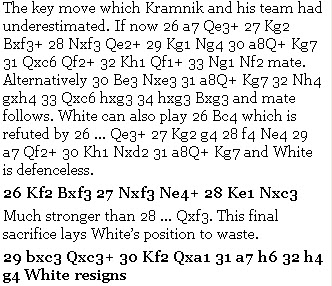
And here are some excerpts from his column Caro Can't from the Spectator for 23 October 2004 (as opposed to his column Caro Can't for 21 January 1989 or his column Caro Can't for 16 October 2010).
This is a new move. Black has one way to free himself before White's pawns begin to exert a fatal grip.
Black's position is resilient but White has a promising future on the central dark squares.
From now on White's play is direct and brutal - I would have played 18 Bf1 followed by Ke3. Kramnik has no truck with such sophisticated nuances and goes directly for the jugular
Black must now take on a4.
Creating a terrible outpost on c7 for his rook - Black must prevent such an invasion at all costs.
The decisive coup - White's small but highly efficient army is ready to concentrate its powers and deal the death blow. If now 34...Rxd4 35 f5 cxf5 36 e6 Re4+ 37 Nxe4 fxe4 38 Rc7 threatening Rxc6 and if 37 ... Bb5+ 38 Ke3 when Black's b-pawn is doomed and White's king penetrates.
After 41...Ke8 43 Rd8+ Kd7 42 Rd8 is mate*.
Sophisticated nuances? Direct and brutal? You decide.

[* This article sourced using a library search system. The wrongly-numbered moves appear like that in the article as sourced. I decided to leave them as they are, especially as they're not quite right in the Times version either!]

[Thanks to Angus French]
[Ray Keene index]

Thursday, July 18, 2013

An unlikely customer

Here's Ray Keene's Times column from 23 April 2013, annotating the eighth game of the classical world championship match between Vladimir Kramnik and Peter Leko played in Dortmund in 2004.


Here, by way of contrast, is Ray Keene's Times column from 24 August 2012, annotating the eighth game of the classical world championship match between Vladimir Kramnik and Peter Leko played in Dortmund in 2004.


And here is also Ray's Times column for 2 December 2010, annotating the eighth game of the classical world championship match between Vladimir Kramnik and Peter Leko played in Dortmund in 2004.


The similarities are perhaps as evident as the differences, but let us for once be grateful for the differences. For as it happens our subject today isn't plagiarism, necessarily, but - in part - another of Ray's interesting habits, covered here last September, which is sock-puppeting on Amazon.

Wednesday, July 17, 2013

The revolution should not be plagiarised

Below is Ray Keene's Times column from 19 April 2012, in which he discusses the game Polugaevsky- Ftáčnik from the 1982 Olympiad.


The notes are all plagiarised, obviously.

How plagiarised? Let's take a look.

Tuesday, July 16, 2013

The Worst Move On The Board XVII


Arkell-Osborne, e2e4.org.uk Sunningdale Open, round four, 7 July 2013. Position after 41...Kf8-e8.

It's a tough one, this, but there's no tougher competitor in British chess than Keith Arkell and in the position above, he found the Worst Move On The Board. Can you?


[Thanks to Jack Rudd]
[Worst move index]

Monday, July 15, 2013

Amateur Hour III: The Adjournment


White to play and seal a move
JMGB v T. Bates, Thames Valley League 2013


So here we are in Penarth, knee-deep in the South Wales International - as you'll already know if you've had a gander at Saturday's post - John Lewis III.

Anyhoo, as of now I'm in Wales and with 9 rounds to play I'll have a fairly decent chance of adding to my rook endings of 2013 tally (Amateur Hour; Amateur Hour II) and the five-hour sessions will mean if I do get one I'll more than likely have the time to appreciate it. One of the joys of tournament chess.


A couple of years ago I came to the conclusion that league chess was just inherently endgame unfriendly. Necessarily short sessions meant steam-powered blitz finishes and if you don't like them you have the choice of adjournments which tend not to materialise in practice. Well not usually.

My favourite slowplay rook ending of the year so far - and I'm sure this is no coincidence - came from an adjournment that actually got played. The session ended with the position you see at the head of today's blog, at which point my opponent effectively offered me a draw by saying he was happy for the game to go to adjudication.

OK, I'm obviously not winning, but still I wanted to play on. For a start I think I have the more active rook and therefore am objectively better, but also as my opponent was 30 odd points lower rated than me I felt that the longer the game went on, the more chance he might make a mistake. On top of that, though, I was acutely aware that it could be a very long time before I got another chance to play out a rook ending at such a leisurely pace.

So an adjournment it was and off to Ealing for the second session I went. There wasn't much computer analysis to aid either of us - my opponent didn't own an engine and I didn't have the time for more than a cursory peek - and no doubt it wasn't the most accurately played ending, but it was enjoyable. Certainly well worth the trip west.

If I get the chance to play out a rook ending adjournment in the 2013/2014 season I'll definitely take it if at all possible. First, though, there's Penarth. I'll let you know next week whether that turns out to be worth the journey too.


Rook and pawn Index


Saturday, July 13, 2013

John Lewis III

By the time you read these words EJH and I will be on the way back to Penarth for a week's holiday and the South Wales International. Follow me - @Berlin_Endgame - for tournament updates, between-rounds chat and general inanity (chessic and otherwise).


Talking of travel to other countries and twitter ...


A bit of an eyebrow raiser that. For somebody last heard of being booted from a venue for non-payment of two tournaments' worth of rent, I mean.


Oh dear. Receiving bad service and a fibbing is not pleasant, is it? I'm curious about a point of etiquette, though. Does anybody have a Debretts handy? When you've been giving it 'the cheque's in the post....no, really, the cheque's in the post this time', precisely how long do you have to wait until it becomes seemly to complain about that sort of thing yourself?"


Disgusting company, indeed. It certainly doesn't sound very good. But, then again, at least Dixons Travel actually exists. Which is more than you can say for Chevannes Chess Academy Ltd when London's chessers were invited to send cheques to it if they wanted to enter the Richmond Rapidplay last September.

Not that we can explain that away as a one-off mistake. There's also, for example, the "Chevannes Chess Weekender" advertised for 10th/11th November 2012.


Clearly marked as being run by the Chevannes Chess Academy Ltd ...


... with a request that cheques be made payable to Chevannes Chess Academy Ltd ...


... even though, as we know - as we now know, I should say - CCA Ltd had actually been "Struck off and dissolved" by Companies House in July 2010.

This is all rather unfortunate. So is not filing accounts as you are required to do when you are a Limited Company - as Chevannes Chess Academy Ltd did not; so is not keeping your details at Companies House up to date as you are required to do when you are a Limited Company - as London Academy of Chess and Education Limited has not.

An unfortunate mess, then, but what to do about it?


Accepting the consequences of your actions? That's a good idea. I like that.


Anyhoo, let us return to the pressing matter of the day. To wit: the purchase of digital cameras. I think I can help with that one.

When I wanted electronic stuff - a washing machine, say, or a computer (like the one upon which I type these words) - I went to John Lewis. If I wanted a camera I'd do the same. They're good at customer service there, you see. Really. Why not try them?


With thanks to EJH
Camera


Friday, July 12, 2013

Predecessors VI: Fischer-Euwe 1960 (Part II)

Yesterday we were discussing the game Fischer-Euwe from the 1960 Olympiad, in the context of its appearance in two Times columns by Ray Keene, both of which, though in largely different ways, plagiarised their content from Part Four of Garry Kasparov's My Great Predecesors.

In the course of writing those columns Ray plagiarised another book as well - one of the most famous chess books ever written.

He plagiarised Bobby Fischer's My 60 Memorable Games.


Thursday, July 11, 2013

Predecessors VI: Fischer-Euwe 1960

In his Times column for 8 July 2011, Ray Keene annotated the game Fischer-Euwe from the Leipzig Olympiad, 1960. The column is below.


This was not the last time he was to annotate that game for the Times since on 4 April 2012 he chose the same game for his column, which you can see below.


At first sight the columns don't have much in common beyond the game itself, though a closer look (try White's twenty-fourth and thirty-second moves) suggests that the later column wasn't written without reference to the earlier one.

Thing is, though, it's not really the relationship between the columns that interests us here. It's the relationship both bear to a third work, from which they are both shamelessly plagiarised.

That volume is the fourth part of Garry Kasparov's My Great Predecessors.


Wednesday, July 10, 2013

Predecessors V: Reshevsky-Najdorf 1952

On 22 February 2011 Ray Keene's column in the Times annotated the sixteenth game of the 1952 match between Reshevsky and Najdorf. The column is below.


On 2 May 2011 Ray Keene's column in the Times again annotated the sixteenth game of the 1952 match between Reshevsky and Najdorf. The column is below.


The two columns are not identical. But - on an inspection which they presumably have not previously received - they're pretty close.

They're pretty close to something else, as well.

What do you think that might be?

You think they're plagiarised from Part One Of My Great Predecessors?


Good Lord no. Absolutely not.

They're plagiarised from Part Four.


Tuesday, July 09, 2013

Academy status

About this time last year, a Telegraph piece appeared plugging "a young entrepreneur and chess enthusiast".


Monday, July 08, 2013

Amateur Hour II: One That Got Away


Black to play and offer a rook exchange?
Acs - Berkes, 2008


Returning to my review of the rook endings I've played in 2013 thus far, I have to admit that they haven't all been peaches and cream. Not even the ones I played at Golders Green.

One in particular that I didn't close down as I could have done stands out in my memory. It was the last round at the February tournament. I discovered afterwards that if i'd won I'd have shared first place. As it was I finished equal third and out of the money. Close, but not close enough.


I was White in this position, having just swapped queens to get here. My opponent offered me a draw hereabouts, but I was never going to take it. I felt I was on my home ground and not his for a start, but objectively I thought I had a little something to play for.


Although I quickly realised that things might not be as easy as I'd hoped. He activated his rook so I felt I had to retreat mine to protect my second rank.

Still I had a plan: use the Rubinstein Method to protect my pawns, pushing forward on the kingside, create a weakness in the enemy camp. And lo, mucho shuffling later, I got exactly what I was aiming for.


My next idea was to be able to protect f3 and b3 with the rook and push the a-pawn forward to try to create a second target on the queenside. I remember nearly playing Re3 here - which would have been embarrassing - and then realising I'd have to go to c3 instead.

I had two main problems.  Firstly, Black didn't let me push my pawn to a5 ...


... and secondly I was nearly out of time. I'm not sure how much I had left on the clock, maybe a minute and a half to my opponent's 10+, but I felt like I'd lost the thread. I'd got a weak pawn to attack on h6 just like I wanted, I just couldn't see how to get at it. So here I accepted my opponents second offer of a draw.

After the game I quickly realised something that simply hadn't occurred to me during it: I can try to put my rook on g6. I'd seen this idea before, it just didn't come to mind while my flag was hanging.

Given another minute, would I have found the right plan? Gone on to win? Maybe, maybe not.

I know that I spent much of the tube ride home kicking myself for missing the opportunity, but on reflection I'm prepared to break the habits of a lifetime and see this as a glass half full situation rather than 50% empty. Yes, I should have done better at the end, but I felt that I'd played pretty well to get to a position where I could screw up. This time last year I simply wouldn't have had the first clue as to what was really going on in this type of ending. At least now I knew that I'd let a chance slip by.


Anyhoo, here - via our regular visitor John Cox's Declining the Queen's Gambit - is somebody playing a very similar ending. With a good deal more competence than I managed, I should say.

In the position at the head of today's blog Black did indeed choose to play ... Rg2-g3 and White didn't swap. There are a few tricks to work your way through in the pawn ending, but if you have a look at it you'll see why White didn't want to go there. Not that his Rf5 saved the game either.

So nicely done for Berkes and a point on the board for him. For me it's halfway there and better luck next time.


Rook and pawn Index