Friday, June 24, 2011

You've Gaddafi joking

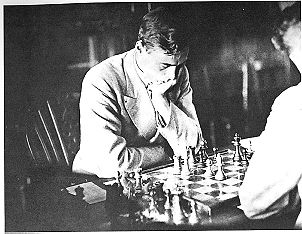
Last weekend, Kirsan Ilyumzhinov made a visit to a country with a long record of human rights abuses and a complete lack of democratic government. During his visit, he played a game of chess with the country's political leader.


Hang on. Was that not the photo you were expecting? But I said last weekend. The other chap was the weekend before.


No, last weekend Kirsan was in Vietnam. With its complete absence of democracy. And its very long record of human rights violations.

No-one said a word.

Whatever. Anyway, I wrote a piece about Kirsan's visit to Libya at the time, which I was going to run on Wednesday last week. And I changed my mind, it being, coincidentally, my birthday that day. Politics and war and dictators seemed far too serious for a birthday, so I dropped it, substituted something harmless and went up to the mountains for the day. But it's been nagging at me that there was something I wanted to say. So I'll try and say it now.

One of my persistent, albeit occasional, themes in writing about chess politics and media is the difficulty which the chess world, in Western Europe and North America, has in understanding the point of view of the rest of the world. The reason being, chiefly, that it does not try.

Because it doesn't understand, it doesn't really understand how Kirsan works, not entirely, and understands still less, how he gets away with it. It understands that he's corrupt, that his friends are crooks, that he silences some people and buys others, that the structure he controls is a parody of democracy, of course. That's well understood. But it doesn't understand that, however things may look from here, they may look differently from elsewhere. Specifically, what looks like justified moral outrage, from where we are standing, often looks like selective outrage, not to say hypocrisy, when viewed from elsewhere in the world.


So, Kirsan goes to Libya, in the middle of a war, one of whose causes is the de facto leader of that country, with whom he has a friendly meeting. How could he? we ask. Doesn't he care about who he associates with? we ask. Doesn't he realise how this looks? Do me a favour.

How could he? Because he can.

Doesn't he care who he associates with? Course not. He never has.

Doesn't he realise how it looks? Of course he realises how it looks. But it depends on who's doing the looking. What he probably didn't ask himself, all that much, is how it was going to look to you. Assuming that you are in the West.

This isn't because he's bad, although he surely is. Nor because he's mad, although he probably is not. It's because his constituency isn't you. It isn't, by and large, the West. And this, it seems to me, is the point that nobody was making any effort to see. Or understand.


It's a constituency that's largely located elsewhere and one which may take a different view of Western military campaigns than is normal in the West. One which may not believe that when the West starts bombing somebody to whom they were cuddling up just yesterday, it's because of a deep commitment to human rights. One which may hold a jaundiced opinion of a system of political ethics which barely notices a dictator until it's time to have a war with them - but then, when that war happens, demands that everybody else organises their moral outrage around the same new-found priorities.

Suddenly the same countries whose leaders were queueing up to be photographed with Gaddafi are crying out that Gaddafi's the one person in the world you absolutely can't be photographed with? Some people might be just a little bit sceptical about that. And they might be just a little bit right.

You can see their point of view, can't you. No? You can't? Well, then maybe they can't see yours either. Which is why the West has never been able to cope with people such as Kirsan, or Campomanes, or for that matter João Havelange, all of whom have understood very well how much resentment there is, outside the West, at Western intervention in other countries.


Not that they care, I hasten to add: on the contrary, all the three individuals named in the paragraph above have been good friends not just to dictators, but to corruption on a considerable scale. Kirsan's allies in FIDE consist in good part of the corrupt, the bribed, the paid-for, just as was true of Campomanes before him, just as was true of Havelange in FIFA (and for that matter, of Blatter now). There's nothing principled about Kirsan. Far from it. The man is 100% cynical. Though not necessarily more cynical than the policy of buying dictators one day and bombing them the next.

What I'm driving at is that there's such a thing as public opinion, to which any politician has to play: and that public opinion outside the West is not necessarily the same as public opinion inside it. And hence it's possible for a politician to play on genuine resentments of what is perceived as an arrogant and hypocritical West. And how do we deal with that? By being the arrogant and hypocritical West, and making no effort to understand why other people have a different point of view to ours. (I am painting in very broad strokes, since "we" and "they" represent many millions of people with many millions of opinions, but as a generalisation, I think the picture fits.) One way in which this manifests itself is in the habit of picking and choosing who we decide to support and encourage, and who we decide needs to be bombed, and then making a huge moral noise about it whenever we do the latter.

So, when I read about Kirsan's flight to Tripoli, I wasn't outraged. I just laughed. I laughed at the sheer cynicism of it. But I wasn't outraged. He's just playing to an audience. He's playing to an audience that doesn't see The Most Evil Dictator In The World. It may well see a couple of dictators, and ought to. But it also sees a capital city under bombardment by (for want of a better phrase) the West. It may or may not care how Kirsan looks. But it may also think about how the West looks.


And, you know, I don't see that meeting Gaddafi now is particularly more outrageous than meeting him when most of the photos in this piece were taken. The venality of a government really ought to be measured by their actions. Not by whether somebody's decided to go to war with them. That's the point where you can count me out.

Everybody knew that Gaddafi had a very long history of very serious human rights violations when they were paying him, and taking his money in return. Well, perhaps not everybody in the world knew, but everybody who was taking his money did. And everybody who was paying him.

So I'm kind of reminded of Tartakower's refusal to act against Alekhine, after the war, because of the latter's anti-Semitic articles. You all knew what he was like, said Tartakower, but back then you preferred to accept it. I think I am with Tartakower here.

You know, I've argued before that the same principle applies to Kirsan. People knew, or ought to have known, what he was when he first took over FIDE. But, as I put it then:
People kept their mouths shut and took his tainted money.
Now to be fair, that's the usual standard of ethical due diligence (or any kind of due diligence) obtaining in sport - or, for that matter, in international relations. Tell us about your money, and we'll ask questions later, if we ask them at all. I don't like that, but I understand it. But if that's the game, I'm not going to then turn cartwheels of moral umbrage when people decide they don't want to play any more.


So let's complain, yes, when FIDE presidents make friendly visits to dictators. But let's not reserve our special outrage when it's one on whom we happen to be dropping bombs. That, to me, is what makes a mockery of the whole process of promoting human rights: when it's partially and conveniently applied, and when it's accompanied by war, so that instead of a genuine support for human rights, it just becomes a card that's played in pursuit of an aggressive foreign policy. That's the sort of thing that makes people cynical. It's the sort of thing that's made me cynical. And disinclined to go along with the periodic fits of morality which accompany it.

So - if people want to spread their outrage a little more widely, and look into the use of chess to promote chess in repressive states generally, if people want to make it policy that we should ethically audit hosts, and sponsors, and who the President of FIDE goes to see, then that's something else. How often do questions of human rights come up in relation, for instance, to tournaments in China? If people want to complain about visits to Libya, perhaps there's a case for complaining about visits to Vietnam? Or visits to Sri Lanka or Iran?

I'm not going to be outraged when Kirsan does what half the political leaders in Western Europe did just recently. You be outraged, if you want to. That's OK. There's good reasons. Kirsan is what he is and Gaddafi is what he is. But perhaps other people order their priorities differently. Perhaps I do. Perhaps I'm not going to keep track of who's on the moral outrage list this weekend and who's the beneficiary of constructive engagement. Of whether we're at war with Eastasia or Eurasia.

[Gaddafi photo: The Malaysian Insider]
[Mandela photo: Political Scrapbook]
[Blair photo: Guardian. Via Aaronovitch Watch]
[Berlsuconi, Chirac, Obama photos: NewStatesman]
[This piece represents the view of its author and not of anybody else, individually or collectively. If you disagree with it, a comments box is available.]

Wednesday, June 22, 2011

Apparently Got Something to do with chess VI


Godmund, the White King and Hrosmunda, his Queen, live in warmth and peace with their people in the garden. But one day a coldness arose between the King and the Queen, which allowed the enemy, the Red Horde, to invade the garden, led by a serpent with the head of a man. Then the chessboard at the centre of the garden becomes the battefield for the battle to end all battles.


Or so it says here.


... to do with chess Index

Tuesday, June 21, 2011

Sauce for the Nosher


Nosher, complaining about arbiters in the latest New In Chess:
In fairness, even the finest arbiters will occasionally make misjudgements, but serial incompetency ought to be eliminated. The problem is that currently, short of committing downright fraud - such as submitting fake tournament tables - no one is ever going to be stripped of his IA title, regardless of how bad it may be.
How does that differ from the Grandmaster title?


[Nosher index]

Monday, June 20, 2011

Kingpinning


It's Kingpin time again: the new issue is, at last, on sale. Available from the usual outlets and conceivably directly from the magazine itself, if you can work out how. You can always email the editor on kingpinchess@yahoo.com.

All sorts of promising-looking stuff in it, but of course you'll be most interested in the two pieces the present writer has contributed, including the single most hostile book review I have ever written. Well, if it wasn't the worst chess book I'd ever seen, I'd have written a different review.

Anyway, do read it. Come to that, do buy it. Buy and enjoy.

Saturday, June 18, 2011

Every Picture Tells A Story: Big Pics Have Little Pics Hanging Up Inside ’Em….

Number 13 in a series of collaborative posts, this one by Martin Smith - the fruits of a theoretical discussion with Richard.

Take a look back at the three versions of the painting of the Hereford Gents playing chess: “Hereford” (which you can see here), “Greenlees” and “Christie’s” (both here). All of them have pictures within the pictures, they are on the walls, and Richard and I have puzzled long and hard over their source and significance.

They appear in identical positions in all three versions: on the left-hand wall of the room, where there are three different pictures; and over the fireplace where the picture stays more or less the same, and this is where we start.

It is recognisably a distant view of Hereford Cathedral across Castle Green, with Nelson’s Column, erected in 1809, prominent in the composition. It is a prospect that would have been much painted by artists aiming to surf the wave of the Nation’s euphoria after Trafalgar.

This is the “Hereford” view, a bit fuzzy though it may be:


The “Greenlees” version is reasonably clear, even in our distorted scan, and is pretty much the same:


But the Christie’s equivalent is just a splodge of white (you can see it at the back of the full picture via the link above) which, with imagination, could be seen as relating to the pedestal of the column. As with so much in the Christie’s curate’s egg of a painting, some parts, eg the miniature portraits, are good enough to have been painted by Leeming himself. But other parts are not, including the painting on the back wall.

So was there actually a painting of the Cathedral view on the wall of the room that was then copied, in miniature, into the Gents paintings? We got quite excited when we discovered that there was a candidate, sitting in storage in the Hereford Museum and Art Gallery, artist unknown.


[By kind permission of Hereford Museum and Art Gallery, Herefordshire Heritage Services ©]

The view is the same, but there are some telling differences from the Leeming miniatures: the figures in left foreground, and the trees, for example. It’s close, but unfortunately not close enough, and anyway not of the standard (clearer when seen in the flesh) to pass muster in a room of this quality.

So the Cathedral view appears definitely in two, and probably all three of the versions, and in each case is a reminder to the viewer that these are Gentlemen of Hereford playing on home turf. But otherwise there are no correlations among the wall paintings. So we’ll take them one by one, and first up is the portrait in “Hereford”.


It is rather indistinct here although, again, the original in the Hereford Art Gallery is clearer. In spite of some efforts, we have not made any progress finding a source for the image. Maybe it’s a family portrait, or maybe, given that we now know that Leeming copied the Magdalen Christ, it has a religious theme. But we will leave it for now and come back to it later in this post. Let's move swiftly on to the figure painting in the Greenlees version.


Mario Praz, the Italian art historian whose book on interior design kicked off our saga, referred to it as a representation of a “Saint Sebastian of the Venetian School” which was a helpful pointer. The blessèd saint has nowadays morphed into a gay icon, and there are compendious websites devoted to him, and his uncommonly slumped pose in Greenlees led us to this:


Jan Thomas (1617-1678) “sketch” for Saint Sebastian
in Lokenhaus Church (1689)

Yes, that’s Lokenhaus church, not in rural Herefordshire but alpine Austria, and the sketch itself is in the National Art Gallery of Hungary. In spite of the close visual fit we haven’t established how Leeming could have been able to copy, even at second hand, the Jan Thomas, and so we explored a suggestion from Dr Enikö Buzási of the Hungarian NAG which pointed us in another direction closer to home:


Gerard Seghers’ St.Sebastian
in the little dining room at Petworth House, Sussex.

Seghers, a Flemish artist working in the early 1600s, reversed the pose compared with the later Leeming, and put an angel into the action. However, the picture was in England in Leeming’s time, in Lord Egremont’s Petworth House, Sussex, where it has hung ever since.

Moreover, there is an engraving, now owned by the Royal Academy, of the Seghers by Paulus Pontius RA (1603-1658) which reverses the image, putting it the same way round as Leeming’s mini St. Sebastian. So, leaving aside the interfering angel, and focussing on the Saint, the arrows and the tree, the painting and its engraving could have been an accessible source for Leeming’s Greenlees miniature. According to the National Trust, which now manages Petworth, “painters and sculptors [were] free to turn up, with or without their families, whenever they wished to, a source of numerous accounts in the diaries and letters of the period.”

But while possibly it is the source for the Greenlees St. Sebastian, looking at the closer correspondence with the Jan Thomas we’d still feel more comfortable if we could establish a link, even at several removes, between his painting and Greenlees’ mini-version by Leeming.

Now we come to the picture on the left hand wall of Christie’s. We are looking at it last, but certainly not least.

We had noticed this image back in September last year at the Christie’s auction but without understanding what we were looking at. Only in April this year did we realise it was a mini-version of Leeming's copy of Christ Carrying His Cross for Hereford Cathedral which we talked about in this blog.


[© Dean and Chapter of Hereford Cathedral]

The striking similarity made us think again about what Leeming was up to with the pictures on the walls. We had assumed that he was making these mini-pictures to personalise each version of the Gents appropriate to their dedicatee, or whoever commissioned them, perhaps copying an item from their private collection. But the Christie’s Christ image suggested otherwise, that perhaps Leeming was copying his own work. Of course, given what we have said above about the unevenness of the Christie's version, the Christ mini-copy may not itself be by Leeming’s own hand, but possibly by a lesser talent under his direction. But nonetheless, the source appears to be Leeming's copy of the Magdalen College original.

If this is right, why then was Leeming putting copies of his own work into the Gents? We suggest that he was taking the opportunity afforded by these paintings to advertise his skills as a copyist. The mini-pictures were an ingenious, and opportune, prospectus for his work. Moreover, by referring to prestigious old-master works, he gave his chess paintings, and through them his patrons, an additional caché of connoisseurship, to everyone’s advantage.

If this is so then the Greenlees version with its mini St. Sebastian, which was shown in the Royal Academy Summer Exhibition of 1818 – then, as now, a popular place to show-case your talents in the competitive London art scene – may hint at the sometime existence of a real-size copy by Leeming of an old-master original.

Well, if there was, and it still is around, we haven’t found it yet. But his obituary refers to Thomas copying yet another, and these days rather well-known, old-master work, and that is highly suggestive. He copied, towards the end of his life, Raphael’s School of Athens, perhaps not the original itself, which is huge and in Rome, but probably one of two smaller copies already in London. This, the better known of the two, may have been the one.


Mengs' (1728-1779) copy of the Raphael School of Athens,
executed in 1755 and now in the Victoria and Albert.

Leeming's reproduction was unsold at the time of his death, which was only four years after the 1818 RA show. As with the Magdalen Altarpiece, it is a copy of a high-end work, suggesting he may have done others, with the Seghers/Paulus Pontius, or Jan Thomas, St.Sebastian as a candidate.

Continuing our train of thought and looking now for a source for the portrait on the wall in the “Hereford”, well, Leeming had painted many portraits of course, so he would have had plentiful raw material at hand. But it opens the intriguing possibility that it may be a copy of a portrait of a high-status subject by another artist, or as we mentioned above, of a religious figure, another Saint for example. Such pious imagery would have had resonance for the Bodenhams of Rotherwas Hall, where we think the Gents were playing chess. They were a long standing Catholic family, and may even have commissioned direct copies (by Leeming, or others) of the religious works upon which the mini-copies were themselves based.

As for the landscape view of Hereford Cathedral: admittedly we have not seen any references to any other landscapes by Leeming – apart from a small local scene in the Hereford Art Gallery’s collection – but the installation of Nelson’s Column on Castle Green was a major, and even locally controversial, event perfect for this market-savvy artist to exploit.

Leeming, we suggest, was taking the opportunity provided by the Gents to set out his stall as a skilled miniaturist, accomplished copyist (as his obituary emphasises) and perhaps even competent landscape painter. It is a speculative theory, with several levels of conjecture, built on a narrow foundation of evidence, but not, you might say, completely off the wall. We are now patiently waiting for the missing pictures to show themselves and provide the buttresses to hold it up.


References etc
National Trust (1978?) The Picture Collection at Petworth House.
Thanks to Alessandro Giua who runs this St. Sebastian site for the Jan Thomas photo.Every Picture Index
Chess in Art Index


Friday, June 17, 2011

This is the end VII


Black to play
A. Fella v JMGB, Sunningdale Major (6)


I'll be on a train to Gatwick later today, another weekend of e2-e4 chess ahead of me. Sunningdale already seems like ancient history, and chuffed though I was to win my first tournament in twelve years (and only the second ever), this is no time to rest on my laurel. There won't be much time to relax after Gatwick either, as I'm heading off to Benasque for the first half of July.

All this chessing is really getting in the way of blogging. I want to write a post or two about my Sunningdale experiences and I've already got posts in several series - Letter to the Editor (I, II, III); Sing a Song of Chess (I, II, III, IV); The Interesting Sacrificed Exchange (I, II, III, IV) - that are waiting to be written. As well as that lot, I really must get back to the Anti Chess (I, II) story sometime soon. Chess blogging zeitnot!

Something else I must get around to is that review of Nick Pert's Killer Endgames DVDs. My plan is to do something in depth on Disc One at some point between Gatwick and Benasque. For today, though, I'll kill two birds with one stone and take a look at how the Ginger GM's DVDs helped me win an important game at Sunningdale.


Gatwick's Crowne Plaza hotel - where your author is heading to this evening


It was the morning round of the last day.  We had reached the position at the head of today's blog when, just as I was about to play my original intention (the simple ... Nf6 followed by lobbing my pieces in the general direction of White's king), a thought occurred to me: what about ... Nc5?  My silicon friend doesn't think much of the idea - after a couple of minutes to think, the BIM considers Black to be clearly better after ... Nf6 while ... Nc5 is only it's twelfth choice (behind such moves as ... Re8, ... Rd8, ... Ra6 and ... Ra7) - but nevertheless there's a rather attractive idea behind it.  "White will have to swap", I thought. "I'll take back with the b-pawn, exchange everything off except for one rook, stick that on b3 and then just sit on White's position until it breaks."

A Blue or Red Pill? moment, then. Play for a direct attack or head for an endgame? Frankly, I found it very difficult to make the choice, but in the end, three factors tipped the balance in favour of trying ... Nc5: the Killer Endgames preview clip that we had on the blog last week (TITE VI), the memory of a game I played at Golders Green back in January and the amount of time we each had left on the clock.


White to play
Karpov v Hort, Tilburg 1979


If you watched the Killer Endgames preview video you will probably remember this position. I hadn't seen the whole DVD before I went to Sunningdale, but, fortunately for me, I had at least seen the this clip.  It seemed to me that there was a similarity between what I wanted to do and Karpov playing 1 Bxd7 followed by moving his rook to the f-file and eventually to f6. True, unlike Karpov, I wasn't going to be trying to create a passed pawn, but I was going to get an active rook while my opponent's rook was going to be stuck passively defending a pawn just like Hort's was.

If you watch the video again, you'll notice how often Pert talks about the importance of having active pieces in rook endgames. This is hardly an original observation, of course, but it's an important one and in retrospect given the emphasis he puts on this point, it's not really surprising that the thought should come to mind at the point that it might prove useful.

Once I'd begun thinking about active rooks another position came to mind: one from a rapidplay game from January's Golders Green tournament. My opponent, playing Black, had offered me a draw, but I declined because I could see several factors in the position that were in my favour, not least the relative activity of the rooks. I did indeed go on to win the game, but it was more my opponent's reaction afterwards - as soon as he resigned he announced that the diagram position is a simple draw - than the result that encouraged me to play ... Nc5 in the game at Sunningdale.

My feeling, you see, was that regardless what an objective assessment of the position might be, my chances of winning were pretty good and that weaker players, by which I mean people around my strength, often underestimate the difficulties of holding such positions. Sitting at the board in Sunningdale I remembered Golders Green and felt that if my opponent there had allowed me to get such an ending and then not manage to save it something very similar could well happen again.

Finally, there was the clock; the thirty-third piece, as T.C. calls it. At the point I was deciding between ... Nc5 and ... Nf6 my opponent was already down to his last thirty minutes while I had a little short of twice that. I felt that even if he managed to reach a defendable position, the pressure of having to find a decent move once every thirty seconds (the time control at e2e4 events is all moves in 90 minutes with a 30 second increment from move 1) would eventually tell and sooner or later he would crack.

That's how I saw it anyway. So I chose ... Nc5 - my scoresheet tells me the decision only took four minutes which doesn't really seem enough - and ten moves later we arrived here ...


Black to play
Fella v JMGB, Sunningdale Major (6)


... and I went on to win the game in pretty much exactly the way that I'd imagined at move 23. I was even right about White's time trouble: at one stage just before the end he had seven seconds left to my three-quarters of an hour.

During the game I wasn't too bothered whether heading for an endgame was the correct thing to do or not. I was just trying to win and the rook ending seemed like a pretty good way to try to do that, while minimising my chances of losing.

As things turned out, I clearly made the right choice. In retrospect, though, I have more doubts as to whether it was, objectively speaking, the best choice. After all, I hadn't put any thought into how I'd swap the pieces off, I just kind of assumed that I'd be able to. Looking at the game again, White was rather compliant around moves 27 to 32. Had he tried to keep some bits on, the game the end of the game could have been very different.

Opinions as to what you would have done in the original position, and perhaps how White might have defended the ending better, are welcome in the comments box. They'll be too late to help me for Gatwick, but they could well help me at Benasque.

Anyhoo, it's time I caught that train. See you Monday.


This is the End Index

Thursday, June 16, 2011

The Chess Girls

There's a drama-documentary on Radio Four today: The Chess Girls.

According to the blurb:
The emergence of the Polgar sisters in the 1970s and 80s rocked the chess world. In a heavily male dominated game, the three Hungarian girls broke record after record. The youngest, Judit, was talked of as a potential world champion.

The Chess Girls is the story of their parents, Laszlo and Klara Polgar, and how they defied the Communist authorities to conduct a remarkable educational experiment. Laszlo Polgar, convinced that any healthy child can be trained to become a genius, set out to prove his theory with his own children.

This is a drama-documentary with excerpts from an interview with Laszlo and Klara Polgar recorded for the play. The writer, Lavinia Greenlaw, takes their account and re-creates the lives of the young Polgar family in their tiny Budapest flat. The fictional Laszlo is played by Kerry Shale, and Klara by Sally Orrock.
It's on at 2.15 this afternoon, and presumably available subsequently on iPlayer.

[Thanks to Richard for this]

Wednesday, June 15, 2011

Lookalike


Nick Pert


Shakhriyar Mamedyarov


[Photos: ChessVibes, Royal Automobile Club]

Monday, June 13, 2011

Deleted Scenes

So I’m back. Not from out of space, as per the Gloria Gaynor song, but from deepest Dorset, although as far as being able to connect to the internet was concerned, the effect would have been pretty similar.

Things are pretty different here in London. Looking out of the window I no longer see cows grazing on the far side of the valley, nor, off to one side, do I glimpse the sea knowing it to be just a ten minute walk through fields and country lanes away. I’m guessing most of you, our valued readers, have never actually been to Streatham, so you'll have to trust me when I tell you that is not, in fact, what I'd see if I were to look out of the window right now.


The view is not the only thing that changed for me. After spending most of the week either building sand castles or reading stories to Freya and Thanial, my sister’s children – after what must have been at least a thousand repetitions, I have become intimately acquainted with Hairy Maclary from Donaldson’s Dairy - I suddenly found myself at rather a loose end.

I could have filled the time by watching Nick Pert’s Killer Endgames DVDs, I suppose - last week I spent many of the hours after F & T's bedtime doing exactly that - but for my first night home I decided to take a night off from endgame study and watch Harry Brown on DVD instead. An evening of urban dystopia seemed quite appropriate given the change in my surroundings.


The film, I have to say, was pretty much as expected. Imagine Death Wish transported a few thousand miles east and 35 years into the future, replace Charles Bronson with My Name’s Michael Caine and you’ve got 95% of the film in your head right there.

Not that it’s terrible by any means. It's just that you’ve probably kind-of sort-of seen it before and it's not a little predictable as a result, that’s all. The DVD extras are fun, though, and not just because you get to see the actors and director get asked “what attracted you to this project” and then try to come up with an answer that isn’t “I thought copying an already successful film would give me a decent paycheck”. Buried in the Extended & Delected Scenes section, you see, is an extra bit of dialogue that got cut out of the Frampton-Brown chess scene.


{in the original version, what follows comes immediately after the bit about getting a chess computer}

Harry Brown:
I couldn't play a machine. Len always said 'you play the man not the board'.

He also had this theory that everybody had a personal identification with a particular chess piece. It represented who you are, whether you knew it or not.

I mean, like some people are pawns. One move at a time, one space at a time. Simple. Easy. One-dimensional.

Others are rooks. Straight ahead. Forward. Backward. Life in a straight line. Come at you direct.

And then there are others who are crazy knights. Jumping over people. A little step to the side. Unpredictable.

And they're all there to protect the king who's one of the most powerless pieces on the board. He has no more movement than a pawn.

You see the real power is with the queen. She can go anywhere.

DCI Frampton:
You forgot the bishop. He cuts across the board. Comes at you sideways. Blindsides you.

Harry Brown:
You didn't come here to talk about chess.


Well, you can see why they took it out, can’t you? Just a tad trite, methinks.

Mind you, sometime it's best to leave things behind even if you quite like them. Take where we stayed in Dorset, for example. It was lovely and all that, but, aside from the absence of internet, it would probably have taken at least an hour's drive to get to the nearest chess club.


Saturday, June 11, 2011

What Dadd Did Next

This is the second post (see all others via the Asylum Index) on Richard Dadd's 1857 painting The Child's Problem:


In the first post we saw that the artist had painted a two-mover into his picture.


Which is the diagram of this position:


It's not too late to have a go at solving it. The answer is further down if you need it.

However, success won’t get you any bonus points as, frankly, most decent ten year-old chessers could get it, as we'll show below. So, who first figured out the position that was indistinctly represented in Dadd's murky painting?

It appeared in the Chess Addict editions, but Richard James says that it was the late Mike Fox who wrote the section on chess-playing artists, and so for obvious and sad reasons that trail goes cold. Eduardo Sadier’s mega database of two-movers has the problem, but Sñr Sadier says he doesn't know from where it was sourced, and moreover there are no variations of its setting in his files. It’s a one-off. So that’s another cul-de-sac.

But, as I then discovered, the diagram is given in a couple of art books about Dadd, with the prior claim going to Patricia Allderidge’s 1974 The Late Richard Dadd. She says:
“The title [of the picture] refers quite literally to the position on the chess board, which represents a very simple composed problem…simple enough, in fact, to be solved or even set by a child”.
Well, is it "simple enough to be solved by a child"? Richard James tried it out on a group of his young chess students (thanks Gerard, Max, Marley, Anais and Nick), and the answer is "yes", though whether a ten-year-old Victorian child (guessing at the age of the Child), without Richard’s coaching skills, could have managed it is another question.

So, she may have been right about solving it, but the “even set by a child” assertion is debatable. Richard says “I don't think any of [the ten year-olds in my group] would even be able to start composing a problem like this” and I think that given his eminence in the field of child chess development that settles it - ten year old Victorian composing prodigy Lilian Baird being the exception that proves the rule.*

As to her source, Ms. Allderidge gives a footnote where she diagrams The Child’s Problem, and acknowledges - we've got there - Leonard Barden and the late Hugh O'D. Alexander for transcribing it, and so they must take the credit for solving this part of the mystery. Not mincing their words, they offered the following assessments of the problem: “banal” - Barden - and “rather poor” - Alexander - the latter adding “but not so poor if it was set by Dadd himself and not by a serious problem composer.”


C.H.O'D. ponders another problem.
And another thirty-plus years later, opinion remains the same (thanks to Michael McDowell, Vice-President of the British Chess Problem Society, for taking the time to give us his contemporary assessment). Serious problemistas, such as all the aforementioned, like to savour more than one line of play after the key move. But, while nul point is their verdict, an over-the-board player (well this one, anyway) might be rather pleased to see the black king obliged to self-destruct. We could even go a bit psychological and see it as a metaphor for Dadd’s own predicament.

So, could Dadd play chess well enough to compose a Problem as rudimentary as this? Ms. Allderdice, who was the archivist of the hospital says “chess was a popular pastime in Bethlem". Although she adds “but there is no evidence as to whether Dadd played or not”. Mike Fox suggested otherwise in the Addict. He said “In his journals [Dadd] raved about the Ruy Lopez”, which makes Dadd sound like a real devotee of the game, “raving” (as Mike indelicately put it) knowledgably about a favourite and sophisticated opening.

It is unlikely though, Richard thinks, that Mike researched the primary sources, and it seems therefore that he got the reference from Isaure de Saint Pierre’s portrayal of Dadd’s life published in 1984: Richard Dadd - His Journals.


Be warned. This isn't the dry and dusty documentary analysis suggested by the title but, as the author freely admits in the preface, an imaginative interpretation in the service of an entertaining and readable novel. It is an account which the term "sexed-up" fits nicely and, in parts, literally - enough to make your blogger blush one morning in the V & A's National Art Library, when he fumbled in the moist passages. Mike must also have dipped into this colourful volume. This is the relevant chess bit, in which Dadd supposedly reminisces as follows:
“Those endless games of chess in Bethlem Hospital! I’ve moved my king’s bishop to square B5. This is the Spanish attack: the Ruy Lopez opening. My White
Bishop commands the centre. I think my opponent was Dr. Hood,……I can’t say for
sure I was playing this game against him, but I have a picture in my mind’s eye
of a …hand…moving over the chess board, attacking my bishop diagonally by way of
square A6. The bishop retreats to A4, the second knight moves to F6, I castle,
he castles…..”

Really? Would Dadd have used algebraic notation? Would he have spoken of the Lopez Bishop commanding the centre from b5? And those moves. The precise order may have been misremembered, of course, but an early ..a6 in the Spanish in the mid-19th century, in Bedlam? Black castling without moving his f8 bishop? Authorial licence? More than likely.

It seems probable, then, that the author consulted, adapted, and maybe inadvertently mangled, a late 20th century chess source for the words she puts into Dadd's mouth. To spare my further blushes I won't mention the other things she puts there in the course of the novel.

There is, however, something rather more reliable on Dadd's chess interests: a note made by Dr. William Orange, the second Medical Superintendent of Broadmoor, on November 7th 1864 when Dadd was there as a patient. Dadd, incidentally, painted his portrait, suggesting mutual trust and confidence.


Dr. Orange’s contemporary note (available in the Berkshire Record Office) should be accurate, although its meaning is not immediately apparent :
“As examples of his thoughts [Dadd] told me this afternoon that the power
some people have of playing Chess without the board was probably due to
their having a familiar spirit and that towards some people the chess pieces
were evidently unfriendly and that this unfriendliness might be due to the
antiquity of the Game.”
If you strip out Dadd's idiosyncratic theory concerning the selective animus of the pieces he seems to be saying that (a) some people can't play, (b) others are so good they can do so without seeing the board or, as we would say, they can play "blindfold".

So here is an intriguing thought: could the reclining figure in the picture painted seven years earlier be doing just that: playing blindfold?


"After your last move, I now announce mate in two, beginning 1.Qd8!"

From the chess point of view could this explain the relative placing of the two characters in The Child’s Problem? Although there may be a contrived two-mover on the board, Dadd may have indeed intended that the figures should be seen as playing a genuine contest. One player, the child, has sight of the board, but his opponent is playing alongside with eyes tight shut: or as Dadd phrased it, "playing Chess without the board".

And with that, please come back for a further post in a few weeks time on the Dadd story, when we will look at more chess in the Asylum. And in the meantime check us out on the Bethlem Royal Hospital Archive and Museum Blog (see their post of 6 June).

References etcIsaure de Saint Pierre (ed. Anthea Bell), Richard Dadd - his journals. Aiden Ellis, Henley 1984 (originally published in Paris 1980).
Thanks to Colin Gale and Victoria Northwood of the Bethlem Royal Hospital Archive and Museum for their generous assistance, and to Richard James for his help in general, and for the solving exercise and the Miss Baird tip, in particular.
For the story of another involuntary, but brief, visitor to Bethlem see the last episode of Every Picture Tells A Story.

*Postscript: in the TATE Etc mag. for Spring 2011, Jennifer Higgie (author of Bedlam, another novel inspired by Dadd) says it is "..a position on the chessboard considered easy enough to have been set by a child.." Said often enough it becomes accepted as a truth...

Friday, June 10, 2011

Giving a simul

I am giving a simul on Saturday, at El Corte Inglés in Zaragoza.


(actually this is a different El Corte Inglés)

I've never really given a simul before. I've stepped in to help, on one occasion, to give the proper players a rest, but I've never actually been invited to give one before now. 45 - as it happens, just a few days shy of 46 - must be unusually late in life for giving one's first simul. Presumably because most simuls are given by people who are good at chess and these people usually develop their talent at a rather earlier age. About three or four decades earlier.

Fortunately, saying "I am giving a simul" rather exaggerates the extent of my involvement, since I am only one of a team of players, some of whom can actually play the game.


It's an annual event called Ajedrez En La Calle (Chess In The Street, as the simul takes place out of doors) organised by the Aragonese Chess Federation. I'm invited to take part as the reigning champion of Huesca, one of the three provinces of Aragón.

Might be fun. Or might be an absolute disaster in which case I will presumably be forced to flee the city by boat.

I've been on the other side of a few simuls, of course, not that I have any scalps to tell you about. I did once win a prize at a simultaneous organised at the 1983 Candidates' Semi-Finals in London. There was no play in either match that day (in those days players could and did take time-outs) and so would-be spectators were invited to take part in a simul given by the estimable Jon Speelman, an offer I accepted.

I didn't win this game. I might very well have done: I won the exchange


and had I played, the computer says, 30...d5! rather than the asking-for-trouble 30...Qc6 I selected, then in theory at least I'd have been favourite, though in practice it would have been very easy to go wrong, playing a grandmaster.

But, as it turned out, I didn't win. I didn't even draw.


I nevertheless received the aforementioned prize ... for being the last player to finish. This prize was, you'll be impressed to learn, a copy of Ray Keene's notorious book on the 1978 World Championship match. A book that I already possessed.


As it happens, I played Ray himself in a simultaneous eleven months later, at Blackwell's bookshop in Broad Steet in Oxford, in which city I was then a student.


I remember, after the game, telling the Oxford Mail reporter that I'd had a better position but I had to go home to finish an essay. Which may even have been true, but that doesn't make it much less embarrassing a thing to have said.

The prize, this time, was the perhaps equally notorious first edition of Batsford Chess Openings, which Ray was touring to promote.


Anyhow, I can't imagine that, in twenty-seven or twenty-eight years' time, anybody will be remembering a simul in Zaragoza in June 2011. Or reproducing the score of a game they played against me.

[Ray Keene index]

Wednesday, June 08, 2011

Order! Order!


The diagram below is taken from James Vigus' Play the Slav, Everyman, 2008, page 177. The position depicted arises after the following sequence:

1.d4 d5 2.c4 c6 3.Nc3 dxc4 4.e4 b5 5.a4 b4 6.Nb1 Ba6 7.Nf3 Nf6 8.e5 Nd5 9.Ng5 h6.


Vigus writes:
The untried 10.Ne4, focusing on the d6-square, is perhaps not so bad for White: for example, 10...e6 11.Nbd2 c3 12.Nc4 Bxc4 13.Bxc4 cxb2 14.Bxb2 Be7, when the potentially strong bishop on c4 gives him arguable compensation for the pawn.

Untried? Sort of.

But sort of not. Let's have a look, for instance, at page 119 of James Vigus' book Play the Slav (Everyman, 2008) in which the following sequence is investigated:

1.d4 d5 2.c4 c6 3.Nf3 Nf6 4.Nc3 dxc4 5.e4 b5 6.e5 Nd5 7.a4 e6 8.Ng5 h6 9.Ne4 b4 10.Nb1 Ba6

bringing us to the following diagram...


...which is the same position as would have arisen after the "untried" 10.Ne4 and then 10...e6 as given above.

Three game references are given.

[Number one in an occasional series]

Monday, June 06, 2011

This is the end VI


Endgames to the left of me, endgames to the right of me .... it was only the beginning of last month that I was lamenting the fact that actually getting to play an endgame out could be rather difficult for club players (TITE IV; TITE V) and now I find myself having played four king and pawn endings in the last couple of weeks alone.

Quite handy, then, that review copies of Ginger GM's Killer Endgames DVDs (see above) should have just dropped through the letter box. I haven't had a chance to watch them yet, so it's probably just as well that the king and pawn positions that arose were rather straightforward, as the final positions of those games indicate:-


Slater Kennington (3)
23.5.11

Sunningdale Major (1)
27.5.11

Sunningdale Major (6)
30.5.11

Slater Kennington (4)
2.6.11


Not that things are always so easy. Take this position, for example,


White to play
Rogers - Shirov, Groningen 1990


which I found in Nunn's Secrets of Practical Chess (Gambit 1998). White to play, what result?

Anyhoo, by the time you read this I'll have wended my way out of London to a land without internet. I'll be back in a week or thereabouts with a review of those DVDs and a word or two about Sunningdale. Behave yourselves while I'm gone.


Saturday, June 04, 2011

Every Picture Tells A Story: The Cast of Players, Part 2

Number 12 in a continuing series . This one mainly by Richard Tillett.

This is the second of two posts in which we share the results of our research into the gents of Hereford chess club, depicted in Thomas Leeming’s painting of 1815. Here, once again, is the picture…


In our previous post, we profiled Charles Biss, Theophilus Lane, Samuel Beavan, Francis Lewis Bodenham and Edwin Goode Wright. These were men from the higher echelons of Hereford society, colleagues as well as friends, with close family and business connections. They were confident men, assured of their status in society and comfortable in each other’s company.

But there is one man in the group who doesn’t quite fit the template, John Allen Junior (1787-1829). He is the short and slightly hunched figure on the far left of the picture, and he is the subject of today’s blog.


Allen is an engaging figure - energetic, innovative, radical, impulsive - but a man whose demons ultimately got the better of him. His life has been researched in some detail by Paul Latcham, himself a former Hereford bookseller, and this blog is greatly indebted to an article by him published in A Hereford Miscellany in 2000.

Allen’s father, John Allen Senior, had moved from London to Hereford around 1779 where he founded what was to become a well-regarded bookselling business. From an early age the young Allen was fascinated by things antiquarian and bibliographical. This would have equipped him well for a career in the family business and indeed it traded as John Allen & Son, though only briefly.

He also had military inclinations. In 1808 he joined the local militia, the Herefordshire Volunteers, and by 1813 had risen to the rank of captain. For part of his time in the militia he served in the company commanded by Edwin Goode Wright, the figure in the right foreground of the picture holding a chess piece.

At the time the picture was painted in 1815, Allen was much involved in setting up the Hereford Permanent Library, the city’s first non-commercial library. Allen would have been well qualified to advise on the project, as the family business had previously run a ‘circulating library’ where for 12 shillings a year readers could borrow books from an extensive selection.

Allen travelled frequently to London and it is possible that he met Thomas Leeming on one of his visits, perhaps even at the London Chess Club in Cornhill. It could have been Allen who provided Leeming with his entrée into Hereford society and the commissions which followed.

Today, Allen is mainly remembered for his Bibliotheca Herefordiensis, which can claim to be the first county bibliography of its kind to be published in Britain. It was an ambitious attempt to list all the printed and graphic material relating to Herefordshire. As we recounted in an earlier blog [insert link], when we visited Hereford Cathedral library Martin and I were privileged to examine one of only 25 copies that Allen printed. None of these were offered for sale - Allen kept one copy for himself and gave the others away.


Allen’s magnum opus:
dated 1821 on the title page but not completed until the following year.
By the time the Bibliotheca appeared in 1822, Allen was already a famous, if not notorious, figure in the county, having found himself on the losing side of a highly controversial libel action. The case hinged on Allen’s decision to deposit a copy of a pamphlet in the Permanent Library which had already been declared libellous by the courts. Although Allen was not involved in the original action, by making the pamphlet available via the Library he was effectively re-publishing it, and a private prosecution duly followed.

Allen was no stranger to controversy. He had campaigned vigorously in the robust 1818 parliamentary election in Hereford, and subsequently played a leading role in inviting the radical MP Joseph Hume to attend a dinner with 300 guests, including many of the great-and-the-good of the county. Allen had also taken a high profile stand against a decision taken by the Permanent Library to destroy two books deemed to be of ‘unmoral and irreligious tendency’.

Allen’s promulgation of the libellous pamphlet was motivated by his sense of moral outrage at the conduct of the solicitor who had brought the original action. When the case against Allen was heard at Hereford assizes in April 1822 an immense crowd had gathered there, according to the Hereford Journal. Allen had little option but to plead guilty, since the libel had already been established. His chess mate Francis Lewis Bodenham (Allen’s opponent in the picture) stood by him - the Bodenham law firm not only took on the case for the defence but waived its fee. They seem to have done their job well as, on the surface, Allen emerged relatively lightly. The plaintiff received only nominal damages of £5, but Allen still had to meet the plaintiff’s costs of over £400.

Then the wheels started to come off. In 1823 Allen Senior sold the family business rather than passing it on to his son, which suggests that their relationship may have broken down. In the same year, Allen Junior moved to London where he dealt in books and continued his bibliographical and antiquarian researches. But he was soon seriously strapped for cash. In 1827 his stock and much of his private library was sold at auction.

A sad note scrawled by Allen in 1827 from Clerkenwell Prison survives, in which he asks his librarian friend William Upcott to stand bail for him so that he can be released ‘from this damned place’.


John Allen Junior's cri de coeur from Clerkenwell Prison

We don’t know why he was there, but Clerkenwell was not a debtor’s prison so perhaps he was detained for attempted suicide, in those days an imprisonable offence. Within a few days a certificate of insanity had been obtained, and Allen spent the next eight months in Bethlem Royal Hospital (Bedlam).


An 1828 engraving showing the the forbidding exterior
of the Bethlem Royal Hospital .
On his discharge he returned to Hereford, but his mental health soon broke down again and in 1828 he was admitted to Hereford Asylum. He died there the following year at the age of 40.

His passing was barely noticed in Edwin Goode Wright’s Hereford Journal. John Allen Junior had not so much been forgotten as airbrushed out, perhaps a victim of the stigma that in those days attached to mental illness.

Our next blog in the series will be on 18 June, when we look at the paintings on the walls of the room in which the gents are playing.

References
Paul Latcham: John Allen, Jun. and his Bibliotheca Herefordiensis, pages 219-223 of D. Whitehead & J. Eisel: A Hereford Miscellany (2000).

Every picture tells a story Index
Chess in Art Index

Friday, June 03, 2011

"It's all over now, Baby Blue"


Just yesterday - and probably days after everybody else - I happened to come across the YouTube channel belonging to a chap calling himself Sir B0b1. This gentleman - his real name is not a secret, but we'll leave it as an exercise for the reader - introduces his channel thus:
Welcome to my channel. I intend to add Master Game Chess episodes from 1980 to 1982 for public viewing.
Well hurrah for that, we say, particularly because the programmes feature the original visuals, not available last time we brought you The Master Game.


It's a work in progress: some of the videos have been added in the last few days. Among several games are three finals, all of which are embedded here, but there's plenty of others to enjoy - and perhaps remember.


So do, indeed, enjoy. And watch out for You-Know-Who being described, by Bill Hartston, as "a very fine, erudite writer on the game". Those were the days.


Wednesday, June 01, 2011

Chiv Chat

Click for this edition of Chiv Chat, featuring a fabulous chess analogy, ramblings about candidates matches, some great news from one of my fellow bloggers, a puzzle - all that and absolutely nothing else!