Nick Pert seemed to get himself quite a few endgames in Sheffield. Aside from that 144-mover against Gawain Jones in the last round (Draw Bores), he ended up with a bishop ending against George Salimbeni in round 3, bishop and knight ending against Kolbus in round 5, a rook ending against Adam Hunt in round 7 and a double rook and minor piece ending against Houska in round 8.
It was probably just as well that out of all of them only The Corporal was able to hold Pert to a draw. Aside from avoiding giving an uppity blogger the chance to take the piss - Epishin failing to mate with B&N against king? How we laughed - that 90% score won't hurt sales of his Killer Endgames DVD set.
Jan Gustafsson
Not that everybody would have you believe that studying the endgame is a good idea. In the video below Peter Svidler and a young Martin Clunes suggest that studying other areas of the game should be the priority.
I suppose whether or not you agree with this will depend on how you define Svidler's "starting from a certain level" at 7:51 in the clip. I play people up to the high 180s ECF/2150 elo and at that standard it simply isn't true that you get 'killed' in the opening if you don't know exactly what you're doing. Whether it's different at 2250 or 2350 I wouldn't know, but for me at least the argument doesn't really apply.
Still, it's an interesting discussion and well worth a listen. The endgame content of the chat starts around 2:40.
There’s a lot more to be said about Dadd’s 1857 chess painting The Child’s Problem, the starting point for this mini-series.
Be Warned. There are no chess moves in this post. It is, frankly, a Chess Free Zone. It is a detour before the next episode (with a blood-curdling near-chess experience at Broadmoor). But if Dadd's picture, and its mysteries, intrigue you, hang on in. It has attracted a fair amount of interest from art commentators, and we are going to check out what they say.
So, to get down to business. Look at Dadd's painting below, and ask: what is all that stuff in the background; what are we to make of the figure in the chair; and who is the boy?
The Child's Problem in black and white. (Click on any image in this post to enlarge)
We'll start, for better or worse, with author Jennifer Higgie’s interpretation in the Spring 2011 issue of Tate Etc. She says:
“There are three women in the picture: an old one, asleep, while a younger one, trapped in stone, floats above her like a spectre. On the wall is a picture of a naked woman, her arms raised in supplication, which was used as a poster for the anti-slavery movement.”
"Three women"? I reckon that’s only about one third right, and possibly less.
To begin with the easiest: is that really a “naked woman” in the anti-slavery poster?
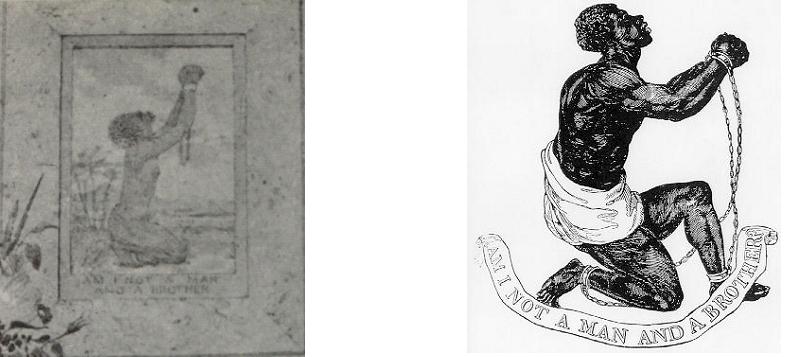
Patricia Allderidge shows that Dadd’s family was indeed sympathetic to the cause, and Dadd would surely have seen the poster before his incarceration. So far, so good. But in his picture Dadd paints in the text (my italics) : “Am I not a man and a brother”, which suggests he was recalling a “male” version; and although there was a “female” version of the poster it declares “Am I not a woman...”.
Here is a crop of Dadd’s painting, left, compared with the well-known "male" original on the right:
Dadd's eye for design has dominated his recollection and simplified the image. He makes the figure’s heavenward entreaty yet more emphatic. But Dadd’s caption clearly says it's a man, even if you might be sympathetic to Ms Higgie’s alternative, but surely mistaken, reading of the figure.
Next there’s the “woman trapped in stone”. Here Ms Allderidge points to two sources for Dadd’s image. The first is his own oval painting of a kneeling nude in “Evening”, a typical Dadd fairy-style fantasy made around 1841, before his incarceration. The second is a statue of “Narcissus” initially supposed to be by Michaelangelo (though that is now discounted). With due deference to Ms Allderidge, there is another possibility. For my money the attention that the lady pays to her coiffure makes a Hellenistic statue of Venus, also now in the V&A, a more likely candidate.
Here they are, left to right: The Woman in Stone; Evening; Venus.
The similarity of the poses is telling. However, there is a feature that sets “Evening” and “Venus” apart: their unmistakable femininity. By contrast Dadd’s bad-hair-day-lady looks like a chap-with-breasts-attached.
Rather dodgy gendering I reckon, and we'll find out why in a moment; but let's get on to the person in the chair, skipping the barely legible painting of a ship on the right save to say that Dadd was brought up in Chatham with its Naval Dockyards, and was forever painting boats. This one is a slave-runner, as the inscription on its bow indicates (see note below).
So, the "woman", the "old one, asleep" in the chair. Is that a "woman" (as Ms Higgie says) and the child's Governess, or a man and its Master?
We can do a poll of the commentators here: Ms Higgie, as we know, says it’s a woman, as does Madame Isaure de Saint Pierre in her novel based, imaginatively, on Dadd's life; Alison Smith in the TATE Watercolour exhibition catalogue stays shtoom; David Greysmith in his book sticks his neck out and says it’s a “he (or she)”; Ms Allderidge says it’s a man.
If only it were that straightforward.
To put things in context: Ms Allderidge comments that in the Asylum Dadd would have had to use male models, even when painting women. Criminally insane inmates were kept on separate gender-segregated wings, with meals probably brought to the wards, and were denied attendance at Chapel or the Asylum Ball (thanks to Colin Gale at the Bethlem Archive for this info). Perhaps then Dadd's memory of the specifics of female physiognomy had waned, along with his sureness of touch at rendering them in paint.
So, first the face - is that male or female? Well, here is another revealing comparison.
It's a reasonable guess that Dadd's 1854 painting of Lucretia - "female" - on the right, is based on the same male model as the figure in the chair (dated 1857), hook-nose and all. And like Lucretia, Dadd may have intended the seated figure to look like a woman, but it has regressed to the appearance of a man.
Now look at the figure's garb, and compare it to Dadd's 1842/3 portrait of Sir Thomas Phillips in Arabian costume (cropped below). Phillips was a major figure for Dadd's reputation as an artist. He was the patron who took Dadd on his tour of Europe, the Middle East and North Africa before the fateful patricide.
The figure on the left apparently wears a Victorian lady's shawl wrapped round its shoulders and peaked above the forehead, but surely it is based on the Arabian male's Keffiyeh that Sir Tom models for us on the right. The cuffs correspond as well. Dadd, it appears, has used artistic license to borrow the ethnic get-up of his one-time patron.
So, man or woman sitting in the chair? FWIW I reckon Dadd was led astray by his misremembered past and his gender-bent present: they made a shaky foundation on which to build a stable and convincing image of the female form. His vision wobbled. Man or woman? If it doesn't sound too arch: both.
Finally, let’s look at the last piece of the jigsaw – is the boy (it can't be a girl, can it?) in the painting Richard Dadd himself, as Madame de Saint Pierre has it in her souped-up novel?
Other commentators are silent on the matter, which perhaps says a lot. Here is an identity parade of the child (in the middle, and reversed for ease of comparison) with a Dadd self-portrait at age 23 on the left, and, another etching of himself, perhaps a year later, on the right.
Dadd in the middle? May be, or maybe not, as Mr Greysmith might have put it.
So, that's my deconstruction of The Child's Problem: autobiographical and self-referring; infused with faded memories and distorted perceptions; Dadd in the detail.
Enough. Now it is time to put the Child and his Problem to bed, because next time we have an exciting adventure at Broadmoor.
Note.
The inscription on the bow of the boat is given by Ms Allderidge as "THE BLACK FEREE. Remarkable Fast Slaver. Commanded by Captn S. Nigger. [?.]"
Acknowledgments.
JenniferHiggie, on Richard Dadd's The Child's Problem (1857). In TATE Etc. Spring 2011.
Alison Smith's note in the Catalogue to Watercolour , Tate Britain 2011.
Patricia Allderidge, The late Richard Dadd 1817-1886. The Tate Gallery, London 1974, also Richard Dadd. Academy Editions, London 1974.
David Greysmith, Richard Dadd; the rock and castle of seclusion. Studio Vista, London 1973.
Isaure de Saint Pierre (ed. Anthea Bell), Richard Dadd - his journals. Aiden Ellis, Henley 1984 (originally published in Paris 1980).
Thanks again to Colin Gale at Bethlem Museum and Archive; and to Seani for his technical wizardry with the illustrations.
Don't know if you've noticed before, but our banner says,
Updated every Monday, Wednesday, Friday and Saturday ... and maybe other days too.
Obviously, then, a post is due. The trouble is, what was going to be today's offering went out just after six last night. It's worth a look, if you haven't already seen it. Well, it is if you're interested in the ECF's response to the jiggabubble that was created by Ray Keene's surprise appearance at the British Championship opening ceremony anyway.
Still, we promise you a post on Fridays so you will get a post on Fridays. Here's something my friends Larissa and Rob saw in a shop window in Venice earlier this week.
As you may have noticed, the guest of honour at Sheffield's opening ceremony rather caught our attention: When will they ever learn?; The man who would be mentioned. Interested readers might also wish to peruse the comments box to CJ, the ECF and Constable Savage which contains contributions from ECF Chief Executive Andrew Farthing and many other chess worthies as well as from chess unworthies such as myself and a couple of my fellow bloggers.
Andrew has been kind enough to answer some further questions on the matter. I was originally intending to write a full post on this topic for tomorrow. However, given that similar queries are now appearing on the EC Forum, I have decided to publish the ECF's response straight away, but without without any additional commentary (which I haven't had time to write).
S&BCB:
I am hearing that Ray Keene was invited to open the British Championships by CJ who had not previously discussed the matter with anybody in the ECF. Is that true?
ECF:
Yes, I believe that it is true that CJ did not discuss RDK's invitation to open the Championships with any other Board member. Speaking for myself, I did not learn of it until after the event, when I saw mentions of it online.
S&BCB:
Do the ECF find this an acceptable way for the President to behave?
ECF:
The President has traditionally been the Board member in charge of the opening and closing ceremonies at the British. As far as I know, it has not been usual for the President to consult the Board regarding the individuals invited, so what happened this year was not outside the norm.
S&BCB:
Are we now deciding that the Ray Keene/Tony Miles issue is best forgotten as it was so long ago, or has the matter been resolved in some way?
ECF:
I have no comment on this.
S&BCB:
Why has no mention of Keene’s presence at the opening ceremony appeared on either the tournament or ECF websites?
ECF:
I wasn't present that Monday - I intended to be there, but car trouble intervened - but the reports from Board members who were indicate that the opening ceremony was a relatively low-key affair. I understand that CJ gave the main opening address, after which RDK formally declared the Championships open. (Most of the feedback related to inaudibility, i.e. the lack of microphones.)
In general, the website coverage throughout the event didn't include much "colour" commentary, concentrating in the main on the results and the games. I don't believe, therefore, that there is anything particularly significant in the omission. If the opening ceremony had been "grander", perhaps there would have been some coverage.
Tuesday 9th August: Danny Baker tweets it like it is
What were you doing last Friday around 5pm? As this was back when it was possible to venture out of doors in the late afternoon/early evening without having to calculate the chances of being looted, set ablaze or generally pillaged I suppose there are any number of things you might have been up to. What I was doing, let me tell you, was packing my cozzie and a towel into a bag and thinking, "I'll just watch the end of the last round then I'll head down to the pool." As it turned out, though, I never made it for my swim. Five hours on I was still glued to my computer, totally captivated by a game of chess that seemed like it might never end.
It was a remarkable evening. Of the top four boards Wells-Hawkins was the first to finish ...
... followed by Gordon - Short ...
... and Adams - Zhou ...
... these last two finishing within five minutes of each other around about a quarter past seven. Jones - Pert, though, that went on and on and on before, after 144 moves and very nearly eight hours at the board, they finally called it quits.
It was a truly epic evening of chess. There might not have been a single decisive result on the top four boards, but nevertheless the last round was entirely in keeping with the fighting chess that we saw, with rare exceptions, throughout the tournament.
Needless to say, Sheffield's last round would have been enthralling in any circumstances, but it was made all the sweeter by the fact that the latest issue of CHESS features the Rustam Kasmidzhanov 'open letter' and three pages of utter cobblers from John Foley on the subject draws. They are dull, they are bad for chess and they should be eliminated from the game to the greatest extent possible, apparently. Not just short 'grandmaster' or 'struggle free' draws, mind. All draws.
We've seen a lot since last Friday. OK, it hasn't quite been attack ships on fire off the shoulder of Orion, but neither has the torching of furniture stores in Croydon and party shops in Clapham been much of a joke.
LIF.EG.O.ES.ON, though, and we mustn't let what was important to us before the unrest began be completely replaced in our minds by images of destruction and violence. It is for precisely that reason that while I am busy joining the line of people for Danny Baker, I will also make time to contact editorATchess.co.uk to ask if John Foley and Rustam Kasmidzhanov could join the queue for me.
Raymond Keene, beloved of this blog, has a bit of a reputation for throwing his weight around when he's not happy. Or so some say. To be honest, it's not seemed like that to me these last few years, perhaps because Ray has mostly been happy to plough his own furrow: Simpson's, the Times, Impala, Chessgames.com, that sort of thing.
It's like a man who believes he should be king: living a kind of exile life, surrounded by his courtiers and admirers, hardly impinging on the rest of us at all except for the occasional cross-border raid to borrow a passage of writing that isn't strictly speaking his. We know he's there, we talk about him now and then. But he doesn't really bother us.
But if this has been the age of Ray in exile, it is also the epoch of social media, which respect and recognise no borders man has made. You may find Ray cropping up on your Twitter feed, or your Facebook page. Quite unexpectedly, at least at first. And naturally, all kings-in-exile yearn to return to the kingdom they believe is rightfully theirs. They all dream of coming back, and if they get the chance, they take it. So even more unexpectedly, you may find him cropping up at your chess championship, speaking to the people he still believes are his. Whether they think so or not.
He dreams of coming back, the king acknowledged by his people. It is lonely, being an exile, and what the would-be-king demands, as much as anything, is recognition. Acknowledgement. Worse than being talked about, is not being talked about. So you can see how ill he took it, when he made his speech and nobody mentioned it. It is as if Bonnie Prince Charlie had come back - and everybody shrugged their shoulders and pretended it didn't happen. Intolerable.
So it is that over the past week or so, we've seen Old King Ray back to something like his previous form, demanding apologies on Twitter like he was ordering desserts at Simpson's. It was I, says Ray, who opened the British Championships. CJ made the ceremonial first move: but the opening of the tournament was I and I alone. Thus spake Ray. And those who failed to acknowledge the King must be made to submit to him.
Strangely, it took until 28 July, as late as the fourth round, before Ray, perhaps waking up after a long sleep, realised that people were writing about the British Championships as if he had never been there.
Even then, the campaign didn't really get going until Monday 1 August, when Ray - perhaps, by then, having recovered from Sunday lunch - realised that the Daily Telegraph chess column had failed to mention his central role in the opening ceremony. He demanded a correction. Or, more accurately, for we know that accuracy is important to Ray, he demanded a retraction. A retraction, and an apology. And a cherry on top.
(Readers still unfamiliar with Twitter may need to know that Tweets display above the one before, so that they proceed, chronologically, upwards on the screen. Usually.)
At this stage, though, it seemed more of a skirmish than a campaign, since only two days later, with Short-Adams I out of the way, Ray was claiming victory, having - according to him at least - received his apology. (Via CJ, he said, perhaps explaining why it hadn't appeared on Malcolm's Twitter or anything.)
Just in case we had missed it, he said it again the next day
and again later the same day. And then he opened up on another front. With victory due to be sealed officially the next day, with Malcolm due to publish his surrender in the Daily Telegraph, he moved his cannon to a new position and opened fire on the English Chess Federation.
(This one goes chronologically downwards. Don't ask.)
He fired once! He fired twice!
And then there was a lull, while he waited for Malcolm's official surrender. But what was this? Had Ray been double-crossed? Nothing appeared in the Telegraph on the Friday.
He complained. He insisted. He raged. (He pointed, too, at The Week In Chess - prop. Malcolm Pein - who had also failed to make it up to him for their previous earlier omission of his role.) He complained on the Saturday
and he complained again on the Sunday.
He complained, and he raged. My word, did he rage, since that weekend the CJ T-shirt controversy kicked off, to which Ray applied himself vigorously, on Twitter and in the Sunday Times. And in his rage, he found another subject for his displeasure, since one of the ECF officials - who he had decided, without communicating with them, were responsible for CJ's unhappy experience - was brave and foolish enough to risk his further displeasure by confronting him in front of his own court.
The "glass of water" Tweet very much the pick of the bunch, if you ask me, but regrettably Ray failed to see the funny side. Lara Barnes, new to Twitter as she was, had made the dreadful error of thinking that in referring to a "Laura", Ray was referring to her. Dreadful. Awful. And woe unto Lara for her mistake.
Woe be upon her. Woe.
Thrice woe.
Though for a few hours, Ray's wrath subsided, since he had in front of him an actual, tangible correction. If not an actual tangible apology.
How enthusiastic a correction it actually was - let alone how prominent - one might well wonder, since it gave the impression of having been carelessly compiled
and hence perhaps its presumably accidental resemblance to the old optical illusion that goes something like
PARIS
IS THE
THE CAPITAL
OF FRANCE
not to mention the possibly unconvincing suggestion that Ray's presence had been overlooked due to the absence of a PA system when he spoke. (Such a system had indeed been absent, but it strikes me that Ray is one of those people who one can see, even if one cannot hear him.)
Still, emboldened by this success, Ray was keen for more, and turned his cannon back onto Lara Barnes. Boom! Her "entirely erroneous approach". Boom! Her "obvious blunder". Boom! Her "false accusation".
The smoke cleared. The firing stopped. The surrender was forthcoming, and humbly with it.
There's lovely. I'm glad Ray didn't spoil his dinner. And it was generous of him to consider the matter closed, even if it meant that Dr Harris' suggestion, that Lara's error had been of a minor nature, went unanswered. But that is how a king behaves in victory. With magnanimity.
So ended the campaign, or at least, that is how it seemed at the time of writing. How did the old king fare? By my count, he scored one apology received, another claimed and one correction of sorts on TWIC. No obvious correction, however, on the ECF or British Championship websites, though the latter did give Ray a mention. Plus, according to his claim, a forthcoming apology in Chess, which isn't out yet. Plus one in the Telegraph, which was still overdue last I heard. Then again, I don't see the Telegraph.
So Ray may be claiming more than he's actually entitled to here, not that this is an entirely unusual habit for him. Though perhaps the most important thing, for Ray, is that Malcolm, apparently, apologised. My word, did he apologise. Not only graciously but "profusely". And other people should apologise "as Malcolm Pein did". Ray was in the right. He had been there. He did it. He was acknowledged.
We'll get back to the question of apologies, and who should make them, and whether they are forthcoming as often as they might be, later on. Before we do, though, it may be time to make the obvious point, which is that there may be a reason that people chose to avoid mentioning Ray's presence at the opening ceremony, and Ray knows that as well as everybody else.
It may be because they were embarrassed at his presence. It may be that they didn't want to have him there. It may be they didn't know that he was going to be there, because nobody had told them.
Why would this be? It would be because there is a bad smell hanging around the name Ray Keene, a bad smell that has been there for an awfully long time. A bad smell which is there for a lot of reasons, all of them known to Ray Keene, and by this time known to most of the chessplaying community, if not always recognised by his acolytes on Chessgames.com and elsewhere. (Hello, Steve. Hello, Nigel. Hello, Sean.) We know what Ray Keene is. Ray Keene knows what Ray Keene is. And that's why CJ, who appears not to know what Ray Keene is, had to invite him to Sheffield on the quiet.
Now Ray, for all his sins, can be a lot of fun, and following his Twitter account can be a lot of fun. I follow it, and I recommend it. But while it can be fun to watch Ray at work, making an unlikely claim and then backing it up with a sliver of the truth, it's not quite so much fun when he goes barging around bullying other people into apologies that they don't really owe him.
I wonder, for instance, regarding his dispute with Lara Barnes, whether Lara's real sin may have been trying to take the piss out of him. It seems to me that mistaking "Laura" for herself was about as minor a sin that one can possibly commit. It also seems to me that Lara was not obviously making false accusations, and that if anybody was making them, Ray was not necessarily their target.
Well, short-lived dispute on Twitter, nobody died, no bruises sustained, no pride much hurt, not even Ray's. So let's get back to this business of being prepared to make apologies, rather than the somewhat less gracious affair of demanding them. Another glance at Ray's admirable sentiment:
Like many admirable sentiments, it does rather beg the question of whether it's actually applied in practice, and I do confess that my memory admits to very few examples of Ray accepting that he's been in the wrong, let alone issuing, with courage, one of these admirable apologies.
I'll spare the reader the detailed list, what with life being short and blog articles being long. But just to come up with one example, when a long passage from Edward Winter turned up on Chessville.com, and later in the Spectator, with barely a word changed and without any note of attribution, I don't recall any apology from Ray, let alone any admission of guilt. All I recall, and I can find it here, is a highly unconvincing claim as to how this copying came about, and a suggestion that somebody else could organise a proper attribution.
Not obviously a demonstration of Ray's courageous willingness to apologise when he gets something wrong. Perhaps readers can furnish us with some better examples.
To be honest I doubt that Ray could stand up all the claims he made on Twitter about the T-shirt affair, but I leave that for the exceptionally patient reader to look into, and decide. (Quite a few things Ray says on Twitter don't entirely stand up, but that's part of the fun of following him.) Enough: I am off on holiday today. England, since you ask, which currently has bigger problems to deal with than Ray Keene. Anyway, I could probably have saved you all the trouble of reading this, simply by making this observation. Can we imagine anybody other than Ray Keene, making a speech at the British Chess Championships, and then going purposely unmentioned?
If not, why do we think this might be?
Perhaps because it's one thing to be the man who would be king. But quite another, when there are so many reasons for us to have it otherwise.
[Author's note: It seems a little odd to be writing about chess this morning. After the tumultuous events of recent days - the riots I mean, not CJ's t-shirt - it seems a tad trivial, but, as you know, that's how we roll.
As it happens, I was playing chess last night and until about 11:30 I was completely oblivious to how it was all kicking off just down the road. Can't helping feeling that if there was a little more knight to king bishop three and little less global economic meltdown/burning of stores that sell sports footwear we'd all be much happier. Anyhoo, chess blogging resumes ...]
White plays 10 b3
Houska v Rendle, British Championships (10) 2011
I've written about exchange sacrifices before: exchange sacs to get rid of a fianchettoed bishop (TISE); exchange sacs to start an attack on the king (TISE II); exchange sacs that become standard theoretical ideas (TISE III); exchange sacs to power-up a fianchettoed bishop (TISE IV), but until now I haven't mentioned one of my favourite kinds: the exchange sac that doesn't happen. Jovanka Houska's game with Tom Rendle from the recent British Championships is a good example of one of those.
From the diagram at the top of today's post play continued 10 ... Na6, 11 Ng5 Qe7, 12 Nxe6 Qxe6, 13 Bb2 Nc5, the players ending up in a position
that is very close to one once reached by Keene and Botterill at the British Championships nearly forty years ago. Actually, the only difference between the two is that Raymondo hadn't played Nxe6 although according to Tim Harding's book The Leningrad Dutch (Batsford, 1976), exchanging knight for bishop was RDK's own suggested improvement on that old game.
This is all very well, but why answer 10 b3 with ... Na6 as Rendle and Botterill did? Why not play the obvious - obvious to this middling club chesser anyway - 10 ... Ne4? Black's just winning a piece isn't he?
Not quite, but he can 'win' the exchange after 11 Nxe4 Bxa1, 12 Bh6 Bg7, 13 Bxg7 Kxg7, 14 Qd4+ Kg8, 15 Nxd6.
What does White have for the rook? Knight and pawn and a lead in development for a start. I would also have mentioned Black's restricted light-squared bishop, but perhaps that's not the most significant factor because in the game given by Harding (Bukhman-Blekhstin, Leningrad - appropriately enough - 1968) White's next move was e2-e4 opening things up somewhat.
Most of all, I suppose, White has the weak dark squares around Black's king to aim for. This isn't quite the same as the otherwise similar Shirov - Bareev, though, because White still had a bishop on the long a1-h8 diagonal in that game. I found it hard enough to judge whether White had sufficient compensation with Shirov's position, but I find it even harder in this case.
Does White really have enough? I guess he must do. Harding quotes Taimanov saying that White's "initiative outweighs his small material deficit" and the fact is that when RDK switched from 10 b3 to 10 Qd3 (Ray Could Play VI, for example) it was not because his opponents were taking the rook, but because they weren't. Even Harding considers Rendle's 10 ... Na6 to be the 'safest' move. I suppose if Black players are avoiding a line that's a pretty good sign that it should be good for White.
I was curious what Tom Rendle thought about all this so I emailed him to ask whether he'd given any thought 10 ... Ne4 and 11 ... Bxa1. He replied simply, "It's known to be an inferior (or at least very risky) line." Fair enough. He is a bit of a Leningrad expert after all. For the rest of us, though, I think it's worth a ponder.
That's exchange sacrifices for you. Even when they don't happen - especially then, perhaps - they can be pretty interesting.
Yes, we've had it before, but it's 2:43 that interests us today
T-shirts, eh? Who knew that seven words on one could generate so many words about one?
There’s so much to choose from, but of everything I’ve read over the last couple of days - and I’ve read a good deal, not to mention written a fair bit - one small section of CJ’s first statement caught my attention above everything else:-
The other 2 arbiters said "no problem with it" and "I hadn't actually noticed” but after a discussion returned and ....
Hold on a second. Let’s back up a moment and run that middle bit past ourselves a second time.
Somebody hadn’t noticed? The bright red t-shirt with the MESSAGE WRITTEN IN WHITE BLOCK CAPITAL LETTERS? They hadn’t noticed?? That’s right up there with Constable Savage not spotting that Mr Winston Codogo was a 'coloured gentleman'.
"I hadn't actually noticed"? For real? It would be hard to believe that such a thing could possibly have been said outside the realms of parody if we didn't have CJ's assertion right at the beginning of his post that, "everything in inverted commas is an actual quote given this morning from an interested party" to reassure us that it was.
Anyhoo, whether the quote is true in detail or merely true in substance doesn't really matter. Either way it rather neatly illustrates how the ECF have (not) been responding to some of the things that CJ has been up to over the last year or so. It isn't just the arbiter cited above; the whole federation has been Savage-esque in its ability not to notice for quite some time now.
The ECF President: hard to notice
I ended last Thursday's post by acknowledging that to a very large extent (I save some praise for the players being willing to slug it out and everybody behind the scenes whose work allowed me to watch the games live/download the pgns) the credit for Sheffield 2011 being a great tournament goes to CJ. I wrote those words with the intention of following up with something this week on the theme of, "however that doesn't give him a free pass for everything else" although, I must confess, I hadn't exactly expected that it would turn out quite like this.
When we look, if we choose to look, there's a back story to the last couple of days' argy-bargy and focusing only on the actions of the one particular arbiter who did notice the t-shirt* will leave us missing a much bigger picture. Sooner or later we'll take a peek at CJ's penchant for private initiatives and the ECF's taste for managing not to notice how they create conflicts of interest, be they actual or potential, for him. For now, let's quickly review what happened at the beginning of Sheffield 2011 and start to wonder whether all the unpleasantness, not to mention the negative portrayals of the game that appeared in the press yesterday, could have been avoided had our national body opened their eyes just a little bit sooner.
Guess Who breaks the news on Twitter
I was going to write something about CJ wearing a t-shirt and jeans at the opening ceremony first, but let's cut to the chase. It's the fact our old friend Raymond Dennis Keene was present that's really interesting.
Raymondo popping-up raised a few eyebrows, not least our own. The ECF, however, seem not to have noticed Keene's presence at all. In fact they failed to notice to such an extent that his name does not appear in official programme nor, as EJH pointed out at the time, could any mention of him be found on either the tournament or ECF websites. Even today, although room has been found to thank Ray for "over thirty articles" that mention the championships, I still don't see anything to say that he opened the tournament with CJ. Not that's all very odd, isn't it?
It is important, I think, that we keep a sense of proportion about all this. It was twenty years ago that RDK left what was then the BCF [Keene's Gambit; Keene's Move; Checked Again] after all. To put that in perspective, that's sufficiently long enough ago that even if he’d murdered Tony Miles back in Tunis, he would have been released from prison by now.
Nevertheless, as fond as I am of RDK - and I am genuinely fond of him - the fact remains that there is a difference between allowing somebody who has ‘paid their debt’ to get on with their lives and simply pretending that murky events from days gone by never happened. I have, therefore, some questions for the ECF:-
Have the matters relating to Ray Keene's departure from the (then) BCF now been resolved?
If so, how?
and also,
Who decided that Ray Keene should be at the Opening Ceremony?
When was this decision made?
Why was the decision not made public?
Why has no mention of Keene’s presence at the opening ceremony appeared on either the tournament or ECF websites?
I'm not saying that it's necessarily wrong that Ray be brought back into the fold, but it might be as well that we clear that lot up before we - including CJ - go any further.
Dated reference ahoy:
CJ didn't get where he is today by being noticed
It's been quite a weekend, but fortunately it ends with everybody loving everybody else once more. That is to be welcomed, although it is also to be hoped that the matter does not end here. Many pages before the end of that EC Forum thread I wrote,
A good discussion of the nature of CJs relationship with the ECF is overdue
and that's as true after the kiss-and-make-up messages as it was before.
The ECF's ability not to notice - including but not limited to clothing and blossoming relationships with former British Champions - paved the road that led us to Saturday morning. If there's one thing I know about the last few days it's that, regardless of what I feel about the issue, I'd rather hear "Um, CJ, about what you're wearing. Perhaps ..." over "I see no t-shirts" every time.
Or are we - meaning the ECF and the English chess world in general - going to decide that the only thing that we're going to notice is the amount of cash a person, CJ, RDK or anybody else, can bring to the table? We could, I suppose. We could reduce our relationships to "Show me the money" and "We love you long time" if we want. It would be a rather savage existence, though, don't you think?
*which is unfair anyway since CJ's account makes clear that a number of people were involved in making the decision. However, I shall take advantage of this footnote to say that while I do not know the particular arbiter concerned, Jack Rudd does and if he is willing to write publicly that "I'm happy to accept that she wasn't being homophobic and that she was trying to act in the best interests of the tournament" I am equally happy to accept that he what he writes is true.
You may have missed this, what with everything else going on, but congratulations are due to Mickey Adams. After winning yesterday's play-off he now has the 2011 British Chess Champion title to add to those that he won in 1989, 1997 (shared) and last year in Canterbury.
Nice one Mickey, then, but it seems a bit harsh on Nosher that he should have missed out on what would have been his fourth championship (previous wins: 1984, 1987, 1998) because of a brace of games played at 20 minutes on the clock plus ten second increment per move. All the more so after he matched Adams' +6 =5 -0 over the regular eleven rounds despite facing tougher opposition.
We'll have more on that next week, but for now: them's the rules, so hurrah and huzzah for Michael Adams. While he celebrates Nigel gets to console himself with the knowledge that he'll be leaving Sheffield with some serious wedge - getting on for £7,000 not counting expenses/appearance fee - in his back pocket. He's come a long way since the days when winning a tournament meant £65 cash money and a set of Goodyear tyres thrown in.
By the way, check out Nosher's Parker. I think the organisers must have insisted that he wear it to ensure a teeshirt with an unseemly political message - something like, "hey everybody, let's all get along" or "I like tea" - remained tastefully covered up. Thank goodness chess doesn't make a complete dick of itself by doing that sort of thing these days, eh?
Addendum:
As I was writing the above last night the teeshirtgate story appeared on the Guardian website. Oh goody. Just what we need.
I suspect this story will run for a while longer. We at the S&BC Blog will certainly be coming back to it soon, if only to ask, why is RDK turning up at the opening ceremony OK, but a red teeshirt with some writing on it completely out of the question?
Addendum to the addendum:
Don't miss Martin's Chess in Art Postscript from Saturday. It features a man playing chess in top hat and tails. Just what we need right now, wouldn't you say?
Big story breaking today. We'll start on it properly tomorrow. In the meantime, don't miss Martin's Chess in Art: Postscript piece which will, undeservedly, get pushed down the batting order a bit more quickly than would usually be the case.
Source Material: originally spotted on an EC Forum post by Sebastian Stone
The starting point for this Postscript comes from fellow blogger Tom Chivers. A month or so ago he kindly forwarded to me an exquisitely painted picture that he saw on Mark Weeks’ blog, and Mark saw it at Gandalf's Gallery. I was sure you’d want to see it too. Who’d have thought it: Chess in Art goes viral.
The Chess Player (date unknown) Isidor Kaufmann (1853 - 1921)
Kaufmann's work is a very fine example of the Staring Into The Abysssub-genre of Chess-in-Art works, hence this opportunity for a PostscriptPostscript. The primary elements are familiar: one player only, a board, and a decent arrangement of pieces. This is the triangular armature essential to Staring Into The Abyss, here presented with a Jewish inflection.
Regarding the pieces: who, following EPTAS: Leeming Plays a Blinder or What Dadd Did, can now resist the urge to count them? We need to know whether or not the artist has done a proper job and painted in a full set.
After Richard Dadd’s jiggery-pokery (in his chess picture, The Child's Problem,he hid a pawn under a walnut shell) we hope we are not going to be misled this time by disguise or camouflage.
Oi vey; is he hiding a piece under his left hand? The schmuck.
And is that a rational position on the board? I can’t make sense of it. Perhaps, if he’s reading this, Leonard Barden could please help us out, as he did with Dadd's picture.
There are some telling anecdotal details on show. That ciggie smouldering on the edge of the table – forgotten while his hand is put to better use soothing his cudgelled brain – appears to be wedged into an ivory cigarette-holder. Perhaps it’s a family heirloom, as the rest of his thread-bare schmutter doesn’t speak of self-indulgence. The room is also spare and down at heel. We are looking at a scene from the shtetl. Kaufmann mines a vein of European Jewish cultural experience not yet fractured by the Shoah.
Some other details are also eye-catching. Look at how Kaufmann has set the board at an angle to the table. Such a subtle misalignment, echoed by the book on the slide, and the teetering top-hat, creates some visual action where otherwise all is paused in concentration.
And that finger picking out a square on the ‘a’ file. It suggests that the fellow is struggling not just with the position, but with chess itself. He needs a physical crutch to help him with his mental stumbling.
We can see also that, for the moment, he has cast aside the book with the problem that gives him so much grief. In fact there’s a whole careless pile, and it speaks volumes for his ambition to elevate learning, culture and our obsessive game above personal affectation. All serious chessers will recognise here their own heap beside their favourite armchair. It could never be replaced, aesthetically anyway, by a Kindle™.
But let's get back to our theme, and the finger. We know from our previous dip into the murky waters of this sub-genre that the solitary player, lacking a human opponent, is pitted instead against another, indomitable, adversary: the unfathomable deep of chess itself, standing in for the mystery of life, the universe and everything.
His digital stab reveals that his grasp of the game is shaky. He is marking out the imagined trajectory of a piece in the forlorn hope that it will conform to his intention. But it is really a sign that betrays another meaning: that he is already defeated, not only chessically, but existentially. His hold on reality is as tenuous as that on his chess. He gingerly taps the board, a pictorial analogue for the thin crust of his sensible world. He is desperate lest it split asunder to reveal the Abyss beneath.
Not surprising, then, that the doomed patzer looks worried.
Note: For more rivetting Kaufmann portraits see Art Inconnu.
And for a spot of artistic reverence, and pale imitation, cop this.
The following email was sent to New in Chess on 20 June. It does not appear in the latest issue, 2011#5.
Dear New in Chess
The Isle of Man tournament of which Nigel Short complains took place eight years ago, and Short has spent much of those eight years going on about it. I was a participant in the tournament and have a rather different view of events than his.
Firstly, everybody seems to have been aware that repairing would take place - everybody, that is, except Short. There is a very good argument, which Short makes, that this should not have been the rule. There is also a very good argument, of which Short takes (and took) no notice, that it was, nevertheless, the rule, and one should not change the rules of a tournament after a tournament has started. Even if the top seed insists otherwise.
Secondly, what attracted criticism about Short's conduct wasn't that people felt he had no case, but the way in which he put that case. It would have been possible simply to disagree, or even to appeal, and then to continue play: in Short's case, this would have entailed playing a game of chess against somebody graded about 500 points below him. Instead, he chose to throw his toys out of the pram, walking out of the tournament when he didn't get his way and subsequently attacking not just the arbiters but anybody who had had the temerity to criticise or disagree with him. (A process which, it seems, continues.) It was not a performance that impressed or endeared him to anybody.
Now we've all behaved unimpressively in our time, the present writer no exception. We've also all felt we were in the right when other people took a different view. But Short didn't seem able to accept that other people see it differently - and eight years on, still doesn't. I wonder whether this insistence, that there is no other valid point of view than his, might help to explain why the other players didn't queue up to agree with him.