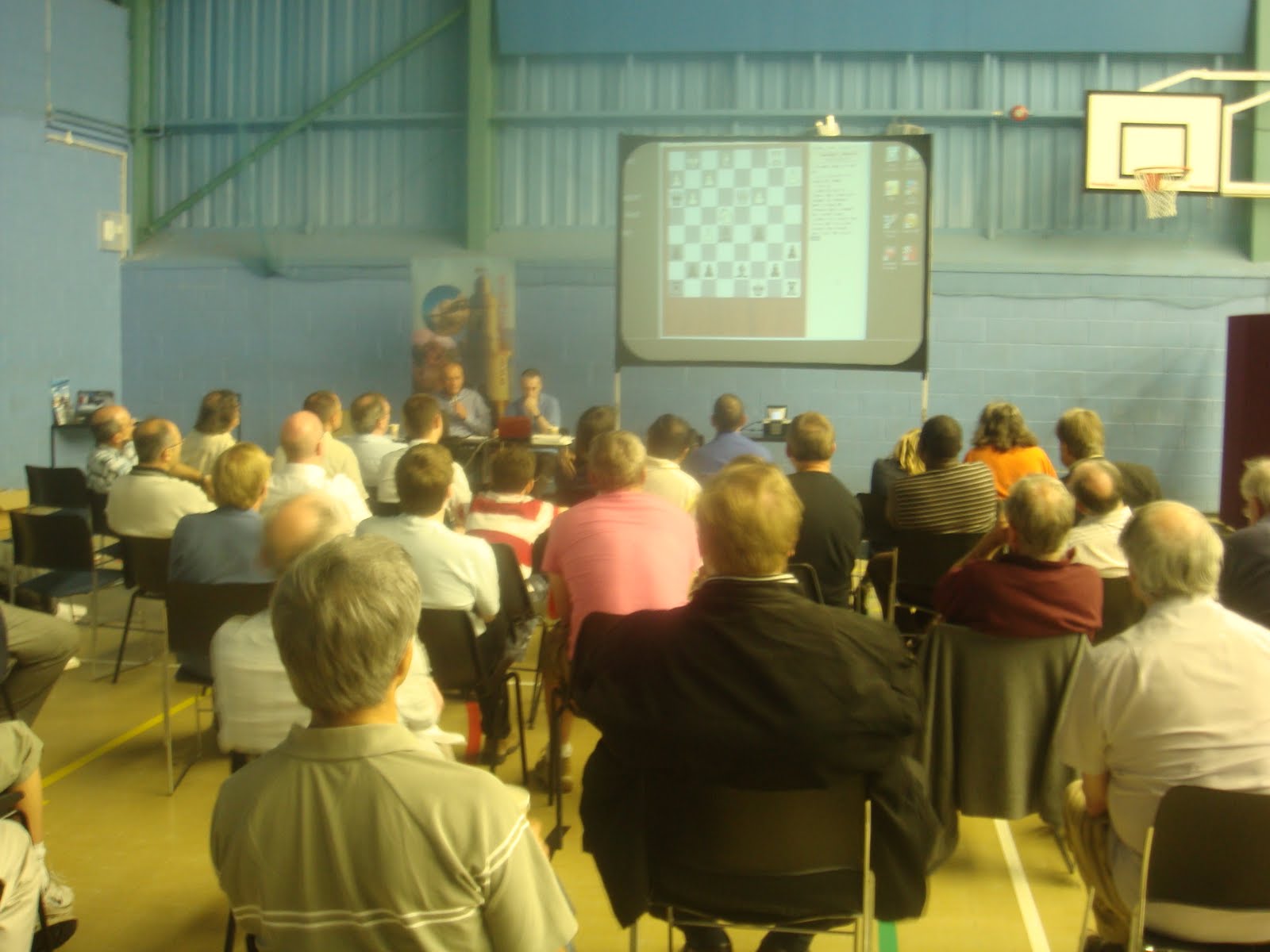
Friday, August 13, 2010

When we were Kings IX: Little Earthquakes


Small Earthquake in Chile - Not Many Dead

Claud Cockburn


I have a friend who lives in Canterbury. She, it turns out, had no idea that the British Championships were being played in her home town until I mentioned it to her a few days ago. As a matter of fact, she even works at the University and yet still didn't have a clue what was happening right on her doorstep. We're not exactly writing the songs that the whole world sings are we?

As EJH mentioned on Monday, the Evening Standard's decision to ditch Leonard Barden's chess column right in the middle of the British was rather symbolic of the how chess gets treated by the mainstream media in general right now. I'm not sure it's our fault particularly, in fact I'm sure it's not, but the fact remains that these days we have a bit of a problem getting anybody to notice us. The current, rather dismal, state of affairs certainly stands in marked contrast to how things were in the '70s.

Claud Cockburn once famously claimed to have created the least interesting headline in newspaper history. I wonder what he would have made of,

“Spassky Calls Off Chess Game Because of a Cold”

This zinger appeared not once but twice in The Times in December 1977 and shows better than anything else just how newsworthy our favourite game was back then. It's not just that it used to be front page, mainstream news. When we were Kings chess even got reported even when it wasn't played.


The Times
10th November 1977
page 7

INJURED KORCHNOI HAS TO PUT OFF SPASSKY MATCH
Frauenfeld, Switzerland, Nov 9. – Viktor Korchnoi, the Russian chess grandmaster, was injured in a road accident last night and will have to postpone his world championship semi-final against Boris Spassky.

Korchnoi, aged 46, who defected from Russia last year, suffered a broken hand and other minor injuries when a taxi in which he was travelling collided with a Swiss Army vehicle.

The semi-final match against Spassky was to have started in Belgrade on November 15. Swiss chess officials said the two men’s managers were discussing another date. – UPI


The Times
16th November 16, 1977
page 11

KORCHNOI DELAYS SPASSKY MATCH
Belgrade, Nov 15. – The world chess championship semifinal match between Viktor Korchnoi and Boris Spassky will start next Monday instead of tomorrow as had been planned.

Korchnoi, who injured his hand in a car accident recently, asked for a postponement today and Spassky agreed. – Agence France-Presse


The Times
3rd December, 1977
page 5

SPASSKY CALLS OFF CHESS GAME BECAUSE OF A COLD
Belgrade, Dec 2. – Boris Spassky, the former world chess champion, today called off the sixth game in this match against Viktor Korchnoi because he had a cold. The game will be played on Monday.

Korchnoi is leading in the match by 3 ½ points to 1 ½. The winner will challenge Anatoly Karpov, the present champion, for the world title. – Reuter.


The Times
8th December, 1977
page 6

SPASSKY CALLS OFF CHESS GAME BECAUSE OF A COLD
Belgrade, Dec 7. – Boris Spassky, losing 2-4 to Viktor Korchnoi in the match to decide who will challenge Anatoly Karpov for the world chess championship, called off the seventh game today because of a cold. The game will be played on Friday.

Each player has the right to three postponements during the 20-game match. Spassky has now exercised the right twice.


The Times
19th December, 1977
page 5

KORCHNOI PUTS OFF GAME
Belgrade, Dec 18. – The tenth game in the match between Boris Spassky and Viktor Korchnoi to find a challenger to Anatoly Karpov, the world chess champion, adjourned on Friday night and due to be resumed last night, was put off until tomorrow at Korchnoi’s request. – Reuter.


See also: Trio
WwwK Index

Wednesday, August 11, 2010

Best of the British

In my view, this was the best game played in the British Chess Championship 2010.


What more could you possibly want? A curious opening battle, followed by a brilliant sacrificial attack. If white plays 30.Bxc4 he will finish the game a rook and two bishops ahead - but checkmated.

Monday, August 09, 2010

Substandard

How typical of doctors to find the one part of Randolph's body which is not malignant and to cut it out.

Evelyn Waugh, on Randolph Churchill undergoing surgery.
It's been some time since I read the Evening Standard, and rather longer since I paid to read it, my acquaintance with it gradually withering to the point where the only time I would ever read it was when I found a discarded copy on a train.

Even then, the only reason for reading it was Leonard Barden's daily chess column, which I would hope to find quickly, before coming across Allison Pearson or anything else that would be bad for my blood pressure. In future, it appears I need not take the risk: for Barden's column has been discontinued, in the print version of the newspaper at least. This is - or was - the oldest daily-running chess column in the world.

There are any number of reasons why this is bad news, but one of them can be seen by viewing the image below (click to enlarge, if you can bear it) in which the solutions to the puzzles are actually displayed above, and alongside, the diagrams to which they apply. Amazing. I expect the Standard will now start running film previews which give away the ending. Or crossword puzzles with the grid already completed.


The fact that this actually occurred during the British Chess Championships is a testament to how not only the Standard but the British media as a whole cover chess: to wit, they don't. Losing - so casually - the longest-running chess column we have can only make that situation worse.

However, it's not impossible that the column might be saved. The same thing happened last year, and the column was restored after a lot of people contacted the newspaper to complain. A campaign is being mounted and people are requested to contact the editor of the Standard, Mr Geordie Grieg, and ask him to reinstate the column.

You can email via
managingeditor@standard.co.uk or
letters@standard.co.uk
or you may prefer to write a letter, in which case the address is
Evening Standard
PO Box 2309
London W8 5EE
but whatever you do, please do something. Please be polite (and you may wish to avoid the kind of pejorative description of the newspaper with which I began this piece). But you may also wish to remind the Standard of the role that their newspaper played, back in the Seventies, in making English chess world-class - for instance, in sponsoring the Evening Standard congresses in Islington, in which so many talented players took part.

They were happy enough to be associated with chess then, and chess was happy to be associated with them. On my desk is a copy of Leonard Barden's Chess Puzzle Book from 1977: published by Faber and Faber, it is subtitled An Evening Standard Chess Puzzle Book. These are sad days for our game.

Sunday, August 08, 2010

Time, gentlemen, please

This was going to be a different posting: I had intended to close our Canterbury Fortnight by encouraging all who can to go to Sheffield next year. I understand it's looking like it'll be a a stronger Championship than usual, for which congratulations will be due to everyone involved. I recommend Sheffield - I like it very much as a city and while it's been some years since I've been to the Fat Cat, if it's as good as it used to be, then that's pretty good.

But in the meantime, back to Canterbury, and specifically back to the controversy that emerged from the tenth round in the Major Open, and the game, if game it can be called, between Francis Rayner, the veteran Welsh Olympiad team member and pianist and Angus French, longstanding Streatham and Brixton Chess Club player and personal friend of the present writer. As well as declaring that interest, I should add that I was around 650 miles away from the University of Kent while the events described were happening, and while every effort has been made to establish the facts in order to write this piece, I'd be happy to accept any well-informed correction. But enough preface: to the narrative.

The Major Open functions as a qualifying event for the British Championship. There are various ways one can qualify for the Championship, but one of these is to attain a certain score in the Major Open. Any player who scored 7.5/11, or more, in the 2010 Major Open would have a place reserved for them in the 2011 Championship. There was also a first prize of £1000, a second prize of £500 and so on, down to £100 for fifth.

When the tenth round was drawn Angus, the long-time leader of the tournament, had lost to Caius Turner in round nine and the two of them shared second place on 6.5, half a point behind Paul Talsma and half a point ahead of six players on 6.0 including Francis Rayner. That's the players' positions relative to one another: but perhaps more important was their position relative to the magic score of 7.5. Angus, who had never qualified for the Championship, was a point off that target, so for him, a win would clinch qualification. Francis was a point and a half away, so for him, a loss would render qualification impossible.

Francis Rayner

Angus, who had the black pieces, arrived at the venue. The clocks were started and when the half-hour that represented the normal default time had elapsed, Francis had not yet arrived, though he did so very shortly afterwards. Angus claimed the game: Francis played his first move and pressed his clock. The arbiters conferred and declared that play should continue, a decision against which Angus then appealed.

It transpired that Francis had phoned, prior to the normal start time of the game, to say that he was going to be late. It is not 100% clear to me who he spoke to, nor what exactly he was told, nor on what basis he was told it - and so, though these things are of some importance, and in each instance I have a good notion, I won't pretend to know for sure. What is clear is that, for whatever reason, nobody communicated this information to Angus. He was not told that Francis had called. He was not told that he was going to be late, nor that this might result in the default time not being applied.

The consequence of this failure was that when that default time arrived, Angus had an entirely reasonable expectation that he had already won the game (and, not unimportantly, achieved qualification for the 2011 Championship). Moreover, his opponent, then arriving at the venue, apparently had a reasonable expectation that the game would be allowed to start. Clearly the two are irreconcilable.

Angus then had to submit his appeal in writing, which naturally meant that the game did not in fact continue. Nor did it do so while the Appeals Committee were considering his application. The Committee decided that Francis should not be defaulted, but that instead, he should be awarded a half point, while Angus should receive the full point. Among the consequences of that decision was that a game which should only have yielded a point yielded 1.5 to its two participants, something which, very understandably, did not entirely amuse all of their rivals for the prizes.

I don't want to paraphrase the Committee's reasons for making their decision, not having spoken to any of them or having the text of the decision to hand. For what it's worth I think they probably did their best with what, for reasons I'll enlarge upon below, I think was a stupid and impossible situation that should not for several reasons have arisen.

I'll also leave, for now, any discussion of the obscure but nevertheless comprehensible decision to pair the two players again in the eleventh round (though the comments box is available should other people wish to go into it) and I'll mention only briefly that that eleventh round game was a draw, which meant that Angus, with 8.0, came second in the tournament while Francis, with 7.0, missed out on Championship qualification by half a point and finished fifth, shared with five other players.

But what of the impossible situation which had arisen? As I've said above, I do not know exactly what Francis Rayner was told, nor who told him, nor the reasons for saying whatever was said. It appears that he was told that there would be no default: certainly he seems to arrived at the board under that impression and the decision of the arbiters not to enforce the default tends to back that feeling up. So does the decision of the Appeals Committee not to default him.

If he was told this, though, I do not think he should have been. It was certainly within the powers of the arbiters not to enforce the default: the relevant clause (under INFORMATION FOR COMPETITORS) reads
Default time:- Players arriving 30 (10 for Rapidplay) minutes or more after the start of a session shall lose, unless the arbiter decides otherwise. Repairing will normally be offered after that time.
Shall lose, unless the arbiter decides otherwise. Or put more briefly, does unless it doesn't, or will unless it won't. It's a real crock of a clause, saying, effectively, nothing at all, giving neither competitors nor arbiters any guidance whatsoever as to what circumstances will cause the default to be applied, or otherwise.

However, let us try to offer such guidance, albeit retrospectively, and suggest what should have been taken into account. There are, of course, very different philosophies when it comes to the framing, interpretation and enforcement of rules, whether these relate to default times, or start times, or mobile phones, or players' behaviour, or any of a myriad of situations and circumstances that may arise during a tournament.

I probably tend to the stricter end of the spectrum in most instances, partly because I believe that that way, people know where they stand and partly because otherwise, I think people who manage to comply with the rules are penalised for doing so, to the benefit of people who do not. Be that as it may, I accept that not only are there legitimately differing approaches, but that the rules of this particular competition gave particular scope for different approaches to be taken.

However, my view is that no assurance should have been given to Francis Rayner (if indeed it was) that the default time would not be applied, because such exemptions should only be made in exceptional circumstances, and these would be circumstances which are wholly beyond the capacity of the player to anticipate. His reason for phoning was, as I understand it, that he had missed his train because a cashpoint hadn't been working.

Which to me, is not within a mile of good enough. It is really up to the player to get to the venue on time. It is up to him or her to anticipate that traffic jams may occur, that trains may be late or cancelled, that cashpoints may not always operate, that there may be queues at the ticket office. Ash clouds causing the cancellation of your flight? That would likely be good enough, provided that there is space to reschedule your game. Hurricanes, blizzards, plagues of frogs? Fair enough. But "the cashpoint didn't work" is about as good, as an excuse, as "the dog ate my opening preparation".

That may not be the most generous view ever taken. But why should it be? This wasn't a mid-table, end of season fourth division club match. This was the tenth round of the Major Open, with qualification for the country's most important tournament at stake. There was too much to play for it to be treated trivially, If, in the British Championship itself, in the penultimate round, on a high board, one of the players had phoned in and said they were going to be late, does anybody imagine that this would have been accepted and a default not applied? I do not think so. So is there really any reason for treating the qualifier for that competition so very differently?

I think Francis Rayner should have arrived at the venue under the clear impression that if he was not there within the stated time, he could expect, subject to appeal, to be defaulted. But he didn't. And if he didn't, if he was definitely and clearly told, by an arbiter, that this would not happen, then he was quite right to have the expectation that he would be allowed to play. Otherwise, the arbiter's word means nothing. But if that was the case, then plainly, for all sorts of reasons including basic courtesy, the player who was waiting surely had to be told. Angus wasn't.

Angus French

This is incomprehensible to me. It blows my mind. I can imagine no good reason for it. None. Even if Angus left the board after thirty seconds and came back to it after twenty-nine minutes and forty-five seconds, I can imagine no good reason for his not being contacted. [EDIT: but see comment from John Saunders which may very well provide a good reason.] Nothing better than "gross incompetence", at any rate. At the very least, if a player is not at the board and can be nowhere seen - and these are very sizeable ifs - it is quite possible to leave a note on their side on the board saying something like

URGENT - MR ANGUS FRENCH, PLEASE GO TO ARBITERS' TABLE.

Is this not the case?

I appreciate that arbiters have many things to do, but I do not believe that in half an hour - or more, assuming that the call came before play began - it is impossible either to contact a player who is present either at his board, or elsewhere in the venue, or to leave him a note. I can only conclude that if he was not contacted it was because it was not considered necessary to do so.

If that's the case - and believe me, I'd be glad to be informed of any circumstances which somehow made it impossible or undesirable to contact Angus - then the arbiter responsible made a rod for their own back. Because they put two players in a position where they were entitled to expect opposite, mutually exclusive things, and they put the subsequent Appeals Committee in a position where they had no way of resolving this without being unfair to somebody.

To summarise. Francis Rayner called an arbiter, and asked if it was all right if he was late.
a. If they did tell him it was all right, they should not have.
b. If they didn't tell him it was all right, he should have been defaulted.
c. If they did tell him it was all right, they should have informed Angus French of the situation and of their intentions.
I would fault, and fault seriously, the phrasing of the rule relating to the default time, the decision (if such decision was made) to allow late arrival and - perhaps more than anything else - the failure to inform Angus.

I wouldn't fault the Appeals Committee. What could they do? They could have told Francis that he was to be defaulted, but if he was given an arbiter's assurance, that would be very harsh. (If he wasn't, then he should have been defaulted, end of story.)

They could have told Angus to play, but given that he had done absolutely nothing wrong, and had arrived at the default time with every legitimate expectation that he had won the game, it would have put him in a completely unfair psychological position. He was present at the default time, his opponent was not and he had been given no reason to think that the default time would not apply.

They could have instructed the players to play, or they could have suggested that half a point be awarded to both players unless both were willing to play. That would have been possible. But that would have posed the problem of treating both players as equally responsible for the situation, whereas one had arrived on time and one had arrived more than half an hour late.

It's a common cop-out, in all sorts of situations, to wave one's hand and say "let's split the difference" regardless of whether all the parties concerned are equally responsible, and to my mind the Committee are to be commended, rather than criticised, for not taking that easy route. In the end they seem to have said that one player should have won on default, hence he gets a point: the other should have lost, but was unwisely told that he would not, so we'll give him half a point.

This of course, neglects the question of the interests of their rivals, who were penalised themselves, at least potentially, as a result of 1.5 points being awarded for a game when only 1.0 should have been available. In the event, I think the only adverse consequence from their point of view was that a five-way tie for fifth became a six-way tie. Although you could argue that had the Committee decided to split the point (which I think would have been wrong) the two players who shared third and fourth would have shared second to fourth with Angus instead.

Either way, it is an an absurd situation whereby 1.5 points have to be awarded for one game, actually or potentially penalising players in other games, players who have played within the rules and arrived within the stipulated time. This is why you have clear default times - so that everybody knows the rules. If you don't apply them, that is when you cause problems for everybody else. If you bend over backward to accommodate people who are late, you penalise other people as a result, people who have managed to comply with the rules. This is why it is weak, and wrong.

I would hope that lessons are learned, and that this doesn't happen again in the future. Specifically, I would hope:
  • that the rules relating to the default time are rephrased ;
  • that they are tightened, and that it is made clear that a player will in normal circumstances be expected to arrive within the default time, i.e. that the phrase "default time" has real meaning ;
  • that on any future occasion where a player's reason for arriving late will or may be accepted, their opponent is informed as a priority ;
  • that the concept of the 1.5 point game does not become commonly applied as a get-out clause to cover bad arbiting practice and decisions.

I've no desire to get on anybody's back about what happened, partly because I think it turned out all right in the end, partly because arbiters are people who give their time to enable the rest of us to play - and often do it for plenty kicks and little thanks. But at the same time, when there is so much at stake, there really cannot be this kind of circus. For some players, qualification for the British Championship might be a once-in-a-lifetime chance. That has to merit better practice than occurred last Thursday.

[Francis Rayner photo: Gibraltar Chess Congress]

Saturday, August 07, 2010

Adams Wins

They think it's all over ... it is now.

A big plus score, some great chess, games full of incident and if not the tournament of a life time then certainly a most excellent result with a TPR well above an already high elo rating. I refer, of course, to S&BCC's own Angus French who gave the Major Open a good tonking and finished 2nd on 8/11, just half a point behind the winner. Mickey Adams didn't do badly either and became the 2010 British Champion.

As well as his excellent finish, Angus will be bringing home quite an anecdote relating to his battles with Francis Rayner. EJH will be here tomorrow with an account of the whole shebang but suffice to say for now that the pair played two games (sort of), shared 2.5 points between them from those games (definitely) and generated pages of comment over at the EC Forum.

I hope Angus will send us some games to publish in due course. For today though we'll focus on what happened in the British Championship. Here's the top of the final table:-


9.5
Adams


8.0
Pert (N)


7.5
Conquest, Greet, Hawkins, Hunt, Pert (R), Slavin


So Adams, probably to the surprise of nobody, won and Nick Pert finished second. Pert was the last of all the top guys to enter the championship so it was fitting that he was the last to finish, his 11th round game going to 86 moves before he finally took the point from Stephen Gordon. The extra effort was definitely worth it; had our tardy but determined GM not won that B+N+3P v R+3P ending he'd have left Canterbury over £1000 the lighter.


Unfortunately neither of our recent interviewees had spectacularly good tournaments. Keith Arkell finished 9th-14th on 7/11 and Simon Williams 15th-21st on 6.5/11. Keith may, at least, have the satisfaction of setting a new record for the most moves played in a single Championship tournament - around 700 I believe.


The Salimbeni game is noteworthy, incidentally, not just because it was the longest of Keith's many long games but also for the fact that just two short years ago George was defending this very line against your humble scribe. Would it shock you, dear reader, to learn that I gave him considerably less trouble?

Of the remainder we should give an honourable mention to Adam Hunt who had a tougher tournament than anybody but, despite facing 7 GMs and 3 IMs, finished equal third. Hunt's 7.5/11 secured him a GM norm and about £850. Curiously, IM Andrew Greet earned the same amount of prize money even though he faced no GMs at all, just 3 IMs, 2 FMs and only three opponents rated over 2249. This sort of thing is what happens when the Championship Tournament gets bigger and bigger and in the process is allowed to get rather bottom heavy I suppose.

Enough. I want to finish with my favourite game from the Championship - Mickey Adams' smooth crushing of Stuart Conquest. I read somewhere that Mickey has now beaten The Conq twelve games running. Random unsourced internet posts are not the most pukka of references I grant you but if this is true then the 2008 British Champion obviously needs to find a new strategy the next time he gets to play the 2010 Champion. Perhaps he should try turning up after the default time then claiming he deserves a half-point anyway?


And with that our coverage of Canterbury 2010 is almost at an end. EJH will be here tomorrow and thereafter we return to our usual Monday-Wednesday-Friday-Saturday schedule ... until Sheffield 2011.


Friday, August 06, 2010

Style Wars

Style wars at the British Chess Championships: grinders versus slashers; pythons against piranhas; "silky smooth" (Jonathan Speelman in the Indy on GM Adams in Round 2) v. rough and tumble.

I'll leave it to my fellow Streatham and Brixton Chess bloggers to comment on playing style, pugnacious or otherwise. This post is about style wars in another place, a parallel universe, where you'll also find an annual outpouring of popular enthusiasm in the cause of competitive display, aesthetic enrichment, conceptual engagement and, nice when it happens, financial reward. Go to the Royal Academy Summer Exhibition.

The RA Summer Expo. and the British: both held in the summer, can get hot and stuffy, and make a nice day out. And there's more: both have a democratic dividend where amateurs and professionals rub shoulders and find themselves hanging (out) together; and both thrive on rivalry and contestation, in public view and behind the scenes.

But in this year's space-time conjuncture there's a worm hole between the two, and a chess set has made it through. Yes, a chess set has appeared at the RA Summer Exhibition. It is in the Architecture Room where it fights for its place in a mêlée of exhibits, no buildings as such for obvious reasons, but designs in gestation, thought experiments taking shape, concepts half-built, models of possibilities, and small-scale replicas of some realised things.

Spot the set competition at the RA Summer Expo.

The set is the size of a pretty decent Staunton, presented in a glass (well, perspex) case, and it is exhibit number 1064 (the curator had a sense of humour).

Found it!

In this buzz a chess set must pack a meaningful punch to get your attention, and in the grand tradition of chess sets with attitudes, this one is "Style Wars: Modernists versus Traditionalists", produced by The Mobile Studio.

Exhibit 1064

STYLE WARS (CHESS SET): MODERNISTS VERSUS TRADITIONALISTS.

selective laser sintering nylon and acrylic.

Mobile Studio. £1,500.

The Mobile Studio has happily let us use their photos, and has given us a link to Iconeye, an online design/architecture magazine, where a piece by Manijeh Verghese explains what Style Wars is all about (links added):

[Style Wars]...... took the debate over the Chelsea Barracks as its subject. A variety of infamous modernist and traditionalist buildings became the chess pieces: Foster’s Gherkin was the modernist king with Clarence House as its traditionalist counterpart. The pawns on each side were the opposing proposals for the Chelsea Barracks by Rogers and Quinlan Terry respectively.... The Mobile Studio took the game and elevated it to a platform for the discussion of architecture and politics....[They] made us question the relevance of style in architecture; explaining that good architecture arises not from modernist or traditionalist schools of thought but rather out of discussion, collaboration and game-playing.

Of course, you don't have to be an architect, or a chess enthusiast for that matter, to realise that the éminence grise in this debate is Charles Windsor; not mentioned explicitly in the article, he is the elephant in the exhibition. Perhaps, though, there is an implied criticism - each side should contend on a level chess board, and not via back channels from the elevated bastion of royal privilege.

As chessed-up readers will know, the ancestry of Style Wars is a long one. Sets with a dialectical disposition go back to the Collective Farm v Town, and Capitalists v Communists creations of the 1920s, and further. This is a welcome addition of direct relevance today.

It also visually alludes to Yoko Ono's Play it by Trust (White Chess Set) conceived in 1966/7.

Yoko plays a new move.

With everything one colour, you have to trust your opponent not to move your bits, you'll probably get confused as to which side you're on and who won; and does it matter anyway - Yoko wants us to "imagine peace". There's a foretaste here of "good architecture arises.....out of discussion, collaboration and game-playing"; everyone's a winner.

At the risk of blundering in this particular game, I'll ask, as the Chessman on the Clapham Omnibus, whether having all the pieces, and the board, rendered white, as in Style Wars, is making an architectural-aesthetic point, rather than a conceptual-cum-ludic one as in the White Chess Set.

I think it must be, because if you were playing a side with all its buildings painted black you'd be at a serious disadvantage, and not just because white moves first. To find out why you only need stay on the bus a few more stops further south until it reaches Colliers Wood.

The Brown and Root Tower, Colliers Wood.

Voted "the ugliest building in London in 2006."

Black does not become her. But it would look lovely in white. Wouldn't it?

Whatever. It's brilliant that a chess set makes it to the RA Summer Exhibition, and that our favourite game can once again assist as a vehicle for representing the play of thesis and antithesis in contemporary debates. Maybe the next one will be Republicans v Monarchists. And I know which side I'd like to play.

Note.
The edition of Style Wars [© July 2010] in the exhibition has been snapped up already, but you can commission yours from The Mobile Studio; Directors, Chee-Kit Lai and Max Dewdney. http://www.themobilestudio.co.uk/
Photography: Mobile Studio © June 2010


Chess in Art Index

Thursday, August 05, 2010

Camera Kent Lie

On Tuesday I travelled down to Kent to watch round 8 of the British Championships. In the finest Chessbase (hack, spit) tradition, I have produced a lazy 'photo report' of my day, below. (Note: this post was scheduled for yesterday, but I missed the last train back and was stranded in bloody Canterbury.)


"Where the right wing go to die"


On campus: bland shit.


From the balcony.


S&BCC President Angus French in his rightful place on board one in the Major Open...


...and at the other end of the table, just a few boards down, Stephen Ledger (right), another S&BCC member.


A closer look at that bowman visible in the background of the previous picture. Looming large over every single participant in this year's British Championships, I like to think of him as a sort of modern-day Caissa, and a more aggressive one, constantly threatening to shoot down the weak-willed. I call him 'Archie'.


Match of the day: British no. 1 versus the last-but-one British champion.


Danny Gormally versus Donald Mason. Insert your own 'fruit punch' gags.


Blog reader Simon Williams (left) on the Guinness.


IM Tom Rendle.


GM Aaron Summerscale.


Silver-haired epitome of cool: S&BCC's very own Alan Hayward.


Chappers.


Foreground: Felix Jose Ynojosa-Aponte (right) versus IM Andrew Greet. Background: FM Peter Constantinou (right) versus IM Richard Pert.


Mike Surtees shaping up to make one of his wacky moves.


A view from the back of the commentary room, where IMs Andrew Martin and Malcolm Pein were doing their thing. Foreground: the back of Chappers' head.


The chess player's lot.

Wednesday, August 04, 2010

Fighting Spirit

[Major Open Update:

S&BCC's own Angus French is still top of the Major Open and he's already played a couple of his closest challengers.

Go Angus!!]


Things are heating up down in Canterbury. Yesterday's top four boards gave us three decisive games and the only draw, Williams-Pert (Nick), lasted 48 moves. Obviously there were a lot of chessers up for a scrap yesterday. Not literally, mind. I mean, you'd never get actual fisticuffs at the British Championships would you?

For my money Adams - Conquest was Round 8's Game of the Day. It was one of those 'all-these-moves-look-like-anybody-could-play-them' jobs and perhaps akin to Keith Arkell's crushes of David Eggleston from Torquay and Liverpool which we featured on these pages last year.

I imagine Conquest felt throughly duffed up after running into Mickey. That's metaphorically speaking of course; as we know, there's never any real argy-bargy at the British. Well not often anyway.

The Times
7th August 1990
Author: Michael Horsnell


CHESS PLAYER ACCUSED OF WOUNDING

A CHESS player was remanded on bail yesterday after allegedly wounding another competitor in the neck with a broken table lamp in a restaurant at Eastbourne, East Sussex, where the British chess championships are taking place.

Conor Bracken, aged 22, of Reading, Berkshire, was charged with maliciously wounding Philip Hughes, aged 21, with intent to cause grievous bodily harm. Mr Bracken has been barred from the open championship, which is running parallel with the British championships at the town's Winter Gardens. Mr Hughes, who had not played Mr Bracken, is recovering from the attack in hospital and is said to be comfortable.

George Smith, secretary of the chess congress, said: "This incident is to the detriment of the chess congress. We have never had anything like this before."

In the seventh round of the British championship, grandmaster Jonathan Mestel, a former British champion, beat grandmaster David Norwood in 22 moves. Mestel now leads the championship with six points from seven games. Jon Speelman, Michael Adams and Daniel King all beat their opponents to achieve 5 1/2 points each.


Rest assured that if we ever find out that DCI Mondo was assisting the police on this one you'll be the first to know. In the meantime, enjoy this afternoon's 9th round and let's keep the fighting confined to the chessboard if at all possible.

Tuesday, August 03, 2010

Thesis hypothesis

In 2001 the British Championships were held in Scarborough, the second of three times in six years that they took place there. On the third occasion, I went for a week and played in a side-tournament: the second time I only visited, having neither the time nor the money to take part. My deficit in these two qualities had a common root - I was a postgraduate student, trying to eke out both his remaining cash and his remaining weeks of the summer vacation to try and finish his thesis. And, of course, to start it.

Originally I had proposed to write on a subject nothing to do with chess. Having on at least one occasion, when working in a library on an issue desk, issued Mein Kampf to a reader, I'd thought of investigating the ethical and legal problems involved in libraries holding and issuing - or not - that book. I dropped the idea, though, since on reflection it seemed to me that this turf must have been trodden many times before.

So rather than regurgitate other people's research in a project anybody else could do, I preferred to find something to research that nobody else had touched before and nobody else was likely to be doing. Librarianship having, not with my approval, long since morphed into something called Information And Library Management, the possible range of topics was much widened, given that almost everything involves Information at one level or another. Thus it was that a librarian's thesis involving the issue of library books became an information professional's thesis involving opening theory in chess.

Having said so much, I don't propose to say very much more about it here. I might do so some other time. It's not a brilliant thesis. It's OK, it's not entirely pedestrian and it's as original as I'd intended it to be, since in researching the thesis I could find almost no other academic work relating to my particular field. But it's a thesis for a vocational MA, it took a few weeks to write and it fell short (one percentage point short, as it goes) of gaining a Distinction. It's not one of those PhD theses which is years in the creation and which forms the basis for a brilliant intellectual career. (It is also, to tell the truth, poorly produced, with several errors in the text that would have been spotted and removed had I had more time to spot them and more than three quid left in the world, by the time I handed it in, to divide between reprinting and eating.)

It's the fact of the thesis, more than the thesis itself, that may be of interest during this fortnight. Because, in order to research the impact of the information revolution on chessplayers, I needed some real, actual players to tell me how it had affected them and whether or not they thought this was for the better. So, as the Championships were in Scarborough that year and as that town is relatively close to Newcastle, where I was studying, I went down to Yorkshire, with a very large number of envelopes in my bag, each containing a questionnaire and a stamped addressed envelope, and I left them on the Championship boards before the start of play, with an explanatory note.

It was packed, honest

Thankfully, I received a number of responses, for which I will always be grateful, and without which I could not have written any thesis. The sample wasn't huge - thirteen responses, if I recall, though a few more arrived a little too late for inclusion. Then again I wasn't carrying out a medical trial, I was beginning some provisional research in a sociological field, and the size of the sample wasn't very important provided it was recognised. It was enough, and it was interesting.

So interesting, that I'm not going to tell you much more about it. Well, perhaps I may do so in the future, here or in another place. I've meant to do so for years. In truth I meant to do so ever since the questionnaire was first conceived of, by which time I was already writing for Kingpin. As with so many other things, I have never got around to it. It was not the least turbulent period of my life and I changed address sufficiently often that much of my stuff, including the questionnaires and all the other documentation pertaining to the thesis, never left my packing-boxes. (I would want to refer to them, rather than just the thesis itself, not least because of the questionnaires that arrived late. They were no less interesting and valuable for that.)

I don't think the nine years that have passed are so important. Certainly it seems to me that much more changed between, say, 1991 and 2001 than it has between 2001 and 2010. The materials we use today to study developments in opening theory are not very different to those which we were using then, nor is the torrent of fresh information much more overwhelming now. Though I'd be interested in contrary opinions, I think the fundamental changes mostly happened in the decade before 2001, not the one after - from card indexes to computer files, from human analysis to computer-led analysis, from individual research in chess magazines to sortable and downloadable game scores available to all and hence from information scarcity to information overload.

Another day. A lot of interesting things were said. But what I can tell you, in brief, is that the amateurs who responded were a lot more fond of the information revolution than were the professionals. For the former, it meant access to information that they'd never had before. For the latter, those for whom chess is primarily work, it meant the need to access more information, since all their rivals had access to it as well - and hence more work, just to stay in the same place vis-à-vis their peers.

Which, I suggested, might be true of information technology in the wider world. It's wonderful as a tool. It's life-enhancing where we are in control of it. But in the world of work, its major effect is to make the treadmill turn faster than it did before.

Ironically, having written this thesis, I probably understand less about information technology in chess than most other chessplayers. I can just about click on Analyse and that's your lot. I downloaded ChessBaseLight a few months ago. I still have no idea how to use it.

In that, I'm far from unique. But - and this is really the point of today's piece - am I the only person who has ever written a university thesis using the British Chess Championships as the basis for their research? Am I unique in that?

[Thaks to Sean and Jonathan for their help with this.]

Monday, August 02, 2010

Ray Could Play VII

British Championship Special Edition

With the championships in full swing, now seems the perfect time to remind ourselves that should whoever wins Canterbury take a leaf out of Kasparov’s book and pen a tome on their Great British Predecessors* it will be necessary to include a chapter on one Raymond Dennis Keene. Raymondo’s triumph may be four decades old now but neither the time that has passed since his victory nor Tony Miles’ disdainful response to RDK's claim of "14 separate British championship titles" – “That's twelve more than are generally known about” - should blind us to what Keene achieved in his day.

Blackpool 1971** is the championship that will forever be associated with Keene. It was, as we will see, very much a tournament of two halves for my occasional fellow blogger. After decimating the field in the early rounds he finished with either an unseemly stagger over the finish line or a triumphant coast home depending on your point of view.

That RDK emerged victorious is only half the tale though. Perhaps an even bigger story is his crucial game with Jonathan Penrose on the second Monday of the championship which proved to be of critical importance in deciding not just who would win that year but also the outcome of the battle between Ray’s generation and chessers of the old guard. The truth is, Raymondo didn't just win the British Championship he ended an era - and that makes Blackpool 1971 worth a closer look I hope you'll agree.


Whoever takes home the trophy this year will find that the name R.D. Keene is already on it.


The relatively quiet draw (Bonner, 41) with which he began his campaign gave no hint of what was to come. From the second round Keene began a blistering run, his next six games including that marathon with recent S&BC Blog interviewee Eric Holt, a brace of wins with the Black pieces (Sugden 0-1, 29; Ludgate 0-1, 63 – the latter containing what RDK considered to be one of the better combinations of the whole tournament), an easy victory over regular victim Andrew Whiteley, the defeat of Penrose and just a solitary dropped half-point (Knox, 25).


By the time the dust had settled our man was sitting comfortably on 6/7 a point clear of his nearest challenger (Whiteley) and a further half-point beyond everybody else. It's hard to imagine that Raymondo's confidence could have been any higher but instead of continuing to machete his way through the field his tournament suddenly took a radically different course. It seems that he had a quick look at the standings, calculated that 8/11 would be enough to finish on top of the pile and decided that for the remainder of the proceedings he would spend as little time as possible at the board.

RDK’s new halving-out strategy did not receive a serious challenge from John Littlewood (½, 38) and still less so from Bill Hartston (½, 14) but Bob Wade was an entirely different kettle of fish. The defending champion wanted nothing to do with Keene’s early doors peace offer and a double-edged game developed; Wade had the bishop pair and chances to menace on the kingside while Ray had given White doubled pawns and had his own protected passer on d4.

On move 24 Keene dramatically sacrificed an exchange with opinions divided as to whether he had sufficient compensation. Ritson Morry felt Black had a “promising position” but Raymondo himself later disputed this assessment. He felt he had been losing and had been lucky that Wade’s time shortage had forced him to agree a draw half a dozen moves later.


Whatever the truth of the matter, Keene entered the last round knowing that while beating Williams would guarantee him the title outright another draw would mean that Whiteley alone could catch up - and he'd have to defeat Wade to do so. Cue a very firm shutting-up of the Raymondo shop; a blink-and-you-missed-it final game where the queens left the board on move seven and the players followed them shortly afterwards.


White to play ... or head to the bar?
Keene - Williams, Blackpool 1971 (11)


I like to imagine Ray immediately repairing to the nearest bar for a celebratory tipple. If he did his supping would not have been in the least bit disturbed by the prospect of a play-off. Whiteley was Keene’s whipping boy throughout their careers; he had lost every one of their seven most recent games and by 1976 had amassed a lifetime score of +1 =5 -13 against his nemesis. That he had no chance in a match between them was as apparent to Whiteley, it seems, as it was to Raymondo; his last round game went only one move longer than Keene-Williams before he gave up and agreed a draw.

Busy quaffing or otherwise, Ray Keene was the new British Champion ...


... but let's take a step back for a moment; what about that encounter with Penrose? It seems to me that with the benefit of hindsight we can see it as one of the most significant games between two British players of the whole decade and no less meaningful than the two Short-Speelman Candidates matches that would be fought twenty years later.

Why so important? Well for a start Penrose had dominated British chess for more than a decade winning an unmatched ten titles between 1958 and 1969 so Ray, having shared second place with him in Coventry the year before and come second to him at Bristol in 1968, would have known from the off that to realise his ambition to be British Champion he would have to take Penrose down at some point. Their 7th round clash was about so much more than who was going to win that one tournament though: it was a fight for the right to be considered the country's undisputed Number One Chesser and perhaps even a struggle for the very future of British chess.

After being head and shoulders above everybody else for so long, in 1971 Penrose suddenly had a genuine contender snapping at his heels. It wasn't just that Keene had already beaten the old champion twice - in the London League (playing for Streatham!) in 1967 and in a County match in 1970 - he'd also temporarily taken possession of England's top board on more than one occasion - initially for a couple of isolated matches in which his rival had not played and then for the entire final stage of the 1970 Siegen Olympiad after Penrose fainted in the middle of a match from the preliminaries. By the time Blackpool came around Keene was even about to replace his rival at the head of the new grading list, albeit only by a single point.

When they sat down to play both men must have known that Penrose's position was under threat like no other time before but if Keene had seen the game as an opportunity to end a long reign and seize the throne himself he must also have seen it as the chance to turn the entire British chess scene around. Raymondo considered the Penrose years to be a time of stagnation and decline which had left England as a third-rate chess power; more than that he blamed Penrose personally for the sorry state of English chess because his rival's annexation of the British championship together with his famous victory over Tal in 1960 meant that he was the only home player that organisers of foreign chess events wanted at their tournaments.


Penrose playing that game against Tal at the Leipzig Olympiad


So for Keene the long-term dominance of the British game by one man was limiting the opportunities available to young up-and-coming players, not least RDK himself, and to rub salt into the wound this man wasn't really interested in playing abroad anyway and consistently turned his invitations down. The extent to which this irked Raymondo can be seen from his explanation of why he agreed to play at Palma de Mallorca at the end of the year in the midst of an already heavy schedule,
"it seemed a pity to waste one of the international invitations received in England – so many have been wasted or ignored in the past"
not to mention the entire chapter he devoted to the theme in his 1977 book Becoming a Grandmaster and his contribution to Revolution in the Seventies in which he gave the argument another airing some 35 years later.

In Raymondo's eyes, then, if he could only defeat Penrose he would at a stroke secure a virtually unassailable position in the race for the 1971 championship, get top-dog status and bring a new dawn for British chess. The stakes could hardly have been higher.

And the result of this momentous encounter? A “crushing defeat for Penrose at the hands of Keene” (Ritson Morry).


The king is dead long live the kings. After this game, a 2nd= finish in 1972 notwithstanding, Penrose never returned to his former heights and eventually he switched - with a good deal of success it has to be said - to correspondence chess. In his place younger men such as Keene, Evil Uncle Ernie, Hartston, Basman and later Tony Miles became the leading over-the-board players of the day.

At some point we will return to the significance of this tournament for British chess in general and Ray in particular but for today let us end with thoughts of that final round at Blackpool. Keene was British champion and had won the tournament without losing a single game. The number of titles that Keene possesses may later have become a point of conflict between him and Miles but nevertheless Blackpool 1971 provides absolute proof that Ray could most definitely play.


* or get an underling to do it for them at least

** the other title that is beyond dispute is the under-18 championship that RDK won in 1964


CREDIT:


SOURCES:


  • Peter Clarke The Anglo-Dutch Match, BCM 1/69


  • Ray Keene & David Levy Siegen Chess Olympiad, Chess Ltd 1970


  • Harry Golombek The 17th Clare Benedict International Team Tournament, Paignton, April 6-10, BCM 5/70


  • Peter Clarke The XIXth Olympiad, BCM 11/70


  • Ritson Morry The British Chess Federation Congress Blackpool 1971, BCM 8/71


  • Letters to the Editor, BCM 11/71


  • Ray Keene Palma de Mallorca 1971, BCM 1/72


  • Ray Keene Becoming a Grandmaster, Batsford 1977


  • Ray Keene's contribution to Revolution in the Seventies, Everyman 2007


Sunday, August 01, 2010

Something to try if you're bored on the rest day

After 160 moves on Friday and 78 yesterday, I imagine Keith Arkell might be feeling at a bit of a loose end today. For him, and for anybody else (player or spectator) who finds themselves in an absence-of-chess induced bout of thumb twiddling, here's something to occupy the long hours until 2:15pm tomorrow afternoon ...

[Major Open Update:

S&BCC's own Angus French leads with an unbeaten 5/6. Go Angus!!]


Click the image for a closer look
(recommended!)


Dear Jonathan,

Here's the picture of the Great Chess Pile as promised. The history of it is as follows:

It all started with a conversation when I was still at school with a lovely fellow, and fine player, called KW Lloyd who told me that he'd wasted much of his time at Cambridge trying to pile an entire chess set on one white rook, but had never succeeded. I didn't know whether he was just making it up, or how hard he'd tried if he wasn't, or how close he'd come, but when I got to Cambridge and needed a way to waste my own time, I remembered the idea and started trying it myself.

The standard cheap set of the time, which I had with me, was made of French boxwood and had knights with ears that pointed upwards. That's very important.The first stage was designing the architecture.

Just trying to balance pieces on top of each other is clearly never going to work, and I quickly realised that they key was to come up with a design that comprised a number of storeys, each with a top that allowed the next storey to rest on top. I soon came up with the following plan:

1) You can hang a couple of knights by their noses over the top of a rook. The knight's ears then form a four-pointed base for the next level top balance on.

1a) Furthermore, two bishops can be tucked under the knights' paunches, held in place by the weight of the knight. Two rooks with knight-and-bishop accompaniment thus gets rid of all the minor pieces.

2) Three pawns may be hung around the Queen's crown to provide a three-point base made of the pawns' bobbles for the next level.

3) The kings' crosses can be used to attach the kings to the top of a rook.

4) That leaves only a large handful pawns to get rid of. Four of these can hang around the top of the rook at the base of the pile, kept in place by the weight of a rook/knight/bishop or queen-and-pawns combo above it. Two more pawns can sit between the ears of the knights. Two more pawns can be right at the top, where the kings' crosses are. Which leaves, I think, only two more pawns to be balanced on a couple of bishops that are already in the pile.

Easy! Only it took me most of my undergraduate career to get it to work, and my rooms was constantly echoing to the sound of clattering chess piles.

You can see why Islam banned representative images in their chessmen in the Middle Ages - flat draughts-like pieces are so much easier to pile.


Regards

Bill Hartston