Monday, December 10, 2012

Sixty Memorable Annotations

Author's note:
Yes, yes, I know. Maggie is going to be the highest-rated chesser in history. Nobody gives a hoot about a blogger having a rubbish year.


I don't care, I'm going to write about it anyway.
- JMGB


#14: Korchnoi-Spassky (7), Belgrade 1977


11 b4

This move, suggested by Hort, was specially prepared by Korchnoi before this match. The plan is to cramp Black's queen side pawns.

Ray Keene, Korchnoi vs Spassky: Chess Crisis (Allen & Unwin 1978)


A couple of weeks ago (Looking forward, looking back) I mentioned that this hasn't been the best of years for me, chessically speaking. I haven't been able to devote either the time or the energy that I could last year, so I suppose it's not surprising that I haven't been enjoying it as much.

Still, even amongst all the filth, I've had a few happy moments.  Probably the high-point of my year relates to Korchnoi's 11 b4, a move he wheeled out in the seventh game of his match against Spassky (WwwK XXIII) precisely 35 years ago today.  I'd been waiting an eternity to play it myself and finally this year I got a chance to do so ... not once but twice.


Match preparation 70s style


Chesswise, 2012 has been a complete contrast to last year. I've hardly played - barely 30 games all told compared to the 70-odd I got through in the second half of 2011 alone - and even when I have got to push a few pawns it's usually been with a complete lack of oomph.

Last year I'd never have dreamt of accepting a draw in this position,


Wimping out as Black


let alone offering one. For a while now, though, my main objective on sitting down at the board has not been to win, or even to avoid losing, but simply to get on the bus home asap.

I suppose doesn't help when you spend two hours building up a big advantage like this one


Screwing up as White


only to play Be2??, chucking a pawn away for nothing to a fork that you'd already seen. What's the Informator symbol for FFS?

Short draws and points thrown away. That pretty much sums up my club chess in 2012. Frankly, it's all been a bit of a chore: like jogging when you clearly don't want to.


Your humble scribe and Angus French failing to solve the Penarth Pier Problem


Tournaments, on the other hand, have been a lot of fun. There were only two this year - Penarth in July and Twyford in August - but I thoroughly enjoyed them both.

True, in Wales I got splattered once or twice. However, I also got to play a Grandmaster for the first time, got my first draw against a FIDE Master and bookended the tournament with wins on the Black side of the Classical Dutch.

As for Twyford, it was my second visit to the August Bank Holiday tournament there and, as things turned out, it was also the second time that I scored +2=2-2. This time around, though, I was facing much stronger opposition so 50% was a rather satisfying outcome. It wasn't my score per se that was so pleasing, however. Mostly, it was the way I got my points.


I've been playing the White side of the Queen's Gambit Declined since Paignton at the start of the 2009/10 season. My interest in the opening, combined with the fact that I was just starting to write a series of articles about chess in the 1970s meant that I got pretty familiar with game 7 of the 77/78 Korchnoi-Spassky Candidates' final. b2-b4 is a pretty well-known idea now - although Kasparov and Karpov usually played it with Be2 instead of Rc1 - but back in the day it seems to have been regarded as pretty fresh and rather unusual. In any event, it led to a spectacular clash - a game which Vik's young English seconds felt was his "best creative achievement" of the entire match.

I'd always intended to follow in Korchnoi's footsteps and punt 11 b4 as soon as I got the chance, but what do you know? No bugger would play the Tartakower against me. My first experiment with the White side of the Queen's Gambit came on the 7th September, 2009. Time passed - two years, eleven months and eighteen days to be precise. I played 151 games in 72 of which I had White and in 12 of those I faced the Queen's Gambit. All that time and all those games, and not one single Tartakower.


Oi, Baldy.  I waited three years for you to show up


Finally, in the second round at Twyford, Phil Stimpson did the decent thing. Needless to say, by that time I had nothing but a hazy memory of how Korchnoi-Spassky had proceeded, but I got to play 11 b4 at least, and I even went on to win the game.

I was delighted, of course, but my pleasure at finally getting to play Korchnoi's move was also tinged with sadness. When I got home I calculated that at my current rate it was likely to be around 2019 before I'd have the chance to give it another go. That's after Blade Runner is supposed to have happened!

Which just goes to show, you never know when opportunity is going to present itself. The next morning, perhaps 12 hours later, Tim Rogers (the same Tim Rogers against whom I'd had a total 'mare at Imperial College) went down the very same line. After fourteen moves


the position was identical to my round 2 game except that this time Black had played ... c6 instead of ... a6. This is a much better set-up, I think, although as it happens Tim ended up resigning 32 moves earlier than Phil did.

A three year wait and then two opportunities to play 11 b4 in less than a day and two victories! I can't say that they were the most accurately played games in the world, but still, two wins is two wins!


Finding a photograph of loads of buses turning up together is harder than you'd think


Well that's chess life I suppose. You wait an age for an opening to turn up and then two come along at once.

It was pleasing, of course, and back-to-back wins against opposition rated in the high 170s don't come along for me too often, although I'm not sure these two games make up for a dozen or more horrible ones that I played in club chess.  That's our game, isn't it? It doesn't seeem to matter how badly things are going, there's always something to keep us coming back for more.

2013 is just around the corner and my working life is becoming more manageable.  Time to draw a line under my club chess in 2012 and move on.
Penarth Pier via EJH
Tartakower is everywhere
Joggers can be found in a late 70s BCM

Saturday, December 08, 2012

Mr Rosenbaum's Chess Picture. Part 7: Adonis

We have been rooting around in the nooks and crannies of Anthony Rosenbaum’s chess picture and, as we've gone along, we've noted its public appearances. Here is another one:

From Matthews British Chess (1948) 
Find out who everybody is here.
Now we turn to look at a man whose time has come, in this series anyway: Wordsworth Donisthorpe (1847-1914) - about whom, with the generous help of others, there is much to tell, which for the chessers of the period outside the first rank is perhaps unusual, but he was no shrinking violet and so left a heavy footprint in the historical record, of unusual breadth and depth to boot. He is sitting, and reading, in the bottom right-hand corner. 

A thoroughly researched account of his adventures by Stephen Herbert and Mo Hearn Industry, Liberty, and a Vision (1998) has brought much to light, and in particular does full justice to him as an inventor. It also mentions his chess. For other important chess data see Batgirl's helpful blog here, and there's a mention in Tim Harding's Victorian Chessers book.

With this episode, as with all of them, the usual caveats apply: all misrepresentation, misinterpretation and narrative overexcitability are the responsibility of the author.  

To begin with let's remind ourselves of how Rosenbaum painted him. Here's a man who ploughed his own furrow, and dressed for the part. Not, though, in cloth cap and clogs. He is Wordsworth Donisthorpe à la mode, a dedicated follower of fashion.  
Because I'm Wordsworth it.
He was nicknamed "Adonis" (according to Sergeant) and in Rosenbaum's painting we can see why. It plays to WD's borderline bumptiousness by putting him down-stage left (see the full-colour tableau in earlier episodes via this link), where prima donna-ish he affects disinterest in the proceedings. We can take it as read that, of all Rosenbaum’s mini-portraits, this one was done from life – Donisthorpe would, methinks, have settled for nothing less. Rosenbaum, by the way, is back row, second from right.

Chess-wise he was strong, if not quite in the top flight. Initially he had been a "pawn and two" player, according to an appreciation in The Chess-Monthly of December 1890, but latterly "an amateur of the 1st class", and with Bird's (balding, seated behind the board top-left) commendation. In wider chess matters he was a full-blooded mover and shaker, taking a role in club governance (British Chess Club Vice-President, for example, in 1885), voicing opinions on proper national arrangements (e.g. a revitalised British Chess Association, of which he was a founding Council member the same year), and tournament administration (he was on the Management Committee of the 1883 London International). In the Saturday Review of 1893 he proposed a rule amendment to permit the king to be captured, thereby eliminating stalemate and as a by-product reducing the number of draws (see Batgirl). It has yet to catch on.    
By the time of the unveiling of Rosenbaum’s picture in 1880 Wordsworth (his mother claimed to be the great-niece of the poet) he had already made his mark. Back in 1876 he'd applied for a patent for an “apparatus for taking and exhibiting photographs”- moving ones - and in that year he'd published his first political tract  The Principle of Plutocracy which “ investigates the law of value…and the source of wealth”. This was after his studies at Cambridge where he got a First in spite of indulging his passion for billiards, at which he was “first for the cue” in 1868 - in that respect, the Adonis was a kind of Victorian Steve Davis.  

A kind of 20th Century Wordsworth Donisthorpe. 
WD was called to the Bar in 1875, and “never did anything since” as he put it. He belonged to the “leisured class”, was “a gentlemen of independent means”, and “…devoted his leisure to the solution of various social problems” as The Chess Monthly put it - though it might have said, more accurately, "attempted solution" as his brand of extreme Individualism also hasn't yet carried the day.     

His many talents include his wit and banter - even at the board apparently - which survives in his copious writing. A chess-related example would be his “poetical alphabet” which, said The Chess-Monthly of January 1895, "rightly or wrongly, is attributed to the gifted pen of the genial philosopher Wordsworth Donisthorpe" and for legal reasons was not formally acknowledged as by him, indeed one stanza was retracted for fear of litigation. The "poem" lampoons several of his fellow British Chess Club members, and the three who are in Rosenbaum’s picture are given below. Although you are a contemporary reader, and are not easy to shock, be warned: these extracts are really rather tame. 

On the green-baize skills of the editor of The Chess Monthly, at board two, left of Steinitz: 
"H stands for Hoffer. At chess he gives odds; / But to see him play billiards’ a sight for the gods ;"

On the classically educated, white-haired gent who stands behind the front board:
"W for Woodgate, a walking Thesaurus. / His English is grand – but his Greek tends to bore us ;"

And, as if to put up a smokescreen as to authorship, he writes this about himself:
"D stands for Donisthorpe ; some folks complain / That he oftener wins with his tongue than his brain ;" 

Well, he said it; although he did have genuine chess success, for example when he tied with the Rev MacDonnell (bearded, two left of Bird) in the 1897 London Tournament secondary competition for participants with qualifications in “Art, Science, or Literature”. Professor John Ruskin, vice-president of the BCA, was a patron of the tournament and a selection of his works made up the prize. The cerebral side of Donisthorpe might have been pleased to add the great man’s voluminous tomes to his library as he was a fan of sorts: in "The Claims of Labour" (1880) he concurs with Ruskin's denunciation, delivered "with force and ability", of the destruction of individual craft and skill by industrial machinery. Before we move on here is another example of WD's wit, manifest this time at the board. In this little bit of nonsense the coup de grâce cannot fail to make you smile.

Something else to raise a smile is this wonderful cartoon by Harry Furniss published in Punch in 1885:
   Click on to enlarge
All the usual suspects are there (see Appendix), including Donisthorpe cadging a light, perhaps even the cigar, from W. D. Duffy, over on the left-hand side.  The fellow seated in front of them, reading his own Chess column in The Field, is Leopold Hoffer. Sorry about the blurriness of this crop:  


Donisthorpe is described by G. A. MacDonnell in his commentary on the cartoon as "a pillar of fire...for he is a guide as well as support...of the Grand Chess Divan", and as for Hoffer, MacDonnell injudiciously applied the word "racy" to his writing. Hoffer may not have been amused as it was edited out later (see Appendix for detail).

As for his politics, you get the flavour of Donisthope’s "small state" (as we'd say today), "let-be" (as he said then) persuasion from this statement of aims of his Liberty and Property Defence League, of which he was the President:  
"[The League] opposes all attempts to introduce the State as a competitor or regulator into the various departments of social activity and industry which would otherwise be spontaneously and adequately conducted by private enterprise.” 
That came from a League pamphlet (1888) "against teetotal tyranny" written by Isidor "Mephisto" Gunsberg, no less, opposing the Temperance movement’s “Local Option” proposal for community rights to ban the local sale of alcohol. It is a pretty dry read, and one suspects the hand of Donisthorpe in this attempt to froth it up: why stop at booze - he asks rhetorically - why not also ban “meat [as it is] very generally abused by Englishmen, causing a great national evil [of] indigestion, a far more serious evil, in our opinion, than intemperance”.

Chesser James Mason (in profile, middle row, first left of page break) also brought home the bacon thanks to WD's good offices (per Tim Harding) and, what with his “The Claims of Labour” finding a publisher in Samuel Tinsley & Co. a few years earlier, chess connections were evidently proving mutually advantageous, as we suspected in episode 3.

Gunsberg's 1888 pamphlet, & Donisthorpe's published by 
Tinsley (front row, right of waiter) in 1880.
(apologies for the BL watermark) 
Wordsworth wrote copiously, and lectured and debated far and wide. George Bernard Shaw heard him and commended his courage for venturing into the lions' den down at the Fabians, although GBS took issue with most everything Donsithorpe said, even aiming this low blow: that many League supporters had deserted WD (finding him rather strong meat, perhaps?) so as to set up their own "Individualist Clubs, which, by a curious freak of evolution, turned into chess clubs..."   

His thinking and interests evolved from political economy to encompass social philosophy and we find him as the President of the Legitimation League in the 1890s. It/he argued, in respect of  family life, that the status of illegitimacy visited on children born out of wedlock was a misconceived notion - as you might say - and was unacceptable. Not that he was advocating anything other than monogamy, married or otherwise: it was "the highest and best state of sexual relationship". Yet he was reluctant to condemn multiple partnering ("let-be!"). "Perhaps the epicure is right in approving oysters and chablis..."  - WD's lubricious trope for monogamy - but "...it may be that the coster really prefers whelks and porter, and it would be quixotic to reprove him for indulging his 'low' and 'beastly' appetite...". Chew on that.
"What's for luncheon?"
The Adonis around 1910. 
It was the challenge of capturing, and then projecting, a moving image that had occupied him (till the money ran out), and together with his cousin William Carr Crofts he built the Kinesigraph.  William's brother was Royal Academician Ernest Crofts who specialised in military subjects – Civil War scenes, battles versus the French, and the like. He gave us another painting of the Adonis strutting his stuff, this time modelling a gay Hussar. 
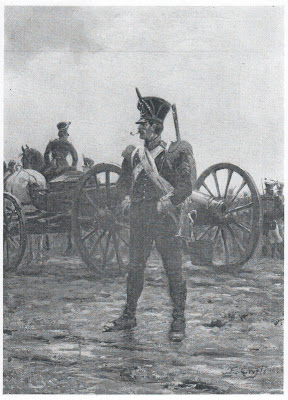
The Advance Guard.
Ernest Crofts RA (1847-1911)
Image from the Witts Library.
"Crofts grafi bel Kanbide men prelam" as Donisthorpe might have said. 

But it was with cousin William that (sometime in, or close to, 1890) Donisthorpe set up their Kinesigraph...
A recent reconstruction
 of Donisthorpe and Crofts'
 Kinesigraph of 1889/90. 
...in a vacant office at 1, Northumberland Avenue overlooking Trafalgar Square and recorded the passing traffic - then the benchmark test of a successful moving image. Remarkably the film survives – or at least ten frames of it does: and you can see it here (in the first three seconds of this clip, before the open-top bus arrives).   


Stephen Herbert conjectures that there may have been, in part, a hidden agenda in photographing this particular scene – traditionally the site, in the heart of London less than a mile from Parliament, where freedom of speech and expression is exercised en masse in demonstrations and assemblies. Donisthorpe might have intended to use it in his lectures to show the very place where ordinary decent citizens found that their right freely to walk the pavement, and go about their daily business, monstrously trampled by whelk-chomping trade unionists led by John Burns and other bolshie Scots. WD's collaborator, W. C. Crofts, had written a broadside against the "Socialism of the Street in England" in 1888. The reality was however (according to Mr Herbert) that projection proved even more problematic than the initial recording. Raising funds for further development, even with Sir George Newnes' assistance, proved too much of a challenge.

That's Sir George Newnes who made an appearance in episode 5. He was, for 20 years in total, the Liberal M.P., for Newmarket and, later, Swansea; chair of both the British and City of London Chess Clubs; "reportedly the best chess player in the House of Commons" (according to G. A. MacDonnell); and publisher, from 1881, of the popular weekly, jauntily titled "Tit-Bits", from which he made his fortune.
Tit-Bits in 1906, offering a cure for the abuse of meat.  
Just a couple of further examples of Donisthorpe's active mind always at work, demonstrating an unstinting zeal to smooth the inner rumblings of the body politic.  He devised a new language (Esperanto-style) based on Latin: "Uropa", for which he wrote an instructional exposition, the introduction to which betrays a little, rather atypical, self-doubt. 
"All are requested to read through the following chapters [that's all 28 of them - MS], without mental protest [his emphasis - MS] till the end is reached. Then, but not before, let them pour forth their pent-up fury over its apparent shortcomings and defects." 
Look again at that example of "Uropa" in the caption to the gay Hussar above, though it is not a phrase which, in translation, has the quotidian utility of  "What's for luncheon?". "Crofts grafi bel Kanbidem men Waterloo prelam" in Uropa-speak translates, so Donisthorpe assures us, as "Crofts paints a fine canvas representing the Battle of Waterloo". Uropa didn't catch on, either.

Nor, as a lubricant to free trade, did his proposed new system of weights and measures. Though actually that's only half right, as we (here in the UK) are moving, if only half-heartedly, towards a universal decimal base such as he advocated. Perhaps, for those times, Donisthorpe made a tactical mistake in proposing a system that was associated with things French, something his novel nomenclature based on cod Olde English didn't quite disguise. After "Jot" (that's a millimetre), he has "Quil" and "Hand", but then "Mete", which was a bit of a giveaway. In money matters our man did, however, catch the eye of H.G.Wells, who was minded to adopt WD's "Lion" as the principal denomination in the decimal currency of his Wellsian Utopia.  

Donisthorpe's final adventure was a kind of Eight Men in a Boat cruise around the Mediterranean with Newnes and sundry other chaps. It was written up as "Down The Stream of Civilization", and even has a literary reference chess game in the dialogue on the first page: "...looking up from the chess-board, on which he was struggling with a rather nasty attack..." ("Then give him some Beecham's", they cried?). Here he is (on our left), aka "Jus - a Literary Failure", waiting to splice the mainbrace with some fellow hearties. Newnes, "The Commodore", is on the far right, and it was he who published the yarn in 1898.


Wordsworth Donisthorpe. Larger than life. You couldn't make him up, and he is a natural for dramatisation on stage or screen. Stephen Herbert has done just that with a performance, music and film production at the Museum of Moving Image, and at the British Silents Festival in Nottingham. My own fantasy - recently alluded to in the blogosphere by a certain lady - is for a theatre piece in which Wordsworth, wit, chesser, politico, and undoubted charmer, meets the admirable Louise Matilda Fagan, and regards it as his masculine obligation to flirt (their age difference being just three years). We encountered her in episode 4, you will recall. She was a Fabian, and a more than decent player. Her father is in the bottom left-hand corner.

Admittedly Louise was abroad (Irish husband serving in India) for some of the time, but when in London visiting papa and her brother, and taking time off from campaigning for women's rights etc, don’t you think Wordsworth would have manoeuvred so as to engage her in a game? This would have been his pretext to impress her with his badinage and witty repartee, providing the dialogue for my projected comedy of manners. He would gambit a libertarian tease. She would rebuff him with suffragette ease. All in Donisthorpian rhyming couplets. 

So, Wordsworth Donisthorpe: what a character, who, in spite of his shortcomings (i.e. his politics IMHO), adds colour to the assembly of Rosenbaum's worthy gents. Possessed of "intellect and energy" - as Stephen Herbert puts it - who developed "a most powerful concept, that of reproducing filmed movement...which, when finally realised by others would revolutionise communications throughout the twentieth century." If we add to this his contibutions in those other fields of enquiry touched on above we see an exceptionally fertile brain at work, even if his efforts are now largely forgotten today.      

Next week, for the conclusion of this series, we meet Anthony Rosenbaum; the artist himself.                        

Acknowledgments etc
Published by the The Projection Boxbut now out of print.
Read the full "poetical alphabet" in Winter's Chess Note 5662 and in A. M. Fox's reminiscences of the British Chess Club in BCM February 1941. 
Thanks again to Stephen Herbert and Mo Hearns. Their most recent research shows that WD had applied for a patent as early as 1868  when he was still  at Cambridge. See here.
And thanks, yet again, to Paul Timson and Richard James for their help; and also to Tim Harding's Eminent Victorian Chess Players (2012) for Donisthorpe related info.
G.B.Shaw (1889)  Mr Donisthorpe's Individualism 
H. G. Wells (1905)  A Modern Utopia  
Donisthorpe's many writings are easily Googled, and Batgirl lists them, too. He has an entry in the Dictionary of National Biography.

See all episodes, previous and subsequent, in this Rosenbaum series via our History Index. 

Appendix follows after the jump   

Friday, December 07, 2012

The Great Chessboxing Swindle : a huge signing

Fed up with proper chess? Never mind - tomorrow it's chessboxing again!


And what's that name we see at the bottom? Yes! It's Ray!


Pop quiz for Andy "junior chess champion" Costello. Ray did indeed second Korchnoi in his 1978 match against Karpov...


...but why, as a result, didn't Korchnoi want Ray as his second in the 1981 match?

[Chessboxing index]
[Ray Keene index]

Wednesday, December 05, 2012

The day I played Tony Miles

Players like me normally get to play the very best players - if we ever do - when they are young, or when they are old. Or in simultaneous displays, if we are lucky. Over the board only rarely, or not at all. But I played Tony Miles, the first English grandmaster and the first of the world-class English players of the Seventies and Eighties, twenty years ago today.

It was in Wolverhampton, more or less Miles' home patch. I hadn't known he was going to play - I just fancied a tournament that weekend and Wolverhampton happened to be on. Nor, when I arrived on the Friday evening and saw that Miles was among the entrants, was I expecting to play him at all, since I was in the lower half on the draw and he was at the top of the top half. I assumed the likelihood was that I would start the second round on 0/1, he would be on 1/1 and the nearest I would get to him would be when I got up in between moves to go and watch his games.

I was indeed on 0/1 come Saturday morning, having lost to Lawrence Cooper despite catching him in a line of the King's Gambit which had recently won Joe Gallagher a game or two: but playing strength soon won out over opening preparation. When I set off that evening for my guest house, I noticed that Miles seemed to be struggling to show any advantage in an endgame against Graham Lilley, but nevertheless I was still more than surprised to arrive at the venue in the morning and find that Miles had ended up losing it. Not as surprised, though, as I was to find that he had also ended up being drawn against me in the second round.


He was, I think, the first grandmaster I had ever played. He was also, I think, the highest-placed player in the world rankings I have ever played, or am ever likely to. Though his breakdown had, by then, occurred, and his playing strength was declining, he was still at 47-53 in the then most recent FIDE ratings.

He is not the highest-graded player I have ever played - that's Alexsander Delchev just last year, nor the player strongest at his peak (in 2007 I played Ulf Andersson, who has been rated 2655 and fourth in the world, to Miles' 2610 and ninth). But neither of these were the legends of my youth.

I believe I even used to have his autograph, though I surely no longer have it and my recollection as to where and when I got it is confused. (I think it was in London during the 1983 Candidates matches, but I also have a memory that it was on a copy of the short-lived Chess Express - and that it was a copy giving his Skara game* against Karpov. Not all of these memories can be compatible.)

"When I play close to home", wrote Miles once, "it's the complex - I play badly". Not this time he didn't, though the gap between his own play and capacities, and mine, was so enormous that he wasn't really given the opportunity to play well either. I certainly, played badly. Very badly, and hence the only interesting thing about the game is that it took place.


After the game he just said something about the two tempi I lost in moving the bishop from e7 to f6 and back again. I wanted to say yes, I know, but I couldn't see what else I could do after 15.Ne4. But I felt silly then - and it looks silly now - to have assumed the knight was going to c4. We shook hands. He got up and I got up. After that tournament I'm not sure I ever saw him in person again.

I don't think I would play that badly again: I didn't against Delchev or even against Andersson. I don't think I was overawed - it's just that you maybe have to lose a couple of games against grandmasters without a fight before you realise that you can do better than that. I didn't realise it, then. But as I say, I think he was my first.

It doesn't matter. He was also the first chess player whose games and career I followed. The original, the first English grandmaster, the leader of the English chess explosion. And I sat at the other side of the board and played against him and we shook hands at the end.

[* 2013 UPDATE: in fact it was almost certainly their 1983 game in Bath]

[Image: Antonio Gude]

Monday, December 03, 2012

500 Days of Magnus


500 days ago, Magnus Carlsen taught Fabiano Caruana that even knights on outposts sometimes require defenders. Yesterday, he schooled the world. 

Poor Lev Aronian - it can't have been a fun prospect after Saturday's defeat to Naka. I tuned in just as Matt Lunn, manning the Telegraph Chess Twitter feed, asked whether Magnus, playing white, had winning chances in this position:


Position after 42. Ne2
 

Jon Speelman thought that Magnus was probably still playing for a win but that it wasn't that clear what he'd do. Within 17 moves, Lev was offering his hand. 


 Position after 59. Rf8+ 1-0
 

Magnus Carlsen, forever crushing the souls of the great and good. Today he plays Vladimir Kramnik. Both are on two wins from two. You'll be watching, won't you? 

Won't you? 


Saturday, December 01, 2012

Mr. Rosenbaum's Chess Picture. Part 6: Close Up

In this episode of the series we are going to pick over the detail in Rosenbaum's picture, and have a look at it as a piece of art.

                ©National Portrait Gallery 
       Click to enlarge
But before we do, a quick mention of another spot of the picture in the chess press...
From R.D.Keene. Chess: An Illustrated History (1990)
pub Phaidon

...which is a reproduction of a photo, now on display at Simpson's (or it was the last time I looked), of the original painting, which itself had been on show there over 130 years before.

In earlier posts we noticed some of the references that the artist had wittily insinuated into the composition, particularly on the back wall. It was the only one that Rosenbaum had at his disposal, and he took full advantage of it.


To recap a bit, there are the barely discernable roundels honouring chess heroes whose deaths antedate the picture. They were listed, slightly inaccurately, by The Chess-Monthly, but notice that the most recently demised, Evans (in 1872) and Staunton (in 1874), are added at the extremes left and right respectively, as if to convey that they had, subsequent to the others, just been installed. Then there are the two images - "paintings" note, as if to accord them special celebrity - of Paul Morphy (not yet dead), with a chess set, and Adolf Anderssen (died 1879), with a trophy: nice details within the details.

Lower down there are the “placards with the conventional club notices and comical inscriptions” as The Chess Monthly put it. They are more or less legible when you are up close to the painting. Going from left to right there is a notice referring to the City of London Chess Club; then something very faint and barely noticeable followed by a group of three on green baize (all unclear); next to Gumpel we find Mephisto as discussed in episode 3; then a notice for St. George's CC; finally, just behind Rosenbaum, there is an In Memoriam requiem for the ill-fated West End Chess Club with a faint illustration, possibly of two characters seated at a chess board.   

The clock, top dead centre in front of the mirror, tells us the time of day: it is a most civilised five o’clock in the afternoon - that’s real time, in the real world, where and when the factory whistle signals the end of the shift or, as is more likely in polite company, the bell tinkles and tea, or something stronger, is served. Compare this with the other clock, the one at the front on the table by the ongoing chess game...


...which says, not five o’clock, but three; an anomaly that resolves when we remember that these gents, intent on their game, are in a chess world, not the real world and, as all chessers know, chess time flies at its own tempo. This clock marks the hour of the telegraphic transmission of the move, the one that the footman is now presenting to the Master of Ceremonies. Here in the Universal Chess Club it is not tea-time, it is move-time and the chess clock will tick-tock at its own pace till the last move is made, and the game is done.

Now transported to the front table you can inspect the other paraphernalia that Rosenbaum has put there. Speaking art-wise you could call this arrangement a pretty competent still life, though purists may prefer to see the entire front page of The Field (in which Hoffer was running a chess column). The other paper could be showing a chess problem (or a crossword, if non-chessers would prefer). We know about position on the board from episode 3, but what about that trophy? Looks familiar?   


Yes, it was recently seen stealing the show from Streatham and Brixton Chess Club member Andrew Stone after Middlesex’s victory in the Inter-Counties Championship (that's right: Streatham isn't in Middlesex). It is the same Löwenthal Cup (purchased from a surplus in his Testimonial Fund, and after various changes of hands bought by the BCF in, or shortly after, 1922) as sits on the table at the front of Mr Rosenbaum’s chess painting.  Here is the trophy in all its gilded magnificence.
Pic thanks to Steve Mann
 at Yorkshire Chess History 
Löwenthal himself is in Rosenbaum's painting (between Bird and MacDonnell), even though he died in 1876 (Anomaly Alert! How then could he appear along with a cup purchased after his death?).  The empty chairs are odd, when so many of the gents are made to stand, but maybe Rosenbaum was leaving room for a few more so as to get his tally nearer to a round 50 or, running with the Gunsberg gag, Mr R has reserved him a seat for when he returns from Mephisto duties.

Over to the right is the nicely-painted and well-stocked drinks tray (mentioned by The Chess-Monthly, see episode 2) which has also caught Wordsworth Donisthorpe’s attention (he's in the light suit, and we will come back to him in another post, promise). 

You'll recall, from episode 1, that The Chess Monthly spoke about Rosenbaum's difficulties of getting his subject matter...i.e. "of getting the necessary sittings, the photographs, or even sight of the originals he wished to paint " [my emphasis-MS]...implying that he relied on the copying of photographs, or illustrations in the press, to get the job done. To catch him at it - copying borrowed portraits - just look at this: from a picture-weekly of the time...

From the Daily Graphic December 29 1875
(via Chess Archeology )
  ...and here you will recognise some familiar Rosenbaum faces. He has used the seated figures of MacDonnell, Löwenthal and Bird (left) around his Board 1; and Horwitz and Murton (sitting right) at Board 2. Standing are Messrs. Gastineau and Rabbeth - unnamed (as are Lowenthal and Murton) by the Daily Graphic -  but recognisable from Rosenbaum. 

Now for a bit of retrograde analysis. With a bit of cutting and pasting from the Rosenbaum portraits here is my reconstruction of  The Graphic image above:

Pretty close, apart from some small spacing issues and the orientation of Gastineau to make him peer at us rather than the board. Clearly Rosenbaum copied The Graphic or, perhaps more likely, had access to the same material as did the magazine. There may well be more of Rosenbaum's sources in the popular graphic or illustrated press (chess or otherwise), but I haven't stumbled on them yet. That would have to include the source for Henry Bird above, because if you put the Rosenbaum and Daily Graphic images side by side (as below) you can see that Mr R must have used some other original; in fact he has flattered Mr B a touch, given him a haircut, and maybe knocked a few years off him. He has also tried to scale the head more harmoniously to the body - not completely successfully -  because The Graphic image looks unnaturally contrived (perhaps with a head "pasted" on to the wrong shoulders).    


Let’s now go back to the five o’clock clock, or more precisely the mantelpiece upon which it sits. This detail opens the door to the wider view. It has an important role in the organisation of the painting as it is the horizon line for its governing perspective scheme, as you can see from the diagram below. All the receding parallels on view, from the three chess boards for example, meet there. In the conventions of perspective they are supposed to meet at "infinity".    


This high horizon line conveys the impression of a high view point for the spectator (you and me). But because the mantelpiece is so close, and not at the "infinity" point somewhere north of Watford, we get the impression of a sloping floor; or of tiers (as around an intimate tea-dance salon, or a modern-day football stadium). It looks like one of those school photos with rank of uniformed pupils piled one on top of another. But, in the one clear stretch of floor that we can see (running up to Bird and friends on board one) it is flat and continuous.

If Rosenbaum's intention was to help us see all the portraits clearly, even in the back row, we'd have to say that he pretty much pulled it off, even if he has, willy nilly, distorted the perspective. Compare it to the painting below where, with pukka perspective, the floor is obviously level and every one stands on it...

George Elgar Hicks
Dividend Day at the Bank of England (1859)
Bank of England Collection
... but you can't make out the faces at the back, even though, very cleverly, Hicks has enabled us to glimpse all 30-odd of his characters. Incidentally, it's likely that Dividend Day would have been known to, and admired by, the investment-savvy gents of the Universal Chess Club as it was in the RA Summer Exhibition of 1859. Some of them might even have witnessed such a scene first-hand when down at the Bank collecting their own wind-falls.

So, we are at a high vantage point vis a vis Rosenbaum's gents; and we are looking down on that game at the front. But we see the figures, in all the rows including the first, as if we are at the same eye level - and that creates problems for the look of his composition. This inconsistency arises because, Rosenbaum was either painting in portraits posed from real life, or (as we have seen above, and this is crucial to his method, and his achievement) "pasting in" copies of images from photographs and the press; and of course these would all have been originated at eye level before they were added to the full tableau. Given the technical difficulties of the task Rosenbaum set himself we can forgive that the relative sizes of the sitting and the standing figures also sometimes get out of kilter (e.g the group around Donisthorpe).

For the record let's mention one other intriguing aspect. How big was the picture, and could it have been trimmed at some time in its life? At its unveiling The Chess Monthly said it was "6ft. by 4ft. including frame". Today the NPG says it is "32 in. x 60 in." - which is 5ft. by 2ft. 8 in. excluding frame. Which means that, when unveiled in 1880, the frame could have been a generous 6 inches all around: not impossible, but rather ostentatious. R.N.Coles, when he saw it in 1980, expressed surprise that the picture, by then more modestly framed (if at all), wasn't bigger. Perhaps, though, he mistakenly had in mind The Field's dimensions as being the canvas size.

But could it have been reduced by a foot or so? At the bottom Donisthorpe is cut off at the ankle; and along the top we lose the edges of the Morphy and Anderssen picture frames. Could there have been some scissoring along the way?
A couple of feet less than expected?
Well, the NPG's own condition report (in its Archive) doesn't mention it. Maybe if they ever unscrew it from the wall at Bodelwyddan Castle they will have a look again. Possibly Hoffer et al exaggerated the dimensions for effect. Given the size of his ambition, Rosenbaum may simply have miscalculated what he could get in and then ran out of space, denying us the opportunity to admire Donisthorpe's taste in shoes.  

It is, though, a monumental feat of organisation and planning, fraught with compositional challenges, at the mercy of the subject matter that came to hand, and vulnerable to unforeseen eventualities - such as the premature demise of a personnage already placed in position: Löwenthal for instance. Once you know he had already passed on it is difficult to expunge the thought that his cadaver remains upright only because of the discreet connivance of Mr Gastineau behind.

Overall, you have to admire Rosenbaum's vision, and perseverance to see it through, and you could say that Rosenbaum's 50-up was in the grand manner of action-packed Victorian crowd-scene painting such as  Frith's Railway Station of 1862 which has 60-ish and a dog, and another Hicks: The General Post Office - 1 minute to 6 with 40-ish (and another dog) of 1860. Like Frith and Hicks, AR attempted to imbue his tableau with incident and interplay, however downbeat and low-key a chess séance would be. Hicks incidentally earned £1700 per annum at the height of his career, which puts into context Rosenbaum's £200 for the several years' on-off labour over his chess painting.

Perhaps (wild hypothesis warning) Rosenbaum was hoping also to get his magnum opus selected for the RA Summer Exhibition, to catch the eye of the art-viewing (and purchasing) public and thus to make his artistic reputation. Perhaps he was persuaded by his chess chums to let them buy it instead, so as to keep it in the family. Perhaps, also, they could see what he couldn't: that it would be savaged by the art critics of the day.

The NGA Archive contains an expert's comment a hundred years or so later: that Rosenbaum's chess picture  is of worth as an historical document rather than as a work of art. Perhaps we should settle for that, and value it for giving us a unique record of the chess characters of the time, even if Rosenbaum's own self-portrait (leaving aside all the others) should not to be taken at face value - as we will see when look at the man himself in the last episode.

What a painting!

Next week another character takes the limelight; someone who would have basked in it.

Two episodes more to goSee all episodes in the series via our History Index