Friday, March 11, 2016

Openings and endings

The Moving Finger writes; and, having writ,
Moves on

- The Rubaiyat of Omar Khayyam
I was looking for a theme for today's post, and nearly picked the one that we used yesterday, since it's not hard to find old sources which give the impression that Kasparov announced his retirement on March 11, or even one that (in this surprising case) says so outright.


Still, Dirk was there, and Dirk is reliable if nothing else


so if we are to find an event that coincides with 11 March then we may have to make do with the Candidates Tournament, which starts today. Or, alternatively, yesterday - depending on which part of the front page you look at


or come to that you could have consulted AGON and discovered that the tournament actually began last Tuesday.


I assume the 10 March date refers to the Opening Ceremony. What AGON are on about, I have no idea.

Thursday, March 10, 2016

To retirement

On this day, 2005.


Far too soon and yet not a moment too late. A far better chess player than he will ever be anything else and yet a far better chess player than almost anybody else.

There'll never be another.

Wednesday, March 09, 2016

Traditions

If we want things to stay as they are, things will have to change

- Giuseppe Tomasi Di Lampedusa, The Leopard
Ray, Saturday:

Did Ray actually make it to the Varsity Match this year? Not as far as I can tell [edit Wednesday afternoon: he did! see below] since he doesn't appear in any photographs that I've seen. If that's right, it was anything but the worse for his absence.

But he was there in spirit, as his chum and crony Tony Buzan appears to have been present at the "splendid black-tie dinner" and sent Ray what appears to be the menu  (is that David Sedgwick's signature at the top?) and something else that our man describes as a souvenir but seems to resemble a mindmap.

Who knows what it means.

Tuesday, March 08, 2016

Les Chesseurs Britanniques de Paris: Part 6 The Addendum

Just a quick addendum on the British Chess Club of Paris while Part 5 is still hot off the press and fresh in the memory, and before the series disappears from view to find its final resting place somewhere in the depths of the Blog's History archive.

This post-script is possible due, once again, to the generosity of Dominique Thimognier of Héritage des Échecs Français, who unearthed so much of the material that documents the activities of the BCCP - thus it is only right to thank him again. The snippets below are from him. I'll just mention also, en passant, how tolerant he has been of the liberties taken in the series with his mother tongue. A propos of the blogs as a whole he commented to me, with un peu d'humour français, that my faux pas here and there added "une petite touche de charme britannique". Very drôle. 

In Part 2 The Opposition we mentioned that the BCCP had taken a table at a 60 board simul by Alekhine in February 1932. It was held, in fact, at the Hotel Claridge - and, more importantly, the BCCP was one of the 17 teams that drew with the World Champion. Well done chaps - even if not one of the 6 that beat him.

For the sake of completion we can also add that on May 30 1931 the BCCP was one of 10 teams that played Alekhine in an earlier simul, sans voir, to raise funds for impecunious Russian students. Alekhine won 6, and drew 4. Sadly, this time our boys were among the losers. Here is the score of the Champ's comprehensive 19 move rout of l'équipe britannique:


Source: Alexander Alekhine's Chess Games 1902-1946  L.M.Skinner and R.G.P. Verhoeven (McFarland, 1998).

Part 1 The ClubPart 2 The OppositionPart 3 The MatchPart 4 The BeastPart 5 The Robot. 

Monday, March 07, 2016

Chess goes to the movies: The Seventh Seal

WARNING: This post contains spoilers


You know this one. The Thomas Crown Affair and From Russia With Love might be classics, but when it comes to chess in film, The Seventh Seal is the daddy of them all.

It’s the one where the guy plays chess with Death. Yes, you know it. Everybody does.

Everybody knows it, it’s just that nobody’s actually seen it. Not even cultured aesthetes like you, dear reader. Which makes you just like me. Well, it makes you just like me until last week when I finally took the DVD down from the shelf where it’s been sitting still in its plastic wrapper these past couple of years.

Sunday, March 06, 2016

A Literary Reference: Goodbye To All That


The most honoured man there was Geoffrey Young, an Eton master, and the President of the Climbers' Club. His four closest friends had all been killed climbing; a comment on the extraordinary care which he always took himself. It appeared not merely in his preparartions for an ascent - the careful examination strand by strand of the Alpine rope, the attention to his boot-nails, and the balanced loading of his ruck-sack - but also in his caution on the rock-face. Before making any move he thought it out foot-by-foot, as though it were a chess problem.

Robert Graves, Goodbye To All That, Penguin, 2000, p. 49. (Original date of publication 1929.)


[Thanks to Martin]

[A Literary Reference index]

Friday, March 04, 2016

Les Chesseurs Britanniques de Paris: Part 5 The Robot

So far in this series we have tracked the fortunes of the British Chess Club of Paris (1926 to 1938/9) and some of its more famous, and infamous, members. In this final post we continue to dog the footsteps of one of them: George Langelaan. Apart from his escapades with the BCCP, his heroic war service in occupied territory, and his association with Planète, he will be known to many readers as the author of The Fly, published in the States in 1957, then in Belgium as La Mouche in 1962.

In 1986 it was famously made into a film by David Cronenberg - and before even that, a 1958 original starred Vincent Price.

At the time it created quite a buzz.
In this episode we will examine another short-story by Langelaan, a sci-fi not-so-far-in-the-future shocker also published in 1962: the chess-themed Robots Pensants. 

Thursday, March 03, 2016

More than one billion

So now the Carlsen v Candidates-winner world championship match has been set up, how many people are going to watch it?

605 million, perhaps?

Not at all.

More.

This many.

Wednesday, March 02, 2016

Whatever happened to the Scheveningen?

Writing about the Accelerated Dragon the other day jogged my memory where my one-time favourite Sicilian, the Scheveningen, was concerned. The Scheveningen was the Sicilian variation that first appealed to me in my youth: it appealed also to the most exciting and strongest young player in the world. So whatever happened to the Scheveningen?


I grew up in a house full of books, and more than a few of these were chess books: the first opening books I saw were probably Barden's on the Ruy Lopez


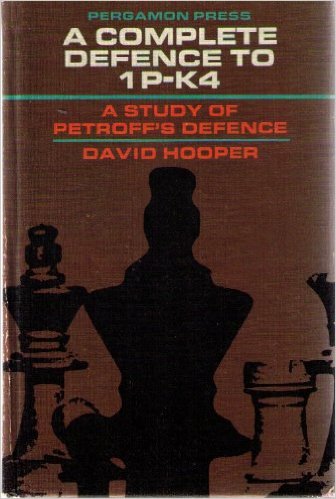
and Hooper's on the Petroff


the second of which was a particular influence.

But those books had been there as long as I remembered: the Barden may even have turned up before I was born. Certainly both were around before I knew there was such a thing as chess.

The first opening book I can remember actually arriving was Craig Pritchett's Batsford book on the Scheveningen, published in 1977, just as I was beginning to play tournament chess.


Tuesday, March 01, 2016

You decide

I often remark that after you reach the age of forty, it becomes impossible to distinguish satire from reality. Once you turn fifty, even more so.

So I find myself unable to make sense of this remark from Stewart Reuben, at least in the sense of understanding in which of the two aforementioned categories I should place it.

Perhaps readers can help. In your opinion:


(a) is Ray taking the piss, or just completely lacking any sense of self-awareness?

Alternatively:

(b) is Stewart taking the piss?

Your assistance urgently required.

[Ray Keene index]
[Ray Keene plagiarism index]

Monday, February 29, 2016

Just Barely Got Something to do with chess XII


Philosophers have discussed at great length the ultimate goal, if any, of mankind, but they have reached no consensus, for that is the nature of philosophy. To be rational, a goal for mankind must be one that everyone could follow without conflict. Three plausible candidates are the survival of the human race, the greatest happiness for the greatest number and the pursuit of knowledge. Noe of them withstands scrutiny. If alien beings who were kinder, more intelligent and in every way superior to us landed on earth carrying a virus that we knew would wipe all of us out and if the only alternative to extinction were to kill them, we would undoubtedly do so: but that could be seen as a parochial and selfish act. In these circumstances some people might want to take into account goals other than the survival of the human race. As to happiness, how is it measured? How does one offset one person’s happiness against another’s joy? The pursuit of knowledge sounds very glorious, but why is it better than everyone striving to be good athletes or excellent chess players? Moreover, it could  be self-defeating, since the unwise use of its technological spin-offs could result in there being nobody left on Earth to know anything. In thinking about ultimate goals, we are beyond the realm of rationality. A given goal can only be defended in terms of a superior goal: one cannot as the saying goes 'get an "ought" from an "is". In Pascal’s words, 'The heart has its reasons that reasons knows not of'. Hence, ultimate goals cannot be defended by their nature they have no superior goals in terms of which they can be justified. In practice it may be doubted if anyone has systematically pursued any such ultimate goals.


... to do with chess Index

Friday, February 26, 2016

Les Chesseurs Britanniques de Paris: Part 4 The Beast

In this series we have tracked the fortunes of the British Chess Club of Paris and its members for the 12 years or so up to its demise when war was declared in 1939 (though the serious fighting didn't start until 1940). In this episode we will see what happened to two club stalwarts afterwards, although this will also involve a return to the years when the club was in full swing. As we have come to expect in this series, we will do all this in the company of George Louis Alexis Langelaan (19 January 1908 - 9 February 1972). He will take centre stage in much of this episode. It is where he would have felt at home. As tends to happen where George is concerned, fact and fiction blur at the edges - even when it comes to his appearance.

At the beginning of the war this is how Langelaan would have looked - the bit of him we can see - in a cropped mugshot-style photograph.  
   
George fact.
It is how he might have appeared, partially anyway, to the other members of the BCCP between 1926 and 1938/9 (plus or minus a few years). And this is how he looked a little later...

Thursday, February 25, 2016

Highly typical

When we were discussing Reti's 15. Qa1 yesterday, we observed that Fine, annotating the move in The World's Great Chess Games, quoted Hans Kmoch.


What we left until today to observe is that when Ray annotated the same move in the Times, on 27 August 2011


so did he.


Difference is that Ray didn't bother to say so.

The plagiarism wasn't just of Kmoch*, but - as so often - of the first volume of My Great Predecessors.


Wednesday, February 24, 2016

My favourite moves XVII


Reti-Rubinstein

Karlsbad, 1923

15. Qa1!

This is a an obvious move, isn't it? It's obvious to you. It's obvious to me, now. But it wasn't obvious to me when I was shown it as a child, and the thing we all knew was that we had to centralise our pieces.

I've gone over this ground before, when we were looking at Nimzowitsch's Nh1, which I notice now was also played against Rubinstein. Ray's remark in Nimzowitsch: A Reappraisal makes sense here too:
When I first read My System I was so impressed by this game that I deliberately created situations in my next few games where the move Ng3-h1 was possible
or at least, when I had a long period playing the Reti Opening in the nineties I was always particularly keen to get the queen to a1, behind the bishop on b2.

Easier said than done, since you have to get round the queenside rook, but Reti himself managed it again the following year against Yates


which may go some way to explain Kmoch's comment, quoted by Fine (in The World's Great Chess Games) when annotating the Rubinstein game:


Golombek, annotating the same encounter in his collection of Reti's best games


describes the queen move as
beautiful play that increases the pressure on Black's position both diagonally and vertically
and in Flank Openings Ray gives 15. Qa1 an exclamation mark, as it merits.

In the Times (paywall) for 27 August 2011 he was more forthcoming, if slightly more careless:


Strong and typical, but perhaps a little obvious, today: I'm sure most readers would play it almost without thinking. But it still has the same, simple, geometric beauty, in the combination of rank and diagonal,as it must have had in 1923, or as it had when I first saw it, half a century later. One should not confuse what is complex with what is attractive. Not in art, not in music, not even in chess.


[My favourite moves index]

Monday, February 22, 2016

C92: 84 - 95


Here’s a post that’s long and pointless: a theoretical survey on an opening that nobody bothers with these days. I’m not even going to be looking at the current state of what’s happening in the Zaitsev variation of the Ruy Lopez. I’m only going to cover what was happening from roughly 1984 to 1995. The closest I’m going to come to topicality is a brief reference to a game played in 2005.

Why?

Since you (or at least I) ask, I did it purely to see if I could. To be precise, I wanted to know if I could do it from memory. I’m sorely lacking in chess culture when it comes to mating patterns. This much we know. After last week’s post, I wanted to see if I’d picked up anything at all in nigh on thirty years of chessing.

You want Karpov-era Zaitsev theory? It turns out I’m still your man. I remembered nearly everything. A few details of the game references aside, virtually everything that follows came to mind pretty easily.

It's knowledge entirely lacking practical value, sure, but then it always was. Yes, I was tooled up with a ton of options at move 17 and beyond in the Zaitsev mainline. No, in all the years I played 9 ... Bb7 and 10 ... Re8, nobody ever took me beyond move 12 in a serious game.

So well done me. I have a detailed knowledge of 25-year-old theory of an opening I haven’t played for more than a decade. That’s not an awful lot to show for a life in chess, but at least it’s something.

Sunday, February 21, 2016

Cover version: Handel / ll Complesso Barocco / Curtis


Alan Curtis, Il Complesso Barocco, Handel: Lotario (Deutsche Harmonia Mundi, 2011)


[via Richard James]
[Cover version index]

Friday, February 19, 2016

Surprise moves

Lord Avebury is dead.

I think I missed that at the time, or I'd forgotten about it since, but I had a look around and as per usual, having gone searching for something on the internet I found myself looking at something else, specifically a statement by Baroness Symons to the House of Lords in June 1999 concerning the conflict in Kosovo (and subsequent questions). My search caught it becase Lord Avebury contributed, but it was someone else who raised the question of chess.

Our man in the ermine on this occasion was Baron Marlesford, of Eton and the Coldstream Guards, who offered the House a surprising, if unoriginal, chess-centred perspective on Russian troop movements in the conflict.


Pompous arse

What the hell Liz Symons was supposed to reply to that I don't know (I'd have gone for either "yes, we're shipping over two dozen of them on the next transport" or "haven't you been abolished yet?") but you can almost hear the "oh, Christ" at the start of her reply.


Wednesday, February 17, 2016

Once was enough VIII : Accelerated Dragon


1. e4 c5 2. Nf3 Nc6 3. d4 cxd4 4. Nxd4 g6

The Accelerated Dragon. Never remotely as popular as its allegedly slower cousin, but as far as I recall I've never played that version at all, almost the only major variation of the Sicilian that I haven't. When I started out playing competitive chess, lots of people (but probably above all, Miles and Mestel) were giving it a go, in English chess at any rate, but I took more notice of Fischer's annotations in 60 Memorable Games.
I once thumbed through several issues of "Shakhmatny Bulletin," when the Yugoslav Attack was making its debut, and found the ratio was something like nine wins out of ten in White's favor.
"Weak players even beat Grandmasters with it", says Fischer of the Yugoslav Attack. I suspect I'd lose to weak players with either side of it.

There's actually an Accelerated Dragon in the book too, though I never properly noticed that at the time: the second game in the Fischer-Reshevsky match, in which Fischer improved on Alekhine-Botvinnik from 1936. I wasn't paying attention: not only does the 1961 game open with our move order as above (rather than the 2...d6 of the normal Dragon) but Fischer's note to White's eighth specifically refers to
the point of Black's "accelerated fianchetto"
which is precisely to play, if possible, ...d5 in one go.

Monday, February 15, 2016

The Worst Move on the Board XXVI


White to play


I was leafing through an old chess magazine the other day.  I came across a piece by Jacob Aagaard on what was then the new edition of Chess Tactics from Scratch. The original version was apparently one of the best selling books from Quality Chess’s original range. The new edition, or so the claim went, was the best of its type ever produced.

Mr A’s thoughts notwithstanding, my opinion remains that Chess Tactics from Scratch is very likely the worst written chess book that I’ve ever seen. If only I had time enough to expound on this thesis I would happily do so. At length. For now I’ll just have to limit myself to saying that doesn’t mean I think it has no value.


The Epaulette Mate


Like a lot of chessers, I suspect, I didn’t learn the game in any kind of systematic way. I just picked things up here and there. I played a lot, spent much too much time reading openings books and by and large completely neglected to build up a store of the basic patterns. The ones that good and even moderate players take for granted.

One of the mating patterns that pretty much passed me by is the Epaulette mate. You can see it above. If White has a supported queen on d5 - or Black has one on g3 - it’s mate. Well, it is as long as the highlighted squares are blocked by defending pieces. It’s not too fanciful to see these squares as being on the king’s shoulders, hence the name.

I have a vague recollection of seeing this explained in a book at some point in my late teens.  As I said, though, I never worked on chess in a coherent way so even if I did 'know' it, the pattern of the Epaulette Mate never became part of my unconscious thinking. I could and can tell you about various theoretical ideas that Black had at move 17 of the Zaitsev - starting from either  ... c5-c4 for ... f7-f5 - but the Epaulette Mate didn’t stick.


Chess Tactics from Scratch is certainly lacking in all sorts of ways. I can’t deny, though, that working through it means I can now, usually, see the Epaulette Mate coming. Indeed, it was Weteschnik’s book that came to mind when I saw the position at the head of today’s blog.

I gather the position at the head of today’s blog occurred in the last round of one of the Gibraltar side events. White is an exchange and a couple of pawns up. By my count White has over 30 legal moves to choose from. Our man found the only one that hands the win to Black in an instant.

A tough break for White. Especially since had he won the game he would have shared first place in the tournament. One move on from the position you see above, it was the player of the Black pieces who was going home with a share of the £900 first prize.

As many people have said in the past, there really should be an Informator symbol for "Ouch".


With thanks to David Sedgwick
The Worst Move on the Board Index

Friday, February 12, 2016

Les Chesseurs Britanniques de Paris: Part 3 The Match

In the first post on this series about the long-forgotten British Chess Club of Paris (1926 to 1938/9) we looked at some of the personalities involved in its activities. Part 2 looked at its impact on the Parisian chess scene of the time. In this episode we will take the long view backwards to 1931. It was a good year for the Club: 5 years after its foundation it was the year when it made the headlines.

     
Well, a small one, anyway, on Monday 23 November. The reason? On Sunday 22 November 1931, "le club anglais" - our French friends were a little shaky on the British/English distinction - played a match against the Manhattan Chess Club. The BCCP team resigned on the 31st move. Not quite the headline the Club would have wished. But, any publicity...etc. They played in Paris. Their American opponents played in New York. The match was played by cable between teams of five-a-side in consultation.

In this episode of the series we tell the story of the "match", as it was invariably referred to (even though only one game was played; but as it was a team event I suppose we could let that go), and we will do so occasionally in the company of the inevitable George Langelaan, for it was he who was credited as the author of the account of the event in the British Chess Magazine of January 1932.