Saturday, June 11, 2011

What Dadd Did Next

This is the second post (see all others via the Asylum Index) on Richard Dadd's 1857 painting The Child's Problem:


In the first post we saw that the artist had painted a two-mover into his picture.


Which is the diagram of this position:


It's not too late to have a go at solving it. The answer is further down if you need it.

However, success won’t get you any bonus points as, frankly, most decent ten year-old chessers could get it, as we'll show below. So, who first figured out the position that was indistinctly represented in Dadd's murky painting?

It appeared in the Chess Addict editions, but Richard James says that it was the late Mike Fox who wrote the section on chess-playing artists, and so for obvious and sad reasons that trail goes cold. Eduardo Sadier’s mega database of two-movers has the problem, but Sñr Sadier says he doesn't know from where it was sourced, and moreover there are no variations of its setting in his files. It’s a one-off. So that’s another cul-de-sac.

But, as I then discovered, the diagram is given in a couple of art books about Dadd, with the prior claim going to Patricia Allderidge’s 1974 The Late Richard Dadd. She says:
“The title [of the picture] refers quite literally to the position on the chess board, which represents a very simple composed problem…simple enough, in fact, to be solved or even set by a child”.
Well, is it "simple enough to be solved by a child"? Richard James tried it out on a group of his young chess students (thanks Gerard, Max, Marley, Anais and Nick), and the answer is "yes", though whether a ten-year-old Victorian child (guessing at the age of the Child), without Richard’s coaching skills, could have managed it is another question.

So, she may have been right about solving it, but the “even set by a child” assertion is debatable. Richard says “I don't think any of [the ten year-olds in my group] would even be able to start composing a problem like this” and I think that given his eminence in the field of child chess development that settles it - ten year old Victorian composing prodigy Lilian Baird being the exception that proves the rule.*

As to her source, Ms. Allderidge gives a footnote where she diagrams The Child’s Problem, and acknowledges - we've got there - Leonard Barden and the late Hugh O'D. Alexander for transcribing it, and so they must take the credit for solving this part of the mystery. Not mincing their words, they offered the following assessments of the problem: “banal” - Barden - and “rather poor” - Alexander - the latter adding “but not so poor if it was set by Dadd himself and not by a serious problem composer.”
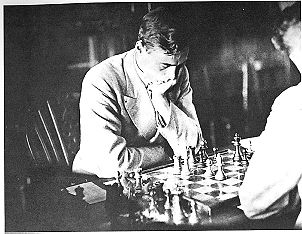

C.H.O'D. ponders another problem.
And another thirty-plus years later, opinion remains the same (thanks to Michael McDowell, Vice-President of the British Chess Problem Society, for taking the time to give us his contemporary assessment). Serious problemistas, such as all the aforementioned, like to savour more than one line of play after the key move. But, while nul point is their verdict, an over-the-board player (well this one, anyway) might be rather pleased to see the black king obliged to self-destruct. We could even go a bit psychological and see it as a metaphor for Dadd’s own predicament.

So, could Dadd play chess well enough to compose a Problem as rudimentary as this? Ms. Allderdice, who was the archivist of the hospital says “chess was a popular pastime in Bethlem". Although she adds “but there is no evidence as to whether Dadd played or not”. Mike Fox suggested otherwise in the Addict. He said “In his journals [Dadd] raved about the Ruy Lopez”, which makes Dadd sound like a real devotee of the game, “raving” (as Mike indelicately put it) knowledgably about a favourite and sophisticated opening.

It is unlikely though, Richard thinks, that Mike researched the primary sources, and it seems therefore that he got the reference from Isaure de Saint Pierre’s portrayal of Dadd’s life published in 1984: Richard Dadd - His Journals.


Be warned. This isn't the dry and dusty documentary analysis suggested by the title but, as the author freely admits in the preface, an imaginative interpretation in the service of an entertaining and readable novel. It is an account which the term "sexed-up" fits nicely and, in parts, literally - enough to make your blogger blush one morning in the V & A's National Art Library, when he fumbled in the moist passages. Mike must also have dipped into this colourful volume. This is the relevant chess bit, in which Dadd supposedly reminisces as follows:
“Those endless games of chess in Bethlem Hospital! I’ve moved my king’s bishop to square B5. This is the Spanish attack: the Ruy Lopez opening. My White
Bishop commands the centre. I think my opponent was Dr. Hood,……I can’t say for
sure I was playing this game against him, but I have a picture in my mind’s eye
of a …hand…moving over the chess board, attacking my bishop diagonally by way of
square A6. The bishop retreats to A4, the second knight moves to F6, I castle,
he castles…..”

Really? Would Dadd have used algebraic notation? Would he have spoken of the Lopez Bishop commanding the centre from b5? And those moves. The precise order may have been misremembered, of course, but an early ..a6 in the Spanish in the mid-19th century, in Bedlam? Black castling without moving his f8 bishop? Authorial licence? More than likely.

It seems probable, then, that the author consulted, adapted, and maybe inadvertently mangled, a late 20th century chess source for the words she puts into Dadd's mouth. To spare my further blushes I won't mention the other things she puts there in the course of the novel.

There is, however, something rather more reliable on Dadd's chess interests: a note made by Dr. William Orange, the second Medical Superintendent of Broadmoor, on November 7th 1864 when Dadd was there as a patient. Dadd, incidentally, painted his portrait, suggesting mutual trust and confidence.


Dr. Orange’s contemporary note (available in the Berkshire Record Office) should be accurate, although its meaning is not immediately apparent :
“As examples of his thoughts [Dadd] told me this afternoon that the power
some people have of playing Chess without the board was probably due to
their having a familiar spirit and that towards some people the chess pieces
were evidently unfriendly and that this unfriendliness might be due to the
antiquity of the Game.”
If you strip out Dadd's idiosyncratic theory concerning the selective animus of the pieces he seems to be saying that (a) some people can't play, (b) others are so good they can do so without seeing the board or, as we would say, they can play "blindfold".

So here is an intriguing thought: could the reclining figure in the picture painted seven years earlier be doing just that: playing blindfold?


"After your last move, I now announce mate in two, beginning 1.Qd8!"

From the chess point of view could this explain the relative placing of the two characters in The Child’s Problem? Although there may be a contrived two-mover on the board, Dadd may have indeed intended that the figures should be seen as playing a genuine contest. One player, the child, has sight of the board, but his opponent is playing alongside with eyes tight shut: or as Dadd phrased it, "playing Chess without the board".

And with that, please come back for a further post in a few weeks time on the Dadd story, when we will look at more chess in the Asylum. And in the meantime check us out on the Bethlem Royal Hospital Archive and Museum Blog (see their post of 6 June).

References etcIsaure de Saint Pierre (ed. Anthea Bell), Richard Dadd - his journals. Aiden Ellis, Henley 1984 (originally published in Paris 1980).
Thanks to Colin Gale and Victoria Northwood of the Bethlem Royal Hospital Archive and Museum for their generous assistance, and to Richard James for his help in general, and for the solving exercise and the Miss Baird tip, in particular.
For the story of another involuntary, but brief, visitor to Bethlem see the last episode of Every Picture Tells A Story.

*Postscript: in the TATE Etc mag. for Spring 2011, Jennifer Higgie (author of Bedlam, another novel inspired by Dadd) says it is "..a position on the chessboard considered easy enough to have been set by a child.." Said often enough it becomes accepted as a truth...

Friday, June 10, 2011

Giving a simul

I am giving a simul on Saturday, at El Corte Inglés in Zaragoza.


(actually this is a different El Corte Inglés)

I've never really given a simul before. I've stepped in to help, on one occasion, to give the proper players a rest, but I've never actually been invited to give one before now. 45 - as it happens, just a few days shy of 46 - must be unusually late in life for giving one's first simul. Presumably because most simuls are given by people who are good at chess and these people usually develop their talent at a rather earlier age. About three or four decades earlier.

Fortunately, saying "I am giving a simul" rather exaggerates the extent of my involvement, since I am only one of a team of players, some of whom can actually play the game.


It's an annual event called Ajedrez En La Calle (Chess In The Street, as the simul takes place out of doors) organised by the Aragonese Chess Federation. I'm invited to take part as the reigning champion of Huesca, one of the three provinces of Aragón.

Might be fun. Or might be an absolute disaster in which case I will presumably be forced to flee the city by boat.

I've been on the other side of a few simuls, of course, not that I have any scalps to tell you about. I did once win a prize at a simultaneous organised at the 1983 Candidates' Semi-Finals in London. There was no play in either match that day (in those days players could and did take time-outs) and so would-be spectators were invited to take part in a simul given by the estimable Jon Speelman, an offer I accepted.

I didn't win this game. I might very well have done: I won the exchange


and had I played, the computer says, 30...d5! rather than the asking-for-trouble 30...Qc6 I selected, then in theory at least I'd have been favourite, though in practice it would have been very easy to go wrong, playing a grandmaster.

But, as it turned out, I didn't win. I didn't even draw.


I nevertheless received the aforementioned prize ... for being the last player to finish. This prize was, you'll be impressed to learn, a copy of Ray Keene's notorious book on the 1978 World Championship match. A book that I already possessed.


As it happens, I played Ray himself in a simultaneous eleven months later, at Blackwell's bookshop in Broad Steet in Oxford, in which city I was then a student.


I remember, after the game, telling the Oxford Mail reporter that I'd had a better position but I had to go home to finish an essay. Which may even have been true, but that doesn't make it much less embarrassing a thing to have said.

The prize, this time, was the perhaps equally notorious first edition of Batsford Chess Openings, which Ray was touring to promote.


Anyhow, I can't imagine that, in twenty-seven or twenty-eight years' time, anybody will be remembering a simul in Zaragoza in June 2011. Or reproducing the score of a game they played against me.

[Ray Keene index]

Wednesday, June 08, 2011

Order! Order!


The diagram below is taken from James Vigus' Play the Slav, Everyman, 2008, page 177. The position depicted arises after the following sequence:

1.d4 d5 2.c4 c6 3.Nc3 dxc4 4.e4 b5 5.a4 b4 6.Nb1 Ba6 7.Nf3 Nf6 8.e5 Nd5 9.Ng5 h6.


Vigus writes:
The untried 10.Ne4, focusing on the d6-square, is perhaps not so bad for White: for example, 10...e6 11.Nbd2 c3 12.Nc4 Bxc4 13.Bxc4 cxb2 14.Bxb2 Be7, when the potentially strong bishop on c4 gives him arguable compensation for the pawn.

Untried? Sort of.

But sort of not. Let's have a look, for instance, at page 119 of James Vigus' book Play the Slav (Everyman, 2008) in which the following sequence is investigated:

1.d4 d5 2.c4 c6 3.Nf3 Nf6 4.Nc3 dxc4 5.e4 b5 6.e5 Nd5 7.a4 e6 8.Ng5 h6 9.Ne4 b4 10.Nb1 Ba6

bringing us to the following diagram...


...which is the same position as would have arisen after the "untried" 10.Ne4 and then 10...e6 as given above.

Three game references are given.

[Number one in an occasional series]

Monday, June 06, 2011

This is the end VI


Endgames to the left of me, endgames to the right of me .... it was only the beginning of last month that I was lamenting the fact that actually getting to play an endgame out could be rather difficult for club players (TITE IV; TITE V) and now I find myself having played four king and pawn endings in the last couple of weeks alone.

Quite handy, then, that review copies of Ginger GM's Killer Endgames DVDs (see above) should have just dropped through the letter box. I haven't had a chance to watch them yet, so it's probably just as well that the king and pawn positions that arose were rather straightforward, as the final positions of those games indicate:-


Slater Kennington (3)
23.5.11

Sunningdale Major (1)
27.5.11

Sunningdale Major (6)
30.5.11

Slater Kennington (4)
2.6.11


Not that things are always so easy. Take this position, for example,


White to play
Rogers - Shirov, Groningen 1990


which I found in Nunn's Secrets of Practical Chess (Gambit 1998). White to play, what result?

Anyhoo, by the time you read this I'll have wended my way out of London to a land without internet. I'll be back in a week or thereabouts with a review of those DVDs and a word or two about Sunningdale. Behave yourselves while I'm gone.


Saturday, June 04, 2011

Every Picture Tells A Story: The Cast of Players, Part 2

Number 12 in a continuing series . This one mainly by Richard Tillett.

This is the second of two posts in which we share the results of our research into the gents of Hereford chess club, depicted in Thomas Leeming’s painting of 1815. Here, once again, is the picture…


In our previous post, we profiled Charles Biss, Theophilus Lane, Samuel Beavan, Francis Lewis Bodenham and Edwin Goode Wright. These were men from the higher echelons of Hereford society, colleagues as well as friends, with close family and business connections. They were confident men, assured of their status in society and comfortable in each other’s company.

But there is one man in the group who doesn’t quite fit the template, John Allen Junior (1787-1829). He is the short and slightly hunched figure on the far left of the picture, and he is the subject of today’s blog.


Allen is an engaging figure - energetic, innovative, radical, impulsive - but a man whose demons ultimately got the better of him. His life has been researched in some detail by Paul Latcham, himself a former Hereford bookseller, and this blog is greatly indebted to an article by him published in A Hereford Miscellany in 2000.

Allen’s father, John Allen Senior, had moved from London to Hereford around 1779 where he founded what was to become a well-regarded bookselling business. From an early age the young Allen was fascinated by things antiquarian and bibliographical. This would have equipped him well for a career in the family business and indeed it traded as John Allen & Son, though only briefly.

He also had military inclinations. In 1808 he joined the local militia, the Herefordshire Volunteers, and by 1813 had risen to the rank of captain. For part of his time in the militia he served in the company commanded by Edwin Goode Wright, the figure in the right foreground of the picture holding a chess piece.

At the time the picture was painted in 1815, Allen was much involved in setting up the Hereford Permanent Library, the city’s first non-commercial library. Allen would have been well qualified to advise on the project, as the family business had previously run a ‘circulating library’ where for 12 shillings a year readers could borrow books from an extensive selection.

Allen travelled frequently to London and it is possible that he met Thomas Leeming on one of his visits, perhaps even at the London Chess Club in Cornhill. It could have been Allen who provided Leeming with his entrée into Hereford society and the commissions which followed.

Today, Allen is mainly remembered for his Bibliotheca Herefordiensis, which can claim to be the first county bibliography of its kind to be published in Britain. It was an ambitious attempt to list all the printed and graphic material relating to Herefordshire. As we recounted in an earlier blog [insert link], when we visited Hereford Cathedral library Martin and I were privileged to examine one of only 25 copies that Allen printed. None of these were offered for sale - Allen kept one copy for himself and gave the others away.


Allen’s magnum opus:
dated 1821 on the title page but not completed until the following year.
By the time the Bibliotheca appeared in 1822, Allen was already a famous, if not notorious, figure in the county, having found himself on the losing side of a highly controversial libel action. The case hinged on Allen’s decision to deposit a copy of a pamphlet in the Permanent Library which had already been declared libellous by the courts. Although Allen was not involved in the original action, by making the pamphlet available via the Library he was effectively re-publishing it, and a private prosecution duly followed.

Allen was no stranger to controversy. He had campaigned vigorously in the robust 1818 parliamentary election in Hereford, and subsequently played a leading role in inviting the radical MP Joseph Hume to attend a dinner with 300 guests, including many of the great-and-the-good of the county. Allen had also taken a high profile stand against a decision taken by the Permanent Library to destroy two books deemed to be of ‘unmoral and irreligious tendency’.

Allen’s promulgation of the libellous pamphlet was motivated by his sense of moral outrage at the conduct of the solicitor who had brought the original action. When the case against Allen was heard at Hereford assizes in April 1822 an immense crowd had gathered there, according to the Hereford Journal. Allen had little option but to plead guilty, since the libel had already been established. His chess mate Francis Lewis Bodenham (Allen’s opponent in the picture) stood by him - the Bodenham law firm not only took on the case for the defence but waived its fee. They seem to have done their job well as, on the surface, Allen emerged relatively lightly. The plaintiff received only nominal damages of £5, but Allen still had to meet the plaintiff’s costs of over £400.

Then the wheels started to come off. In 1823 Allen Senior sold the family business rather than passing it on to his son, which suggests that their relationship may have broken down. In the same year, Allen Junior moved to London where he dealt in books and continued his bibliographical and antiquarian researches. But he was soon seriously strapped for cash. In 1827 his stock and much of his private library was sold at auction.

A sad note scrawled by Allen in 1827 from Clerkenwell Prison survives, in which he asks his librarian friend William Upcott to stand bail for him so that he can be released ‘from this damned place’.


John Allen Junior's cri de coeur from Clerkenwell Prison

We don’t know why he was there, but Clerkenwell was not a debtor’s prison so perhaps he was detained for attempted suicide, in those days an imprisonable offence. Within a few days a certificate of insanity had been obtained, and Allen spent the next eight months in Bethlem Royal Hospital (Bedlam).


An 1828 engraving showing the the forbidding exterior
of the Bethlem Royal Hospital .
On his discharge he returned to Hereford, but his mental health soon broke down again and in 1828 he was admitted to Hereford Asylum. He died there the following year at the age of 40.

His passing was barely noticed in Edwin Goode Wright’s Hereford Journal. John Allen Junior had not so much been forgotten as airbrushed out, perhaps a victim of the stigma that in those days attached to mental illness.

Our next blog in the series will be on 18 June, when we look at the paintings on the walls of the room in which the gents are playing.

References
Paul Latcham: John Allen, Jun. and his Bibliotheca Herefordiensis, pages 219-223 of D. Whitehead & J. Eisel: A Hereford Miscellany (2000).

Every picture tells a story Index
Chess in Art Index

Friday, June 03, 2011

"It's all over now, Baby Blue"


Just yesterday - and probably days after everybody else - I happened to come across the YouTube channel belonging to a chap calling himself Sir B0b1. This gentleman - his real name is not a secret, but we'll leave it as an exercise for the reader - introduces his channel thus:
Welcome to my channel. I intend to add Master Game Chess episodes from 1980 to 1982 for public viewing.
Well hurrah for that, we say, particularly because the programmes feature the original visuals, not available last time we brought you The Master Game.


It's a work in progress: some of the videos have been added in the last few days. Among several games are three finals, all of which are embedded here, but there's plenty of others to enjoy - and perhaps remember.


So do, indeed, enjoy. And watch out for You-Know-Who being described, by Bill Hartston, as "a very fine, erudite writer on the game". Those were the days.


Wednesday, June 01, 2011

Chiv Chat

Click for this edition of Chiv Chat, featuring a fabulous chess analogy, ramblings about candidates matches, some great news from one of my fellow bloggers, a puzzle - all that and absolutely nothing else!

Monday, May 30, 2011

Шахмат Печенья

At last we know.

How every Russian schoolboy knows his Rooks from his Bishops.

They digest it...


...with...


...their tea.

Warning: the packet says they contain "lemon". Yes, that's ' "lemon" '.


Contains "lemon"


Thanks to Richard Rawles for kindly bringing all this to my attention.

Saturday, May 28, 2011

Letter to the editor III

The latest instalment of Every Picture Tells a Story, will appear next week. In the meantime, we interrupt our schedules to bring you news that 30 years ago today, an amateur chesser was sitting down to put pen to paper. I wonder if he is still with us, and, if so, what he makes of the game today.


FROM:
CHESS
Volume 46, Nos. 855-856
June 1981
p. 75


WHAT WE NEED (?)

Dear Ed. and fellow readers of CHESS.

What modern British chess really needs, are

1. A residential chess, holiday and week-end centre, for keen chess players of all ages.

It should have really good facilities.
A games shop.
Computer chess.
Friendly and tournament games.
Simultaneous chess.
Human chess, played on a giant chess-board, preferably inside a hall, because of our uncertain weather.

There's nothing quite like acting out a game for some really good chess fun.

Why human chess has tended to die out, is the fact that so many games were drawn with only the two kings left, so that that the crowd's interest dwindled. Something should have been done before it largely died out, for it can be quite exciting to watch, almost as exciting as an actual battle, which of course it is supposed to be.

I believe Human Chess is still played on the continent, and of course in Eastern Bloc countries, where chess is almost as popular as football.


2. Do we need to modernize chess? I think we do; it would look something like this:
A-Bomber 9 pts
Tank 5 pts
Missile 3 pts
Strike aircraft 3 pts
Infantry 1 pt
King ? 
The rules of the game, would of course remain the same. But it would look more modern, and one might easily be able to plan the tactics of one's game better, who knows?

I'd be interested to hear what other readers think of these ideas.


3. Another idea would be to have a Western World Championship, with the U.S.S.R excluded, to give players in the west something to aim at.

One might argue that this wouldn't be be quite fair.

On the other hand if we had what we considered to be our world champion, it might stir up more enthusiasm among people, to learn the game. Such was witnessed in 1972, when for a while the west really did have a world champion.

Anyway, that's all of my ideas for the moment.

BOB FLETCHER
Byfleet, 28 May 1981


Letter to the editor
Letter to the editor II


Friday, May 27, 2011

Bad book covers XIX


Win In The Opening! Opening mistakes and how to punish them, Neishtadt, Olms, 2003


The Spanish Exchange Variation: A Fischer favourite, Kindermann, Olms, 2005


222 Opening Traps After 1.d4, Müller and Knaak, Olms, 2008


Zaubern wie Schachweltmeister Michail Tal:
Der Taktikratgeber mit 100 Opferkombinationen zum Selbstlösen
,
Müller and Stolze, Olms, 2010


[Also see this and frankly almost anything else published by Olms]

[Bad book covers index]

Thursday, May 26, 2011

Not so New In Chess


Win In The Opening! Opening Mistakes And How To Punish Them, Neishtadt, Olms, 2003


Improve Your Chess Tactics: 700 Practical Lessons & Exercises, Neishtadt, New In Chess, 2011

Wednesday, May 25, 2011

Adam Raoof


Adam Raoof, at somebody else's tournament
photograph by Brendan O'Gorman


If you were to follow me home and hide in the bushes outside my flat one evening – and, let’s be honest, we both know that you want to – you would notice two things pretty quickly: (a) I live on the second floor so you can't can’t see in particularly well; and (b) the fact that you can see in at all is in no small measure due to the fact that I don’t have any curtains in my front room.

The absence of drapery I would explain by saying that I haven’t got around to putting any up as yet. As it happens that’s also the answer I’d have given if I'd been asked about curtains in the weeks after I first moved in twelve years ago.

Charlies: the restaurant just by the
Golders Green playing hall
Photograph from Adam Raoof
This is all by way of explanation of why this post has been waiting for me to write it for three months. Having the attention span of a gerbil, I am very easily distracted and unfortunately it often takes me quite a while to finish a project once it’s started. Sad to say, but frittering away time is an affliction I struggle against off the board as well as on it.

Anyhoo, the original motivation for this post was that I’d wanted to find out about chess tournaments. More specifically, I'd wanted to know what makes a good one. Who better to talk to, then, than Adam Raoof? If you’ve played any chess at all in London over the last couple of decades you almost certainly already know Adam and very possibly have played in one of the rapidplay events he holds each month at Golders Green. Actually, even if you don’t live here there’s a fair chance that you’ve heard of him anyway. He’s that sort of guy.

Back in February we – along with Chris Andrescu – met for a bite to eat and a chat about the history of the Golders Green tournament. We discussed much else too - Adam’s work as Chess Consultant on the sequel to Guy Richie’s Sherlock Holmes movie and his role as Director of Home Chess at the English Chess Federation for starters – but those other subjects we’ll save for another day. This post has already been delayed for long enough.

Many thanks to Adam and Chris for their time, and my apologies to them for taking so long to write up what was a very interesting conversation. If you want to sample Golders Green yourself, the next tournaments will be held on June 11th and 9th July. Unfortunately I will be out of London and will miss both, but I hope to play in the one after that (6th August). You never know, once that's out of the way I might even get my tape measure out and start measuring up for those curtains.


Golders Green chessers
Photograph from Adam Raoof


Jonathan Bryant:
It seems to me as if the Golders Green tournament has been running forever.

Adam Raoof:
Yes, me too! At least 15 years.

Chris Andrescu:
Since ’91. Maybe ’90, but I think ’91.

JB:
I came to London in 1992 so that’s why I think you’ve always been around, then. How did you get started?

AR:
Hendon Chess Club used to have an annual rapidplay and one year they couldn’t run it, so I said I’d do it. We held it in Hendon Library, where I worked, and after that I think the second two were in Edgware in a church hall. I went to a guy I knew, Glynne Jones, and said I need some help. He came along for a couple of tournaments and then he said, “Right, you’re on your own.” That was it. I was hooked.

CA:
There were three or four tournaments in Edgware in 1994.

AR:
I used to go and play in George Goodwin's quickplays on Sundays. At that point he ran two of those a month so I thought “I’m going to run mine on Saturdays, and I can go and play his.” At that point there were lots of tournaments

CA:
John Sargent, the Civil Service tournament.

JB:
International Students?

CA:
International Students was good while it lasted.

AR:
We all met as organisers and made sure we didn’t clash and I just fitted around everybody else’s dates because they were already established.

JB:
Now you’re the established event. Your dates are already set to the end of next year aren’t they?

AR:
I always do it a year in advance. I generally keep the same dates, except when Easter moves, but that’s about it.

JB:
What’s the average entry that you get?

AR:
It used to be 70 was a good weekend, but now we’re disappointed if we don’t get 80 and today I think was 100.

CA:
102.

AR:
The record breaker was … (pauses to think)

CA:
119.

JB:
Do you ever have to turn people away?

AR:
Never.

CA:
Once or twice almost to the edge.

AR:
We ran out of clocks once and we literally said “As soon as somebody else finishes you can have their clocks” and we got around it for one or two games. When we had 119 we actually had more than that entered and some people didn’t turn up. It was good weather so we put them outside, we put them in the little annexe just as you come into the church hall. We’d have put them in the kitchen if we had to.

CA:
The worst ever was 20 players.

AR:
That was early on.

CA:
No. About ’96 or so.


A brief interlude followed during which we debated whether 15 years ago counted as "early" for Golders Green. That tells you something about the tournament's longevity, I think.


CA:
It clashed with the British Rapidplay.

AR:
That was in Leeds and even I went to Leeds. Nobody came here, not even me.


Chris Andrescu guarding the Golders Green pairing cards
Photograph from Adam Raoof


Golders Green is such an established event that it's hard to imagine it ever not being there. I was shocked when Adam told me that there had been a time when he was thinking about giving it up.


AR:
There was a point when I was getting a bit jaded and I’d run it for so many years and I thought “It’s not going anywhere. I’m going to hand it over to somebody else to run” and at that point I thought, “No. I’ve got to give it one last shot” and I started using Facebook, I started collecting email addresses. And it worked, it really worked. The numbers went up and up and up.

JB:
No more thoughts of jacking it in, I hope.

AR:
Well it went up very steadily, I wouldn’t say overnight, but it got me interested again. It had become very routine and I thought “Where am I going to get those entries from?”

When I originally started out organising 12 tournaments a year didn’t seem like such a strange idea because I could save lot of money on printing. But after a while we never printed anything really because people just knew about the tournament.

I realised where I could get those extra entries from were people who used Facebook, people who use email but don’t really pick up leaflets at all, maybe they look at the calendar on BCM online or the ECF calendar or teletext or Ceefax when that was going.

We always get a core. At the fringe the people who come and make the difference are the people who decide “this month I’m going to come and play at Golders Green. Next month I’m going to play in a weekender. The month after that I’m not going play in Golders Green, but I’m going to play in Richmond.” Those are the people. If you can just remind them on Facebook or send them an email it makes the difference.

JB:
I think Golders Green is the only one you can actually enter online.

AR:
My friend Mike Bennett does HendonChessClub.com. He’s a web designer. I thought I could put the entry fees up but what I really want is more players so I said to him, “Can you design a system so people can enter online? They don’t have to pay. I just want to be able to do all the paper work before they get there.” I just wanted people to come in and sit down and start playing. Mike did it all for me.

JB:
I always used to enter on the day because I was unorganised and I’d end up queuing with loads of other people waiting to pay…

AR:
I hate that. When you go to a tournament and it’s supposed to start at 10 but it starts at half-past because people are late. I thought let’s just get people to come in and play and we can settle up later.

JB:
A lot of people would assume they wouldn’t pay.

AR:
I do sometimes chase them! But they do pay. People are very honest and it does save them a lot of time.

We did put the late entry fee up to £20. It is quite expensive to go to other tournaments and enter late. It’s relatively simple to enter Golders Green. They’re more likely to make a decision to come and play at the last minute and they can also enter online and save themselves a fiver.

I lose in the sense that I could probably put the entry fees up and the late entry fees up but I'd probably get less players. I’d rather have more players and make it a more significant event. That’s what makes it interesting. If we had 70 or 80 players every time that would be OK, but to get 100? 120? That’s great.

JB:
Golders Green is a very important event for London chess now, I think. Even though I don't play in it very often I know it's there and if I ever want to play I know I'll be able to get a game.

AR:
It’s only a little local rapidplay and yet because it’s in London and it’s been going on so long, we’ve had just about everybody come through it at one point or another.

CA:
Such as John Nunn, Michael Adams.

JB:
A few years back Jim Plaskett was here each time I came.

CA:
Harriet Hunt.

AR:
Luke McShane. That’s how I got to know people. They turned up and played here and I got to know them.

More and more we get a lot of juniors, under 16s, coming to practice for events that take place on the Sunday. So if they’re coming for a National Junior Squad event on the Sunday, they turn up at Golders Green to give them a little warm up. At one point we had an influx of juniors from Sri Lanka and India too.

JB:
So, when it comes down to it, what is that makes Golders Green a success?

AR:
I think the only secret is to keep on running it, no matter what. We have kept going every month and eventually that wins a certain loyalty from the players. We are blessed with a convenient venue right next to a tube and bus and coach station at Golders Green. We've made certain improvements over the years and we’ve got modest but guaranteed prizes.

JB:
Do people sometimes ask you why you don’t increase the prize money?

AR:
Occasionally, but not that frequently. The main reason why people play at Golders Green is that it’s organised well, hopefully, and it starts relatively late and finishes on time. We don’t have a lunch break so people get six games of chess without hanging around, and it’s friendly. Prize money isn’t a priority.

I’ve thought about the prize money very seriously, but with the capacity of the church hall limited to 120 at the most and the fact that I get a pretty large entry at the moment, there’s not much of an incentive for me to put the prize money up because I’m not going to get that many more entries. If I had a bigger venue, then maybe.

JB:
I know some people look at prize money in relation to the entry fee, but I think to me and a lot of people it makes no difference.

AR:
We’ve kept the entry fees at a reasonable level. Ironically, that’s for the convenience of the person taking the money - i.e. me! – though. It’s easier to take an entry of £15 than it is to say “let’s put it up a pound” and then have to faff about with change all day.

People appreciate it and it doesn’t seem to affect the strength of the entry. You still get a very competitive tournament. In the end people are very friendly. They treat it like a local tournament. They get to know people and come along as regular competitors.

JB:
Having large prizes for what are essentially amateur tournaments can risk causing trouble, I think.

AR:
I’m in charge of the grading and rating. To be honest there aren’t that many people who would play the system. If you provide a financial incentive of course there are always going to be one or two exceptions. We generally don’t have that problem at Golders Green.

CA:
No, not at all.

AR:
I know the players pretty well. It’s very unusual that I see somebody at Golders Green that I don't already know. When I do, I introduce myself and try and get to know who they are.

JB:
Have you had any other difficulties running the tournament? My experience is that any disputes are pretty low-level stuff.

AR:
No, I think it is fair to say that this is one of the friendliest events around, and we try to keep up that efficiently-run-yet-informal atmosphere at all times. On occasions I have had to throw out drunks, and stop players strangling each other, but generally they get on well, playing in a competitive spirit.


Interview Index


Monday, May 23, 2011

Have Your Cake and Play It

A tasty morsel to start the week.


As seen last month in a Parisian pâtisserie.
Another one for LASTG*UR. Possibly.

Touch a piece, and eat it. You can have another bite here, if you can bear it.

*Gâteau

Saturday, May 21, 2011

What Dadd Did

Victorian artist Richard Dadd (1817-1886) was a Royal Academician by the age of 20. This is a well known photo of him some two decades later.


Richard Dadd in the mid/late 1850s.


He became famous for painting fairies. But it wasn’t for this fashionable eccentricity that he was confined, at the age of 24, to Bedlam and then Broadmoor, where he lived out the rest of his 69 years. He was there because he murdered his father. In a psychotic episode Osiris, the ancient Egyptian God of the After Life, told him to do it. An appalling tragedy by any standard.

During his years inside Dadd continued to paint, and exhibit. One of his pictures was a chess painting. Just one. This one. Painted in 1857, after 13 years of detention. It is rather bleached out, indistinct, and altogether rather odd.

The Child's Problem (1857) by Richard Dadd (1817-1886).(click on any picture to enlarge)


It is currently on show in TATE Britain’s Watercolour Exhibition, where it was spotted by fellow blogger Jonathan B, who, perhaps in the knowledge that every picture tells a story, suggested this enquiry into the painting, and its chess.

Pausing to look in the gallery most visitors would simply see a game in progress, where the child’s problem seems to be reaching the pieces or, if he can, deciding what to play before his opponent wakes up. Some visitors might also wonder if that kid has got a problem of a more delinquent kind...like cheating. Could he be taking advantage of his elder and better’s careless dozing to adjust, without so much as “j’adoube”, the pieces? Seen this way, the picture might take the moralising stance of so much Victorian art (as suggested by David Greysmith - see References for details of this and other sources consulted), even if the artist, himself, was hardly an unblemished role-model.

And a few might notice that there is hand writing, presumably Dadd’s, across the top of the picture, giving the title, and a subtitle, but at the height it's hung you have to be six-foot-six to read it. The subtitle, not always mentioned by commentators, adds a touch more ambiguity. It is “A Fancy Sketch”, and goes on to give the date (December 18th 1857) and the place it was painted (Bethlehem Hospital, London, St. George’s in the Fields). But is that “Fancy” in the sense of imagined, or as in ornate? We’ll come back to the former in a later post, but as for the latter just look at the picture’s obsessive detail. You don’t have to be a chess addict (though it helps) to find yourself counting off the pieces to check they are all there - it's easier in zoom-able black and white.


You can make out the complete black (or is it red) army on and off the board, and white's too (don't miss the pawn seen through the decanter), except it appears to fall one 'p' short. Actually, as I found out from Patricia Allderidge’s book, the errant pawn is partially concealed by a nut-case, at the front of the table.


Spot the pawn

Unfortunately that's not completely clear, and maybe the colour reproduction is more helpful where, before our very eyes, we can see the final pawn, half-hidden. We can see it, you and I, but maybe the child can't, and perhaps that's its problem. But a pawn with a hat on? Dadd's little joke perhaps; a situation for which another lunatic wordplay - madcap - might have been coined.

Now drawn into the chess mysteries of the picture chessers will know that the title has other connotations. Maybe it is not a game, but some kind of chess puzzle: “The Child’s Problem” of the title might refer to a problem on the board, one the child is trying to crack; or even one that it is composing for the later amusement of the snoozing figure (however unlikely that may seem, as we'll explain in a later post). If so, Dadd had to be chessed-up enough to paint a proper position, rather than some random arrangement. But has he?

In the black and white version the pieces on the board are easy to identify: White King, Queen, Rook and a couple of pawns; Black King, Knight and pawn. It’s their precise squares that is the problem. Here the chessically well-read will reach for their copy of Mike Fox and Richard James’ 1987* volume The Complete Chess Addict where the picture was reproduced (or most of it – a lot of the background was cropped, and we'll come back to that as well) for the first time in chess literature (apologies if this claim is wrong, when a corrective comment would be welcomed), and the position diagrammed.

The details in a moment, because there are some other chess mysteries to note first. Eduardo Sadier (who maintains a huge data base of two move chess problems) has pointed out (in an email to me) another oddity from the chess point of view – if the child is solving (or even setting) a chess problem, then he is seeing it from black’s side of the board, which goes against convention in chess-problemdom. And (Eduardo continues) talking of sides, go back to the notion that there might be a game in progress between the two of them: in that case the dozing figure is again on the wrong side of the board. So could there be someone else on our side? Who? You? Me? And at child's eye-level to boot.

So, to get to it at last: what is the position in The Child’s Problem? Although Dadd doesn’t spell it out, and to make it easier for you, it is "White to play and mate in two". Try and solve it, and as you do so, ponder whether the child might be offering a clue with his left hand. If it really is too difficult, you could consult The Complete Chess Addict for the key move (or come back next time).


There is more chess yet in the Richard Dadd story, including who transcribed the problem, and what the experts say about it. We’ll see what Dadd did next in a couple of weeks, or so.
BTW a touring exhibition of Dadd's work is about to open at the Orleans Gallery, in Richmond, London.

Subsequent episodes on Dadd, and chess in the Asylum, may be linked via our Asylum Index here.

References
Patricia Allderidge, The late Richard Dadd 1817-1886. The Tate Gallery, London 1974.
Mike Fox and Richard James, The Complete Chess Addict 1987 & The Even More Complete Chess Addict 1993.*
David Greysmith, Richard Dadd; the rock and castle of seclusion. Studio Vista, London 1973.


Bethlem Royal Hospital Archives and Museum.
For an informative biographical note on Dadd see here.
*indicates that a correction has been made to the original post as a result of the first comment. (Martin S.)


Chess in Art Index

Friday, May 20, 2011

Blue or Red Pill IX

Have I really not done one of these since January 2010? Time to fix that.


White to play


White's a long way ahead in development, but his knight's out on the rim and, more immediately, his bishop is attacked. So, what to do?


Exchange on d5,


or retreat to b3.


Think carefully: the championship of the world is at stake.


Blue or Red Pill? Index


Thursday, May 19, 2011

Duffers' Delight IV

[An early draft of today's post was published in error yesterday morning. Since then I've made a few minor changes to the main body of the text and the conclusion has received a much needed polish.]

From age eight to eighteen, my son Daryl actively participated in the highly competitive world of "Juniors" tennis. By age twelve he had developed all the basic strokes, and by the time he was in his late teens, and over six feet tall, he - and any of his peers - could have taken the court with any of the world-class touring pros. Daryl would not have won any games against the professional, but he could have won points, and if you had sat in the stands and watched them play just a few points, you could not have easily discerned that the pro was levels above the teenagers ...

In tennis, the strokes of the leading juniors look the same as those of the top pros. Minor differences set the two groups apart.


Ken Weber, Maximum Entertainment: Director's Notes for Magicians and Mentalists
Ken Weber Productions 2003


Did you see Doctor Who - Neil Gaiman's The Doctor's Wife - last Saturday? It was a great episode which, aside from the absence of a chess theme, was missing only a cliffhanger ending and the opportunities for deeper and more involved narratives that come with multi-part storylines. I don't want to give anything away, we may have a reader or two who hasn't already seen it, so all I'll say here is that fans of Jonathan Rowson's concept of "talking with your pieces" will find much of interest awaiting them at the Beeb's i -Player catch-up service.

Consider this all another (see also Star Trek and Blake's 7) pitiful excuse to write about telly sci-fi if you will, but the Candidates' matches we've been seeing in Kazan over the past couple of weeks remind me of a single-part Doctor Who story. It's not that four-game matches must be total rubbish, but they are inevitably going to pale in comparison to the longer format that seems to be completely out of fashion these days.

Sad to say, but Candidates' matches of a decent length have gone the way of the four-part plus stories that were standard for Doctor Who when I was a nipper. If Grischuk - Gelfand, which starts today, goes the distance (i.e. the 'full' six games), the two Gs will have played a total of 14 standard length games throughout the whole event. That was the scheduled length of the Candidates' final alone for the cycle which took Nigel Short all the way to a World Championship match with Kasparov, and if anything Nosher's 40 games spread over four Candidates' matches is itself rather limp by the standards of his predecessors. Viktor Korchnoi, for example, played 43 games on his way to Baguio in 1978 and had he not finished off Polugaevsky and Boris Spassky early, it could have been as many as 48.

Which brings us to Ken Weber's Maximum Entertainment. Substitute Grischuk and Gelfand for Weber's 'leading juniors' and switch-in Anand, Carlsen, Aronian and (perhaps) Kramnik for his 'top pros' and the passage at the head of today's blog describes the fundamental problem with very short Candidates' matches rather well, I think.

Grischuk and Gelfand are currently 12th and 16th on the FIDE Rating List at 2747 and 2733 respectively (12th - 2752.2 - and 15th - 2740 - on Hans Arild Runde's Live List). They're certainly not 'levels' below the three or four guys who have a realistic claim to be the absolute best chess player in the world. With 40 to 80 fewer elo points to their names, however, they clearly are a level down even if, just like Weber's tennis players, it's minor differences, microscopic even, that divide these men. Four-game matches, the equivalent of FIDE watching them bash the ball back and forth across the net for a few points, simply aren't enough to distinguish one from the other.

Consider Grischuk's progress to the Candidates' final, for example. According to GM Sergey Shipov, had Aronian played Ne5 instead of 69 Nc5 in game one of the quarter-final,


or if Kramnik had tried Rb1 or Nf4 instead of 31 Rd8 in game four of the semi,


then Grisch might well have lost those games and been knocked out of the tournament as a result. They didn't, though, and he went through after taking the rapid and blitz play-offs. When entire matches hang on such slender threads sheer luck must inevitably play a significant part in determining the outcome - which is just about the only way we could have made chess even less appealing than Edgar Allan Poe thought it was (see yesterday's post).


Limp Streak of Piss and Karen Gillan talk about The Doctor's Wife and Neil Gaiman


'Duffer' is a relative term. It seems - and is - harsh to apply it to folk who are the 12th and 15th best chessers out of the 7 billion-odd people who live on this planet, but the fact remains that Grischuk and Gelfand are a notch below the very best that humanity has to offer our favourite game. Whatever else they might be, neither of them is the best chess player in the world right now and nor will they ever be. In most circumstances that wouldn't matter a jot, but it is rather important when you're talking about a contest to find a challenger for Vishy Anand's title of World Chess Champion.

They've made it through to the Candidates' Final which one of them will eventually win and therefore, assuming FIDE manage to find somebody to pay for it, get to play that match with Anand. They've played to the rules in place so good luck to them; chesswise, there's much to look forward to regardless of whether it's Grischuk or Gelfand who gets to play Vishy.

None of that changes the fact that turning the Candidates' tournament into an event that any one of fifteen or twenty people could win demeans the World Chess Championship itself and risks turning the title into a meaningless bauble. I understand there are financial issues to be considered*, but if the Challenger for World Championship isn't the guy other than the existing World Champion who plays the best - the absolute best and not just kinda-sorta-perhaps-one-level-down-from-the-best - why bother to find one at all?


PREVIOUSLY:
Duffers' Delight - A strange bishop move in the QGA
Duffers' Delight II - Dutch Mentalism
Duffers' Delight III - Jeffrey Archer's 7-pawns attack


* for FIDE just as for the makers of Doctor Who. The BBC favours single-episode stories for Doctor Who because it makes the series easier to sell abroad, which in turn allows the Beeb to recoup some of the costs of production.  Similarly, a decent length Candidates match could cost twice as much to run and FIDE is hardly being flooded with cash pouring into the game just now. True, they could have gone for an eight-player double-round all-play-all instead of these micro-matches, but while that would be a shorter event (when you take rest days into account) , you'd also have to factor in the extra costs of accommodation and living expenses when all the players and seconds stay for the whole thing rather than half of them going home after a week and another bunch clearing off after a fortnight.


Wednesday, May 18, 2011

Murders in the Rue Morgue

Edgar Allan Poe, Murders in the Rue Morgue:
I am not now writing a treatise, but simply prefacing a somewhat peculiar narrative by observations very much at random; I will, therefore, take occasion to assert that the higher powers of the reflective intellect are more decidedly and more usefully tasked by the unostentatious game of draughts than by all the elaborate frivolity of chess. In this latter, where the pieces have different and bizarre motions, with various and variable values, what is only complex, is mistaken (a not unusual error) for what is profound. The attention is here called powerfully into play. If it flag for an instant, an oversight is committed, resulting in injury or defeat. The possible moves being not only manifold, but involute, the chances of such oversights are multiplied; and in nine cases out of ten, it is the more concentrative rather than the more acute player who conquers.

You've got to wonder what Poe would have made of four-game Candidates' matches [more on them, btw, in a bonus post tomorrow]. Anyhoo, onward.

In draughts, on the contrary, where the moves are unique and have but little variation, the probabilities of inadvertence are diminished, and the mere attention being left comparatively unemployed, what advantages are obtained by superior acumen.

Chess is the second best game after draughts? Would that it were.

Whist has long been known for its influence upon what is termed the calculating power; and men of the highest order of intellect have been known to take an apparently unaccountable delight in it, while eschewing chess as frivolous. Beyond doubt there is nothing of a similar nature so greatly tasking the faculty of analysis. The best chess-player may be little more than the best player of chess; but proficiency in whist implies capacity for success in all these more important under-takings where mind struggles with mind.

Cards are where it's at?. Perhaps that explains poker-loving Alexander Grischuk making it to the Candidates final, then.