
Le chevalier Cifar observe le camp ennemi jouer aux échecs
de Carrion (14th cent.)
[BNF Paris]

Croisés refusant de combattre
de Tyr (attr, 14th cent.)
[BNF Paris]
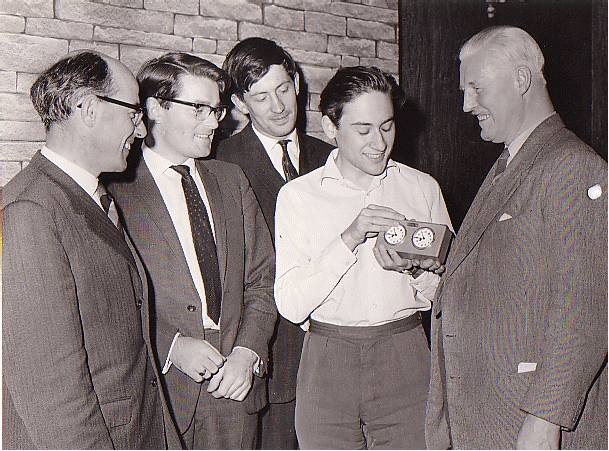 Well, he said, settling down in his armchair, Hartston was a strong international master who was an early favourite to become the first English grandmaster, a title, however, that he never ultimately obtained.
"You don't need to be a great player to know that time management is as important a feature of the game as accurate calculation, opening preparation, intuition etc."


John Nunn:
“Chess is all about making decisions. Postponing a decision doesn’t improve it. Try to get into the habit of asking yourself: is further thought actually going to be beneficial?”
So what to do? Bring my last piece into the game or play ... Kf8 before or after swapping rooks on the e-file. At the time I wasn't clear whether exchanging rooks would help me or merely emphasise the strength of his bishops. In fact after a few months to think about it I'm still not clear what's best. I frittered away a few more minutes here simply because I couldn't decide on what course to take.
Sometimes you've just got to choose one plan or the other
TOTAL TIME SO FAR: 43 minutes
POSSIBLE SAVING: 21 minutes
21. Kf1 Rxe1,
TIME SPENT ON MOVE: 5 minutes
Unfortunately I chose one plan then the other and worse still spent ten minutes doing it.
TOTAL TIME SO FAR: 48 minutes
POSSIBLE SAVING: 26 minutes
22. Rxe1 Kf8, 23. h3 h6, 24. g4 g5, 25. Bc1 c6, 26. h4 f6, 27. hxg5 hxg5, 28. Be2 Kf7, 29. f4 gxf4, 30. Bxf4 Re8, 31. g5 Rh8, 32. Bxc4 Nxc4, 33. Re4 b5, 34. gxf6 Kxf6, 35. Be3

An interesting moment. I'd already seen his rook was vulnerable to a knight fork but on the other hand his bishop attacks my a-pawn. With a bit more time to think I might have put these two ideas together and realised the a-pawn can't yet be taken without allowing a knight check on d2.
My dawdling earlier had left me with little more than a quarter of an hour to finish the game by this point. The rook ending is obviously much better for me but is it winning? With pawns on one side of the board general principles suggest my knight should be better than his bishop so perhaps I want to keep minor pieces on the board anyway. Pressed for time I made the exchange after less than a minute's thought. It worked out well in the end but in less favourable circumstances this could have been the point where I let the game slip away.
Needless to say, had I not haemorrhaged the minutes away earlier in the game I would have had plenty of time for a proper think here.
35. ... Nxe3, 36. Rxe3 Rh2, 37. a3 Ra2, 38. c4 bxc4, 39. Rc3 Ke5, 40. Rxc4 Kd5, 41. Ra4 c5
I hadn’t foreseen that he might go after my a-pawn but when he played Ra5 it occurred to me that he might not actually have the time to take it anyway. Since there’s nothing to be gained by worrying about this, since there’s nothing I can actually do to stop him capturing the pawn even if I’d wanted to, I just pushed … c6-c5 instantly and hoped for the best. Normally I'd have lost some time to self-recrimination and worries that I'd thrown the win away but I'd finally woken up and actually started to play sensibly (timewise at least).
Incidentally, throughout this ending I was plagued by the recurring thought that it would be an awful lot easier had I actually read some of the rook endgames book (John Emms’) that has been sitting on my shelf for many years. Things turn out pretty well - though your guess is as good as mine as to why I moved my king in front of the pawn on move 51 - but in a less straightforward position my lack of basic endgame knowledge could have cost me a lot of time which in turn might have made the difference between winning and drawing the game.
42. Rxa7 Kc4, 43. Ke1 Kb3, 44. Kd1 c4, 45. Rb7+ Kc3, 46. Ra7 Ra1+, 47. Ke2 Rxa3, 48. Rd7 Kc2, 49. Rd2+ Kb3, 50. Rd1 Ra2, 51. Kd1 Kc3, 52. Rd8 Ra1+, 53. Ke2 Kc2, 54. Rb8 Rd1, 55. Ra8 Rd2+, 56. Ke1 c3, 57. Ra2+ Kd3, 58. Ra1 Re2+, 59. Kf1 c2, 60. Ra3+ Kd2, 61. Ra2 Re8, 62. Kf2 Kd1, 63. Ra2 Rf1+, 64. Kg2 c1=Q, 65. Rd7+ Qd2+ 0-1
There’s no need to do this of course, Fritz takes just a few moments to find mates in 9 after both Ke2 and Ke1, but with my nerves shredded and just three minutes to go I wanted to be able to stop thinking and ensure there was absolutely no way I could lose. White resigned at this point but I think I might have been tempted to make him actually mate me. It shouldn’t go wrong of course but Black is close enough to flag fall to make playing on justified.
So happily enough it all worked out in the end but it could easily have been very different. With a better clock handling I would have been able to play the opening and early middlegame much quicker and saved the time for critical moments later on.
I found the very similar problems in many of my games last year. Just as I said of Peter Wells, it leaves me wondering how many ECF grading points I chuck away every year through poor time management
* I've been following Webb's advice religiously ever since I bought the second edition of his book in the early 90s.
** Sadly Webb neglects to mention simply recording the move times alone will not be of much use to you. After more than a decade of painstakingly keeping track of the time taken for each chess move I made in serious games it was only earlier this summer that I actually got around to making any attempt to systematically analyse the data I'd been gathering. This is a pathetically embarrassing state of affairs, the only possible benefit of which is that it's led to this aside - and I do love a good footnote.

 This position is the outcome of successful opening preparation. I'd realised who I'd likely face before the game, and noticed he always played the Open Ruy Lopez as black. So I'd prepared 5.d3 for this encounter, which rules that out. Visibly flustered, he'd gone into a version of the Closed Spanish where he managed to lose two (!) tempi and then misplay the resultant position anyway. Clearly, in the diagram, there is a lot of wind gusting around his king, and this spells trouble.
My conclusion? If you've not before, then commit to playing the mainline Sicilians with both colours for a significant period of time. The Sicilian is different, and forces us to be different players. This whole experience helps us improve. Maybe.
14. ? ! ( -/+) 15. ?? (-+) ?! 16. ?! ?! 17. ?! ?? (=+) 18. ! ? (=) 19. ?? (-+) ?? (=) 20. ! ! 21. ?? (-/+) ! 22. ?! ! 23. Resigns?? (-/+ of about 1 pawn, says Fritz).

 White to play
Lipschuetz-Zukertort
 White to play
Lipschuetz-Lasker
 Secondly, ever wondered what would happen if you crossed a chess board with a subway map? Tom Brown has, in multiple posts across his blog. In fact he's constructed such a map showing every move for every piece on every square of the board, in subway map style. To the right is d5. If you explore his blog you'll find the rest.
 White to play
“Sokolov-Wells saw the Englishman outplay his formidable opponent, but agree a draw in a position where he stood substantially better, but had little time on the clock”
“Peter Wells gained a dangerous-looking attack against Smeets' king, but used a huge amount of time on the clock. A massive time-scramble saw Peter finally lose the thread at move 34, and when his flag fell three moves later, he was already losing on the board as well.”
 White to play
“Peter Wells played the sharpest game of the day, against Cherniaev, and should certainly have won against the latter's extremely optimistic play. However, the clock was again Peter's great enemy, and he repeated moves in a position where he was objectively winning”
* "Feck me Alexander. Now I'm going to end up on some blog with an eejit 1000 elo points my inferior telling me how I should play chess."
 Black to play
“L'Ami-Wells … White maintained the initiative, but went astray around move 25, and when he offered the draw a couple of moves later, it was doubtful whether he really had enough for his two pawn deficit. However, Peter's clock was doing its usual nasty things to him”


Black to play
The belief that life begins at 40 is a myth. Research has found that the fourth decade heralds the beginning of the end.Bugger.
 Black to play


The organizers are subjected to abuse for many decisions, often under circumstances beyond their control, as the termites would know if they had ever in their lives attempted to put on a Grandmaster chess event ...Indeed, it would be a real shame for London to lose the Staunton Memorial, and I've often wondered why Dutch sponsor Jan Mol hasn't considered moving the event to Holland.
Termites have an affect. They nibble away and cause the true chess workers endless grief, and organizers and staff grow tired of it and become less enthusiastic about repeating the experience. We have lost many good organizers and staff because of this. None of us are making any money on this ...
The termites threaten to destroy the Staunton, as they have destroyed many fine tournaments in the past. Keep in mind the hard work required to put on a major chess event and don’t become a termite! I hope we’ll have another fine event next year, but the insidious insects try to make this less likely.

Black to play
Adams-Short, Staunton Memorial (6) 2008

Black to play
Wade-Adams, Staunton Memorial (5) 2008


