Wednesday, October 12, 2011

Carelessness?

[Firstly, a reminder that This is not a blog post and Nor is this have previously appeared on our pages.
Secondly, all the images below are clickable, should you fancy a closer look.
Finally, on with the post ...]

Thu Jul 08, 2010 7:30pm 2010


... I provided some of the initial funds myself [For the 2010 Staunton Memorial Dinner - JMGB] and am handling all the finances personally...these will be available for public scrutiny when the event is over ....

Sun Aug 15, 2010 4:47pm 2010


The accounts will be published and no-one is being paid a penny.

Thu Sep 09, 2010 11:14pm 2010


... I will publish full accounts as promised when all the money has come in ....

Tue Sep 14, 2010 11:43am 2010


I'm just writing up the final accounts now so will publish those in the next couple of days ....

Tue Sep 14, 2010 4:07pm 2010


The final totals raised (minus all deductions which will be detailed in the accounts) ....

Would it surprise you to learn that, although the thread lasts another three pages, the accounts do not appear?

Would it surprise you to learn that the initial "very rough breakdown" of money raised ...

Thu Sep 09, 2010 11:14pm 2010


Karpov campaign - £15,000
ECF Women's Chess - £700
National Bullying Helpline - £700
Child Care charity (from sale of donated boards) - £900
British Championships - £7500

(my emphasis - JMGB)

... later became ....

Tue Sep 14, 2010 4:07pm 2010


Karpov 2010 - £4216.07 (although it also received a private donation of $10,000 on the night)
National Bullying Helpline - £720.42
Child Care Charity - £1200
British Chess Championship 2011 - £7000

(My emphasis - JMGB)

... (fair enough, probably just a rounding error), and later still was said to be ...

Tue Jul 12, 2011 10:17 am 2011


The income I was able to secure [for the British Championship - JMGB] was -

£1500 - Staunton Memorial Dinner
£15000 - Sponsorship
£1000 - JRT
£16835 - Donation


(My emphasis - JMGB)

...? £1,500 is certainly a 'significant contribution'...

Sat Aug 06, 2011 10:17pm 2011


... (both the Staunton Dinner and Nigel tour made significant contributions to both the Championships and charity)

... but it's only about 21% as significant as £7,000.

Perhaps the £5,500 difference between the figures quoted was actually a donation and appears as such in the 12/07/11 post, although ...

Wed Jul 13, 2011 9:39am 2011


The British Championships this year received 2 donations - one of £250 from a private benefactor and one of £16585 from me.

... perhaps not. Maybe instead it's included in the July 12th 2011 'sponsorship' figure, but, if it is, why does the September 9th 2010 post say,

I am confident of attracting at least 1 major sponsor as several people spoke to me indicating willingness to provide assistance.

after stating the amount generated for the British Championships at the Staunton Dinner was £7,500? Doesn't that suggest that the sponsorship being sought was 'in addition to' rather than 'part of' the money said to have been raised?


Promising financial records and not delivering them?  Inconsistencies in the figures given for money said to have been raised? I'm not sure what Lady Bracknell would have made of all this, but it seems to me that while to do either of this things once might be unfortunate, to do both of them twice is rather beyond carelessness.


Tuesday, October 11, 2011

The Great Chessboxing Swindle: a spiv too far

As you get older, I often remark, it becomes harder and harder to tell the difference between satire and reality. This is an experience I have with increasing frequency, but rarely more intensely than when I heard, through the good offices of our comments box some weeks ago, that Tim Woolgar was a candidate for the post of Director of Marketing for the English Chess Federation.

I got this chess federation off a bloke I know in London

He is, indeed, the only candidate, which prompts the thought that some posts would be better left unfilled if a suitable candidate can't be found, and the further thought that a less suitable candidate than Mr Woolgar might be hard to identify. I mean Tim Woolgar? Really?

Put the cost of the beer bitches on my tab, Dave

I suppose there would be some grounds for preferring a candidate who had some interest in chess as such, rather than someone whose sole interest in our game has been that it comprises part of the freak show which he organises for a living. But in the absence of any actual chessplaying candidate, it's not an absolute disqualification. How it's a qualification, though, I'm not quite sure. Perhaps he wishes to revamp the British Championships so that the games are accompanied by singers, hula-hoop girls and what are tastefully referred to as "beer bitches". Nice. Will Tim be promoting women's chess as well? Still, I suppose Mike Tindall and his mates might turn up.

This time next year, Rodney, we'll be in the Olympics

But why not, you say, appoint a man who has made such a success of chessboxing? Because, as this blog is occasionally obliged to observe, he hasn't. The major success of chessboxing has been in convincing so many gullible people in the media that has been a success, such that one part-time club and one or two shows a year (were there any at all in 2010?) has been reported as if it were a success story of Abba-type proportions. Thing is, the whole point of hype is that the hype is supposed to become reality. But here's Tim - after all this hype and all this time - still with his one part-time club and his one or two shows a year. So what's he got to offer us?

There's a cynical view that somebody who's convinced so many hacks that a Potemkin house is, in fact, a palace, might be just the man to market a niche product like ours: and who could object to a cynical view of marketing? But though it's a cynical view, it's not a very bright one, and there's at least two very good reasons why. The first is that given above, which is that hype which doesn't actually work isn't, in the end, very good hype. The second, which I'll expand upon below, is that if you have someone work for you whose skill is not in telling the truth, you can't be sure it isn't you he's going to fib to.

Did anybody say "total crap"?

This is a guy who makes things up. All the time. He holds a title he invented himself and a rating he invented himself: he invents titles and ratings all the time. He's going to try and get his freak show into the Olympics - and then, he isn't. He's applied to Sport England for recognition - except he hasn't. A well-known International Master is going to come to the club to try out chessboxing - except he isn't. His event - according to his sidekick - achieves "global media coverage on countless national TV networks". Except it obviously hasn't. And so on. This isn't an occasional inaccuracy or a slight tendency to exaggeration. It's a permanent policy of making things up in order to promote his private interests.

Is that what you want in a Director of Marketing? Is this somebody you can trust, do you think, to act in a proper way, and to do so in the interests of chess rather than his own? Is he going to use the role to publicise his own events? If he said he wouldn't, why would you believe him? How far can you believe anything that comes from somebody with such a casual attitude to facts?

You can call chessboxing tawdry, or you can call it a joke. You could call this appointment, if it occurs, tawdry, or you could call it a joke.

Or you could just not appoint this ludicrous individual.

I know, from long experience, that English chess can be a spivvy kind of world. A spivvy world in very many ways. But Tim Woolgar? That would really be a spiv too far.


[Thanks to Angus]
[Chessboxing index]

Monday, October 10, 2011

Not the Wimbledon Variation

I’m as much in the dark as the chesser on the next board as to how openings get to be called what they do: “Spanish”, “Alekhine”, “Modern”, “Orang-Utan” and the like. It is not about the derivation, mind you, which is usually pretty obvious. My question is: who decides?

Not always the inventor of the opening or variation it seems. For better or worse Eugene Colman wanted to call his discovery in the Two Knights Defence the “Wimbledon Variation” (as he wrote in a letter to the British Chess Magazine in 1952).

Hot stuff: Colman's 8...Rb8
Tomorrow is the anniversary of Colman's birth on the 11th October 1878. It is an opportunity to mark, quite rightly, his dedication to chess, his distinguished career in the Colonial Service, and his exemplary conduct in Japanese internment camps during WW2. But his generous and self-effacing suggestion that 8..Rb8 be christened “the Wimbledon Variation” is a bit puzzling. The assertion that this bustling London suburb at the end of the District Line, with its frantic rush-hour station, was the "birthplace" (as he said in the letter) of the variation is stretching it a bit; because he cooked it up when he was in Singapore. So, perhaps Colman was ingeniously hinting that his swashbuckling defence was, like Wimbledon, the end of the line - but, for White, whose play was now destined to hit the buffers.


E.E.Colman at home in Wimbledon in 1953
Although he may have hoped to see his uncompromising gambit indexed in the opening manuals between the Wilkes-Barre and the Winawer, it has come to be known eponymously as the Colman variation. Btw, and as another mark of the man's qualities, it is said that he wanted his fellow internee*, and 8..Rb8 analyst, Dr.Yeoh Bok Choon's name conjoined to it - alas, in vain; although this post allows us to commemorate Dr. Yeoh's contribution, too.

Thus Colman found himself, against his better judgement, as the sole author of the variation and in the good company of other British amateurs whose singular names appear in the openings vocabulary (as spoken in these islands, anyway) e.g. Dilworth, Gledhill, Reynolds, Rice*, etc. Rather it were so, some will say, than we had the Manchester, the Harrogate, or the wherever-they-hailed-from, Variations.

Eugene Ernest* Colman himself was by origin a South West Londoner, coming back to Wimbledon after the second world war, and passing away in Roehampton in 1964. This local interest makes him especially fascinating to your Streatham blogger, and one could contemplate a Colman theme tour of his various addresses among the Victorian villas of Wimbledon, hopping on the train for a couple of stops (as Colman would have done) to take in Tooting Bec Golf Club where he was a member (the course has long been concreted over for housing, but is remembered today in “Links Road S.W.17”), returning finally via Haydons Road station to pay respects at Gap Road Cemetery, his last resting place, where he lies, by curious coincidence, not far from H. E. Bird who was also interred there in 1908 .


Olimpiu Urcan’s widely reviewed, well-received, and absorbing book Surviving Changi. E. E. Colman: A Chess Biography tells the whole story, including of Colman’s time at Cambridge, and his years of enlightened public service in Malaya and Singapore, where at the age of 64 and surely looking forward to retirement, he was interned for three years by the invading Japanese in conditions of great privation, and worse, with the inevitable toll on his health. He organised chess among the fellow internees, and with them analysed this "new defence", unleashing it on hapless opponents in the London and Surrey leagues in the post-war years. This is the "first official recorded game with 8..Rb8" says Olimpiu. Colman's opponent didn't get as far as the buffers - he'd barely left the platform.


There’s no doubting his chess strength, developed though a long association with the game, and I was tickled to notice the happenstance that back in 1903 Colman played on board 42 alongside would-be Ripper and Broadmoor patient Reginald Saunderson (remember him), on board 122, in the Northern v Southern Counties correspondence match (though given Reginald's situation, “alongside” may be another stretch too far).


Given in the B.C.M. 1903 p 344
Olimpiu Urcan’s book comprehensively sets out Eugene Colman’s known chess games (many of them annotated) and activities, including the evolution of his variation. We also learn about his post-war contribution to Surrey and Wimbledon chess, where he conscientiously served his county and his club on and off the board.

There may be more about Colman to be recovered and told, and Olimpiu is working on a revised second edition, with corrections and additional material. He would welcome missing games and personal information; and any reminiscences of the man (though that must now be from a diminishing number) to supplement that of the indefatigable Trevor Brugger, the current Secretary of Wimbledon Chess Club, who knew Colman when he, Trevor, joined as a junior. If you can help please contact Olimpiu on urcanolimpiu@gmail.com

Something that cries out to be found is the 2 missing scores from Colman’s 3 game mini-match against Frank Marshall in April 1911 - a hundred years ago. Here, to finish off this post, and in Colman’s honour, is the one surviving game, and fittingly it is the one in which E.E.C. fought off and beat his illustrious opponent.


*denotes: see Comments
Acknowledgments.
Full details of Olimpiu Urcan's book are Surviving Changi. E. E. Colman: A Chess Biography 2007, published by the Singapore Heritage Society. ISBN 978-981-05-7922-7.
Thanks to Olimpiu for his help with this post, in which all the major historical facts, and both the game scores, are indebted to his book. The minor Saunderson (to whom we shall shortly return) and Bird connections, and any errors, are down to me.
The portrait photograph was kindly provided by Olimpiu, and comes originally from Bruce Hayden's appreciation of Colman in Chess Review May 1953.

Saturday, October 08, 2011

Every Picture Tells A Story: The End, Part 1.

Blog 19 in the series. This one mainly by Richard Tillett

We are nearing the end of our story. And what a story it has been. Our research has taken us far and wide - to the V&A archives, the Courtauld Institute Library, assorted Hereford galleries, libraries and archives, the National Chess Library in Hastings, Westminster City Archives and the London Metropolitan Archives… till our wallets bulged with reader cards.

It’s been, for both of us, an extraordinary journey during which we’ve developed some (rudimentary) skills in historical research, met engaging and knowledgeable people, and experienced at first hand the excitement of historical discovery.

It was almost a year ago when our first blog appeared, when we described how we got so absorbed in the mysteries surrounding this picture of the gentlemen of the Hereford Chess Club, previously obscure but now better known (at least to readers of this blog):


We researched its background and ownership in blogs 2 and 15, and we discovered not one but three versions of the picture (blogs 3 and 4). We established the identities of the figures depicted in the painting, and that the artist, a little-known London painter called Thomas Leeming, included himself in the picture as the standing figure (blogs 4, 5, 11 and 12). We uncovered much previously unknown information about his short life and close links with Hereford society in the second decade of the nineteenth century (blogs 6 and 7). We looked at a later generation of Hereford chessers, the gents who organised the 1885 international tournament (blog 16). We found out more about Thomas Leeming’s art from a contemporary obituary, and discovered that he painted an altarpiece for Hereford Cathedral (blogs 8 and 10). We took a magnifying glass (literally) to the detail in the pictures, including the chess position in the foreground of the picture and the paintings on the walls (blogs 9 and 13).

We found many fascinating side turnings along our journey. We stumbled upon chess paintings we didn’t know about (blogs 17 and 18). And in blog 14 we started to explore the early history of chess clubs. It seems that the Hereford Chess Club depicted in the painting, founded in 1812, is the earliest known provincial chess club in England bar one – the short-lived Brasen Nose Chess Club in Oxford which was founded two years earlier. This blog has recently attracted some interest on the English Chess Forum, where Knowledgeable Chess Gent (KCG) Ray Collett started a lively thread. A further KCG, Tim Harding, has added to the discussion on his blog. With the help of yet another KCG, Brian Denman, we’ve tracked down some early records relating to the Brasen Nose Chess Club and we will be inspecting them soon. If we find anything of interest there, readers of this blog will be first to know.

Our research into the life and works of Thomas Leeming continues. We haven’t yet tracked down his Lancashire origins and we are trying to identify and attribute his surviving paintings. The latter task took us to Oxford in September and the unlikely location of the John Radcliffe Hospital, following Martin’s discovery that the hospital trust owns this portrait of John Grosvenor (1742-1823), surgeon and publisher of Jackson's Oxford Journal.

The picture hangs in a public corridor at the hospital alongside other portraits of figures from the hospital’s past together with more recent artworks, curated by the very helpful Ruth Charity, arts coordinator for the Radcliffe group of hospitals. Ruth told us what was known of the painting’s history and its recent restoration. It is unsigned and the artist was previously unknown but we are confident it was painted by Thomas Leeming and is the “Mr Grosvenor” that he exhibited at the Royal Academy in 1812. As we noted in blog 6, Leeming co-published a mezzotint print of the same sitter executed by Charles Turner in the same year:

The two images are similar enough for us to be confident that the painting was the inspiration for the print. The main difference is the amputation of the eminent surgeon’s legs below the knees in the painting, which we think unbalances the composition. We have a possible explanation: at some point in its history a strip may have been cut off the bottom of the canvas so that it could hang in a confined space (it being a large and imposing painting), losing not only the doctor’s lower legs but possibly also the artist’s signature.

In the next and final blog in this series, we assess Thomas Leeming, the artist and the man.

Every Picture Tells a Story index

Friday, October 07, 2011

Spirit of 76

This is the sort of thing I mean.


Castillo Sanjuan v Horton, Aragón Championship 2011, round six, position after 76. Rh1-h3

When I wrote last week about giving myself a break - a temporary one - from chess, I didn't give any games to illuminate my decision, partly because I didn't want to give the impression that any one game had particularly influenced me, still less that it might be possible to inspect any given game and make, from that inspection, some kind of diagnosis. It's not like that: the process has been a long one and its causes difficult to identify and harder to address.

Still, everybody likes to see a nice disaster, so just to be a sport, here's one of many, this one played in the sixth round of the recent Aragon Individual Championship, against a youth graded just a tad below 2000. It wasn't my first disaster of the tournament, as it happens, though it was the last, since I withdrew from the tournament immediately the game ended.

I live almost exactly 100 kilometres from Zaragoza, and to play in the championship I was driving there every day, parking in the outskirts and walking for about half-an-hour to get to the venue: then, obviously, walking back to the car and driving home each night. You can do that, for a while. But not necessarily keep doing it, not if the game starts getting to you.

Black is much better out of the opening and is doing well enough to drop a piece without giving White more than a draw. Subsequently I'm winning, I don't know, maybe four or five times - and I give it back each time.

But that's not so important. It's more important that - having passed up a lot of opportunities to draw - I'm not actually losing, or even particularly worse, at any point until (as far as I can see) move 76. And even afterwards I had a couple of chances to get my draw.

This is when playing chess becomes soul-destroying. I mean, I've only played a couple of games that lasted longer than move 76: so how many times can I have played for so long without being worse? Yet I lost this one, all the same.

I didn't feel like coming back the next day. Come to that, I didn't feel like getting out of bed the next day. Or the day after.

There's been others, just as bad.

Wednesday, October 05, 2011

Nor is this

[All images are clickable, should you fancy a closer look - JMGB]

Wed Oct 06, 2010 6:15pm


Nigel Short will be touring England, Wales and Scotland between 13th and 19th February 2011.


Sat Jan 29, 2011 10:27pm


... full accounts will be available for perusal upon completion.


Sun Jan 30, 2011 9:42am


The accounts will be available at the beginning of March ....


Sun Jan 30, 2011 10:10pm


I appreciate people's interest or comment as to the privacy of the venture but as I've said, the accounts will be published upon completion.


Sat Feb 19, 2011 9:00pm


Nigel played 29 games in his final simul of the tour ... That means he finishes on +168 =9 ....


Wed Mar 30, 2011 9:12 am


Sounds like the tour was very popular. Are the accounts now available? (an agitator asks)

Not quite yet as I'm still waiting for payment from one of the venues. Once that comes through, I'll know the final figures and put them up.


Fri Apr 08, 2011 10:43am


I'll have the final payment in 3 weeks so will put up details then.


Mon May 23, 2011 7:36pm


"May I provide another gentle nudge in this direction? Thanks." (our agitator, once again)

Sorry, I forgot - I received the final payment 3 weeks ago so the figures are below.

Donation for British Championships - £1500
Travel and accommodation expenses - £837.40
Books and prizes expenses - £138.00
DVDs - £1446
Donation to Shelter - £116.31
CJ's fee - £0
Nigel's fee - undisclosed


Opinions are welcome in the comments box as to whether the final post constitutes the publication of accounts ("full" or otherwise).


Monday, October 03, 2011

This is not a blog post

Sat Jan 29, 2011 10:27pm


All money raised is distributed in 4 ways-
1. Nigel's fee
2. Travel and accommodation expenses
3. Charity donation (probably an HIV or homelessness charity - I'll let the juniors at one of the simuls decide)
4. The remainder to be donated to the British Championships 2011 to help with reduced entry fees for juniors

(my emphasis - JMGB)


Wed Mar 30, 2011 9:12 am


... I can say that £1500 was raised for the British Champs ....


Mon May 23, 2011 7:36pm


Donation for British Championships - £1500


Tue Jul 12, 2011 10:17 am


The income I was able to secure [for the British Championship - JMGB] was -

£1500 - Staunton Memorial Dinner
£15000 - Sponsorship
£1000 - JRT
£16835 - Donation

I believe there was about a £4000 surplus from last year's tournament which was also used


Tue Jul 12, 2011 12:39 pm


There was £500 from the simul tour but I instead gave that to Women's Chess instead


Sat Aug 06, 2011 10:17pm


I hope everyone has enjoyed this year's tournament [The British Championships - JMGB] which I, and others, have been working to support financially for a long time (both the Staunton Dinner and Nigel tour made significant contributions to both the Championships and charity)


Saturday, October 01, 2011

They Have Designs On Us

The London Design Festival and the Royal Academy Summer Exhibition are the last places you’d expect to see the chess set as the vehicle for contemporary design, but your blogger wants to keep you astride the cutting edge of the arts scene, so here's the heads up.

Remember Jaime Hayón’s neo-baroque creation a couple of summers ago? It aimed to please the eye; didn't need to know the moves to enjoy the spectacle.


This photo, and below, from Jaime Hayón's website
His set, a grand installation referred to as "the Tournament", the centre-piece of the 2009 London Design Festival, was staged knowingly in that über-celebration of 19th Century national bombast: Trafalgar Square. Your critic had a ring side seat, and then some; no turning a blind eye here - ho, ho!


A year later we spied this at the Royal Academy Summer Exhibition, by Chee-Kit and the team at the Mobile Studio.


Mobile Studio ©
Like Jaime Hayón, and indeed rather more obviously so, the reference is to London's landmark buildings. But here there's no play today; just a metaphor on view.

The parties are the traditionalists and the modernists. It’s "Style Wars" and it’s a white-out (although for their camp the traditionalists might have favoured a hint of Royal Purple). No victors are envisaged. This set teased the mind; no need to know the moves to relish the argument.

Another year on, and at the London Design Festival 2011 "Style Wars" is/are here again – The Next Generation, maybe…


Mobile Studio © September 2011
…but now saturated colour floods the set, and as before, both sides get equal treatment.

The Mobile Studio says….
"There are nine new sets - this time in full colour. The uniqueness of this series is that it uses full-colour 3D printing which is commercially relatively new. And the boards are colour matched and have a new trompe l'oeil effect too using multi-layered printed acrylic. All the sets are still in the spirit of mono-colour in game playing (not taking sides) like the Yoko Ono piece.....


Mobile Studio © September 2011
…….and we also made one in multi-colours which is a nod to pop artist Michael Craig-Martin's work.”


Mobile Studio © September 2011
Stunning sets, with all that juicy colour (though the cool grey does it for me). And there's no getting away from it: the contemporary London skyline does look like one big game of chess...


Compared with which Paris, for example, she of the regulated roof-line and les grands boulevards...


Photo from existentialist hero on flickr
... evokes another vertically-challenged near-neighbour of ours:


Suggesting the Mobile Studio’s next project, perhaps?

We have games for them.

The chess sets were on display last weekend here. No Chess Club in London should be without one. Hurry while stocks last. POA!

Friday, September 30, 2011

Ceasefire

Nothing depressed him more than the moments in which he contrasted his current mental powers with what he had formerly possessed. Every day he declined in sagacity and vigour.

- Philip K Dick, Do Androids Dream of Electric Sheep?


I'm stopping for a bit.

After changing my mind every thirty minutes or so, over a period of several weeks, I finally decided not to enter the Huesca Provincial championship this year. A particular shame, since I won it last year, and I would have liked to defend that title for all sorts of reasons. But chess has been getting to me, and I decided it was better to stop for a bit. So while I haven't played my last game of chess, I've probably played my last game of chess this year.

To stop for a bit, and then, perhaps, when I start again, to pick up in a different place, and in a different way, from where I left off.

When I say "chess has been getting to me" I mean of course that losing at chess has been getting to me, since I've been losing a lot, to the extent that I've slung away something in the region of eighty Elo points in a couple of years. The Elo points don't matter in themselves, of course, not that I would say so if I'd been gaining rather than losing them, and it seems only recently that I was fantasising about getting close to 2200 rather than wondering if I'd ever see 2100 again. (Losing the game described here might have marked the end of that particular mirage.)

But it's how and why the points have been lost, rather than the fact of losing them, that matters, and it seems to me that over the past three or fours years, but increasingly so more recently, two patterns have become prominent in my chess which were not at all prominent beforehand. One is losing games to players a couple of classes of strength, or more, weaker than me. The other is a pronounced tendency to lose games after holding a large advantage early on.

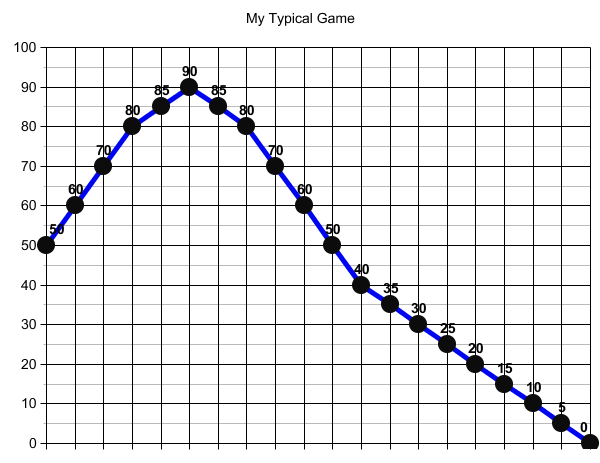
Sure, everybody loses games to weaker players, even much weaker players, from time to time. I used to do so occasionally. Now it's regularly. Everybody loses games from positions where they're winning. But they also do the opposite, which I do but rarely - while the trajectory of my games is so often like that, we might as well depict it on a graph and title it My Typical Game. (I've not titled the axes: I'm sure it's self-explanatory.)


It's a hard way to lose, I think, and familiarity makes it no easier: rather the contrary. It's a lot harder to accept as a pattern than it is as an occasional hazard.

Why this has happened to my chess, over this period, I don't precisely know, and you can be sure that I don't have the time, nor do I have the inclination, to carry out the sort of exhaustive self-analysis that would likely be required, nor the extensive course of improvement that would likely have to follow. No thank you: I am forty-six years old and my future in chess is mostly behind me, and there are many better things to which I could devote my time.

Of course, being in my forties, I also recognise that Anno Domini is friend to no chessplayer, and I notice little things, outside chess, that indicate a tiny loss of focus: lapses of memory, confusion of words, a difficulty in processing and understanding statistics, a problem in grasping the logic of an argument with which I am not already familiar. In truth, I've always been better at generalities than specifics, and if the mental machinery is not working quite as well as it used to, then that tendency can, only be accentuated. And it's a fatal tendency when it comes to the point of the game at which exact calculation is required.

Presumably tiredness plays its part, too, exacerbated by working round the country and sometimes travelling for hundreds of kilometres on the day of a game, or the evening before: maybe the mind, in those circumstances, can only maintain proper levels of concentration for so long, and that length of time time not quite enough to win a hard-fought game of chess. Maybe. Maybe it plays a role. But probably not the major one.

Whatever the causes, all this leads to stress, from which I've suffered, to one degree or another, for quite a long time, presumably much longer than I really know, since there must have been symptoms of stress long before I knew them for what they were. Anyway, that stress has gradually whittled away my capacity to play, and cope with, chess.

About a decade ago, I found myself unable to complete a British weekend tournament. Instead of playing five rounds, or six, I would habitually find myself missing at least the Saturday afternoon, and the final, Sunday afternoon round. Maybe more than those: a particularly difficult-to-take defeat would normally send me home earlier than that. I've entirely cut out rapidplay, blitz, lightning: I've also cut out correspondence chess (far less enjoyable than it used to be, anyway). As for internet chess, I never took to it in the first place.

Now I'm taking a rest from club and tournament play, too: as it stands, chess isn't good for me. Better to give it a rest until such time as I know I'm missing it- and when I start playing again, to play a little less. So that I am less tried when I play. But more importantly, so that when I lose, it matters less. And so that when I play, I'm looking forward to it.

I look forward to that, at any rate. I like chess, in principle. I don't think this is where I stop playing chess competitively. But I think it might be where I stop playing regularly. To play chess less, to appreciate it more.

[Dinky graph: National Centre For Education Services Create A Graph]

Wednesday, September 28, 2011

Blue or Red Pill XII


White to play
JMGB v AN Other, Sunningdale Open September 2011


White, your humble scribe, to play. It's a real life BORP moment.

My pieces are looking menacing. How about I loosen up Black’s king a little with 26 e6? Something like 26 … Qb3, 27 exf7+ Qxf7, 28 Bxg6 will follow


and after Black moves his queen to cover the bishop so a discovered check won’t just win I’ll have an extra pawn as well as attacking chances. That looks pretty good.

What about 26 Bxg6, though? If Black takes on g6 he’ll drop all his kingside pawns and then his own bishop too so he only has one move. 26 … Qxg2+, 27 Qxg2 Bxg2, 28 Bxf7+


After the bishops come off, I’ll be a pawn up here too, this time with a pair of connected passers in a rook ending. That looks pretty good too.

It seems like a straight choice ...


Keep the queens on and go for an attack.


Swap them off and head for an ending.


The choice was mine. Now it’s yours.


Blue or Red Pill Index