Wednesday, September 10, 2008

Richmond Rapidplay, report!

Three Streatham and Brixton Chess Club players took part in the 79th Richmond Rapidplay this Sunday, amidst a bumper field totaling 127 competitors. The present writer somehow managed to win half of the Under-180 grading prize, with 4/6 in an Open that was jointly won by GM Simon Williams and IM Gavin Wall with 5/6 - that's ahead of a strong field that also included GM John Nunn and IMs Graeme Buckley and James Sherwin. Full results will soon be able available on the tournament website.

I'd like to say I fully deserved my prize and that I'm proud of my 4/6 - but in fact, I didn't play anyone higher rated than me! I'm not even sure I deserve a grading prize on the back of such a lucky draw, but of course that didn't stop me taking it.

To the right is a position from one of my games - where it's black to play. "Nice tactic," my opponent said after the game. Kind of him, given the slew of blunders I followed it up with, going on only to draw this particular one. I wondered before the tournament how rusty I'd gotten over the summer - the answer being, very.


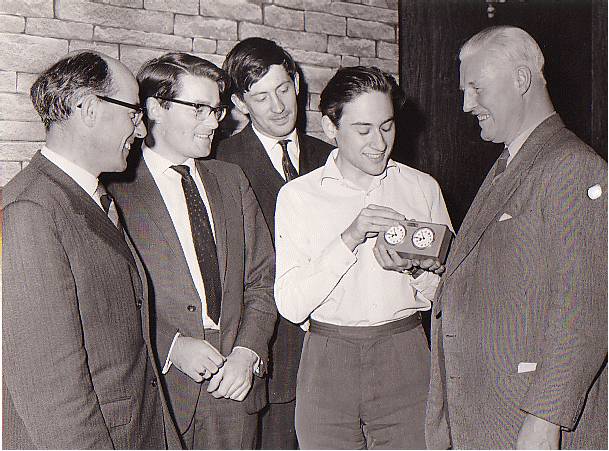
Here's a photograph - again thanks to Vad - of myself and co-winner Alex Galliano receiving our prize:


Now, has that put you in the mood for some pre-season rapid chess? In that case, this Monday evening (15th September) will see the Third Gerald Duncumb Memorial Open, taking place upstairs at The Crown & Greyhound in Dulwich Village. Prizes total £100 - first place taking home £70 - and games start at 7.45 sharp, with registration from 7.15 onwards. Entry is £2.50 or £1.25 for conecssions. More info is available here.


Tuesday, September 09, 2008

Tick Tick Tick ... VIII

What's that coming over the hill? Is it a monster? Is it a monster?

No my friends it's the future. Well it is assuming we don't all die tomorrow*.

Future Boy:-
Magnus Carlsen's win over Aronian at Bilbao yesterday lifted him beyond what could be explained away as a purely mathematical advantage over Anand into clear first on the Live Rating List. Regardless of what you think about real time rating updates it's hard to avoid the feeling that Carlsen's going to be dominating the chess world for the next ten years. That could be twenty if he lasts as long as Anand (and if professional chess is still going in 2028).

Future Scoring System:-
Carlsen now has three wins, two draws and one defeat while Topalov has two wins, four draws and no losses. This would normally tie them for first on plus two, or 4/6 if you prefer, but three points for a win at Bilbao means that the Norwegian lad has his nose in front. It would seem Mike Basman's time has come.

Future Time Control:-
According to the tournament website the time control at Bilbao is 90 minutes for the first 40 moves and then another hour to finish the game. Is there really no time increment in operation? I'd find that a little quick for a league game let alone a Grand Master tournament.

I'm far from convinced that two of these three are A Good Thing but then that's the future for you. It's a package deal. You don't get to pick and choose.


* and let's be honest the knowlege that the Daily Mail and its readership are going down with us would sweeten the pill more than a little wouldn't it?

Monday, September 08, 2008

Improving the Image of Chess?

As I've said before, the last thing I want is for chess to become more popular - because that would just mean more players able to beat me, of which there must be hundreds of thousands alive already, if not millions. Not everyone sees it that way, of course, and there are even those who - for reasons entirely alien to the present writer - try to actually improve the image of chess.

Like David Levens, reports This Is Nottingham, who plans to run a marathon whilst playing six games of chess:
David is . . . taking on the challenge to counter rumours that chess players are nerds.

He said: "It's just something different. I was thinking of ways to raise awareness about chess. It gets no publicity because it's not classified as a sport, but it's very popular.

"I'm doing it to raise money for the Leprosy Mission, but particularly to make people aware that chess players are not all geeks!"
Goodness. It makes chess players sound a healthy, charitable and fun bunch, doesn't it? (Is that what we want in our opponents?!)

Sunday, September 07, 2008

Tick Tick Tick ... VII

How long does now last?

Who is the strongest player in the world right now? Such a simple looking question but surprisingly tricky to answer.

Starting with the obvious we could remind ourselves that it's Vishy Anand who is World Champion. Leaving aside the complicating issue of whether or not Anand can legitimately consider himself 'champion' before winning a match, it's now virtually a year since he won Mexico City. Is his victory there relevant to 'now'? We might want to reserve judgement until the forthcoming* Anand-Kramnik contest but that won't kick-off for another five weeks. Depending on your point of view it may, or may not , tell us who's strongest then but I want to know now.

So let’s try again using the official ratings.

According to FIDE Anand has been Number One since April 2007. Unfortunately for our purposes the most recent official FIDE official rating list was published over two months ago and a lot of pawns have been pushed since July 1st. Anand has played just four times** since the last list came out but FIDE's July top ten average over 18 games each. At this distance, then, we can't be sure the official ratings tell us about the relative strengths of the leading players now.

Sadly, it's not just the fact that a new list appears only once per quarter that causes problems for the FIDE ratings. In fact the current process ensures they are out of date even on the day of publication (which particularly hurt Magnus Carlsen this time around).

So let’s try again again.

Once more, it seems, we have to return to an unofficial website, chess.liverating.org, to find out what we, or at least I, want to know.

My visit to Hans Arild Runde's site earlier today showed clearly that the results of Friday’s games from Bilbao have had a significant impact on the top of the list. The upshot of Anand losing to Topalov and Carlsen beating Radjabov (see the excellent reports at Chess Vibes for details) is that for the first time Carlsen has an objective claim to be the strongest player on the planet. It's true that they are a just a wafer thin mint apart but right now Magnus Carlsen is number one with a rating of 2791.3 and Vishy Anand is in second place with 2790.9.

It's not surprising Anand is slipping down the rankings.
As this photo from
chess vibes clearly shows, Vishy is losing his head.


Now there's an obvious question as to whether a 0.4 elo point differential actually reflects anything in reality. Even if you accept that a live rating system is preferable to quarterly updates (I do) and even if you accept the idea of updating the system during tournaments and not as they finish (I do) you'd be hard pressed to defend a claim that any system could be quite so accurate. For now, then, we'll just say that mathematically speaking at least, Magnus Carlsen is the strongest chess player in the world.

Of course that's my now.

As I sit here in Clapham’s Green Bag cafe munching my chocolate cake, slurping my tea and tipity-tapping away at my lap-top it’s late on Saturday morning. In a few hours time Anand will be playing Carlsen in Bilbao so by the time anybody actually reads this – your now – things could be very different.


* If you want to know precisely how long you have to wait you can go to the official website where you'll find a clock that's counting down to the kick-off. At time of writing it's 37 days, 22 hours, 6 minutes and 24 seconds.

** He shares the title of 'Most Inactive' of the leading grandmasters with Topalov. Ivanchuk, not surprisingly, has played more games - 44 - than anybody else.

Saturday, September 06, 2008

Chess in Art XIII


The King Playing With The Queen


Max Ernst (1944)

[Museum of Modern Art, New York]


© 2008 Artists Rights Society (ARS), New York / ADAGP, Paris

[Chess in Art index]
[Chess in Art collected]

Friday, September 05, 2008

Double or quits

In the same tournament I was watching the last games of a round come to a close and was treated to one of the most egregious examples of I Can't Lose From Here Syndrome I've seen in a while. The position (the game, by the way, took place on one of the higher boards) was as given below, Black having offered a bishop exchange for a second time: White had been moving his own bishop this way and that in the hope of finding a breakthrough that wasn't really there.

Resigning himself to the impossiblity of winning without swapping the bishops, he neverthless convinced himself that he was the only one with winning chances: after all, it was a pure pawn ending, and Black suffered from doubled pawns on the b-file, something which ought to be a crippling disadvantage in such an ending.

So White, with the knowledge that he was the one with pawn moves in hand, continued with some confidence: 1.Bxe6 Kxe6 2.g4 Kd6 3.a4 Ke6 after which he proceeded to immobilise Black's pawns entirely: 4.a5 bxa5 5.bxa5 Kd6

and suddenly he realised that he had undoubled his opponent's pawns and conceded the opposition - and that it was his pawns which, in fact, had been immobilised.

Actually to tell the truth, I don't know whether he realised any of that: he did however realise that he was completely lost, and while a few more moves were played, resignation followed hard upon.

Perhaps one day I shall write a series for this blog about objectivity: which for our purposes we can define simply as not thinking your position is better than it actually is. There are all sorts of reasons why we do so: our strength relative to the opponent, the possibility that we were better, maybe even winning, earlier in the game, or simply the tendency, which is more and more pronounced the lower the strength of the players, to take far more notice of our own moves and ideas than those of the other side.

Rowson calls this Narrative. We tell ourselves a story about how we're beating the opponent, and we consider the board in the light of the narrative rather than the objective truth. In the instance, it does seem to me that whatever the whole story, part of it was I Can't Lose From Here. But, objectively, you always can.

I had my own doubled-b-pawn adventure a little later in the tournament, the very round after the missed-attack episode that I recounted yesterday. There's something about it which makes me cast doubt on yesterday's theory that I may have missed an attack on an opponent's rook at a7 because that piece was partially obscured by a queen on a6. What I think is mostly the truth, about yesterday's game and today's, is that I found myself concentrating so hard on the portion of the board where the action appeared to be, that I essentially forgot about the rest of it.


Gil Capape-Horton, Aragon Individual Championship 2008: position after White's 63.Kg2-h3. It may also be the position after White's 61.Kh3: if truth be told, my handwriting by that stage, four hours into the game, was so poor I cannot be sure whether or not the moves are as given below, or 60...Kf5 61.Kf3.

Either way, it was clear to me that I had made a meal of a pawn ending that had looked easily won, just as I had nearly made a meal of the equally-easy queen ending that preceded it. (What would I have done, I wonder, after 44.Qf5?) Black's f-pawn is too close to the White king to be of any use: and as White's king has access to as many useful squares as does Black's, it cannot be driven away.

I was desperate. I had already drawn too many games and had to win this one if I was to get up among the leaders, but I couldn't see how to do it. The game had surely been won: but there was no way in for the king. I had just a couple of minutes left on the clock (and I only had those courtesy of my opponent having attempted to play 38.Kg2, thus gaining me two extra minutes from the arbiter).

Once again, the answer is obvious if you are looking at a diagram, because you see all parts of it with equal facility: less obvious if you're leaning over the board, getting as close as you can to the king on the h-file to see if you can put it on a killing square, looking essentially at a position like this....

....and forgetting all about a b-pawn that has, after all, been in precisely the same place for four hours and fifty-five moves.

Until, that is, you look round the board just in case there's a miracle to be found, and discover that, Deo gratias, there is.


Thursday, September 04, 2008

Three-dimensional chess


In Think Like A Grandmaster, Kotov mentions the following incident:
During a round of the 1946 Moscow Championship the usual silence of the tournament room was suddenly broken by a frightful cry. The players jumped up from their seats and went over the board where the game between Bronstein and Bonch-Osmolovsky was being played. The temperamental player of Black (who by the way was a good boxer and was well used to receiving physical blows as well as mental ones) was sitting there holding his head in his hands, while young David Bronstein who was also very upset by the unexpected reaction of his opponent was showing everybody what had happened.
In the diagram position Black had just checked with his queen. White moved out of check with K-N2 [I have an old, descriptive-notation copy, and on this occasion have chosen not to translate - ejh] and after some thought Black advanced his KP. Bronstein then played RxQ.

"It's just terrible", said Bonch-Osmolovsky in his distress. "The white king on N2 is a big piece and I didn't notice the fact that the white rook behind it was now attacking my queen."
Kotov is a little sceptical about this explanation, as am I, but perhaps a little less sceptical after a game I played in the recent Individual Championship of Aragón, in which event I came tenth.

In the sixth round I played Lorenzo Montes Santos and found myself in a strange pseudo-Benko Gambit in which I had a tempo to spare over orthodox lines. Nevertheless, I played with the nervousness that is my hallmark in that kind of opening and which probably explains why I play 1.Nf3 which normally avoids them. After Black's fifteenth move, the position at the top of this piece arose, and I decided I should ease the mounting pressure by trying to exchange off Black's g7 bishop. Play continued along the lines I had envisaged: 16.a3 c4 17.h3 Ne5 18.Nxe5 Bxe5 19.Be3 attacking the queen in the following position -


Black moved his queen to a6: and I followed my plan, moving the bishop to d4 and swapping off the bishops. The game was later drawn, in an unimpressive effort on my part (given below for anybody who needs to be convinced). I was just preparing myself for a post mortem in which we'd see how I'd failed to win the ending, when my opponent startled me by asking instead: "why didn't you take the rook with your bishop?"

What? I didn't understand what he was talking about for a moment, until I realised that god, yes, the e3 bishop must have been attacking the rook on a7. How could I have possibly failed to see it? Because, I imagine, I was so wrapped up in my plan to exchange bishops that I didn't see what else was happening on the board. I had an idea, and it was a good one, so I played it: and I never took the couple of seconds I might have taken to look round and see if anything else was on.

But maybe something else, too. When we sat down to look at the game, using a nice, chunky set, and actually got to the position where I could take the rook, I wondered.


Perhaps I never saw it, because I never saw it. The diagram, for once, actually serves to obscure rather than to illustrate: it obscures because you can see.

Everything is the same size, because everything is flat. I should have still seen it, in both pertinent senses of the word: of course I should. But I didn't. And maybe because, on the real, three-dimensional board, the queen - which, like Bronstein's queen, is a big piece - hides the rook.


Wednesday, September 03, 2008

Tick Tick Tick ... VI

The other half
It's pointless talking about time management if you're going to ignore the up to 3 1/2 hrs of the game when it's not your move.
... as Richard rightly said in the comments box to this post.

In Excelling at Chess*, Jacob Aagaard considers the time during a chess game when it's the opponent's turn to move to be analogous to the breaks between the individual games of a tennis match. According to Aagaard the realisation that five sets might actually involve playing tennis for perhaps half an hour at most led to attention being focused on those parts of the contest during which 'nothing' was happening. It was found, not coincidentally he feels, that "the best players all had a similar pattern of behaviour" at those times.

In the light of his findings Aagaard goes on to describes his visit to the Wijk aan Zee tournament of 2001.
"Kasparov, Anand, Morozevich, Ivanchuk and Kramnik all did the same thing. They walked up and down on the stage, staring down at the floor. They occasionally glanced at other games, but never with true interest. The only one of these who was not totally focused was Anand who, occasionally, would talk with Piket or another player. Anand, by the way, did not have a strong tournament ... [**]

Shirov behaved differently, sitting at the board for most of the time. After six or seven games he was leading by a point."


I had this passage in mind during my visits to the Staunton Memorial last month. I took a close interest in what the players did when it was not their turn to move and found their habits remained remarkably consistent throughout the event. Nigel Short, for example, would typically retreat to the arbiters' table where he would often share a word or two with Steve Giddens while Jan Timman would usually spend his time wandering the playing hall taking a close look at each of the other game. The Dutchman had a very lackadaisical attitude towards the clock and on more than one occasion I noticed him returning to his board then wandering off again without noticing that his opponent had actually moved.

Only one player - Michael Adams - was Shirovesque in his approach. Adams rarely left the board and indeed would even remain seated when it was not his move and his opponent was absent. He seemed to make a habit of going for a stroll around the playing hall for a few minutes once he'd reached the time control but other than that once he'd sat down for the start of play that was pretty much where he'd stay for the next few hours. It hardly need be said that it was Adams who ended up winning the tournament***.

Of course outward behaviour doesn't tell us for sure what these guys were actually thinking about. Timman clearly wasn't focused on his game but Short could have been contemplating his position just as much as Adams seemed to be. For that matter it's perfectly possible that England's number one didn't have his mind on chess at all but instead was spending the time pondering just how much fun it would be to find himself trapped in a confined space with Ann Margaret with nothing but a large tin of baked beans and a vat of melted chocolate for entertainment****. Still, if you had to put money on it, you'd have to say that it was most likely it was Michael Adams who was making fullest use of the available time wouldn't you?

Acting on the outside what you want to be on the inside is invariably a helpful technique. Not a cure all for sure but a good start. It's certainly not enough on its own though. We also have to find an answer to the question of what it would be helpful for us to be doing while our opponents' clocks tick away. Unfortunately in the otherwise very helpful and comprehensive chapter on Clock Control in Chess for Tigers Simon Webb doesn't have too much to say about this. His advice pretty much amounts to,

"The Tiger is determined to do his best, and so gets up only as often as necessary to refresh his brain. He spends his opponent's time thinking generally about the position and what manoeuvres are available to both sides so that he can start thinking in terms of exact moves as soon as his opponent makes a move."


What Michael Adams thinks about while waiting for his opponent to move. Maybe.


Sadly he doesn't give any examples of how exploring a position in general might look in practice. I suppose this is about positional understanding and identifying the key features of a position - fianchettoed bishop, queen side pawn majority, insecure king etc etc - but that's much easier to talk about than to do I feel.

So at the end of today's meanderings I'm left with the knowledge that my opponents' clock time is an important resources for me but without any clear idea of how I can best make use of it. Not for the first time I throw my troubles out to the esteemed and most valued readership of the S&BCC Blog and ask two questions:-

(a) what do you do while your opponent is thinking?
(b) what do you think is actually 'good' or 'helpful' behaviour at these times?

All answers gratefully received.


* A book I've discussed many times on the blog (from most recent backwards ... 1, 2, 3)

** Regular S&BCC blog visitors with elephantine memories may find these words familiar. If so it's because this passage is the lead in to the quote about Anand not reaching his full potential as discussed here and the prior to that in the original post here.

*** I might also add that unlike Peter Wells and Ivan Sokolov, Adams invariably arrived at the tournament hall five minutes before the start of play.

**** Or is that just me?

Tuesday, September 02, 2008

Improve Your Chess IX: Earplugs

Why did I lose? Because the door kept banging shut behind my board. Because the geezer's throat I was playing kept gurgling. Because of the boredom of blokes and their predictability of prattle, couched away in the corner of their club. Because the light bulbs were weirdly buzzing. Because, because, because. Not because of my own failures of concentration, accentuated by a weakness to listen to distractions good or bad - and certainly not because I was outplayed from start to finish, after which I fished around for some noises to blame that unpleasant fact upon . . .

And so such excuses after losses went on - until I read what novelist Nicholson Baker had to say about the one thing that got his creative juices flowing. He described the effect of the thing as follows: "I can sit anywhere, in any loud place, and work. Everything becomes 20 feet farther away than it really is. The chirping, barking, jingling cash-drawer of a world is out of reach, and therefore more precious." I realised the solution to his problem might work as a solution to mine, too.

Now, don't worry. The solution won't delude you into believing that the world is a cash-drawer and more precious as such, or something. It was just that earplugs suddenly sounded to me a straight-forward aid to concentration and immersion into any activity (except music.) So I decided to try them myself during chess games. Remarkably quickly my results picked up; these two draws, for instance, can be taken as representative from a tournament where my performance grade averaged ten points higher than the rest of the season up to that point.

I had never drawn with an FM before, let alone against an IM - and then with earplugs, I'd done both in one tournament. Can earplugs alone really be responsible for such a sudden change? I'd like to answer yes, but in my case, it's hard to tell for sure because I began nearly all my attempts at chess improvement at approximately the same time. So instead, does it follow therefore that earplugs might be wholly responsible for my improvement, or maybe for none of it at all - and that there's no way to tell? Maybe . . .

But I think not: in my experience, earplugs have not only a practical value, but a philosophical one too. I might even go so far as to say that even as a placebo that filtered no noise, they would have had a useful function for me. And I think these other lessons earplugs taught me have helped improve my play in general, that there is a sort of Philosophy of Earplugs.

What I mean by this, is that committing to wearing earplugs represents not just a practical decision to filter out distractions as far as possible, but that it also engenders a philosophical attitude to the game. That attitude is to take as much responsibility as possible for your chess games: to say to yourself, so what if the opponent is noisy? The venue creaking? The door banging? I'm entirely on my own, insulated in silence, and everything is down to me. I have nothing to blame but myself. Botvinnik probably benefited from something similar, when he used to play seven hour training games next to a blaring radio or in a cigar-smoke filled room.

Aside from helping to ignore distractions, I think the Philosophy of Earplugs helps decision-making at the board itself, too. In the second link above, for instance, you'll find a position where I sacrificed two pawns and a knight to achieve a drawn endgame. I did this after fifteen minutes thought, and felt almost silly about playing the sequence - especially because of the look it provoked on my opponent's face! Would I have found the same sequence without earplugs? Maybe not. The aloneness of silence frees us from such self-consciousness, reminding us there is no-one listening to our thoughts, however daft they might turn out to be. So we are free to consider ludicrous-looking moves, free to feel unselfconscious about being out of book on move three and thinking for ten minutes, free to play chess as best we can.

In conclusion, try earplugs. Or if you're not distracted by noise, try the Philosophy of Earplugs anyhow!


And finally . . .

A few other bits and bobs before I sign the series off.

Firstly, I'm not the first to advise the use of earplugs for playing chess. In an entertaining article that I recently discovered Nigel Davies praises earplugs here, writing about advantages they bring such as: filtering out the noise of spectators, filtering out the snores of room-mates or other sources of noise in hotels, that you might not hear draw-offers, and so on.

Secondly, I'm amazed that earplug companies don't sponsor chess events, providing say one free pair to each competitor in a tournament and setting up a stall to sell further in bulk. Or alternatively sponsoring a league team that uses them, that sort of thing. Why not?

Thirdly, aside from the Philosophy of Earplugs, pragmatics are important too. Most earplugs sold on UK highstreets - that I've encountered - are orange and chubby, like those to the right. They all seem to be the same, and the cheapest I found were at Tesco. These also usually come with an informative instruction booklet and a handy mini-carry-case. However - and whilst accompanied by no such niceties - I definitely prefer the slimmer, cheaper, softer, yellow "Worksafe Earplugs" sold at Travis Perkins under the code SEP403 - although they are harder to come by.

Finally, this article is the last in this series. I've appreciated the feedback, discussion and links the series has generated, and I hope my posts might have helped improve your own chess in some little way! The series also now has an index.

PS. Beware the dangers of earplugs!

Monday, September 01, 2008

Pinch, Punch

September, serious month. Back to work, back to school, summer in descent, the sense of a winter sun, the chess season approaching, everything in full-swing or about to begin again.

And . . . . why not start it off with a nice rapidplay tournament for a bit of practice? This Sunday the 7th will see the Richmond Rapidplay return in its 79th incarnation down in Hampton, and you can click here for more details or here for the PDF entry form. I'll be there, trying to work out just how rusty I've gotten over the summer.

And here are some photographs from the last one, supplied by our man on the spot Vad, who'll also be playing this Sunday.


Familiar faces . . .


Tough competition (click to enlarge) . . .


The tournament hall in action . . .


Time-scrambles, crowds - inevitable!


PS. The final post in the "Improve Your Chess" series will appear tomorrow, rather than today.

Sunday, August 31, 2008

Tick Tick Tick ... V

I guess time doesn't flow in order does it - A, B, C, D? It just sort of goes where it feels like going.*

Every beginner knows that rapid development is crucial at the start of a game of chess. The opening is all about time isn't it? White moves then Black moves then White then Black and so on and on and on with each side trying to get their pieces out ahead of the other. Whoever's in front in the race has the advantage.

Niggling away at the back of my mind, though, there's a vaguely remembered snippet of a conversation involving some Grand Master or other (Gurevich? Malaniuk?) who when asked something along the lines of,

If you like the Dutch Defence so much why don't you play 1. f4 as White?

responded,

That extra tempo is going to hurt me.


* Haruki Murakami, The Wind-up Bird Chronicle Vintage Books 2003

Saturday, August 30, 2008

Chess in Art XII


Le chevalier Cifar observe le camp ennemi jouer aux échecs

de Carrion (14th cent.)

[BNF Paris]


Croisés refusant de combattre

de Tyr (attr, 14th cent.)

[BNF Paris]


[Chess in Art index]
[Chess in Art collected]

Friday, August 29, 2008

Thursday, August 28, 2008

Name the guilty men

About thirty years ago - or maybe it was a million - I was invited to play in a simultaneous exhibition given at a primary school which sent pupils to the secondary I then attended. Having been reading some opening theory, perhaps for the first time, I thought I would try it against the master giving the display: and so, for the first and last time in my life, I rolled out the Czech Benoni and was duly rolled over without a struggle, the word "life" being just about the last that could be applied to my position. What made my choice particularly stupid was that the master, William Hartston, was in fact the author of the book, Benoni, which I had been reading.

I still have the book and still like it: but wasn't his most famous book of the era. That was How To Cheat At Chess, a book written so long ago I can't find a decent image of the cover to post on here. Indeed, younger readers - or indeed half the authors of this blog - may never have heard of it and may not even know who Bill Hartston is, let alone recall when "are you playing for a win?" was a favoured method of almost-offering a draw.

Well, he said, settling down in his armchair, Hartston was a strong international master who was an early favourite to become the first English grandmaster, a title, however, that he never ultimately obtained.

He was also perhaps the first English chess professional to find that writing about the game was rather more lucrative than playing it, not least as a result of the publication of How To Cheat At Chess in 1976. I was fortunate enough to be given a copy a few days ago when I was back in England. It's quite dated now, in a number of respects (notably as regards women) but it's still an amusing read, not least because it retails several entertaining anecdotes involving skullduggery in international chess events, often Student Olympiads which Hartston attended. Some of these may have been embroidered a little for publication (his recollection of this episode, for instance, differs a little from David Levy's) and real names are omitted, but when, after our game, I asked Hartston who was the opponent who asked him "you vant draw at moof tventy?" - after fifteen moves, the extra five moves being "for the spectators" when there were none - he was quite happy to tell me it was Florin Gheorghiu.

Anyway, rereading the book the other night, I wondered if it was not time,that I found out who the other masters of sharp practice were, more than thirty years after Hartston wrote about them. So I thought I'd ask. If you can convincingly identify any of the subjects below, can you tell us in the comments box?
  • The Belgian player "languishing in a continental prison for illicit currency dealings".

  • The Swedish player who conned his English opponent into agreeing a draw after having sealed a blunder, and the Englishman concerned.

  • The American player who invited his teammates to laugh at the poor sealed move of his English opponent (and that opponent).

  • The Hungarian and Yugoslavian masters who complete their scoresheets inaccurately in order to deceive their opponents into thinking that the time control has (or has not) been reached

  • The player who won a county championship by falsely informing his last-round opponent that he had lost his penultimate game, thus making his opponent think that he was half a point ahead - rather than behind - and that a quick draw would therefore suffice for the title.

  • The Yugoslav who in a lost position loudly accepted Gheorghiu's draw offer (which the latter had promised to make, a promise he had not honoured).
No speculation please, this is a respectable blog. But if you happen to know the guilty men in any instance, my, ah, thirst for historical truth and accuracy is just begging to be quenched.

Wednesday, August 27, 2008

Tick Tick Tick ... IV

Timekeeping for Tigers

As I prepare for my imminent arrival at life's first time control I find my thoughts have also turned to the question of how I’ve been spending my time when seated at a chess board.

As SonofPearl rightly said in the comments box to my post on Peter Wells' difficulties at the Staunton Memorial,

"You don't need to be a great player to know that time management is as important a feature of the game as accurate calculation, opening preparation, intuition etc."


Strange, then, that of the countless books, magazine articles and blog posts the game generates hardly anything is written about how to make the best use of the clock during a game. Indeed, amongst the far too many books I’ve bought over the years I can only think of two - Simon Webb’s Chess for Tigers and John Nunn’s Secrets of Practical Chess - that actually address this area in any depth.

Webb’s chapter on clock control suggests that the best way of finding out where your time is going is to make a note of the clock times after every move. This quickly becomes second nature*, the difficult part being rembering to take the trouble to review the game at some later date**. It takes a little bit of work but it's almost certainly going to help your chess more than another hour or two spent reading some new openings book.

I played this game …


… for the Other Club midway through last season. It has the rather pleasing attributes of being (a) an interesting Interesting French Exchange
and (b) a win for me but more importantly for today's purposes it demonstrates rather clearly many of the problems I have with time management when playing chess.

All the moves were to be played in an hour and a quarter. I ended up using 72 of those 75 minutes but taking a second look at it I have to admit that an alarming proportion of the time I spent "thinking" was at best wasted and even counter productive in some cases.

1. e4 e6, 2. d4 d5, 3. exd5 exd5, 4. Nf3 Bg4, 5. c4 Bb4+


TIME SPENT ON MOVE: 5 minutes

I was still within my opening knowledge at this point but nevertheless I think the pause for thought was quite appropriate.

I’ve faced lines with an early c2-c4 a bunch of times over the years and until this game had always played set-ups based on … Nf6, … Be7 and … Nb8-d7-b6-d5. This time, however, I wanted to try out John Watson's suggestion from Play the French 3. As I was about to head into positions I hadn’t actually played before spending a little time reviewing the main plans and whether or not there were any particular tactics to look out for seems time well spent. That said, given the short time control for the game taking 5 minutes for this is probably a little indulgent.

TOTAL TIME SO FAR: 6 minutes
POSSIBLE SAVING: 2 minutes


6. Nc3 Ne7, 7. Be2 dxc4, 8. 0-0 0-0, 9. Bxc4 Nc6,

It's not until White's next that I ran out of 'automatic' moves so I'm at a loss to explain why it was that I spent two minutes each on moves seven, eight and nine. It might have been justified had I not just had a decent think on move five but to do both is just ridiculous.

With the contest just leaving the opening stages I'd already managed to dither away 8 minutes of the game. Proportionately I'd already given away just as much time as Peter Wells lost against Smeets by failing to turn up on time.

TOTAL TIME SO FAR: 12 minutes
POSSIBLE SAVING: 8 minutes


10. Be3 Bxf3


TIME SPENT ON MOVE: 14 minutes

Oh dear.

My idea was to exchange on f3, take on d4 then after White replies Qxb7 gain some time by knocking the queen around or perhaps even trap her. In fact this is just a bad plan but that's not relevant in terms of clock management. More to the point ... Bxf3 is a classic case of Don't Analyse Unnecessary Tactics (DAUT).

Even if it works it’s obvious that after … Bxf3, Qxf3 Nxd4, Qxb7 there will be a lot of variations to consider. Had I thought sensibly it would have occurred to me that I should hold this line back to analyse only if I could not find anything better. Perhaps then I might have chosen … Rb8 (setting up the idea of taking on f3) or more likely … Nf5 (simply adding to the pressure on d4 with no difficult tactics to analyse). As it happens both of these moves can be found in Watson's book. In any event, a different thinking process would perhaps have taken three or four minutes at most to produce a move. Not only would I have saved ten minutes I would probably have played better too.

TOTAL TIME SO FAR: 26 minutes
POSSIBLE SAVING: 18 minutes


11. Qxf3 Nxd4,

I took two minutes on this which would seem to indicate that I lacked confidence in my plan. In fact it's not too late to back out and find a different way to play. The trouble is, as John Nunn pointed out, after a very long think it can be psychologically difficult to choose a different path and admit the time has simply been lost. Of course the worst of all possible worlds is to worry about things for two more minutes then play the move anyway.

At this stage although I've already used up over a third of my time for the entire game and yet I'm only just out of book.

TOTAL TIME SO FAR: 28 minutes
POSSIBLE SAVING: 20 minutes


12. Qg4 Bxc3


TIME SPENT ON MOVE: 1 minute

I hadn’t considered that White might simply sacrifice the pawn and go for a direct attack. Without much thought at all I gave up my bishop to stop the knight bouncing over to the king side. This was definitely an occasion where I'd have benefited from a couple of extra minutes to weigh the benefits of eliminating an attacking piece against handing White a pair of unopposed bishops on an open board.

Of course having used up so much time on move ten I was now in a position where I'd have to cut down on the analysis and hope for the best to a certain extent.


TOTAL TIME SO FAR: 29 minutes
POSSIBLE SAVING: 18 minutes


13. bxc3 Nf5, 14. Rad1 Qc8, 15. Bg5 Nd6, 16. Qxc8 Nexc8, 17. Bd5 Re8, 18. Rfe1 Nb6, 19. Bf3 Nbc4, 20. Bf4 Rad8


TIME SPENT ON MOVE: 5 minutes

John Nunn:
“Chess is all about making decisions. Postponing a decision doesn’t improve it. Try to get into the habit of asking yourself: is further thought actually going to be beneficial?”

So what to do? Bring my last piece into the game or play ... Kf8 before or after swapping rooks on the e-file. At the time I wasn't clear whether exchanging rooks would help me or merely emphasise the strength of his bishops. In fact after a few months to think about it I'm still not clear what's best. I frittered away a few more minutes here simply because I couldn't decide on what course to take.

Sometimes you've just got to choose one plan or the other

TOTAL TIME SO FAR: 43 minutes
POSSIBLE SAVING: 21 minutes


21. Kf1 Rxe1,
TIME SPENT ON MOVE: 5 minutes

Unfortunately I chose one plan then the other and worse still spent ten minutes doing it.

TOTAL TIME SO FAR: 48 minutes
POSSIBLE SAVING: 26 minutes


22. Rxe1 Kf8, 23. h3 h6, 24. g4 g5, 25. Bc1 c6, 26. h4 f6, 27. hxg5 hxg5, 28. Be2 Kf7, 29. f4 gxf4, 30. Bxf4 Re8, 31. g5 Rh8, 32. Bxc4 Nxc4, 33. Re4 b5, 34. gxf6 Kxf6, 35. Be3


An interesting moment. I'd already seen his rook was vulnerable to a knight fork but on the other hand his bishop attacks my a-pawn. With a bit more time to think I might have put these two ideas together and realised the a-pawn can't yet be taken without allowing a knight check on d2.

My dawdling earlier had left me with little more than a quarter of an hour to finish the game by this point. The rook ending is obviously much better for me but is it winning? With pawns on one side of the board general principles suggest my knight should be better than his bishop so perhaps I want to keep minor pieces on the board anyway. Pressed for time I made the exchange after less than a minute's thought. It worked out well in the end but in less favourable circumstances this could have been the point where I let the game slip away.

Needless to say, had I not haemorrhaged the minutes away earlier in the game I would have had plenty of time for a proper think here.


35. ... Nxe3, 36. Rxe3 Rh2, 37. a3 Ra2, 38. c4 bxc4, 39. Rc3 Ke5, 40. Rxc4 Kd5, 41. Ra4 c5


I hadn’t foreseen that he might go after my a-pawn but when he played Ra5 it occurred to me that he might not actually have the time to take it anyway. Since there’s nothing to be gained by worrying about this, since there’s nothing I can actually do to stop him capturing the pawn even if I’d wanted to, I just pushed … c6-c5 instantly and hoped for the best. Normally I'd have lost some time to self-recrimination and worries that I'd thrown the win away but I'd finally woken up and actually started to play sensibly (timewise at least).

Incidentally, throughout this ending I was plagued by the recurring thought that it would be an awful lot easier had I actually read some of the rook endgames book (John Emms’) that has been sitting on my shelf for many years. Things turn out pretty well - though your guess is as good as mine as to why I moved my king in front of the pawn on move 51 - but in a less straightforward position my lack of basic endgame knowledge could have cost me a lot of time which in turn might have made the difference between winning and drawing the game.

42. Rxa7 Kc4, 43. Ke1 Kb3, 44. Kd1 c4, 45. Rb7+ Kc3, 46. Ra7 Ra1+, 47. Ke2 Rxa3, 48. Rd7 Kc2, 49. Rd2+ Kb3, 50. Rd1 Ra2, 51. Kd1 Kc3, 52. Rd8 Ra1+, 53. Ke2 Kc2, 54. Rb8 Rd1, 55. Ra8 Rd2+, 56. Ke1 c3, 57. Ra2+ Kd3, 58. Ra1 Re2+, 59. Kf1 c2, 60. Ra3+ Kd2, 61. Ra2 Re8, 62. Kf2 Kd1, 63. Ra2 Rf1+, 64. Kg2 c1=Q, 65. Rd7+ Qd2+ 0-1


There’s no need to do this of course, Fritz takes just a few moments to find mates in 9 after both Ke2 and Ke1, but with my nerves shredded and just three minutes to go I wanted to be able to stop thinking and ensure there was absolutely no way I could lose. White resigned at this point but I think I might have been tempted to make him actually mate me. It shouldn’t go wrong of course but Black is close enough to flag fall to make playing on justified.

So happily enough it all worked out in the end but it could easily have been very different. With a better clock handling I would have been able to play the opening and early middlegame much quicker and saved the time for critical moments later on.

I found the very similar problems in many of my games last year. Just as I said of Peter Wells, it leaves me wondering how many ECF grading points I chuck away every year through poor time management


* I've been following Webb's advice religiously ever since I bought the second edition of his book in the early 90s.

** Sadly Webb neglects to mention simply recording the move times alone will not be of much use to you. After more than a decade of painstakingly keeping track of the time taken for each chess move I made in serious games it was only earlier this summer that I actually got around to making any attempt to systematically analyse the data I'd been gathering. This is a pathetically embarrassing state of affairs, the only possible benefit of which is that it's led to this aside - and I do love a good footnote.

Tuesday, August 26, 2008

Surprise, a prize

My long unbeaten run in correspondence chess is over, stretching to nineteen games before I was finally, earlier this month, obliged to resign one. A shame: I'll never achieve a sequence like that again. Still, there is some consolation in the knowledge that one of those nineteen has won the Surrey County Chess Association's 2008 prize for the Best Game In County Correspondence Matches. You've probably already read about it on Chessbase or in the papers.

Normally I never win anything: even if I'm in the running, there's always a last round in which I throw it all away. One of the virtues of correspondence play - and indeed, of Best Game Prizes - is that there's no last round for me to face.

The game, in which I beat Lorin D'Costa, is here. (I am of course not Rafa Tymrakiewicz, you need to scroll down in the menu box until you reach the appropriate entry.) You can also find it here. So good, he blogged it twice.

Oh, a diagram? Well, I can't really show you the position before a decisive coup, because there weren't any: I don't win that sort of game. But I'll give you the position before Black's 12...Be7. Quite likely he should have preferred 12...Nc6 instead, but either way, it wasn't until I started constructing the diagram that I really noticed what had been going on: I chose to use the set pieces up in start position function, because, looking at Black's first rank, they're practically all still there.

Monday, August 25, 2008

Improve Your Chess VIII: Improve Your Chess!?

This is the penultimate installment of this series, and it is different to all the others, including the next. In each other article I suggest ways to improve your chess directly or less directly linked to one way that I improved mine. This article is different. Instead, here are various things I've been thinking about, without reaching any conclusion. I'm not sure if these things are related to chess improvement, or not: maybe, maybe not. Btw, each subsection can be read separately or skipped entirely. They are not in a particular order, and they are more or less independent of each other.

The final installment of the series next week, incidentally, may well include the most important single thing I did to improve my chess. But first, something else, or maybe nothing . . .


Winning Ugly
I've not played a game I've been really proud of for quite some time. Comfortably over a season, at least. Instead, most of my wins from the season just gone have to me seemed bitty, inconsistent, lop-sided, or boring. Yet in the years where I didn't improve, I played many games I was chuffed to pieces over.

Now, I've not read John Watson's famous books, but friends who have say one thing he emphasizes is that in modern chess winning is ugly. I think what he means is the grand plans of the past, the positionally perfect games, logical as clockwork - games won in such ways are gone, at least between players of equal strength. The reason? I'm not sure, maybe the way computers have shown how chess is far more tactically random than previously realised, maybe that Kasparov's reign demonstated how pieces were far more dynamic than previously understood; that pawns are less the souls of chess than ever before.

Whatever the case, I think being psychologically contented to win ugly might help improve your chess, because it brings your way of thinking closer to the reality of the game itself. Here is an example from a game I played in February. I am white and it's my move:
This position is the outcome of successful opening preparation. I'd realised who I'd likely face before the game, and noticed he always played the Open Ruy Lopez as black. So I'd prepared 5.d3 for this encounter, which rules that out. Visibly flustered, he'd gone into a version of the Closed Spanish where he managed to lose two (!) tempi and then misplay the resultant position anyway. Clearly, in the diagram, there is a lot of wind gusting around his king, and this spells trouble.

After I won the game, a spectator I knew was blinking at the final position, so I said hello. He couldn't believe it was the final position, because my knight was still on g3, black's pawn on h5. How had I not played Nxh5 at some point? He was incredulous - and indeed, Nxh5!? was a plausible move many times, not least in the diagram position. But, I said, it was never clear, and anyway, winning material was a cleaner solution. "Yes, but . . ." he mumbled, infatuated with the glamour of sacrifice. But in the diagram position there is no need. Exchanging material, releasing some of the tension and surrendering a part of the centre with the positionally-ugly 23.axb5 axb5 24.Rxa8 Bxa8 25.dxc5! just wins material, thanks to the threat of Bb3 combined with the pin on the d-pawn. I won eleven moves later.

Conclusion? Chess demands ugly play, so be ready to win ugly. Maybe.


The Sicilian is Different
Each of the last five undisputed World Champions have, at one stage of their career or another, played a substantial number of games on both sides of the Sicilian. I'm not sure, but I don't think the same has always been true of their challengers. I think that the Sicilian - I mean, the open Sicilians, the complex mainlines, where a simple pawn exchange in the opening unbalances the position fundamentally, where all other material is left on the board - is different to all other openings. Maybe it's the degree of difficulty, maybe the direct blending of tactical and positional phases, maybe that attack and defence are routinely combined, often on the same sector of the board - I'm not sure. But I am sure it's different.

The Sicilian is something else. And I think it helps improve our chess if, for a certain period of time at least, we commit to playing it with both colours in the mainlines. Why? I'm not really sure. The Sicilian forces us to think. The Sicilian forces us to be constantly alert to shifting strategical feature and an array of tactical opportunities. The Sicilian reminds us how difficult chess is. That kind of thing. Perhaps it's rather like, if you want to be good at pool - practice snooker.

The Sicilian puts us in our place: players struggling very hard with some very difficult things. Now, of course, the results won't necessarily be pretty, but maybe this teaches us a lesson too. For instance, here are the evaluations only of the last 8 moves of a recently friendly game I played as black against a strong opponent in an Open Sicilian. Exclamation marks correspond to moves which are Fritz's first choice, ?! to moves suboptimal by at least a pawn; other marks to the shifts in evaluation given with varying severity. We left theory on move 14 when the position was already =+:

14. ? ! ( -/+) 15. ?? (-+) ?! 16. ?! ?! 17. ?! ?? (=+) 18. ! ? (=) 19. ?? (-+) ?? (=) 20. ! ! 21. ?? (-/+) ! 22. ?! ! 23. Resigns?? (-/+ of about 1 pawn, says Fritz).
My conclusion? If you've not before, then commit to playing the mainline Sicilians with both colours for a significant period of time. The Sicilian is different, and forces us to be different players. This whole experience helps us improve. Maybe.


Your Own Chess Language
Chess has a language: "plus-equals", "passed pawn", "middlegame", "attack", and so on. However, chess itself is a wordless game, not an argument couched in certain key terms. Finding the right balance between thinking in words and analyzing positions and sequences is not an easy thing to do. Too much wordage and we risk confusing ourselves, talking ourselves around in circles; too little, and we don't grasp the fundamentals of the position, instead spend all our time looking for fleeting tactics that are never there.

Being aware of this is one thing. Possibly another, is to develop our own chess language, prioritizing certain terms to ourselves when they reflect problems we regularly face more often than others. For instance, a few years ago I had a spate of games where I got pieces trapped. I realized that there was no neat term for "piece-trapping tactic" like pin, fork, etc. So I made myself consciously check for "piece traps" in every game I played, and increasingly this kind of mistake has left my play.

Or more recently, reviewing some games with the computer, I realized that whilst I was playing many stages of the game reasonably, I was handling the part when the position explodes - when all plans come to fruition, where threats are made each move, when three different unclear endgames are available with every second exchange - particularly badly. In short, I was playing the complications badly. Having realised that, I now try to recognize complications when they occur, calm myself down, remind myself it's meant to be a struggle, and compose myself. My new awareness of the word complications also helps in not thinking for too long in positions that aren't, well, complications.

Now, complications isn't a word that one sees in the book titles of chess literature. There isn't an Informator symbol for it, either. Nonetheless, for me it's become at the centre of my chess vocabulary - the intersection of one of my main problems with the game and the reality of the game itself.

Does developing your own chess vocabulary help you improve? Maybe!


Player Types
"I don't really know this stuff," I said in our second post-mortem in a month, sat on the black side of the position after 1.e4 e5, "but I thought I'd vary. I figured you'd have come up with an improvement in that Sicilian line you lost in last time."
"No."
"No ? ? ? . . . ! ! !"
"No."

What was strange about this was that in our first game, I'd found a very simple improvement for him, but still hadn't fixed the line from my point of view. However, the improvement was an unthematic move (punting e4-e5 in a Closed Sicilian, rather than the usual f4-f5, as he had unsuccessfully tried.) And in our second game? It had been a Closed Spanish, and when I'd prevented him from making the usual kingside manouvers for white by breaking first on the queenside - he'd swapped off as many pieces as possible and offered a draw. I had no reason not to accept.

On the way home I was puzzled. The whole thing in some way reminded me of the second game here, against a different opponent, where white in a Closed Sicilian had been prevented from playing the thematic f4-f5, and so instead had exchanged material into a totally lost endgame. Compare white's pawn structure on move 20 to that on move 25 in that game, and you'll see what I mean.

From this, I speculated that there is a certain type of player who always wants to play the same game. Each game they want to execute the same thematic same plan (usually a kingside attack in a closed position - a King's Indian or Stonewall being typical; maybe it's the "safety" of the closed position mixed with the single-minded simplicity of purpose - mate - that attracts) and if they can't . . . they instead exchange pieces and hope the endgame is drawn.

Conclusion? Players who try to play the same game each time can't improve their chess, so stop doing so if you are one and wish to improve. Also, such players are relatively easy targets if you can recognize them as such, susceptible to severe misjudgements in the transition to the endgame as well as confusion in middlegames that do not follow the pattern they know. In general, recognizing and understanding such "player-types" and their limiations help us improve our chess by overcoming our own limitations, and exploiting the weaknesses of others more clearly. Maybe.


Reading with Empathy?
In my advice about simulating over-the-board chess in training, I briefly discuss trying to read chess books with the ethos of simulation in mind. This involves only reading chess books with a proper set, and being willing to put the book aside and study the positions and games in it without the actual book to hand. That is, on our own - like during an actual game. I admit there that I find this a difficult thing to do, especially with opening books.

When we read this way we are fundamentally trying to objectively understand what's going on on the board in a situation close to otb; typically this involves an expert usually of Grandmaster strength explaining the position and the game. Often the explanations of the game itself will include interesting asides about what the players were feeling, what the tournament context was (last-round must-win, etc) and so on. In the past I've tended to filter this stuff out as "entertaining but irrelevant" in an attempt to come closer to the "objective truth" and "Grandmaster understanding" I assume is on offer.

But maybe this is a mistake. Maybe it is better to "read with empathy" - to try to think about what it's like from an annotations for a top player to be at the board. A position I previously used before in the series can serve again as an example:
Here Nunn writes how he was "dumbfounded" by 16...Nxe4 and that "for several minutes I just couldn't see the point of it . . . Then I suddenly saw the idea." The game continued, 17.Qxe4 Bb7 18.Rd5 Rc8 19.c3! Qc4 20.Qxc4 Rxc4 21.Bg2 Bxd5! 22.Bxd5 and then black played 22...Rxh4! to which Nunn writes: "This move is the key point which it took me several minutes to see at move 16."

Reading the whole of his annotations with empathy (for the rest of which see Secrets of Practical Chess) we see his mood change from complete surprise, to sudden realisation of the unfortunate truth, to grim determination. We also see how quickly he manages to analyze a hidden tactic six moves and five captures from the diagram position: "several minutes".

So what? Well, my feeling is that reading such annotations with empathy, we develop a much more involved intuition for what it is really possible to do in chess. That is, for that we can expect human beings to do at a chess board - and what is hard to do. Not only that, we can relate it to how they are feeling during the game: whether dumbfounded, excited, caught-up, or grimly determined. And in doing so, we open ourselves up for thinking differently at the chess board. In particular if we read the annotations of stronger players this way, perhaps we come to understand how they are at the chess board better, which enables us to be more like that ourselves.

Now, I don't know if this is true or not. But I think we see something comparable in the history of our game and other games. Once Steinitz had demonstrated a defensive technique that made the romantic openings more or less obsolete at the highest level, other leading players followed. Once the hypermodernists had shown the centre needn't be occupied, players at all levels were able to follow their lead. Or in football, when total football changed the way teams approached the whole game. I believe something similar also happened in snooker, when Alex Higgins showed it possible to open the reds in more positions than previously thought possible.

Conclusion? Try reading annotations with emapthy, rather than just the search for objectivity and understanding. Maybe it will help you be more in tune with the experience of playing chess, which will have a useful practical effect.


Overall Conclusion?
Maybe, that because we can't know in advance what will help our chess, we should leave ourselves open to all sorts of changes, always ready to reject, rethink, revise, or alter what we are doing or think we know. Embracing such uncertainty is not easy, but there are a lot of different and confusing things involved in trying to improve your chess. Or, maybe not.

Sunday, August 24, 2008

Tick Tick Tick ... III

Missed Opportunities

One of the things about the approach of a big birthday is that it inevitably leads to a review of life so far and thoughts of what might have been.

Chesswise, at least, for me this process could be worse. I've lost any number of games in any number of stupid ways (e.g. here) but I can't say I regret any really important losses if only because I've never been in a position where winning or losing really mattered. Sure I've sulked for the rest of the night and even into the following morning but that's about it. I wonder what it would be like to recall winning positions against, say, Ivanchuk and Anand but on both occasions I'd missed the simple tactical sequence that secured the win. That, I rather think, would tend to keep me up at night from time to time.

A hundred years ago such was the fate of one S. Lipschuetz who must have spent much of the rest of his life kicking himself after failing to beat Zukertort and Lasker.

White to play
Lipschuetz-Zukertort


White to play
Lipschuetz-Lasker


NB:
today's positions have been taken from Geoff Chandler's Contribution to Master Chess: A course in 21 Lessons, Pergammon Press 1985. My database suggests in the second position there was a Black pawn on c5 and the White rook was on f4 not d4.