TV Programme:
Blake's 7
Previous appearances on the S&BCC blog:
Here and here.
Episode under consideration today:
Games (Series 4)
Plot Details:
Blah Blah ... Feldan crystals ... Blah Blah ... source of unlimited energy ... Blah Blah ... steal them from the Federation.
Chess content:
A computer called Gambit.
A scientist called Belkov who likes to play a chess-like game against his computer.
see
2:23 to 3:01
4:49 to 5:19
6:36 to 6:54
below.
More chess related video clips available here.
Sunday, July 22, 2007


Saturday, July 21, 2007
A Word From Our Sponsors II
Many moons ago in Showdown in Seville, a book about the 1987 World Championship match by Keene, Goodman, and Spanier, I read the following:-
... chess players huddled around the nearest TV set for the unveiling of Kasparov's commercial for Schweppes tonic water. This was ... the first ever Western TV advertisement to feature a Soviet citizen, and it also contained appearances by a blonde Finnish model and a French actor famous throughout Spain as "Mr. Schweppes" for the last nine years.
Kasparov is seated at the board when suddenly Mr. Schweppes arrives. They recognise each other and exchange greetings. Kasparov opens a bottle of tonic water with a knight he lifts off the chess board. Mr. Schweppes tries to copy Kasparov's technique but fails, and Kasparov begins to laugh. As the 20-second segment ends, the drink is described as "Kasparov's Passion".
"We decided to do a TV commercial when we realised what a very good actor he was," commented John de Zulueta, the marketing director for Schweppes in Spain. "At first we wanted to use a very serious type of story, but we changed it when we saw that Gary had such an effervescent type of personality," he added. The deal was struck by Andrew Page, Kasparov's British manager. A storyboard of the commercial had been sent to the Soviet sports committee for their prior approval.
Twenty years later I managed to find a clip of the advert on YouTube.
That's not Gazza's voice either is it? What's up with these advertising folk?
More chess related video clips available here
... chess players huddled around the nearest TV set for the unveiling of Kasparov's commercial for Schweppes tonic water. This was ... the first ever Western TV advertisement to feature a Soviet citizen, and it also contained appearances by a blonde Finnish model and a French actor famous throughout Spain as "Mr. Schweppes" for the last nine years.
Kasparov is seated at the board when suddenly Mr. Schweppes arrives. They recognise each other and exchange greetings. Kasparov opens a bottle of tonic water with a knight he lifts off the chess board. Mr. Schweppes tries to copy Kasparov's technique but fails, and Kasparov begins to laugh. As the 20-second segment ends, the drink is described as "Kasparov's Passion".
"We decided to do a TV commercial when we realised what a very good actor he was," commented John de Zulueta, the marketing director for Schweppes in Spain. "At first we wanted to use a very serious type of story, but we changed it when we saw that Gary had such an effervescent type of personality," he added. The deal was struck by Andrew Page, Kasparov's British manager. A storyboard of the commercial had been sent to the Soviet sports committee for their prior approval.
Twenty years later I managed to find a clip of the advert on YouTube.
That's not Gazza's voice either is it? What's up with these advertising folk?
More chess related video clips available here
Friday, July 20, 2007
A Word From Our Sponsors
Imagine for a moment you are responsible for creating this advert.
You put some thought to it and create an homage to Kubrik's 2001: A Space Odyssey (cheerfully ignoring the cynics who prefer the term "blatant rip-off").
You even go out of your way to get Kasparov himself to take part. Sure he's more expensive than some random jobbing actor but he adds authenticity and credibility. Aside from anything else you get some spin-off publicity from the Kasparov v IBM match of the late 1990s.
You arrange to put the advert out for the first time during the half time break of the Superbowl - the most expensive air time in the calendar and therefore the most prestigious occasion to release a commercial.
Hmmmm ... then you suddenly realise Gazza's (perfectly clear to everybody else) accent sounds a bit, well, foreign and decide to get the aforementioned random jobbing actor to do the two lines of dialogue and dub-in his voice instead.
So I guess you have to ask yourself, have you got a very low opinion of the audience of Super Bowl watchers or is it just that you're a total feckwit?
In the words of the late Bill Hicks:-
By the way, if anyone here is in advertising or marketing ... kill yourself. Thank you, thank you, thanks. Just a little thought, I'm just trying to plant seeds. Maybe, maybe one day, they'll take root - I don't know. You try, you do what you can.
Kill yourself. Seriously, though, if you are, do. Aaaah, no really, there's no rationalization for what you do, and you are Satan's little helpers. OK? Kill yourself, seriously. You are the ruiner of all things good, seriously. No, this is not a joke. You're going, "There's going to be a joke coming", there's no [rude word]ing joke coming. You are Satan's spawn filling the world with bile and garbage. You are [rude word]ed and you are [rude word]ing us. Kill yourself. It's the only way to save your [rude word]ing soul, kill yourself.
Planting seeds. I know all the marketing people are going, "He's doing a joke." There's no joke here whatsoever. Suck a tailpipe, [rude word]ing hang yourself, borrow a gun from a Yank friend - I don't care how you do it. Rid the world of your evil [rude word]ing machinations.
Have a good weekend everybody.
More chess related video clips available here
Thursday, July 19, 2007
Mate in three
After beating the 2477-rated Kuzhuharov in the second round at Benasque - easily the strongest player I've ever beaten and one of the world's strongest players without a master title - I went down to a Georgian grandmaster, not without a fight, the following round and then, expecting a relatively easier game in round four, found myself paired with the legendary Ulf Andersson, still rated 2520. The game was somewhat one-sided: one really shouldn't mess about in the Symmetrical English against someone who knew its intricacies before I learned the moves. Mind you, the imbalance in chessplaying ability may also have been a contributory factor.

Position after 25...Nd3-e1
The game ended a little ignominiously: I played 26.Ne2 to threaten the knight and prevent Qd4 check, but neglected to observe that 26...Qg2 was mate.
Checkmate is rare, of course, at tournament level, even among club players. Bent Larsen once wrote that he was amused how players would play on in hopeless positions until the last move before mate, and then resign. We laugh, but we all like to avoid it and I think that's the first checkmate I've suffered in a serious game since Adam Hunt did it to me in a Kidlington congress not far short of a decade ago.
Anyway, next round I did have a slightly easier opponent, one Aranzana, rated 2001 (it's hard to translate Spanish players' grades directly into ECF but I'd estimate 2000 as roughly equivalent to 160). Easier though it might have been, and despite a good opening, I made heavy weather of the game and spent much of the middlegame hanging on for a draw, but eventually my opponent seemed to lose his way and I found mine again.

Position after 31...Qf6-h4
It ended faster than I thought: I was just contemplating how I should reply to a move like 32.Qd2 when he put the queen on e5 instead, interfering perhaps with plans to check on h1 but also creating the possibility of 32....Qf2 mate.
Two checkmates in consecutive games: not so much unusual as practically unheard of at this level. Indeed, if any reader has had two consecutive competitive games end in mate since their earliest junior days, I'd be interested to hear of it.
But there's more. In the next two rounds I drew, both times against players I was expected to beat comfortably, and in the eighth round, against Camarero (rated 1981) I once again played very poorly but benefitted from my opponent's attempts to win the game when he had a draw for the taking. After 25...b5? (this game and the others can be viewed below) it all went horribly wrong horribly fast.

Position after 32...c3-c2
I think Black believed he was still in the game here, though reality had mostly dawned when he took twenty minutes over his thirty-first move and there are, in fact, a variety of ways for White to win. Anyway, my choice was 33.Rxg7+ Kh8 34.Rg8+ Qxg8 35.Qxg8+ Kxg8 36.a8Q+ Kf7 37.Ra7+ and now the inevitable can only be delayed by one move with 37...Rb7 but he played 37...Kg6 so I played 38.Qe8. He still didn't realise quite how completely the picture had changed: he sat there for maybe a minute working out where to hide the king before realising that there was nowhere to hide it and he was, in fact, in checkmate.
Three checkmates in three consecutive decisive games in a serious international tournament: have you ever seen the like?

Position after 25...Nd3-e1
The game ended a little ignominiously: I played 26.Ne2 to threaten the knight and prevent Qd4 check, but neglected to observe that 26...Qg2 was mate.
Checkmate is rare, of course, at tournament level, even among club players. Bent Larsen once wrote that he was amused how players would play on in hopeless positions until the last move before mate, and then resign. We laugh, but we all like to avoid it and I think that's the first checkmate I've suffered in a serious game since Adam Hunt did it to me in a Kidlington congress not far short of a decade ago.
Anyway, next round I did have a slightly easier opponent, one Aranzana, rated 2001 (it's hard to translate Spanish players' grades directly into ECF but I'd estimate 2000 as roughly equivalent to 160). Easier though it might have been, and despite a good opening, I made heavy weather of the game and spent much of the middlegame hanging on for a draw, but eventually my opponent seemed to lose his way and I found mine again.

Position after 31...Qf6-h4
It ended faster than I thought: I was just contemplating how I should reply to a move like 32.Qd2 when he put the queen on e5 instead, interfering perhaps with plans to check on h1 but also creating the possibility of 32....Qf2 mate.
Two checkmates in consecutive games: not so much unusual as practically unheard of at this level. Indeed, if any reader has had two consecutive competitive games end in mate since their earliest junior days, I'd be interested to hear of it.
But there's more. In the next two rounds I drew, both times against players I was expected to beat comfortably, and in the eighth round, against Camarero (rated 1981) I once again played very poorly but benefitted from my opponent's attempts to win the game when he had a draw for the taking. After 25...b5? (this game and the others can be viewed below) it all went horribly wrong horribly fast.

Position after 32...c3-c2
I think Black believed he was still in the game here, though reality had mostly dawned when he took twenty minutes over his thirty-first move and there are, in fact, a variety of ways for White to win. Anyway, my choice was 33.Rxg7+ Kh8 34.Rg8+ Qxg8 35.Qxg8+ Kxg8 36.a8Q+ Kf7 37.Ra7+ and now the inevitable can only be delayed by one move with 37...Rb7 but he played 37...Kg6 so I played 38.Qe8. He still didn't realise quite how completely the picture had changed: he sat there for maybe a minute working out where to hide the king before realising that there was nowhere to hide it and he was, in fact, in checkmate.
Three checkmates in three consecutive decisive games in a serious international tournament: have you ever seen the like?
Wednesday, July 18, 2007
Double Bishop Sacrifice III
Recently (first here then here) I’ve been looking at double bishop sacrifices.
In many of the examples I’ve found the combination runs something like
1. Bxh7+ 2. Qh5+ 3. Bxg7 4. Q (g-file somewhere with check) 5. R (to third or fourth rank ready to swing over to the h-file).
It’s not always like that though. Take a look at Alekhine- Drewitt from 85 years ago.
Black resigned because after 22. … Kxg7, 23. Qg4 mates in short order.
But what happens if instead Black tries to hang on with 22… f6?
In many of the examples I’ve found the combination runs something like
1. Bxh7+ 2. Qh5+ 3. Bxg7 4. Q (g-file somewhere with check) 5. R (to third or fourth rank ready to swing over to the h-file).
It’s not always like that though. Take a look at Alekhine- Drewitt from 85 years ago.
Black resigned because after 22. … Kxg7, 23. Qg4 mates in short order.
But what happens if instead Black tries to hang on with 22… f6?
Tuesday, July 17, 2007
Monday, July 16, 2007
The March of the Machine
Ever since I got my copy of Fritz, I have renamed computer chess programmes collectively as The Destroyers of Dreams. That Bxb5+ sacrifice which took you ten minutes to spot, another ten minutes for your half-shaking hand to play, and soon a crunching victory was yours!- you come home grinning, but twenty seconds later the computer flashes up the forced draw your opponent failed to find, you too in the post-mortem after. Or you arrive home thinking, I positionally outplayed him, it went from equal to plus-equal to +/- and then I mastered that endgame; such a nice, smooth game. But the evaluation graph shows mountains and valleys, up and down like a hyperactive yo-yo - for in the midst of your vague shuffling, each of you missed dramatic pawn breaks all over the board. Your smooth game has been turned into the battle of two blind toddlers, each armed with drooping swords, dripping with rust.
Personal vanity aside, chess computers are busy destroying broader chess dreams too. The most conspicuous is the idea humans are good at it. That with our intuition, imagination, fighting spirit, understanding, we transcend brute force and formulas and at our best, make an art out of a game. Of course - we can make excuses for each of mankind's losses to the computers - Kasparov was distracted by the possibility IBM were cheating, Kramnik's mate-in-one blunder was a total freak, and how it all might have been different, and so on. But the fact is, we have to make these excuses every time, not just as a one off.
The latest not-just-a-one-off, which finished last week, was nonetheless an interesting encounter. As previewed, the computer Rybka would take on Grandmaster Jaan Ehlvest with considerable odds. An opening book only going to move 3. No tablebases. Black in each game. Half the starting clock time, a third the increment. Quite good odds for the human, you might think?
Not really, as it turned out. Ehlvest drew three and lost three. You can find the often-interesting games, a brief report and comments here on the Rybka Forum, whilst hopefully Ehlvest will update his blog with more comments than currently there. Finally, there was a particularly interesting interview at chessvibes with Rybka's creator Vasik Rajlich and Larry Kaufman, who organised the match. Here's one choice quote from many:
Or is that a new chess nightmare?
PS, for our UK readers. If you prefer chess on TV to chess with computers, there is a programme called "Make Me a Genius", part of the My Brilliant Brain series, on Channel 5 tonight from 9pm to 10pm. It's all about Susan Polgar, and The Radio Times says: "This episode focuses on 38-year-old Susan Polgar, the first female chess grandmaster, whose incredible story suggests that genius does not always have to be innate, but can be taught. How has Susan trained her brain to such a formidable degree?" The rather odd thing here is that Susan Polgar is not a genius, so her story actually suggests the exact opposite conclusion: no matter how much training someone has, you need genius to be a genius. Thanks to Angus for the tip-off.
Personal vanity aside, chess computers are busy destroying broader chess dreams too. The most conspicuous is the idea humans are good at it. That with our intuition, imagination, fighting spirit, understanding, we transcend brute force and formulas and at our best, make an art out of a game. Of course - we can make excuses for each of mankind's losses to the computers - Kasparov was distracted by the possibility IBM were cheating, Kramnik's mate-in-one blunder was a total freak, and how it all might have been different, and so on. But the fact is, we have to make these excuses every time, not just as a one off.
The latest not-just-a-one-off, which finished last week, was nonetheless an interesting encounter. As previewed, the computer Rybka would take on Grandmaster Jaan Ehlvest with considerable odds. An opening book only going to move 3. No tablebases. Black in each game. Half the starting clock time, a third the increment. Quite good odds for the human, you might think?
Not really, as it turned out. Ehlvest drew three and lost three. You can find the often-interesting games, a brief report and comments here on the Rybka Forum, whilst hopefully Ehlvest will update his blog with more comments than currently there. Finally, there was a particularly interesting interview at chessvibes with Rybka's creator Vasik Rajlich and Larry Kaufman, who organised the match. Here's one choice quote from many:
any match between a human and Rybka where Rybka doesn’t give a material handicap must be played with a tiny Rybka book just to keep things reasonably competitive. Even this doesn’t seem to be enough, so probably, we will look in the direction of material handicaps now.Perhaps rather than destroy dreams, a different dream is emerging: that the Romantic, amateur, café-based era of chess will be reborn - but instead of a human defeating ten opponents at once, each at pawn-odds, and with a game of whist on the side, a little laptop performs this miracle instead, and the line of patzers-victims consists solely of super-Grandmasters.
Or is that a new chess nightmare?
PS, for our UK readers. If you prefer chess on TV to chess with computers, there is a programme called "Make Me a Genius", part of the My Brilliant Brain series, on Channel 5 tonight from 9pm to 10pm. It's all about Susan Polgar, and The Radio Times says: "This episode focuses on 38-year-old Susan Polgar, the first female chess grandmaster, whose incredible story suggests that genius does not always have to be innate, but can be taught. How has Susan trained her brain to such a formidable degree?" The rather odd thing here is that Susan Polgar is not a genius, so her story actually suggests the exact opposite conclusion: no matter how much training someone has, you need genius to be a genius. Thanks to Angus for the tip-off.
Sunday, July 15, 2007
Chess on the Telly II
Frasier gets an antique chess set ...
... plays chess with his dad ...
... then conducts a post mortem in the coffee shop. Watch out for the unlikely reference to the Panov-Botvinnik attack.
PS: Check our video index for more clips
... plays chess with his dad ...
... then conducts a post mortem in the coffee shop. Watch out for the unlikely reference to the Panov-Botvinnik attack.
PS: Check our video index for more clips
Saturday, July 14, 2007
Chess on the Telly
George Constanza from Seinfeld is my favourite comedy character of all time. Here we see him playing chess with his girlfriend ...
... then discussing it with Jerry.
The chess content of the second clip is over in seconds but I've included it because the 'what am I doing with my life?' conversation is one I often have within my own head while I'm defending those slightly worse positions on the black side of the Queen's Gambit Declined.
PS: Check our video index for more chess related clips.
... then discussing it with Jerry.
The chess content of the second clip is over in seconds but I've included it because the 'what am I doing with my life?' conversation is one I often have within my own head while I'm defending those slightly worse positions on the black side of the Queen's Gambit Declined.
PS: Check our video index for more chess related clips.
Friday, July 13, 2007
A couple of !! if it's sound
Justin's away at a tournament in Benasque.
When he's back he'll be giving us a full report of his experiences - including how he came to be mated by a veteran of those SuperGM tournaments from the 70s. In the meantime, here's Justin's 2nd round win against a guy who, despite a rating over 2400+, has no kind of title whatsoever.
Today's title comes from Justin's own annotation of his 22nd move. He also points out the checks towards the end of the game were caused by the time control being 90 minutes plus 30 seconds per move and he was down to just four minutes by move 25 - at which point he was assuming the game would end in a draw.
Have a good weekend everybody.
When he's back he'll be giving us a full report of his experiences - including how he came to be mated by a veteran of those SuperGM tournaments from the 70s. In the meantime, here's Justin's 2nd round win against a guy who, despite a rating over 2400+, has no kind of title whatsoever.
Today's title comes from Justin's own annotation of his 22nd move. He also points out the checks towards the end of the game were caused by the time control being 90 minutes plus 30 seconds per move and he was down to just four minutes by move 25 - at which point he was assuming the game would end in a draw.
Have a good weekend everybody.
Thursday, July 12, 2007
Of Jams and Mists: County News
The finals of the 2006/7 English Chess Federation County Championships took place last weekend, with two Surrey teams competing in the Open and Under 175 sections. Traffic jams on the M40 rather affected the Surrey turnout - with one car arriving around tea-time, another breaking down so badly its occupants were left stranded in Warwick overnight - the net result being two defaults for each team. Still, battle hard the depleted teams did - with the Open team going down 10-6 to Lancashire, and the U175s pipped narrowly 8½-7½ by Middlesex.
Three Streatham and Brixton Chess Club players took part on the day. Robin Haldane scored a win for Surrey on Board 2 of the U175 team, whilst Antony Hall was representing Hertfordshire on Board 1 in the U150 Final - where he was on the better side of a draw, but saw his team lose by 8½-7½ to Lancashire. Steve Ledger meanwhile was on the winning team as Bedfordshire beat Norfolk by 8½-7½ in the Minor Counties competition. You can find the rest of the results in the ECF Report.
In brighter news for Surrey and Streathamites, the Middlesex Individual Summer Tournament 2007 (MIST) finished on Tuesday night. I finished joint second alongside Peter Ackley on 4½/6, whilst the tournament was won outright by Robin Haldane on 5/6. Here are our contrasting games from round 4 of the competition. Each feature a pawn sacrifice - but in a very different chess style...
Three Streatham and Brixton Chess Club players took part on the day. Robin Haldane scored a win for Surrey on Board 2 of the U175 team, whilst Antony Hall was representing Hertfordshire on Board 1 in the U150 Final - where he was on the better side of a draw, but saw his team lose by 8½-7½ to Lancashire. Steve Ledger meanwhile was on the winning team as Bedfordshire beat Norfolk by 8½-7½ in the Minor Counties competition. You can find the rest of the results in the ECF Report.
In brighter news for Surrey and Streathamites, the Middlesex Individual Summer Tournament 2007 (MIST) finished on Tuesday night. I finished joint second alongside Peter Ackley on 4½/6, whilst the tournament was won outright by Robin Haldane on 5/6. Here are our contrasting games from round 4 of the competition. Each feature a pawn sacrifice - but in a very different chess style...
Wednesday, July 11, 2007
Double Bishop Sacrifice II
Yesterday we looked at the double bishop sacrifice that occurred in Miles-Browne, Lucerne Olympiad 1982.
It’s fairly straight forward to visualize the main variation as played in the game. Much more difficult, for me at least, is to see in advance what will happen if Black tries to throw a spanner in the works, say with … f6 at some point.
The potentially problematic points are when White plays Bxg7 and when he takes time to bring his rook forward preparing to swing it over to the kingside to join in the attack. Unlike much of the rest of the combination, neither of these moves are check so Black’s reply is not forced.

So the combination runs 18. Bxh7+ Kxh7, 19. Qh5+ Kg8, 20. Bxg7+ Kxg7, 21. Qg5+ Kh8, 22. Qf6+ Kg8, 23. Rc4 1-0.
But what happens if Black declines the second bishop and tries to avoid mate with 20. … f6? Similarly, Miles could have omitted 22. Qf6+ and gone straight for 22. Rc4. Why didn’t he do so?
It’s perhaps not so difficult to work this out when you get there but you need to know for sure at this point because if you’re a couple of moves into the sequence and suddenly find Black has a sideline that works for him you’d already be committed with no way back.
Finally, playing through the game you may have noticed the moves before Miles launched the first sacrifice were 17. 0-0 Rad8.

Given could have avoid the combination, with 17 … Bxe4 say, as a final exercise you might like to work out why Britain’s former leading player didn’t go all in before castling.
It’s fairly straight forward to visualize the main variation as played in the game. Much more difficult, for me at least, is to see in advance what will happen if Black tries to throw a spanner in the works, say with … f6 at some point.
The potentially problematic points are when White plays Bxg7 and when he takes time to bring his rook forward preparing to swing it over to the kingside to join in the attack. Unlike much of the rest of the combination, neither of these moves are check so Black’s reply is not forced.

So the combination runs 18. Bxh7+ Kxh7, 19. Qh5+ Kg8, 20. Bxg7+ Kxg7, 21. Qg5+ Kh8, 22. Qf6+ Kg8, 23. Rc4 1-0.
But what happens if Black declines the second bishop and tries to avoid mate with 20. … f6? Similarly, Miles could have omitted 22. Qf6+ and gone straight for 22. Rc4. Why didn’t he do so?
It’s perhaps not so difficult to work this out when you get there but you need to know for sure at this point because if you’re a couple of moves into the sequence and suddenly find Black has a sideline that works for him you’d already be committed with no way back.
Finally, playing through the game you may have noticed the moves before Miles launched the first sacrifice were 17. 0-0 Rad8.

Given could have avoid the combination, with 17 … Bxe4 say, as a final exercise you might like to work out why Britain’s former leading player didn’t go all in before castling.
Tuesday, July 10, 2007
Double Bishop Sacrifice
Not long ago I wrote about an old episode of Blake’s 7 which featured a game of chess that ended in perpetual check following a double bishop sacrifice.
In an old Pergamon book, Master Chess: A course in 21 Lessons, Geoff Chandler gives a very simple example of the combination taken from Miles – Browne, Lucerne Olympiad 1982.

1. Bxh7+ Kxh7, 2. Qh5+ Kg8, 3. Bxg7 Kxg7, 4. Qg5+ Kh8, 5. Qf6+ Kg8, 6. Rc4
1-0

Chandler quoted Tartakower as to the circumstances required for the idea to work
“The defending king must be exposed and his pieces not readily available for defence. The attacker’s rook must serve a double purpose; to prevent the king’s escape to the other wing and to take part in the final assault without any loss of time.”
then went on to call such sequences, “a fairly rare occurrence in over-the-board play ….” (a phrase he may well have lifted from Tartakower and Du Mont’s classic book, 500 Master Games of Chess).
Fairly rare? I'll say. I first learned to play chess nearly 35 years ago and I've been playing club chess for more than two decades - but in all that time I’ve only twice played Bxh7+ immediately followed by Bxg7, and both of those were in casual blitz games.
As I mentioned before, one of those games was a draw against Justin. The other time was actually on the very first evening I ever came to Streatham & Brixton Chess Club. I don’t remember too much about the game other than it was a 3. … dxe4 French Defence and my opponent took both Bishops allowing me to mate him a couple of moves later.
So has anybody actually played this double sacrifice in a real game?
In an old Pergamon book, Master Chess: A course in 21 Lessons, Geoff Chandler gives a very simple example of the combination taken from Miles – Browne, Lucerne Olympiad 1982.

1. Bxh7+ Kxh7, 2. Qh5+ Kg8, 3. Bxg7 Kxg7, 4. Qg5+ Kh8, 5. Qf6+ Kg8, 6. Rc4
1-0

Chandler quoted Tartakower as to the circumstances required for the idea to work
“The defending king must be exposed and his pieces not readily available for defence. The attacker’s rook must serve a double purpose; to prevent the king’s escape to the other wing and to take part in the final assault without any loss of time.”
then went on to call such sequences, “a fairly rare occurrence in over-the-board play ….” (a phrase he may well have lifted from Tartakower and Du Mont’s classic book, 500 Master Games of Chess).
Fairly rare? I'll say. I first learned to play chess nearly 35 years ago and I've been playing club chess for more than two decades - but in all that time I’ve only twice played Bxh7+ immediately followed by Bxg7, and both of those were in casual blitz games.
As I mentioned before, one of those games was a draw against Justin. The other time was actually on the very first evening I ever came to Streatham & Brixton Chess Club. I don’t remember too much about the game other than it was a 3. … dxe4 French Defence and my opponent took both Bishops allowing me to mate him a couple of moves later.
So has anybody actually played this double sacrifice in a real game?
Monday, July 09, 2007
Miracle Mongers
I’ve heard it said that 35 years after Reykjavik, Bobby Fischer is still the most famous chess player in the world.
I mention that for two reasons.
Firstly I wanted to start with a mention of our favourite game because the chess content of today’s blog is going to be a little while coming. Stay with me dear reader, we’ll get there in the end.
Secondly, it’s a similar situation with magic. The mostly widely recognised name of any magical entertainer is not Paul Daniels or David Blaine - it’s Harry Houdini.
The difference there, I suppose, is that while most people will have heard of Houdini, he’s invariably remembered as an escape artist. That he both started and finished his performing career as a magician is largely forgotten nowadays. What’s even less widely know, even amongst conjurers, is Houdini was an avid historian of magic and compulsive collector of memorabilia related to the performers who came before him.
I mention that because I’ve just finished reading Houdini’s book Miracle Mongers. He wrote it, he said, to,
“… commemorate some forms of entertainment over which oblivion threatens to stretch her darkening wings.”
These were acts on the fringes of what might be considered magic – even more obscure today than they were back when Houdini was writing.
Houdini spends the early chapters of his book recording the history of fire eaters and heat resisters. These were men who entertained their audiences with feats such as walking on burning coals, dipping their arms in molten lead, licking white hot metal and drinking boiling tar.
The leading performer of this kind was a Frenchman called Ivan Ivanitz Chabert (“the only Really Incombustible Phenomenon” as he billed himself) who found fame during the first half of the 19th century. Chabert’s signature piece was walking into an oven heated to 220 degrees holding a quantity of raw steak then emerging several minutes later with perfectly cooked meat in his hands.
Chabert, like any other successful performer, spawned any number of imitators all of whom tried to create their own gimmick or angle. Each one of them tried to add something different to the 'heat resistance' act in order to separate themselves from the crowd. Houdini records one such man to be a W. C. Houghton who performed in Philadelphia in 1832.
I mention that because, and I’m finally getting to the point here, Houdini reproduces a piece of Houghton’s publicity material on page 19 of his book:-
“W.C. Houghton has the honor to announce to the ladies and gentlemen of Philadelphia, that his BENEFIT will take place at the ARCH STREET THEATRE, on Saturday evening next, 4th February, when will be presented a variety of entertainments aided by the whole strength of the company.
Mr. H. in addition to his former experiments will exhibit several fiery feats pronounced by Mons. Chabert an IMPOSSIBILITY. He will give a COMPLETE explanation by illustrations of the PRINCIPLES of the EUROPEAN and the AMERICAN CHESS PLAYERS. He will also (unless prevented by indisposition) swallow a sufficient quantity of phosphorous, (presented by either chemist or druggist of this city) to destroy THE LIFE OF ANY INDIVIDUAL.”
Now that’s what I call a variety act. Unfortunately, though, no clue is given as to precisely what these principles were - nor why they might alter as one crosses the Atlantic!
In any event, it certainly sounds like a fun night. Think of W. C. Houghton next time you attend a chess lecture or simultaneous display. Taking on 30 players at once is all very well but can our current crop of IMs and GMs after setting themselves on fire? Sadly, I rather think not.
Miracle Mongers. Truly, as Houdini says, a dying breed.
I mention that for two reasons.
Firstly I wanted to start with a mention of our favourite game because the chess content of today’s blog is going to be a little while coming. Stay with me dear reader, we’ll get there in the end.
Secondly, it’s a similar situation with magic. The mostly widely recognised name of any magical entertainer is not Paul Daniels or David Blaine - it’s Harry Houdini.
The difference there, I suppose, is that while most people will have heard of Houdini, he’s invariably remembered as an escape artist. That he both started and finished his performing career as a magician is largely forgotten nowadays. What’s even less widely know, even amongst conjurers, is Houdini was an avid historian of magic and compulsive collector of memorabilia related to the performers who came before him.
I mention that because I’ve just finished reading Houdini’s book Miracle Mongers. He wrote it, he said, to,
“… commemorate some forms of entertainment over which oblivion threatens to stretch her darkening wings.”
These were acts on the fringes of what might be considered magic – even more obscure today than they were back when Houdini was writing.
Houdini spends the early chapters of his book recording the history of fire eaters and heat resisters. These were men who entertained their audiences with feats such as walking on burning coals, dipping their arms in molten lead, licking white hot metal and drinking boiling tar.
The leading performer of this kind was a Frenchman called Ivan Ivanitz Chabert (“the only Really Incombustible Phenomenon” as he billed himself) who found fame during the first half of the 19th century. Chabert’s signature piece was walking into an oven heated to 220 degrees holding a quantity of raw steak then emerging several minutes later with perfectly cooked meat in his hands.
Chabert, like any other successful performer, spawned any number of imitators all of whom tried to create their own gimmick or angle. Each one of them tried to add something different to the 'heat resistance' act in order to separate themselves from the crowd. Houdini records one such man to be a W. C. Houghton who performed in Philadelphia in 1832.
I mention that because, and I’m finally getting to the point here, Houdini reproduces a piece of Houghton’s publicity material on page 19 of his book:-
“W.C. Houghton has the honor to announce to the ladies and gentlemen of Philadelphia, that his BENEFIT will take place at the ARCH STREET THEATRE, on Saturday evening next, 4th February, when will be presented a variety of entertainments aided by the whole strength of the company.
Mr. H. in addition to his former experiments will exhibit several fiery feats pronounced by Mons. Chabert an IMPOSSIBILITY. He will give a COMPLETE explanation by illustrations of the PRINCIPLES of the EUROPEAN and the AMERICAN CHESS PLAYERS. He will also (unless prevented by indisposition) swallow a sufficient quantity of phosphorous, (presented by either chemist or druggist of this city) to destroy THE LIFE OF ANY INDIVIDUAL.”
Now that’s what I call a variety act. Unfortunately, though, no clue is given as to precisely what these principles were - nor why they might alter as one crosses the Atlantic!
In any event, it certainly sounds like a fun night. Think of W. C. Houghton next time you attend a chess lecture or simultaneous display. Taking on 30 players at once is all very well but can our current crop of IMs and GMs after setting themselves on fire? Sadly, I rather think not.
Miracle Mongers. Truly, as Houdini says, a dying breed.
Friday, July 06, 2007
The Need for Speed.
Last weekend saw the inaugural Four Nations Chess League (4NCL) Team Rapidplay tournament take place in Milton Keynes, with a prize fund of £1,000. Second seeds Barbican scored 18/20 to claim outright first prize, closely followed by Hilsmark Kingfisher on 17/20 for second, with 3Cs Oldham on 14/20 coming third.
Streatham & Brixton Chess Club first teamer Robin Haldane also played, his team Celtic Tigers finishing 12th from 15. The event was evidently rather strong. Robin's opponents ranged from 2260 up to 2490 FIDE Elo - against whom he scored 4/7, despite having two whites and five blacks. Here he is in action against Gary Kenworthy:
Now, has that got you in the mood to blitz out some chess violence? If so - you don't have to wait long, as Sunday week sees the Richmond Rapidplay return in its 72nd (!) reincarnation. The Surrey Rapid Chess website has all the details, plus results and photos from previous competitions.
Streatham & Brixton Chess Club first teamer Robin Haldane also played, his team Celtic Tigers finishing 12th from 15. The event was evidently rather strong. Robin's opponents ranged from 2260 up to 2490 FIDE Elo - against whom he scored 4/7, despite having two whites and five blacks. Here he is in action against Gary Kenworthy:
Now, has that got you in the mood to blitz out some chess violence? If so - you don't have to wait long, as Sunday week sees the Richmond Rapidplay return in its 72nd (!) reincarnation. The Surrey Rapid Chess website has all the details, plus results and photos from previous competitions.
Thursday, July 05, 2007
S&BCC TV
A few months back, Tom wrote about Chess Now - a television programme about Chess that's so bad I'm tempted to steal the words, "Great God! This is an awful [show]" from Scott. In fact, I rather think he got off lightly. He many have frozen to death in the desolate wastelands around the south pole but at least he never spent half an hour watching the monstrosity that is Chess Now.
We didn't think we could do any worse so Tom and I decided to make our own video to teach chess to the masses. Apart from anything else we thought it time that our non S&BCC readership found out what we looked like.
Here we are in all our glory.
While I'm here I might point out that if you look closely at the sidebar to the left (at the bottom of Our Archives, just below the Blunder and Puzzle Index) you'll see Tom has added a Video Index to enable us to keep track of all the clips we show on the blog.
I'll be keeping it updated so if you want to watch anything from Korchnoi playing chess against a cow to little girls explaining the finer points of King and Pawn endgames (or "ending games" as she prefers to call them) that's the place to look.
Happy viewing.
We didn't think we could do any worse so Tom and I decided to make our own video to teach chess to the masses. Apart from anything else we thought it time that our non S&BCC readership found out what we looked like.
Here we are in all our glory.
While I'm here I might point out that if you look closely at the sidebar to the left (at the bottom of Our Archives, just below the Blunder and Puzzle Index) you'll see Tom has added a Video Index to enable us to keep track of all the clips we show on the blog.
I'll be keeping it updated so if you want to watch anything from Korchnoi playing chess against a cow to little girls explaining the finer points of King and Pawn endgames (or "ending games" as she prefers to call them) that's the place to look.
Happy viewing.
Wednesday, July 04, 2007
Close. Very close
I'm off, tomorrow, to play in the annual tournament in Benasque, the scene of my best game of last year. But the scene also of the game in which I came the closest I have ever dome to standing up to a grandmaster: the veteran Davorin Komljenovic of Croatia, pictured here celebrating. His rating actually appears to have gone up since then, a commendable feat for somebody in their sixties: probably not entirely because he was able to overcome the present writer, but every little helps.
My other games against grandmasters - there's been, I think, fewer than half-a-dozen - have been totally one-sided affairs. They include a trouncing by Tony Miles at Wolverhampton when he was, I believe, number 52 in the world, and a similarly unequal struggle against Mark Hebden in a final round at Coventry after I'd beaten an FM the round before. I did nearly knock over Jacob Aagaard once, but although he had achieved three norms his rating fell (and still falls) below the level required to receive the grandmaster title.
This one, though, was different - hard-fought, tight, the identity of the amateur and the grandmaster not evident from the moves alone. It was played on the same day as the World Cup Final and like that match, it was decided only at the very end. My girlfriend, who knows little of chess, said to me afterwards that she knew it must have been close - because there were so few pieces left on the board.
I must have been better coming out of the opening, perhaps much better - and in the ending, I missed a draw. Komljenovic was a relieved man at the finish. "Close", he said to me, in English. "Very close."
[Playthrough removed due to malware. I'll insert a new one one day! - ejh 15 August 2016]
My other games against grandmasters - there's been, I think, fewer than half-a-dozen - have been totally one-sided affairs. They include a trouncing by Tony Miles at Wolverhampton when he was, I believe, number 52 in the world, and a similarly unequal struggle against Mark Hebden in a final round at Coventry after I'd beaten an FM the round before. I did nearly knock over Jacob Aagaard once, but although he had achieved three norms his rating fell (and still falls) below the level required to receive the grandmaster title.
This one, though, was different - hard-fought, tight, the identity of the amateur and the grandmaster not evident from the moves alone. It was played on the same day as the World Cup Final and like that match, it was decided only at the very end. My girlfriend, who knows little of chess, said to me afterwards that she knew it must have been close - because there were so few pieces left on the board.
I must have been better coming out of the opening, perhaps much better - and in the ending, I missed a draw. Komljenovic was a relieved man at the finish. "Close", he said to me, in English. "Very close."
[Playthrough removed due to malware. I'll insert a new one one day! - ejh 15 August 2016]
Tuesday, July 03, 2007
"I beat Aronian," says Andrew Stone. "Sort of."
Take a closer look at the photo to the right, which you can click to enlarge, and you might notice one or two things that will surprise you. Isn't that one of the strongest chess players in the world sat on the right at the back, looking a touch worried? And aren't the positions on the boards rather wild and wacky? If not downright impossible?
Ah, but this is not chess. It's Bughouse. Last weekend saw the annual albeit unofficial European Bughouse Championships take place in Berlin. Streatham & Brixton Chess Club first teamer Andrew Stone was there, and yesterday provided us a report on how the tournament went. Today, he describes what happened when Levon Aronian turned up to join in the fun - including two videos of their head to head encounters. Here's Andrew's report:
In my report yesterday on the annual Berlin Bughouse Tournament, one thing I failed to mention was that chess world number five and Berlin resident Lev Aronian played in the tournament two years ago. Then he partnered someone of similar strength to myself, and came second. And you also might know that Lev also regularly plays bughouse online - chess permitting - being a popular and friendly member of the FICS community.
Now, this year chess commitments meant he couldn't play in the tournament proper, but he did come along on the Sunday and Monday to the hotel where most of the players stayed. He is a mix of a superstar and a normal very sociable guy, offering everyone he has met before (and those he hadn’t) warm greetings on his arrival. He played for a couple of hours on the Sunday, where he scored around 50% against arguably the best player in the world - and possibly this opponent had a slightly stronger partner, too. Lev returned on Monday, when I managed to play about 10 games against him. Some specialist bughouse players have a style that veers the game away from normal chess-like positions, but Lev has a more chess-based style. This means I can cope with his play to an extent, especially if I have the white pieces. Here is a longish video of a complete game:
The play was pretty even until the latter stages when his ever-present good natured “trash-talk” became even more intense: takes piece “thank you”, takes another “thank you”, takes yet another “you are very friendly today”! Then after six or so games I partnered the organiser Daniel - responsible for making the whole event happen - who was stronger than Lev's partner. This meant we were able to register some wins, and you can see the end of one of them in this video:
This put a halt to the trash-talk ... momentarily. But as with all good trash-talkers, a selective memory enables them to start up again as soon as the pieces have been set up for a new game! After these games, Lev played a few more - in the photo at the top of this report, he's in a spot of trouble against one of the top players, a Swede with the handle Firefly - and then the bug players moved on to a beer garden for more games. But, the airport instead beckoned for me. And that completes the story of my weekend playing bughouse in Berlin, for this year. If anyone fancies giving bughouse a try, I can help show you the ropes at FICS (as I have already done for Tom), where my handle is FantasticCat.
Who knows? You may also end up playing in Berlin in 2008!
 things that will surprise you. Isn't that one of the strongest chess players in the world sat on the right at the back, looking a touch worried? And aren't the positions on the boards rather wild and wacky? If not downright impossible?
Ah, but this is not chess. It's Bughouse. Last weekend saw the annual albeit unofficial European Bughouse Championships take place in Berlin. Streatham & Brixton Chess Club first teamer Andrew Stone was there, and yesterday provided us a report on how the tournament went. Today, he describes what happened when Levon Aronian turned up to join in the fun - including two videos of their head to head encounters. Here's Andrew's report:
In my report yesterday on the annual Berlin Bughouse Tournament, one thing I failed to mention was that chess world number five and Berlin resident Lev Aronian played in the tournament two years ago. Then he partnered someone of similar strength to myself, and came second. And you also might know that Lev also regularly plays bughouse online - chess permitting - being a popular and friendly member of the FICS community.
Now, this year chess commitments meant he couldn't play in the tournament proper, but he did come along on the Sunday and Monday to the hotel where most of the players stayed. He is a mix of a superstar and a normal very sociable guy, offering everyone he has met before (and those he hadn’t) warm greetings on his arrival. He played for a couple of hours on the Sunday, where he scored around 50% against arguably the best player in the world - and possibly this opponent had a slightly stronger partner, too. Lev returned on Monday, when I managed to play about 10 games against him. Some specialist bughouse players have a style that veers the game away from normal chess-like positions, but Lev has a more chess-based style. This means I can cope with his play to an extent, especially if I have the white pieces. Here is a longish video of a complete game:
The play was pretty even until the latter stages when his ever-present good natured “trash-talk” became even more intense: takes piece “thank you”, takes another “thank you”, takes yet another “you are very friendly today”! Then after six or so games I partnered the organiser Daniel - responsible for making the whole event happen - who was stronger than Lev's partner. This meant we were able to register some wins, and you can see the end of one of them in this video:
This put a halt to the trash-talk ... momentarily. But as with all good trash-talkers, a selective memory enables them to start up again as soon as the pieces have been set up for a new game! After these games, Lev played a few more - in the photo at the top of this report, he's in a spot of trouble against one of the top players, a Swede with the handle Firefly - and then the bug players moved on to a beer garden for more games. But, the airport instead beckoned for me. And that completes the story of my weekend playing bughouse in Berlin, for this year. If anyone fancies giving bughouse a try, I can help show you the ropes at FICS (as I have already done for Tom), where my handle is FantasticCat.
Who knows? You may also end up playing in Berlin in 2008!
Monday, July 02, 2007
Introducing The Berlin Bug, 2007
Chess isn't the only game that Streatham & Brixton First Teamer Andrew Stone plays. He's also one serious competitor when it comes to the four-player, two team, two chess-set game known as Bughouse. Last weekend he was in Berlin for the annual Bughouse tournament there, and has kindly sent in a report of his adventures in two parts. Today he briefly introduces you to the nature of the game and the scene, and then describes how his team got on in Berlin, and the overall outcome of the event - at the end of today's report you'll also find a remarkable video of the final in action. Tomorrow, meanwhile, we'll have a taste of what happened when one of the strongest chess players in the world turned up and joined in the fun...
But first things first, here is today's report from Andrew:
Last week I travelled to Berlin to play in the (unofficial) European Bughouse Championships. But first, what is bughouse, I hear you ask?
Well, you may have played it before yourself - perhaps under the name Exchange Chess - where a team of two players battle against another team of two players across two chess sets. Wikipedia can explain all the rules for you, but in essence you play sat next to your partner, who takes the opposite colours to you on his board. Then when you take a piece on your board, you pass it across to your partner. He can then place it on his board in lieu of a "normal" move, when he chooses. It's important to understand that the ability to get even a lowly pawn, say, from your partner to “drop” on the board can often be crucial. This in turn means that the ability to wait for material - called “sitting” - is vital. But, you can only sit if you have more time than your partner’s opponent. So this means that most bughouse games are played at a lightning pace, in an attempt to be ahead on the clock. Hopefully this gives you some impression of how bughouse is played, and there is a video at the bottom of this report of a game, too.
Now, most bughouse is played on the Free Internet Chess Server (FICS) and indeed players from FICS made up the majority of the 22 teams. This is the fourth consecutive time I have played at Berlin, as has been the case with many other players. As such I have made many good friends from all over Europe, and even the US, with most players staying at the same hotel and come for about 3 or 4 days. The tournament is played on the second day, with most of the rest of the time being filled with ... friendly bughouse games! And as the photo shows - even on a pleasant boat trip in Berlin some (most?) of us were more interested in playing bug.
This year I had a partner from Finland, whilst in previous years I partnered people from Russia and Germany. My partner is a strong online player, although his form has suffered a bit from pursuing a successful semi-professional poker career, where he can be found playing as many as 28 games of poker online at the same time! Last year my team came fourth, but this year the opposition was much stronger- there were 5 teams clearly stronger than us, with another 2 or 3 of a similar strength. The format was 9 rounds of 4 games (white and black against both opponents) followed by an 8 team knock-out stage. Being a veteran of these tournaments I realised the key match was the last round- it was vital to avoid a strong team. Our form was not great in early rounds- this did not matter as much apart from it meant we were avoiding the top players. Unfortunately this increased our chances of a tough pairing in the last round, and we got one. Last year’s champions. A 4-0 loss saw us freefall down the table from about 8th to 15th.
At least after that we got to play the B Final - “the losers' cup” as one “great” Dane, who takes delight in trying to wind me up, declared after my team won it 2 years ago! After an embarrassing first round 2-0 loss, we rallied to end with 19/22. This gave us joint first, but after a 1-1 drawn play-off, the others were awarded first on the tiebreak of finishing higher than us in the main tournament.
The final proper saw two Swedes take on two Lithuanians. Whilst many bughouse players are only around 2000 chess strength, all 4 finalists here were around 2350. Remarkably, the youngest was a 14 year old Swede called Nils, who achieved an IM norm 3 months ago. Mind blowing if you are English, hardly worth mentioning if you are Russian, Indian or Chinese! After a tense match the Swedes triumphed 7-5. The video will show you the lightning pace top players play the game at:
A disappointing result for us perhaps, but I will be back next year and for many years to come. Berlin is a great city and this is a great event!
But first things first, here is today's report from Andrew:
Last week I travelled to Berlin to play in the (unofficial) European Bughouse Championships. But first, what is bughouse, I hear you ask?
Well, you may have played it before yourself - perhaps under the name Exchange Chess - where a team of two players battle against another team of two players across two chess sets. Wikipedia can explain all the rules for you, but in essence you play sat next to your partner, who takes the opposite colours to you on his board. Then when you take a piece on your board, you pass it across to your partner. He can then place it on his board in lieu of a "normal" move, when he chooses. It's important to understand that the ability to get even a lowly pawn, say, from your partner to “drop” on the board can often be crucial. This in turn means that the ability to wait for material - called “sitting” - is vital. But, you can only sit if you have more time than your partner’s opponent. So this means that most bughouse games are played at a lightning pace, in an attempt to be ahead on the clock. Hopefully this gives you some impression of how bughouse is played, and there is a video at the bottom of this report of a game, too.

Now, most bughouse is played on the Free Internet Chess Server (FICS) and indeed players from FICS made up the majority of the 22 teams. This is the fourth consecutive time I have played at Berlin, as has been the case with many other players. As such I have made many good friends from all over Europe, and even the US, with most players staying at the same hotel and come for about 3 or 4 days. The tournament is played on the second day, with most of the rest of the time being filled with ... friendly bughouse games! And as the photo shows - even on a pleasant boat trip in Berlin some (most?) of us were more interested in playing bug.
This year I had a partner from Finland, whilst in previous years I partnered people from Russia and Germany. My partner is a strong online player, although his form has suffered a bit from pursuing a successful semi-professional poker career, where he can be found playing as many as 28 games of poker online at the same time! Last year my team came fourth, but this year the opposition was much stronger- there were 5 teams clearly stronger than us, with another 2 or 3 of a similar strength. The format was 9 rounds of 4 games (white and black against both opponents) followed by an 8 team knock-out stage. Being a veteran of these tournaments I realised the key match was the last round- it was vital to avoid a strong team. Our form was not great in early rounds- this did not matter as much apart from it meant we were avoiding the top players. Unfortunately this increased our chances of a tough pairing in the last round, and we got one. Last year’s champions. A 4-0 loss saw us freefall down the table from about 8th to 15th.
At least after that we got to play the B Final - “the losers' cup” as one “great” Dane, who takes delight in trying to wind me up, declared after my team won it 2 years ago! After an embarrassing first round 2-0 loss, we rallied to end with 19/22. This gave us joint first, but after a 1-1 drawn play-off, the others were awarded first on the tiebreak of finishing higher than us in the main tournament.
The final proper saw two Swedes take on two Lithuanians. Whilst many bughouse players are only around 2000 chess strength, all 4 finalists here were around 2350. Remarkably, the youngest was a 14 year old Swede called Nils, who achieved an IM norm 3 months ago. Mind blowing if you are English, hardly worth mentioning if you are Russian, Indian or Chinese! After a tense match the Swedes triumphed 7-5. The video will show you the lightning pace top players play the game at:
A disappointing result for us perhaps, but I will be back next year and for many years to come. Berlin is a great city and this is a great event!
Sunday, July 01, 2007
Saturday, June 30, 2007
Back in the day...
I've always found the tradition of rewarding a champion by making them look like a shrubbery rather curious.
Anyhoo, I posted this clip with the hope that Justin, or anybody else for that matter, might be able to help with a translation (of the translation).
Friday, June 29, 2007
Amateurs Only In London League Chess?
"Moves are afoot to outlaw professional players in the London League," reported Malcolm Pein on Wednesday in The Daily Telegraph.
"The matter may be discussed at the league’s next AGM. Several teams have fielded Grandmasters and International Masters over the years and most recently your correspondent’s team Wood Green, who won the London League 2006-2007 have had as many as five Grandmasters playing in crucial matches."
Read the whole thing here.
This raises more than one intriguing question. Is anti-professionalism good for a chess scene? Is there an official mechanism for determining who is paid to play in a chess match, and who not? How did Malcolm Pein find out about this story? Who are the mysterious unnamed movers attempting to do this? Is this as surprising to you as to me?
(PS. Thanks go to a very busy Jonathan B for the tip-off.)
"The matter may be discussed at the league’s next AGM. Several teams have fielded Grandmasters and International Masters over the years and most recently your correspondent’s team Wood Green, who won the London League 2006-2007 have had as many as five Grandmasters playing in crucial matches."
Read the whole thing here.
This raises more than one intriguing question. Is anti-professionalism good for a chess scene? Is there an official mechanism for determining who is paid to play in a chess match, and who not? How did Malcolm Pein find out about this story? Who are the mysterious unnamed movers attempting to do this? Is this as surprising to you as to me?
(PS. Thanks go to a very busy Jonathan B for the tip-off.)
Thursday, June 28, 2007
Chess: A Treatment for Alzheimer's Disease?
Well, of course not - but it might help mitigate the risk -
Now, I have some personal experience witnessing Alzheimer's at work. My Grandfather suffered from the disease for his final few years. Although perhaps "suffered" isn't the right word, at least for his case. He would frequently pleasantly hallucinate during this period of life, telling us for instance on the phone how he'd just got back from bowling for Norfolk County at cricket, albeit underarm. And he never had to face his own mortality, which is perhaps an existential blessing of sorts, a blessing of innocence. Perhaps. Perhaps not.
He never played chess though. Anyway, I don't think anyone knows if Alzheimer's is inherited or not - so I think I just found another reason to continue playing chess for the rest of my life.
How often old people read a newspaper, play chess, or engage in other mentally stimulating activities is related to risk of developing Alzheimer’s disease, according to a study published June 27, 2007, in the online edition of Neurology® ... The study found a cognitively active person in old age was 2.6 times less likely to develop dementia and Alzheimer’s disease than a cognitively inactive person in old age,- says research by the American Academy of Neurology.
Now, I have some personal experience witnessing Alzheimer's at work. My Grandfather suffered from the disease for his final few years. Although perhaps "suffered" isn't the right word, at least for his case. He would frequently pleasantly hallucinate during this period of life, telling us for instance on the phone how he'd just got back from bowling for Norfolk County at cricket, albeit underarm. And he never had to face his own mortality, which is perhaps an existential blessing of sorts, a blessing of innocence. Perhaps. Perhaps not.
He never played chess though. Anyway, I don't think anyone knows if Alzheimer's is inherited or not - so I think I just found another reason to continue playing chess for the rest of my life.
Wednesday, June 27, 2007
It's Nice To Be Nice . . .
Via Mida, some extraordinary chess news from FIDE:
(Oops. Did I just forfeit a game?)
Having discussed several recent cases in different chess tournaments where the attitude of players toward their opponent or officials, journalists etc. was not acceptable under conventional social behaviour, the FIDE Presidential Board –at the suggestion of President Ilyumzhinov- decided on setting up strict rules regarding such behaviour.Mm. What does "conventional social behaviour" mean to Kirsan Ilyumzhinov, I wonder? And might the emphasis on behaviour towards one's opponent, in the above passage, be a smokescreen by FIDE under which Kirsan wishes to smuggle in a certain over-protection of chess officials? Such as, say, himself?!
Any player who does not shake hands with the opponent (or greets the opponent in a normal social manner in accordance with the conventional rules of their society) before the game starts in a FIDE tournament or during a FIDE match (and does not do it after being asked to do so by the arbiter) or deliberately insults his/her opponent or the officials of the event, will immediately and finally lose the relevant game.
(Oops. Did I just forfeit a game?)
Tuesday, June 26, 2007

Monday, June 25, 2007
Some Rights and Wrongs...
A few assorted bits and pieces that caught my eye from around the chess internet.
First off, how does the horsey move again? And also on the subject of rules being rules - or perhaps not - there was this far more serious post over at Boylston Chess Club.
Meanwhile back in Blighty, the ECF promises change and improvement in our chess scene - whilst the Guardian innumerates reasons to fear terminal decline:
And finally on the subject of Nigel Short, here's an interesting recent interview, and snippet:
Well, I suppose at least one English chess player aside from Michael Adams is still doing comfortably well then. And as for the mysterious recent spate of invitations, any one want to hazard a guess in the comments?
First off, how does the horsey move again? And also on the subject of rules being rules - or perhaps not - there was this far more serious post over at Boylston Chess Club.
Meanwhile back in Blighty, the ECF promises change and improvement in our chess scene - whilst the Guardian innumerates reasons to fear terminal decline:
The active chess population is ageing and numerically in slow decline. Chess has not been regularly on national television since Channel 4 covered the 1993 Garry Kasparov v Nigel Short world title match and junior chess, which led the English advance in the 1970s, has become a potential disaster area.
Thirty years ago it was possible to look at the grading list, spot talents who were far advanced for their age or making quantum strength jumps and invite them to training groups or to the Lloyds Bank Masters. Many became GMs or IMs. Now the GMs Gawain Jones, 19, and David Howell, 16, may be the last of the line. Looking at the current junior grades it is hard to see any under-14 who is better than a long shot for IM. On this subject the ECF still seems in denial.
And finally on the subject of Nigel Short, here's an interesting recent interview, and snippet:
First and foremost I consider myself to be a chess player. However the economic situation was so dire as recently as 2005 that I only played one tournament (Corus), despite the fact I had contacted numerous organisers pleading (unsuccessfully) for invitations. For reasons I do not fully understand, I now very much in demand and have a very full schedule of events up until Spring 2008.
Well, I suppose at least one English chess player aside from Michael Adams is still doing comfortably well then. And as for the mysterious recent spate of invitations, any one want to hazard a guess in the comments?
Sunday, June 24, 2007
Saturday, June 23, 2007
Korchnoi
... and an unusual opponent.
Friday, June 22, 2007
No Tactics
How do you beat the French Defence? The method is rather simple I think...
1. Build a big centre.
2. Exchange the dark squared bishops.
3. Swap off the major pieces.
4. Win the Knight v Bad Bishop ending.
It's all strategy. No need to bother with any of that tiresome business of calculating tactical lines.
Like so...
Thursday, June 21, 2007
Online Illnesses?
The Closet Grandmaster is worried he might suffer from Narcissistic Blog Disorder, "in which the individual consistently denigrates not only the opinions of others, but the very fact that others have opinions... Simultaneously, the individual assumes that people do care about what he or she has to say, in spite of the individual's only political or activist experience being watching the movie Dave, twice."
I've never heard of Dave, so I guess I'm free from that particular sickness. But a close look at my profile and its photo might indicate that I instead am afflicted by Atemporal Fad Disorder:
I've never heard of Dave, so I guess I'm free from that particular sickness. But a close look at my profile and its photo might indicate that I instead am afflicted by Atemporal Fad Disorder:
The desire to participate in an internet fad is considered by psychologists to be a natural, if sometimes unfortunate, aspect of human nature. Some individuals, however, appear to have a clinical inability to recognize the fleeting nature of fads, and continue to attempt to participate after everyone else is sick to death of the whole thing. The current diagnostic criterion is "the use of the phrase 'all your base are belong to us' in any non-ironic context" but in 2010 it is expected to be expanded to include any suggestion that a photo depicts a cat interacting with an invisible object.Do I need a Doctor? What's your diagnosis?
Wednesday, June 20, 2007
How's Wikipedia For You?
From an interesting interview with David Glickman of Boylston Chess Club, and its well-known chess blog:
I have a few quibbles from my direct experience too. For instance, it's coming up to a year since I tagged with a query the article on sacrifice in chess - which to me has some rather odd parts - and as yet no response, correction, talk; nothing. Although I had more luck with my query about the French Defence page, which after four or so months served to correct the erroneous statement that Kasparov beat Short in the Exchange Variation. (In fact they drew.)
Enough nitpicking. After all, it could be worse, so perhaps we ought be grateful. How are the wikipedia chess pages for you?
There have been a couple of attempts to include articles in Wikipedia on chess blogs or the Knights Errant and in each case the Wikipedia community (I affectionately refer to them as “Pinheads”) has decided to remove them. Clint Ballard ran into the same problem when he tried to post an article on his controversial BAP chess tournament scoring system.It seems that the free, open Encyclopaedia isn’t as free or open as we’ve been led to believe. I’m reminded of a quote from Orwell’s “Animal House” [sic]: “All animals are equal but some are more equal than others.”This, I have to say, is not the first time I've heard complaints about a clique dominating wikipedia's chess content.
I have a few quibbles from my direct experience too. For instance, it's coming up to a year since I tagged with a query the article on sacrifice in chess - which to me has some rather odd parts - and as yet no response, correction, talk; nothing. Although I had more luck with my query about the French Defence page, which after four or so months served to correct the erroneous statement that Kasparov beat Short in the Exchange Variation. (In fact they drew.)
Enough nitpicking. After all, it could be worse, so perhaps we ought be grateful. How are the wikipedia chess pages for you?
GeekOut Overdrive II

Regular visitors to our blog may recall about a month ago I wrote about a chess game that appeared in an episode of Blake's 7. Subsequently I managed to track down a video clip on YouTube so you can watch it for yourself.
The beginning of the programme sees Avon and Vila deciding not to teleport down to Freedom City with Blake and the others. They claim to be playing chess but since they’re seen studying the rather unlikely position at the head of this post, what they’re actually up to is anybody’s guess.
Later on, the pair decided to pop down after all with a plan to bankrupt the casino by cheating at Roulette then get back to the Liberator before anybody notices they’re missing. Sadly the plan goes awry and Vila gets drunk and is conned into taking on chess playing genius The Klute. If he wins or draws he doubles their winnings. If he loses, though, he gets fried.
Now The Klute may look like a reject munchkin from a Bollywood remake of The Wizard of Oz but he really is a bit tasty at the chess board. There is some good news for Vila however. He has Orac, the universe’s most powerful, and indeed supercilious, computer whispering moves in his ear.
Reconstructing the game was more straightforward than Klute – Frels.
The game ends in perpetual check…

It’s easy to see that to get from here…

… to here

... White must have played a double bishop sacrifice. I guessed something like,
12. … b6, 13. Rf1 Bb7, 14. f4 Rac8, 15. Bd3 Nd5, 16. Bxh7+ Kxh7, 17. Qh5+ Kg8, 18. Bxg7 Kxg7, 19. Qg5+
Incidentally this is a drawing device I happen to know about because I once used it in a similar position during an off-hand game against Justin – the only time I’ve ever played him and not lost.
So if the end is clear, how does the game arrive at the position in the second game? Initially I’d thought the opening must have been a French Defence with 3. … dxe4 but then I realised if that was the case then White’s Knight would have been on f3 and not c3. Next I considered the possibility of a Centre-Counter and although I came up with a sequence of moves that arrives at the correct position in the right number of moves,
1. e4 d5, 2. exd5 Qxd5, 3. Nc3 Qa5, 4. d4 Nf6, 5. Nf3 e6, 6. Bc4 Be7, 7. Qe2 0-0, 8. Be3 c5, 9. 0-0-0 cxd4, 10. Bxd4 Nc6, 11. Ne5 Nxe5, 12. Bxe5
it didn’t really make sense. Amongst other things, surely at move 11 The Klute would have preferred to play Knight takes Bishop on d4 rather than exchange Knights on e5.
So I gave up and just punched the position into ChessBase. To my surprise it spat out Nunn-Soos from 1979 which went as follows…
[bug in the system. The result of Nunn-Soos should be 1/2-1/2 not 1-0]
… and the case, as Inspector Clouseau likes to say, is solv-ed.
Monday, June 18, 2007
Funny old Geza
Occasionally you find yourself reading some unexceptional passage, so apparently uncontroversial that it's only when you've gone past it that you think you saw something awry. Your eye drags you back up the page, like a kid pulling their mother's arm, and you look again and say to yourself - hang on, that's got to be nonsense, hasn't it?
From Hans Kmoch's reminiscences of Geza Marozcy, republished this month by the Chess Café:
So what was Kmoch babbling about and - since the article first appeared 56 years ago - has anybody, before now, pointed out that this appears to be nonsense?
From Hans Kmoch's reminiscences of Geza Marozcy, republished this month by the Chess Café:
So Kmoch has Maroczy fleeing the country because he was suspected of being a Communist - and being pursued for that by the "Communist authorities"! Not only that, but they "call him home" during a chess career that starts in 1920: despite the fact that their government had been overthrown by a Romanian invasion in - August 1919.Maroczy was forced to live in exile for some seven years. Somehow he had become compromised during the Communist revolution that shook Hungary in 1919. To imagine Maroczy as a revolutionary, and a Communist one at that, is completely ridiculous. He would never knowingly break the law or abet any kind of law-breaking. The only explanation for his difficult situation is that he must have fallen into some sort of political trap, perhaps by signing a petition the portent of which he failed to appreciate. He was naive enough to have done that.
Some time after he left Hungary the Communist authorities realized their mistake and called him home, but since he had in the meantime resumed his chess career, they had to wait.Maroczy's second chess career (1920-1936) was to last about as long as his first (1895-1911).
So what was Kmoch babbling about and - since the article first appeared 56 years ago - has anybody, before now, pointed out that this appears to be nonsense?
Sunday, June 17, 2007

Saturday, June 16, 2007
White to Play and Win

Tom lent me a book on tactics last week. I thought this position, a study by one H. Rinck from 1928, was cute.
Have a good weekend everybody.
Friday, June 15, 2007
Beat Basman!
Your chance to beat the world's most famous Grob-aficionado - the ever-grinning International Master Michael Basman - is coming up sooner than you might imagine.

He's giving a simultaneous display next week over at West London Chess Club, who've emailed me to say spaces are still left. The event will be held on Wednesday 20th June at 7.15pm in Chiswick Town Hall, with an entry fee of £12 for non-members such as ourselves. Those willing to take their chances against Basman's brand of crazy chess should email Mark Lyell as soon as possible to enter.
And should you do so, good luck!

He's giving a simultaneous display next week over at West London Chess Club, who've emailed me to say spaces are still left. The event will be held on Wednesday 20th June at 7.15pm in Chiswick Town Hall, with an entry fee of £12 for non-members such as ourselves. Those willing to take their chances against Basman's brand of crazy chess should email Mark Lyell as soon as possible to enter.
And should you do so, good luck!
Thursday, June 14, 2007
Chess for Girls?
If this didn't convince more girls to take up our delightful game, then maybe this will instead?
 Yes, it's the Hello Kitty chess set:
At first I thought it was the worst chess set I'd ever seen, but it's kind of growing on me, and now I'm starting to wonder if it should replace the standard Staunton stuff.
How about you?
 Yes, it's the Hello Kitty chess set:
At first I thought it was the worst chess set I'd ever seen, but it's kind of growing on me, and now I'm starting to wonder if it should replace the standard Staunton stuff.
How about you?
Wednesday, June 13, 2007
Late news
Recently a correspondence tournament in which I took part finished in strange circumstances: the Tournament Secretary announced that one of the competitors had died. This was unusual enough: but it was more than that, unreal more than unusual, because almost as soon as I had received the information, I began to feel that there was something wrong, something missing, something about it that was hard to believe.
My opponent, Mark Mills, was a professional pool player, or so he said. Pool is not a sport much covered in the UK press, even less so than chess: the death of a professional wouldn't make much news. But it would surely be reported somewhere: in websites devoted to the game, or in the local papers. I searched the Web for references to Mark Mills combined with words like dead or died or death: nothing of relevance could be found. No pool site that I found - though I did not find many - had anything to report.
I looked at his Wikipedia page, which I had seen when playing him in our individual game. At the time (it has been revised a great deal) it had begun like this:
Why was I bothered? For one thing, pure curiosity, the same reason that the reader has continued to read this far. But for another, a feeling that there was a question of ethics here, that if somebody had dropped out of a tournament claiming to be dead, then that was some distance out of order. A generous description might be "childish": at best, the most pitiful way to evade resigning that I'd ever come across. Less generously, it made fun, for no reason, out of friendly strangers: it invited them to express condolence when nothing had actually happened. I was annoyed: I was sure that Mark Mills wasn't dead and equally sure that we should not have been told otherwise.
I emailed a few addresses that I found on the pool websites, asking if they had any information. Only one person replied, saying that she did not know anything but that she would ask around: and I waited to see if she could come up with anything. While waiting, I had another look around pool websites and this time I noticed something I should have noticed before: that on one site, Pro9.co.uk, there was a bulletin board and that one of the posters on that bulletin board was Mark Mills. And that he was posting currently, more than three weeks after I had been informed of his death.
Now I was aware that Viktor Korchnoi is supposed to have played a correspondence game with the late Geza Maroczy, several decades after the latter's death, and by that standard, posting on a bulletin board less than a month after one's demise is no great feat. Nevertheless, from my point of view it was a perfect opportunity to confront Mills and ask him if he would care to provide an explanation. So I registered on the board (as Chessplayer) and opened a thread entitled Mark Mills beginning with a question:
Presumably. But presumptions are only presumptions and are often wrong. He posted a reply:
Provided, that is, that we can believe him....
My opponent, Mark Mills, was a professional pool player, or so he said. Pool is not a sport much covered in the UK press, even less so than chess: the death of a professional wouldn't make much news. But it would surely be reported somewhere: in websites devoted to the game, or in the local papers. I searched the Web for references to Mark Mills combined with words like dead or died or death: nothing of relevance could be found. No pool site that I found - though I did not find many - had anything to report.
I looked at his Wikipedia page, which I had seen when playing him in our individual game. At the time (it has been revised a great deal) it had begun like this:
Mark Mills is a British professional pool player.I was surprised therefore to see that it now began somewhat differently:
Mark Mills is a professional bullshitter.I changed the opening sentence back to how it had read previously, on the grounds that assuming he were dead, it was not an appropriate way for his entry to begin. But I also added a note at the end:
It has been reported to his email chess opponents that Mark Mills has died.This, I thought, might clarify the position: since his entry was the subject of contention, any future changes might tell me precisely what was going on.
Why was I bothered? For one thing, pure curiosity, the same reason that the reader has continued to read this far. But for another, a feeling that there was a question of ethics here, that if somebody had dropped out of a tournament claiming to be dead, then that was some distance out of order. A generous description might be "childish": at best, the most pitiful way to evade resigning that I'd ever come across. Less generously, it made fun, for no reason, out of friendly strangers: it invited them to express condolence when nothing had actually happened. I was annoyed: I was sure that Mark Mills wasn't dead and equally sure that we should not have been told otherwise.
I emailed a few addresses that I found on the pool websites, asking if they had any information. Only one person replied, saying that she did not know anything but that she would ask around: and I waited to see if she could come up with anything. While waiting, I had another look around pool websites and this time I noticed something I should have noticed before: that on one site, Pro9.co.uk, there was a bulletin board and that one of the posters on that bulletin board was Mark Mills. And that he was posting currently, more than three weeks after I had been informed of his death.
Now I was aware that Viktor Korchnoi is supposed to have played a correspondence game with the late Geza Maroczy, several decades after the latter's death, and by that standard, posting on a bulletin board less than a month after one's demise is no great feat. Nevertheless, from my point of view it was a perfect opportunity to confront Mills and ask him if he would care to provide an explanation. So I registered on the board (as Chessplayer) and opened a thread entitled Mark Mills beginning with a question:
Is the Mark Mills who posts on this site any relation to the professional pool player Mark Mills whose death was announced to his correspondence chess opponents last month?I also alerted the Tournament Secretary to my discovery, since he of all people had the most substantial reason for taking offence at the charade. He emailed me back:
That is strange, because the message about Mark Mills dead came from his wife, Tracey Mills, where she stated that Mark Mills passed away on the 9th of May.So, what was going on? By this stage my coda on the Wikipedia page had been removed, so - it seemed to me - it must have been clear to Mills (and his wife) that their deception had been discovered and was not to the liking of those who they had tried to deceive. Possibly his reputation as a "professional bullshitter" was deserved, judging from some of the comments that appeared:
he likes to tell porkies
I'm quite sure Mark did not pass away on 9 may and I'm absolutely 10000000% sure he could never be described as a Professional Pool Player
ha ha ha ha ha ha...he told me he was a pro dart player.and a pro crown green player....ha ha ha ha......he is a pro character
jesus i hope he didnt die because other wise he rang me from the "other" side two weeks agoSo why? I mean why would anybody do this? Jesus, I know some people have difficulty resigning but it's not so hard in an email game where you don't even have to look at your opponent, let alone shake their hand. What's the point? Was he trying to disappear and start his life all over again like Reggie Perrin? I'd never come across anything like it in my life. Was he on the run from his creditors and the law? If so, why keep on posting on a website under his own name? Presumably he just thought it was really funny at the time?
Presumably. But presumptions are only presumptions and are often wrong. He posted a reply:
You will find that was my wife who did that when we split up she told a few people the same thing, i could not don't care though she is the one who screwed some else.So it wasn't him, it wasn't his idea, he didn't find it funny and - except insofar as bathos is funny - it wasn't funny at all. Or funny, but only in the grimmest kind of way.
Provided, that is, that we can believe him....
Tuesday, June 12, 2007
Is this the second most drawish variation in the world?
1.e4 e5 2.Nf3 Nf6 3.Nxe5 d6 4.Nf3 Nxe4 5.Qe2

Though not quite as drawish as 8.Bd3 in the Exchange Slav, the Cozio Variation of the Petroff does its best to keep the draw statistics high. Searching for games played between opponents graded 2400 and above, we find 134 games: six wins for White, three for Black and 125 draws.
Sinisia Drazic holds the distinction of being the only player in that list who has managed to lose the position with the White pieces except for Alexei Shirov, who - remarkably - has managed it not only once but twice.

Though not quite as drawish as 8.Bd3 in the Exchange Slav, the Cozio Variation of the Petroff does its best to keep the draw statistics high. Searching for games played between opponents graded 2400 and above, we find 134 games: six wins for White, three for Black and 125 draws.
Sinisia Drazic holds the distinction of being the only player in that list who has managed to lose the position with the White pieces except for Alexei Shirov, who - remarkably - has managed it not only once but twice.
Monday, June 11, 2007
Surrey County: Finalists Again
On Saturday, Surrey beat Greater Manchester 9½ to 6½ to reach the final of the County Chess Championships. Surrey went 2-0 up after Manchester had a pair of players turn up an hour and a half late and default, and then kept the lead all the way through. Streatham & Brixton Chess Club member Robin Haldane played for Surrey ... but alas lost his game on time. The Open team will now face Lancashire in the final on July 7th, same day that the Under 175 team, who qualified by beating Yorkshire, face Middlesex in their final.
Best of luck for the double!
Best of luck for the double!
Sunday, June 10, 2007
Topalov's Tipple?

"Topalov to open chess cafe in Sofia," reported Chess Lodge last month. "Special guest Veselin Topalov will have the honor of ordering first drink."
I wonder what he chose? I'm guessing it wasn't a White Russian.
Saturday, June 09, 2007
A Fish To Fry...
Place your bets, folks:
In the white corner sits a Grandmaster. In each game of the match he'll have twice as much time on his clock as his opponent to begin with, and with each move he will receive three times the increment his opponent will get - and, he also knows rather a lot of opening theory. As opposed to his opponent in the black corner, who along with the time handicaps, and playing black in each game of the match, only knows theory up until move three. But: who goes by the feared name of Rybka. And there's one extra thing. These two played a match before. Then, Rybka played at pawn odds in each game (albeit with white in each game) and, won. By 5½ to 2½.
So who is your money on?
In the white corner sits a Grandmaster. In each game of the match he'll have twice as much time on his clock as his opponent to begin with, and with each move he will receive three times the increment his opponent will get - and, he also knows rather a lot of opening theory. As opposed to his opponent in the black corner, who along with the time handicaps, and playing black in each game of the match, only knows theory up until move three. But: who goes by the feared name of Rybka. And there's one extra thing. These two played a match before. Then, Rybka played at pawn odds in each game (albeit with white in each game) and, won. By 5½ to 2½.
So who is your money on?
Friday, June 08, 2007
Memories
A couple of weeks ago, Justin wrote about the best game of 2006.
What follows is not my best game of last season but it is my most memorable one, although not for what happened on the board. It was played in early April when I, as an emergency reserve, made it into the London League First Team to play the match against Cavendish.
I realised it was going to be a difficult match when I arrived to see Cavendish had GM Willie Watson on board 3(!). I was to play a guy graded about 25 points higher than me but at least I had White. We whipped out our opening moves then after a flurry of exchanges we reached the following position...

I had just played my 15th move (Knight from d2 to f3) and wandered off to take a leak.
For reasons that I shan’t trouble you with I ended up in the disabled toilet. As I left I pulled the chord to turn the lights off, as you do, only to find it was the light switch at all – it was the alarm to signal the person using the facilities was in need of assistance. I searched frantically for the reset switch but needless to say it was nowhere to be found.
I don’t know if you’ve ever emerged from a public toilet to a siren blaring out in an otherwise silent room and 30 pairs of eyes looking straight at you. It is, I have to say, a rather unnerving experience. “Now”, I thought, “would not be the time to have forgotten to zip up.”
Eventually the OFF switch was found and the room returned to silence (well it did until Natasha Regan tripped the alarm in the Ladies’ an hour or so later). Sheepishly, I returned to the board, and my game was eventually drawn.
I remembered this game last night when I obtained a very similar position in my game from the Surrey Individual Tournament. From the diagram, if you remove the Knights, return Black’s Bishop to c8 and move his pawn from g7 to g6 you have White to play his 16th move in JB v MW, 7/6/07.
The differences must all be in my favour and make the position much better for White than the one I had against Cavendish. In any event, those S&B members (or any other regular readers of this blog) who are fed up of my constant whinging regarding my streak of games without a win will be relieved to learn I actually managed to translate it into a full point – precisely 20 games, and four and a half months since my last victory.
I came across this snippet from John Clare the other day…
“[Chess victories] … forsake me like a memory lost:
I am the self-consumer of my woes.”
No more my friends.
:-)
What follows is not my best game of last season but it is my most memorable one, although not for what happened on the board. It was played in early April when I, as an emergency reserve, made it into the London League First Team to play the match against Cavendish.
I realised it was going to be a difficult match when I arrived to see Cavendish had GM Willie Watson on board 3(!). I was to play a guy graded about 25 points higher than me but at least I had White. We whipped out our opening moves then after a flurry of exchanges we reached the following position...

I had just played my 15th move (Knight from d2 to f3) and wandered off to take a leak.
For reasons that I shan’t trouble you with I ended up in the disabled toilet. As I left I pulled the chord to turn the lights off, as you do, only to find it was the light switch at all – it was the alarm to signal the person using the facilities was in need of assistance. I searched frantically for the reset switch but needless to say it was nowhere to be found.
I don’t know if you’ve ever emerged from a public toilet to a siren blaring out in an otherwise silent room and 30 pairs of eyes looking straight at you. It is, I have to say, a rather unnerving experience. “Now”, I thought, “would not be the time to have forgotten to zip up.”
Eventually the OFF switch was found and the room returned to silence (well it did until Natasha Regan tripped the alarm in the Ladies’ an hour or so later). Sheepishly, I returned to the board, and my game was eventually drawn.
I remembered this game last night when I obtained a very similar position in my game from the Surrey Individual Tournament. From the diagram, if you remove the Knights, return Black’s Bishop to c8 and move his pawn from g7 to g6 you have White to play his 16th move in JB v MW, 7/6/07.
The differences must all be in my favour and make the position much better for White than the one I had against Cavendish. In any event, those S&B members (or any other regular readers of this blog) who are fed up of my constant whinging regarding my streak of games without a win will be relieved to learn I actually managed to translate it into a full point – precisely 20 games, and four and a half months since my last victory.
I came across this snippet from John Clare the other day…
“[Chess victories] … forsake me like a memory lost:
I am the self-consumer of my woes.”
No more my friends.
:-)
Thursday, June 07, 2007
Posthumous First
Readers with high boredom thresholds may recall this somewhat theological discussion (continued in the comments) which touched on many matters of small importance, including the question as to whether a chess game could be declared a win for one party or the other after the two players had actually agreed a draw. Apparently, it can, since I have just been the beneficiary of precisely such a decision.
I have been playing in the preliminary round of the IECG Cup 2006, a correspondence tournament. I've done well: despite being ranked only third in the group I've finished joint first with one other player and qualified for the next round. I beat the second-ranked player in the game mentioned here: I drew with the top-ranked player after a long defence on the black side of an Exchange Slav. Correspondence chess is so exciting.
The lower-ranked players either dropped out - there were several withdrawals - or lost to me, with one exception. Or one apparent exception. One of my opponents was Mark Mills, a professional pool player, ranked several hundred points below me, a fact which possibly caused me to underestimate him. After mishandling the opening I found myself in a position with no possibilities for active play save those which opened the position for my opponent's benefit.
So I was contemplating another arduous defence, but, given that Mills had no obvious threats - simply much better placed pieces - and there was that huge rating gap, I thought I'd try my luck with a draw offer and see if he either jumped at the chance to take a half-point off an apaprently better player, or, maybe, might even fail to appreciate the depth of his advantage.
Either or both applied, as he accepted the draw, to my relief and we wished each other the best of luck in the future. Subsequently I secured my other draw, completed my games and assured myself of a place in the next round.
Then, a couple of weeks ago, I received a message from the tournament secretary saying that Mark Mills had sadly died. As his games were the only ones outstanding, this brought the group to a close and we were sent the tournament table. Much to my surprise it recorded only one draw on my part - since all of Mills' opponents had been awarded a win in their individual games. Including me, despite the fact that I had agreed a draw with him (and considered myself fortunate to get it) some months before.
Can this be right? I know that the practice in OTB all-play-all tournaments is to award wins to the opponents of a player who has withdrawn - unless they withdraw before halfway, in which case (as with, for instance, Bobby Fischer at Sousse in 1967) their record is expunged. In neither of these instances, though, does this entail awarding wins to players who have already drawn (or even lost).
It's an odd business all round, to tell the truth, for reasons I may go into in the comments. Actually it reminds me that when I was at university, it was popularly supposed to be the case that if one died before one's Finals, one would be awarded a posthumous First. Here, though, it's more like the other way round - everybody else is awarded it. There is, I believe (though I have forgotten the title) a Hollywood film based on the similar - and more relevant - story that if one's room-mate dies before the course is completed, one is awarded the top grade in compensation.
Anyway, I've agreed a draw and yet been awarded a win in the tournament table. I've never seen that done before.
I have been playing in the preliminary round of the IECG Cup 2006, a correspondence tournament. I've done well: despite being ranked only third in the group I've finished joint first with one other player and qualified for the next round. I beat the second-ranked player in the game mentioned here: I drew with the top-ranked player after a long defence on the black side of an Exchange Slav. Correspondence chess is so exciting.
The lower-ranked players either dropped out - there were several withdrawals - or lost to me, with one exception. Or one apparent exception. One of my opponents was Mark Mills, a professional pool player, ranked several hundred points below me, a fact which possibly caused me to underestimate him. After mishandling the opening I found myself in a position with no possibilities for active play save those which opened the position for my opponent's benefit.
So I was contemplating another arduous defence, but, given that Mills had no obvious threats - simply much better placed pieces - and there was that huge rating gap, I thought I'd try my luck with a draw offer and see if he either jumped at the chance to take a half-point off an apaprently better player, or, maybe, might even fail to appreciate the depth of his advantage.
Either or both applied, as he accepted the draw, to my relief and we wished each other the best of luck in the future. Subsequently I secured my other draw, completed my games and assured myself of a place in the next round.
Then, a couple of weeks ago, I received a message from the tournament secretary saying that Mark Mills had sadly died. As his games were the only ones outstanding, this brought the group to a close and we were sent the tournament table. Much to my surprise it recorded only one draw on my part - since all of Mills' opponents had been awarded a win in their individual games. Including me, despite the fact that I had agreed a draw with him (and considered myself fortunate to get it) some months before.
Can this be right? I know that the practice in OTB all-play-all tournaments is to award wins to the opponents of a player who has withdrawn - unless they withdraw before halfway, in which case (as with, for instance, Bobby Fischer at Sousse in 1967) their record is expunged. In neither of these instances, though, does this entail awarding wins to players who have already drawn (or even lost).
It's an odd business all round, to tell the truth, for reasons I may go into in the comments. Actually it reminds me that when I was at university, it was popularly supposed to be the case that if one died before one's Finals, one would be awarded a posthumous First. Here, though, it's more like the other way round - everybody else is awarded it. There is, I believe (though I have forgotten the title) a Hollywood film based on the similar - and more relevant - story that if one's room-mate dies before the course is completed, one is awarded the top grade in compensation.
Anyway, I've agreed a draw and yet been awarded a win in the tournament table. I've never seen that done before.
Wednesday, June 06, 2007
In Chess - In Life?
Dr. Martin Luther King said on August 28, 1963, on the steps of the Lincoln Memorial, “I say to you today my friends so even though we face the difficulties of today and tomorrow I still have a dream. It is a dream deeply rooted in the American dream. I have a dream that one day this nation will rise up and live out the true meaning of its creed. Behold these truths to be self-evident that all men are created equal.”
You may wonder how these words about equality are relevant to you, to chess, or to me.
To chess??
(Find out here.)
Tuesday, June 05, 2007
Extraordinary Stuff
The remarkable results of the Ilford Chess Congress, held over the Bank Holiday weekend, are beginning to be published. And whilst my own performance was rather good for me - that was nothing compared to the achievements of a very talented and highly promising trio of London chess juniors. One of whom even achieved the truly extraordinary score of 2½/3 from his games versus three International Masters - and he was pushing for the win in the draw most of the game, too.
Anyway, here's a quote or two from Ivor Smith's report (PDF file), to tell you more - although on a downbeat note, it also includes news of a rather unfortunate incident:
What can you say . . . ?
Anyway, here's a quote or two from Ivor Smith's report (PDF file), to tell you more - although on a downbeat note, it also includes news of a rather unfortunate incident:
Subin Sen (aged 14) beat IM Colin Crouch in round 1, drew with IM Philip Morris in round 3 and beat IM Augustin Madan in round 4.
Akash Jain (aged 13) [finished] undefeated on 4 points ... and must be be the amongst the youngest (if not the the very youngest) [player] to qualify for the British Championship.
Yang-Fan Zhou (aged 13) on 3½ points was also undefeated until he met IM Augustin Madan in the last round. This was a most upsetting and unfortunate loss for Yang-Fan who was always slightly better during the game. Towards the end of the quick play finish, with both players extremely sort of time, Yang-Fan had just a knight and a rook’s pawn left whilst his IM opponent had just a bare knight. When Yang-Fan’s flag fell he perhaps naturally assumed that he would be awarded the half point that would have meant a share of 2nd place with 4 points. However his opponent insisted on claiming a win on the basis that he could still achieve mate with the bare knight however unlikely that might be. This apparently is the rule as we confirmed by referring to an appropriate website on the internet which was available to us at the venue. Our controller then felt that he had no option but to award the win.
What can you say . . . ?
Monday, June 04, 2007
Surrey Under 175s Knock-Out Yorkshire

Despite starting with only 14 players for a 16 board match and then soon facing a ½–5½ deficit, Surrey County eventually recorded a stunning 9½–6½ victory on Sunday over Yorkshire, in the Under 175 section of the National Stage of the County Chess Championships. The team thus qualify for the final, where they will face either Essex or Middlesex.
Two players from Streatham & Brixton Chess Club - Robin Haldane and Angus French - played, and both played their part too. Robin slowly ground his opponent down to take the full point, whilst Angus finished off a tense, manoeuvring middlegame against Trevor Braithwaite with a particularly suave pair of sacrifices (see diagram, white to play and win.) Perhaps the location in Leicestershire – a mere 275-mile round trip by car! - put other players off, but this seems rather a shame if so. The venue Syston and District Social Club has been nominated for CAMRA Club of the Year 2007 - whilst its hire and the excellent buffet from hosts Cyril and Julie Johnson cost a mere £3 per player.
So good luck in the final. And also in Surrey County chess news, next Saturday the Open team play Greater Manchester in their semi-final: best of luck to them too.
Sunday, June 03, 2007
Zwischenzug
Reti-Bogoljubow, New York 1924
White to play and win.

This is quite a famous position but I've been keen to post it for some time now.
To my eyes it's one of the most appealing finishes to a game of all time ... and if that weren't enough, it also gives me the chance to use Zwischenzug (twice now), one of my favourite words.
Saturday, June 02, 2007
What the well-dressed chessplayer is wearing today
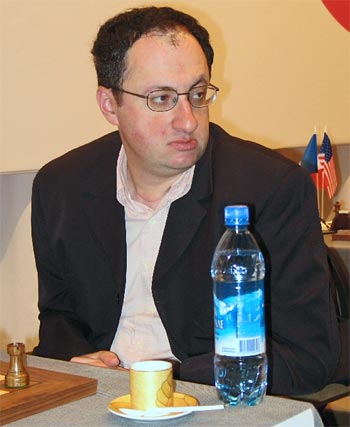
No. 1 in a potentially infinite series
BORIS GELFAND
(picture from Chessbase)
Friday, June 01, 2007
Chess on Sunday?
"The Surrey Under 175 team are short of 4 or 5 players for a match this Sunday near Leicester and versus Yorkshire," emails Robin Haldane.
"I was wondering if you wanted to put something on the blog asking anyone to contact Ray Ryan if they fancy playing."
... and there you go.
Alas myself, I'm off to a birthday barbecue in Blackheath.
But don't let that stop you.
"I was wondering if you wanted to put something on the blog asking anyone to contact Ray Ryan if they fancy playing."

... and there you go.
Alas myself, I'm off to a birthday barbecue in Blackheath.
But don't let that stop you.
Subscribe to:
Posts (Atom)