They are to be found chattering away on the ICC in the early hours. Analyzing graphs that show their tactical ability increasing. Arguing in some forum against century-established theory because of what a bookless Fritz 6.1 just said. Kibitzing how World Champions are patzers for having missed Crafty's anti-positional win of the exchange. Occasionally they scalp a titled player at 1+0, and into their finger notes it goes with the rest.
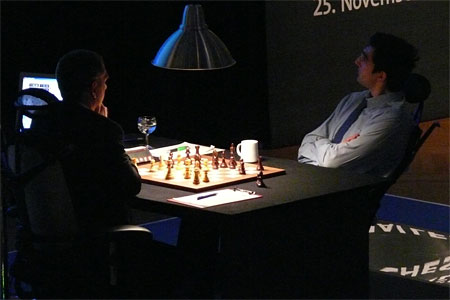
Some, even, when they have decided they are ready, dare to venture out to an actual, physical, real chess tournament or club, confident that their estimated grade (a conversion of their online rating) is accurate. And suddenly it's not a computer screen but a living, breathing human being sat opposite them - fists clenched as if focused on destroying them - and the eyes of spectators are watching here - there - everywhere - and at the board there's no take-backs allowed - no pre-moves - and thousand and one clocks are going tickity tock - and everything looks wrong in three dimensions - and, then, somehow, the game is lost. And there's no play again button. And no comforting suspicion that the opponent plugged in a tablebase in the endgame. No reason to suppose the opponent is secretly Fischer. No chance for immediate revenge, just the bitter taste of a definite defeat. After which, the next round and more of the same . . . Back they retreat to their computer nightly, for months, only venturing out again when they have forgotten what happened before, telling themselves instead it was bad luck anyway the previous time. And after all, that graph of their tactical ability has gone up since then . . .
Am I being cruel? I'm certainly exaggerating, I think. But people do get very much over-invested in what they think they are proving about themselves or chess using a computer, an investment that is not useful for over-the-board (OTB) play, which is the one true test of chess. Here for instance is an example of emotional over-investment in on-line chess. And anyway, I was one of these people. Well, maybe not quite. But I certainly spent too many nights on the ICC, trying to get back over 2300 . . . trying to scalp the IM who keep beating me . . . waiting for my chance to have a crack at someone in a simul . . . that kind of thing, and I have also spent a fair share of my time on sites such as Chess Tactics Server which I am no longer convinced was an optimum use of my time.
At some point I decided to more or less give that stuff up (albeit not entirely successfully) and try something else. I dusted off my board, poured the pieces out from their musty box, got out my clock out, and decided instead to use my chess time at home to, as far as possible, simulate over-the-board (otb) chess. I will give examples of what I mean by this in a moment, but first the reason.
Or rather, reasons. Firstly, I became convinced that I remember things best when they are attached to experiences that have meaningful emotional content. Otb chess is inevitably like this, for me; solving a puzzle in a book on a bus is not. This is the most important reason. Secondly, I think various forms of computer chess skew your game in some not very useful ways. An obvious example is how after hours of blitz we think far more tactically but at the expense of our positional thinking. Thirdly, I think internet chess deceives us into thinking we are better or worse than we really are. Ok, you were feeling great and beat an IM two games in a row. How do you know he wasn't drunk, or that his son hadn't logged on to his account? Or the other way around. So you dropped a hundred and fifty points over a few hours; does that mean your otb form will be terrible, that you should lose confidence, be cautious, start offering as white early draws against weaker players? Maybe you were just tired. Or maybe it really was Fischer's ghost moving the pieces that time. Who knows?
So, I started simulating otb chess at home. I did this in three main ways. Firstly, I would play practice games against computers under the following conditions. I set up the pieces and clock as if a normal game. I turned the computer screen away from me, and set the programme to speak the moves as it made them. I played only one game per session, just like in league chess. If I blundered in the first five minutes, that was it for the night. If I lost on time, I lost on time. Secondly, I set up practice positions that other people recommended as appropriate for simulating otb chess. Once again I set the clock, usually to around 15 minutes, and tried to make a decision as if the position was otb. Below are six sample positions, if you want to take my advice and try this at home. (Remember, this involves setting up the pieces, setting a clock for up to 15 minutes, and trying to make a decision about which move to play as if you were playing a real otb game.) In these first four positions it is black to move:


Whilst in these final two it is white to move:


Thirdly, I tried reading chess books in this way too. That is, not by following the games on a computer or on a travel set, but by going through the games on a proper set, playing out the annotations or visualizing each one, and so forth. Afterwards I would then put the book aside and replay the games, trying to remind myself of the annotations and trying to really "get" what was going on in the games. All of this I found really quite hard to do, especially so when using opening books, which I find extremely hard to actually learn anything from.
Before I summarize today's post, I would like to just reiterate who my intended audience is with these posts: adult players who've hit an impasse. For the most part we are different from children who are growing up in a world where computers are just a straightforward part of chess without any complications. For such lucky children, their computer resources don't seem new and different and such strange temptations, but just a part of chess culture (as say New In Chess does for me.) This means they don't fall into the various traps that coming late to the world of computerized chess risks, as I did.
So, my conclusion. We learn best about chess over-the-board, and over-the-board is the real test of any player. However, various forms of computer chess are so artificial they frequently teach us nothing and merely deceive us, or at the best drastically skew any learning that does take place. Therefore, we should only use a computer in so far as it helps us simulate otb chess, and simulating otb chess at home is a key principle with which to engage in any training activity. Simulation, in other words, not computerisation.
PS. This post is part of a series started here. Number IV is scheduled for Monday next week, and I intend to follow-up with four or five posts on Mondays after that one before closing the series out.
[Index]


 In tomorrow's piece about