Updated every Monday, Wednesday and Friday ... and maybe other days too.
Tuesday, September 15, 2015
The Worst Move On The Board XXI
Bruzón Batista-Vidit, FIDE World Cup, round one (3) 13 September 2015. Position after 38. Nd1-e3.
Bad day at Black Rock for Vidit Santosh Gujrathi in Baku last Sunday. Well placed against Lázaro Bruzón Batista, no problems at all save the approaching time control, maybe push on to try and win it once he'd got there...
...but he never got there. Matter of fact his next move avoided getting there as quickly as it possibly could.
Monday, September 14, 2015
DG XXVIII: The ECF vs The Daily Express
It’s been a bitterly fought campaign. With accusations and jibes thrown by the minute, you wonder how the major players can possibly work together hereafter. Surely the future can only bring yet more bloodletting and acrimony. Splits may emerge that take decades to heal.
But enough of the Labour party and Jeremy Corbyn, let’s get back to the English Chess Federation.
Over on the ECF Forum I’ve been asking why I should be giving much of a monkey’s about our elections. What with having no vote despite having a requirement to pay an annual membership fee and all. Thus far I see no convincing argument as to why I should.
If I did care I think I might be making much more of a fuss about the ECF’s priorities. I might be asking why there’s so much chatter about the effing of offs and nothing at all about the our game’s national body turning itself into the Daily Express in front of our eyes.
Uh huh. Unsurprisingly, the ECF entirely failed to substantiate this claim when asked for evidence (see DG XXVII: The ECF vs Mrs Sally Williams).
There is an emerging awareness of the effectiveness of chess in delaying the onset of Alzheimers (sic)
Uh huh. Unsurprisingly, the ECF entirely failed to substantiate this claim when asked for evidence (see DG XXVII: The ECF vs Mrs Sally Williams).
ECF Director of Home Chess vs ECF Commercial Director
The Daily Express, the very definition of a lost cause, are notorious for their baseless "[whatever random thing they happen to feel like that day] beats dementia" claims. Their latest shouty frontpage headline, reproduced at the head of today’s blog, appeared this very weekend. DG V: In the News has twenty more.
The ECF, though? I hoped for better. I certainly expect better. I could demand better, but why bother? Nobody would listen. Why would they? It’s not as if I’ve got a vote or anything.
Chess and Dementia Index
Sunday, September 13, 2015
Spoiler
I was watching the World Cup yesterday evening,following the game Domínguez Pérez v Pérez Ponsa in which the latter, needing to draw to make it through to the next round, was struggling to hold on in an ending a piece down: in fact it looked, after a long struggle, which had reached 113 moves, as if he might just have let Domínguez in.
Still, it was far from clear and it wasn't the sort of position where computer assessments tell you very much. So I was looking forward to catching the final stages of the game when, going on to Twitter, I was surprised to see:
There were the scoresheets being collected. I'd forgotten, there was a delay in transmission to try and combat cheating. Fair enough, but having followed the game all afternoon, I felt pretty cheated myself in having been told the result before the end of the game.
Still, it was far from clear and it wasn't the sort of position where computer assessments tell you very much. So I was looking forward to catching the final stages of the game when, going on to Twitter, I was surprised to see:
There were the scoresheets being collected. I'd forgotten, there was a delay in transmission to try and combat cheating. Fair enough, but having followed the game all afternoon, I felt pretty cheated myself in having been told the result before the end of the game.
Friday, September 11, 2015
Threehanded
The night before the Bank Holiday tournament at Golders Green I was drinking with Angus and Dave down the Earl Ferrers, which I knew used to have a chess set, because I've had it on a table in front of me: the barman couldn't find it though (a perhaps superior variation on the usual theme of finding the set but not finding all the pawns) and offered me Jenga as a substitute, a suggestion I declined by use of the eyebrows rather than the mouth.
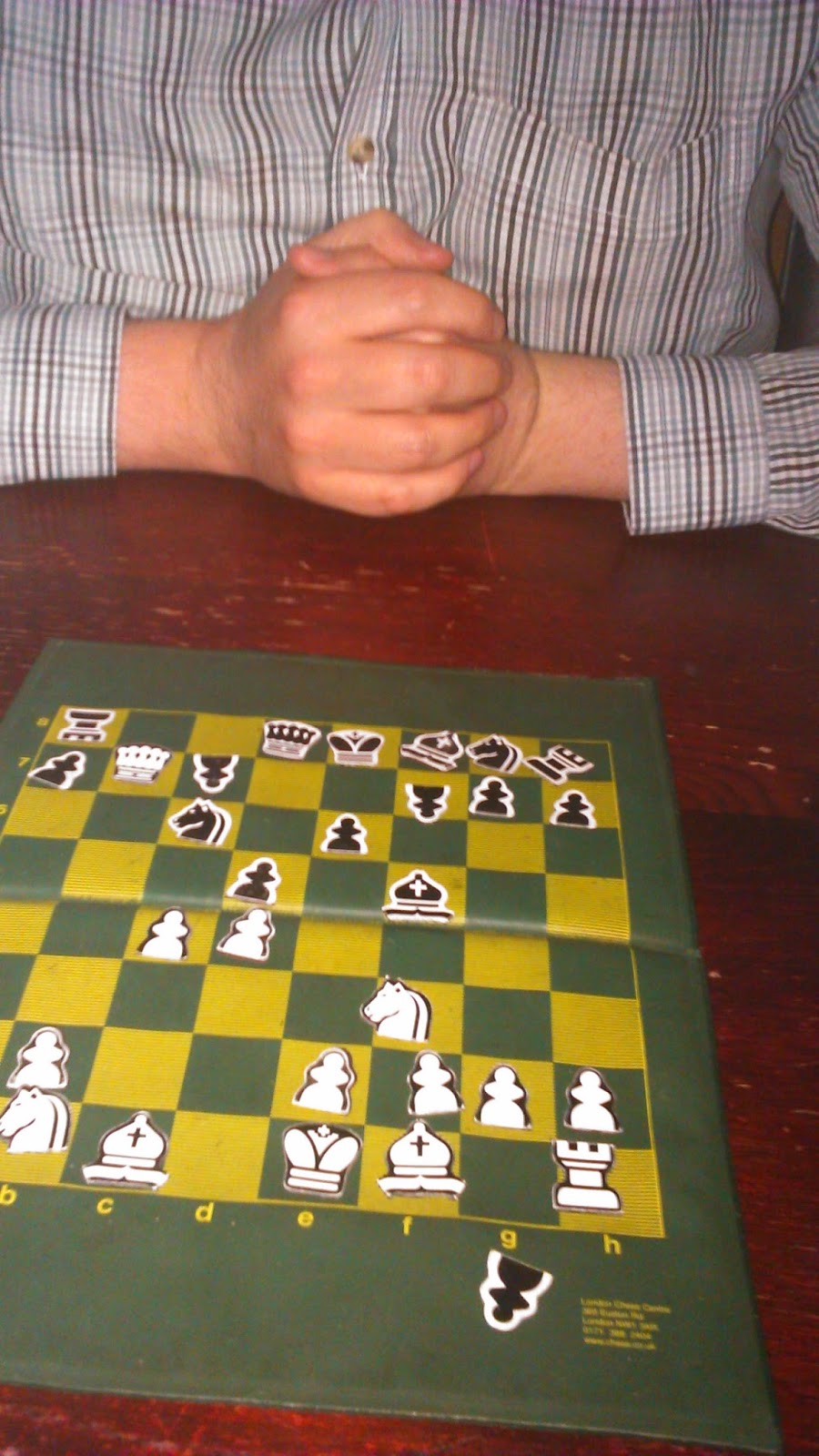
So we made do with Angus's magnetic set, which had the correct number of chessmen but an incorrect number of chessplayers to play with it. Unless one player sits out while the other two play - or unless you play one game, with two sides and three players.
It's a way of playing, and more fun than you'd imagine: perhaps there's not much point in laying traps that you're not going to fall into, but at least you can head for complications in the knowledge that you'll be as lost on the other side of the board as the one you started on.
Threehanded has this virtue, too: the teams are bound to be evenly matched. And two of you don't even have to turn the board round (it falls to the same player to do it each time on their turn.)
We played two games, of which we won one, drew one and lost one. The second (of which the opening stages are pictured) was a particularly good game.
If only I could remember how it went.
So we made do with Angus's magnetic set, which had the correct number of chessmen but an incorrect number of chessplayers to play with it. Unless one player sits out while the other two play - or unless you play one game, with two sides and three players.
It's a way of playing, and more fun than you'd imagine: perhaps there's not much point in laying traps that you're not going to fall into, but at least you can head for complications in the knowledge that you'll be as lost on the other side of the board as the one you started on.
Threehanded has this virtue, too: the teams are bound to be evenly matched. And two of you don't even have to turn the board round (it falls to the same player to do it each time on their turn.)
We played two games, of which we won one, drew one and lost one. The second (of which the opening stages are pictured) was a particularly good game.
If only I could remember how it went.
Thursday, September 10, 2015
How the horsey moves
Held up, switched right over 2f out, headway over 1f out, kept on one pace
[Thanks to Julien Shepley]
[Thanks to Julien Shepley]
Wednesday, September 09, 2015
Back from the dead
Look who's back!
Sorry about that. You probably didn't want to see that. You probably didn't want to see this either.
Yes, it's pathological liar and professional self-publicist CJ de Mooi, in confessional mode just in time for his autobiography to come out.
When I say "confessional mode" the confession is that he killed a man, about which I'd be more concerned if I didn't think the man involved was fictional. But still, by his own account, what does that make CJ?
Sorry about that. You probably didn't want to see that. You probably didn't want to see this either.
Yes, it's pathological liar and professional self-publicist CJ de Mooi, in confessional mode just in time for his autobiography to come out.
When I say "confessional mode" the confession is that he killed a man, about which I'd be more concerned if I didn't think the man involved was fictional. But still, by his own account, what does that make CJ?
Monday, September 07, 2015
DG XXVII: The ECF vs Mrs Sally Williams
via News Thump
I think I like that kid. That pretend kid, I should say. Yes, on the off chance that Jack Warner might wander by today, I should probably start by making absolutely clear that News Thump is a website that publishes spoof news stories.
Wee Jake Williams might be made up, but Sense About Science’s #AskForEvidence new programme aimed at school children is absolutely real. Do you think that if I asked them nicely they’ll do one for the English Chess Federation? Why the need? Well, depressingly, the the ECF has got itself involved with chess and dementia of late with this statement
from Non-Executive Director John Foley in a piece for the Sport and Recreation Alliance.
There is an emerging awareness of the effectiveness of chess in delaying the onset of Alzheimers (sic) *
from Non-Executive Director John Foley in a piece for the Sport and Recreation Alliance.
Saturday, September 05, 2015
Friday, September 04, 2015
Played on Squares (Bloomsbury and Chess) 1: Keynes
This series is a bit off the pace, but the idea of investigating the chess-playing tendencies of the Bloomsbury Group only occurred to me as the three-part TV docudrama Life in Squares was beginning on BBC2 back in July 2015. I had an inkling that they played a bit of chess having come across two of them at it in a photograph a few years ago (see here). So I watched the series with optimism. But, alas, the film's makers overlooked the exciting tele-visual possibilities offered by our noble game: there was not a pawn pushed in anger, nor a piece taken with passion. Hence this series of posts to put the record straight.
A close inspection of their writings suggests that many of the Bloomsberries could and did play, though as we all know, having the moves doesn't mean you can "really play" chess; and it is not so surprising, perhaps, that they should know, even if superficially, a game with such an aura of depth and profundity - it was likely to have been a class/public school thing. This series, though, won't examine all of the several Bloomsbury chessers. Instead, the focus will rest on just three or four for whom chess was perhaps a bit more serious, even if for one or two of these it wasn't much more than a compulsive pastime. For one or two others, however, chess was, as I discovered, a serious diversion at some time in their lives.
Collectively these four will be the hooks upon which the episodes will hang. Around these main chess characters other Bloomsberries will be slotted in, so long as it doesn't get too confusing or protracted. Incidentally, in following the chess in Bloomsbury trail I have wandered occasionally from the straight and narrow to note some associates of the Group. They turn out, here and there, to be worth the detour. We will follow the characters, whether hard-core or peripheral, in a very approximate chronological order.
I hope that the series will appeal to, and interest, Bloomsbury Group aficionados and chessers alike - but as the Venn overlap is likely to be small I have provided explanations of what the others' fuss is all about. At Appendix 1 there is a chess player's Bloomsbury Briefing of my own fashioning; I hope it will be helpful. Reciprocal briefings for Bloomsburyphiles on the chess will occur as we go along. Appendix 2 to this first episode explains how I approached the task in hand; and thereby give an explanation also of its shortcomings. There is also a list of sources at the end of each episode, so references intialised in the main text can be decoded accordingly.
Because of all these preliminaries, this first episode - including the Appendices - is rather long. But it has got a bit of your actual chess. Other episodes in this fortnightly series may be rather expansive as well.
![]() |
| Now out on DVD |
Collectively these four will be the hooks upon which the episodes will hang. Around these main chess characters other Bloomsberries will be slotted in, so long as it doesn't get too confusing or protracted. Incidentally, in following the chess in Bloomsbury trail I have wandered occasionally from the straight and narrow to note some associates of the Group. They turn out, here and there, to be worth the detour. We will follow the characters, whether hard-core or peripheral, in a very approximate chronological order.
I hope that the series will appeal to, and interest, Bloomsbury Group aficionados and chessers alike - but as the Venn overlap is likely to be small I have provided explanations of what the others' fuss is all about. At Appendix 1 there is a chess player's Bloomsbury Briefing of my own fashioning; I hope it will be helpful. Reciprocal briefings for Bloomsburyphiles on the chess will occur as we go along. Appendix 2 to this first episode explains how I approached the task in hand; and thereby give an explanation also of its shortcomings. There is also a list of sources at the end of each episode, so references intialised in the main text can be decoded accordingly.
Because of all these preliminaries, this first episode - including the Appendices - is rather long. But it has got a bit of your actual chess. Other episodes in this fortnightly series may be rather expansive as well.
Wednesday, September 02, 2015
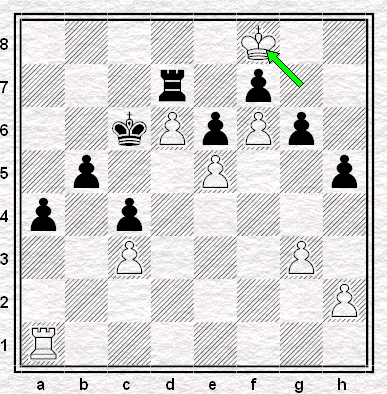
This position is drawn even without White's b-pawn
I'm flying back home today, after a short working holiday in the UK and some Golders Green chess, so in lieu of anything substantial, here's a short item that caught my eye while looking through some old BCMs recently.
This is from the issue for May 1977, page 199. "This position is drawn even without White's b-pawn."
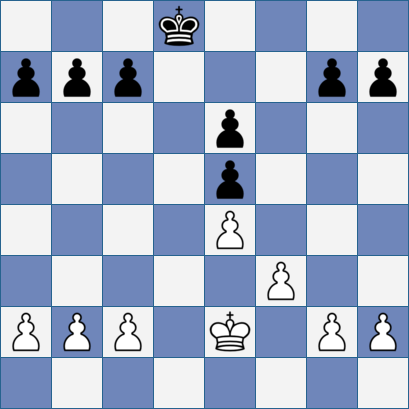
Here's the position without White's b-pawn.
Doesn't the draw strike you as the least likely result?
This is from the issue for May 1977, page 199. "This position is drawn even without White's b-pawn."
Here's the position without White's b-pawn.
Doesn't the draw strike you as the least likely result?
Monday, August 31, 2015
DG XXVI: Disclosure
Disclosure Statement
All of the panelists who participated in this conference and contributed to the writing of this statement were identified as having no financial or scientific conflict of interest, and all signed forms attesting to this fact. Unlike the expert speakers who present scientific data at the conference, the individuals invited to participate on NIH Consensus and State-of-the-Science Panels are reviewed prior to selection to ensure that they are not proponents of an advocacy position with regard to the topic and are not identified with research that could be used to answer the conference questions.
From:
There’s not going to be a pawn ending today. Nor will there be for the next few weeks, I suspect. The chess and dementia stuff has rather kicked off as late and if I only have time to do one or other of these posts - which I do - it’s Doctor Garry that I’d prefer to write.
Over the last 15 months or so there have been a tonne of things that I wanted to cover in this series without ever quite finding the time to get around to them. One of these is disclosures.
If you read the academic literature that’s relevant to chess and dementia you’ll often find statements like the one at the head of today’s blog. Sometimes it will be called something else, e.g. Barnes and Yaffe 2011* page 8:-
Conflicts of Interest
KY has served on data and safety monitoring boards for Pfizer and Medivation, and has received board membership fees and travel
or accommodation expenses from the Beeson Scientific Advisory Committee and consultancy fees from Novartis. DEB declares that she has no conflicts of interest.
Usually they will be at the end of the article, although sometimes you’ll find it embodied in the main text, e.g. the section "Role of the Funding Source" which can be found in Ngandu and others (2015)** page 5:-
The study funders had no role in study design, data collection, analysis, interpretation, writing of the report, or the decision to submit for publication.
Sometimes it’s really long. The disclosure statement that appears on the left, for example, which is taken from Hall and others (2009)***.
This seems to be something of a more recent fashion. You won’t find a disclosure statement in the Verghese article which was published back in 2003, for instance. More and more, though, you get something like this in articles that appear in academic journals.
Why? A growing awareness that a conflict of interest can bring an unwitting bias to what you do - even if you try really really not to let it happen. A greater realisation that sometimes academics who write papers may have motivations beyond the immediately obvious (see Ben Goldacre on Cyagen, for example).
We worry about “conflict of interest” a lot in science, and especially medicine ... There is a large literature showing the conflict of interest is associated with bias in research, but it’s not a guarantee of bias in any one case, and often it’s innocuous. Declaring a conflict of interest doesn’t mean you’re corrupt ... You always declare it, so we can all see it.
Ben Goldacre, Bad Science
All this is quite a contrast with what goes on in the chess world. Academics think about conflict of interest even when there isn’t any. For instance, Hughes and others (2010)****:-
Declaration of Conflicting InterestsThe author(s) declared no conflicts of interest with respect to the authorship and/or publication of this article.
Chessers writing about dementia? They never mention it. Even though it’s absolutely central to what they’re doing.
It’s not so much that I think Kasparov, Polgar Keene, Garcia, Davies, Chessbase and all the others should declare a conflict of interest in a formal way when they write about chess and dementia. It’s more that one time - just one time - I’d like to see some evidence that they’ve thought about it. That they’ve reflected on the conflict between their interest in promoting chess (and/or themselves and/or their mates) and their interest in making a positive contribution to how dementia might be tackled. That they’ve wondered whether their - entirely reasonable - desire for the former is colouring their view of the latter.
I suspect that the reason that this doesn’t happen is that with the exception of Leonxto Garcia, none of those listed above actually care much (if at all) about dementia anyway. So there is no conflict of interest. There’s nothing more than 'how can we promote chess' (and/or ourselves and/or our mates).
Chess and Dementia Index
For full references for all of the following (and links to the original texts where available) see the Journal Articles section of DG: The Knowledge Pile
* Barnes D E and Yaffe K, (2011) The projected effect of risk factor reduction on Alzheimer’s disease prevalence, The Lancet Neurology
**Ngandu et al (2015) A 2 year multi domain intervention of diet, exercise, cognitive training, and vascular risk monitoring versus control to prevent cognitive decline in at-risk elderly people (FINGER): a randomised controlled trial The Lancet online
*** Hall et al (2009) Cognitive Activities Delay Onset of Memory Decline in Persons who Develop Dementia, The Lancet
**** Hughes et al (2010) Engagement in Reading and Hobbies and Risk of Incident Dementia: The MovIES Project, The American Journal of Alzheimer’s Disease and other Dementias
Saturday, August 29, 2015
A Literary Reference : The Big Sleep
I went over to a floor lamp and pulled the switch, went back to put off the ceiling light, and went across the room again to the chessboard on a card table under the lamp. There was a problem laid out on the board, a six-mover. I couldn’t solve it, like a lot of my problems. I reached down and moved a knight, then pulled my hat and coat off and threw them somewhere. All this time the soft giggling went on from the bed, that sound that made me think of rats behind a wainscoting in an old house.
- - - - -
"Put the light out," she giggled.
I threw my cigarette on the floor and stamped on it. I took a handkerchief out and wiped the palms of my hands. I tried it once more.
"It isn’t on account of the neighbors," I told her. "They don’t really care a lot. There’s a lot of stray broads in any apartment house and one more won’t make the building rock. It’s a question of professional pride. You know—professional pride. I’m working for your father. He’s a sick man, very frail, very helpless. He sort of trusts me not to pull any stunts. Won’t you please get dressed, Carmen?"
"Your name isn’t Doghouse Reilly," she said. "It’s Philip Marlowe. You can’t fool me."
I looked down at the chessboard. The move with the knight was wrong. I put it back where I had moved it from. Knights had no meaning in this game. It wasn’t a game for knights.
Raymond Chandler, The Big Sleep, Pan, 1969, p.127, p. 128-9. (Original date of publication 1939.)
[A Literary Reference index]
Friday, August 28, 2015
Sitges: the other ultimate blunder
The day after resigning in a drawn position, I did the other thing. I accepted a draw in a won position.
Not only that, but a couple of moves beforehand, I managed to offer a draw in a won position.
As my opponent turned it down, he therefore refused the offer of a draw in a lost position. That's three versions of the same thing. Not bad eh? At least he had the consolation in the end of having offered a draw in a lost position and got away with it.
Draw offers in drawn positions, though, we weren't having any of that.
Horton-Salles, Sitges 2015 round eight, position after Black's 44th.
Not only that, but a couple of moves beforehand, I managed to offer a draw in a won position.
Horton-Salles, Sitges 2015 round eight, position after White's 42nd.
As my opponent turned it down, he therefore refused the offer of a draw in a lost position. That's three versions of the same thing. Not bad eh? At least he had the consolation in the end of having offered a draw in a lost position and got away with it.
Draw offers in drawn positions, though, we weren't having any of that.
Wednesday, August 26, 2015
Sitges: the ultimate blunder
Persson-Horton, Sitges 2015 round seven. Position after 58. Rb7-b8.
During the tournament at Sitges I came across, can't remember why, some pages on Google Books from Klaus Trautmann's El Último Error, the Spanish translation of his book Der Letzte Fehler, The Final Error, originally published in German in 2004. As far as I can see it's never been translated into English, which is probably a shame. Tim Krabbé mentions it here.
The subtitle of the book is 128 irrtümlich aufgegebene Schachpartien, which is more German than I can read unaided, but in Spanish is 128 Partidas Abandonadas Erróneamente, which I can render without difficulty as "128 games wrongly resigned", which makes it both a suitable introduction to this piece and ironic that I was carrying around the excerpt from Google Books during that particular tournament.
Tuesday, August 25, 2015
DG XXV: "Verghese, chess, Alzheimer’s"
Clause 1 Accuracy
i) The Press must take care not to publish inaccurate, misleading or distorted information, including pictures.
Verghese, chess, Alzheimer’s. Ray Keene - who is currently the subject of a complaint to the Independent Press Standards Organisation relating to comments about chess and dementia that he published back in May - returned to this familiar combination at the weekend.
On Saturday I splurged £1.50 at WH Smiths to get a look at Saturday’s chess column (see left). If Ray’s efforts mean that more people will find "Leisure Activities and the Risk of Dementia" in the Elderly - the article that Verghese and others published in the New England Journal of Medicine in 2003 - then that’s great news. If they end up actually reading it, so much the better. If nothing else, it will become very obvious very quickly that there is nothing at all in Verghese’s work that justifies that claim that "chess is a valuable way to combat the onset of Alzheimer’s".
To recap, the Verghese’s study:-
(a) doesn’t mention the word "chess" even once (DG III);
(b) doesn’t conclude that playing board games prevents Alzeheimer’s (DG VII).
If you do a search for Verghese, chess, Alzheimer’s over the next few days, please feel free to use the comments box to let me know what you find. In the meantime, it’s back to IPSO we go.
Monday, August 24, 2015
History Boy 3
[Pawn endings will be back next week. In the meantime, here’s Martin with something more worthy of your attention - JMGB]
Well done again Paul McKeown for another splendid chess history session at the City Lit., back on 10th August: this time on the great London International Tournament of 1851. It was the second of what we hope (down here in London) will be a regular feature of the annual summer break in local league chess.
Paul didn't disappoint his audience of a dozen or so, comprising a fair cross-section of chess strength and acquaintance with ancient chess history, and including some familiar faces from last year when he talked about the de la Bourdonnais-McDonnell match of 1834. There were some familiar faces in the PowerPoint as well as he lightly reprised a few characters from mid-19th Century chess, before introducing us to some others involved in the first ever London Chess Classic.
Sunday, August 23, 2015
DG: The Knowledge Pile
"The trouble with Social Work", my old professor used to say, "is that it doesn’t so much have a knowledge base as a knowledge pile." With apologies to him - Brian Sheldon - I think I’m about to
reproduce the problem here.
One day this page will have turned in to an orderly list of resources and sources of information about and/or relevant to the theme of chess and dementia. Sorted according to type (journal articles; reports; newspaper /website articles etc) and topic, what I’m aiming for is a webpage that is the place to start for anybody interesting in finding accurate and reliable information from trusted sources. And perhaps a reference or two to the less reliable and less trusted, if only to make sure that we all know what’s out there.
One day.
What it is going to be for a long while - what it certainly is now - is a more or less random list of (a) things I happen to have come across and (b) have had time to record here. No real structure and no explanation of what the different publications are or why somebody might be interested in reading them.
Still, starting small is better than not starting at all. I’ll be adding things as we go along, with an initial focus on material that can be easily found online. If you happen to know of something that’s not already included here, please do get in touch in the comments box and let me know.
Chess and Dementia Index
JOURNAL ARTICLES
Akbaraly T N, Portet F, Fustinoni S, Dartigues J-F, Artero S, Rouaud O, Touchon J, Ritchie K, Berr C (2009)
Leisure Activities and the Risk of Dementia in the Elderly: Results from the Three-City Study, Neurology vol 73 no 11, 854-861
Abstract; Full text not currently available online
Dartigues J F, Foubert-Samier A, Le Goff M, Viltard M, Amieva H, Orgogozo J M, Barberger-Gateau P, Helmer C (2013)
Playing board games, cognitive decline and dementia: a French population-based cohort study, BMJ Open: 3
Hall C B, Lipton R B, Silwinski M, Katz M J, Derby C A, Verghese J (2009)
Cognitive Activities Delay Onset of memory Decline in Persons Who Develop Dementia, Neurology, vol 73 no 5, 356-361
Abstract; Full text
Hughes T F, Chang C-C H, Vander Bilt J, Ganguly M (2010)
Engagement in Reading and Hobbies and Risk of Incident Dementia: The MoVIES Project, The American Journal of Alzheimer’s Disease and Other Dementias, 25(5) 432-438
Abstract; Full Text
Sorman D E, Sundstrom A, Ronnlund M, Adolfsson R, Nilsson L-G (2013)
Leisure Activity in Old Age and Risk of Dementia: A 15-Year Prospective Study, Journals of Gerontology, Series B, Psychological Sciences and Social Sciences, vol 69 no 4, 493-501
Abstract; Full Text
Verghese J, Lipton R B, Katz M J, Hall C B, Derby C A, Kuslansky G, Ambrose A F, Silwinski M, Buschke M (2003)
Leisure Activities and the Risk of Dementia in the Elderly New England Journal of Medicine 348 2508-2516
Wang H-X, Weili X, Jin-Jing P (2012)
Leisure Activities Cognition and Dementia, Biochimica et Biophysica Acta, vol 1822 no 3, 482-491
Abstract; Full text
REPORTS
Daviglus ML, Bell CC, Berrettini W, Connolly ES jr, Cox NJ, Dunbar-Jacob JM, Granieri EC, Hunt G, McGarry K, Patel D, Potosky AL, Sanders-Bush E, Silberberg D, Trevisan M (2010)
National Institutes of Health State-of-the-Science Conference statement: preventing alzheimer disease and cognitive decline, Annals of Internal Medicine, vol 153 no. 3, 176-181
Sense About Science: I’ve got nothing to lose by trying it
International Longevity Centre: Preventing Dementia: A Provocation
FIDE: Social Action Chess Commission: "SACC" Report, 85th FIDE Congress
Alzheimer’s Society Factsheets
What is dementia?
What is Alzheimer’s disease?
What is vascular dementia?
Am I at risk of developing dementia?
The progression of Alzheimer’s disease and other dementias
Websites
Alzheimer’s Society
Alzheimer's Research UK
Ask for Evidence
Bad Science
Sense About Science
Saturday, August 22, 2015
Friday, August 21, 2015
Chess in Art Postscript: Game, Senet and Match
We have been here before.
Back in 2012, in a Postscript sequence that began with Thomas Eakins' well known Chess Players of 1876, we ended up puzzling over Jean-Léon Gérôme's 1859 painting of Arnauts - Albanian mercenaries - playing a board game of some sort. The painting is in London's Wallace Collection.
![]() |
| [Image courtesy of the Wallace Collection] |
The Wallace Collection say they are playing draughts. But, as we pointed out all those three years ago, the principal authority on Gérôme, Gerard Ackerman (2000), says they are playing chess. It was all about the shape of the pieces - or, so we thought.
But now it seems that we have been looking in the wrong place. Three years after the original post, on June 7th 2015 to be exact, a nice surprise popped up in the Comments Box.
Thursday, August 20, 2015
Sitges: took the hint
Korchnoi-Karpov, world championship match 1978, game 21, position after 60. Kd5-c4.
Schmid was now hovering with a White queen ready for the expected promotion of White's QNP. Korchnoi skittishly requested that he have a rook knight and bishop ready as well in case he decided to underpromote. Karpov took the hint and resigned to the accompaniment of loud cheers and clapping.You Know Who, Karpov-Korchnoi 1978, The Inside Story of the Match (Batsford, 1978).
I do like that "skittishly". He might have been ripping off his colleague and employer in order to write an instant book
but at least back then he could write a sentence you'd remember.
I remembered it after this otherwise inconsequential game from Sitges.
Horton-Glebova, Sitges 2015, round two, position after 34...Ke7-d8.
Wednesday, August 19, 2015
Sitges: better late?
I had nine games in Sitges, in four of which my opponents turned up on time and in five of which they did not. The five players who were late at the board arrived fifteen, nine, six, nineteen and sixteen minutes late, an average of thirteen minutes. Of these, precisely one bothered to apologise.
Well, we can all of us be rude in our different ways, I suppose, and some people are OK with lateness and less happy with constant sarcasm. Still, sarcasm at the board is still a rare event, whereas, if we take my experience as indicative, lateness at the board is anything but.
Tuesday, August 18, 2015
DG XXIII: Doctor Nigel
I’m indebted to David Robertson and the EC Forum for the news that we can add Nigel Davies to the list of what I have come to call Verghese bullshitters.
"There is a growing body of evidence that chess is a highly effective way of staving off Alzheimer’s disease", Davies - chess Grandmaster - writes in a blog post published a few years back. "As this research has been around for years", the renowned authority on health matters continues, "it amazes me is that (sic) chess federations around the World are not singing this from the rooftops."
Well, let us pass up the opportunity to comment on Davies’ gauche reduction of the impact of dementia to its financial cost. Let us not dwell on his tasteless - not to mention inaccurate - depiction of those living with dementia as "helpless dependent people". Let us merely address the issue that Doc Nigel raises.
Why is it that Verghese’s study - "specific research", according to Davies - is not being promoted by the world’s chess federations as the answer to dementia? Might it be because the article, which can be found online by anybody who cares enough about the subject to read it, doesn’t actually mention chess?
Susan Polar/Michael Gelb, Ray Keene and now Nigel Davies. Chess celebrity in action. Doesn’t it make you proud to be a chesser?
Chess and Dementia Index
Monday, August 17, 2015
Evaluating Evaluations
White to play
I was looking at an opening position the other day. As you do. I started shoving the pieces around and before I knew it a king and pawn endgame had appeared on the board. The position at the head of today’s blog, in fact.
I’d left an engine (HIARCS) running while I was playing around and noticed that in its esteemed opinion, the evaluation of the position was "+1.14". I can’t say I found that to be particularly helpful. What is "+1.14" supposed to mean in the context of a pawn ending?
Engine evaluations are fine for middlegames. A little over +1? Well you’ve got a clear edge. Not enough to say you’re winning just yet, but it’s certainly beyond +=. Pawn endings? They’re won or drawn aren’t they? A numerical evaluation just seems irrelevant (that’s when the Bloody Iron Monsters aren’t botching it entirely - see Our Electronic Pals: Then and Now and 53, for instance).
Do we really care that this position ...
... is mate in 11 (as your computer will tell you in an instant) with White to move rather than 10 or 12 or 25? Surely not. We just want to know that it’s winning for White.
Equally, amusing though it is that HIARCS gives this position ...
... an evaluation of +0.08, all we need to know about it is that it’s going to be a draw unless Black goes horribly and unnecessarily wrong.
So, since engine evaluations of king and pawn endgames are best approached with caution and since - obviously - my own brain is inadequate for the task, I’m going to ask for human assistance. i.e. you lot. Is that position into which I stumbled at the weekend a win or a draw with best play, do you think?
King and pawn Index
Sunday, August 16, 2015
Friday, August 14, 2015
The Royal Game Not At The Royal Academy
Last time at this year's Royal Academy's annual Summer Exhibition we investigated Karl Singporewala's engaging chess set on show in the main galleries. Now we go upstairs to their Sackler Galleries to pick over Joseph Cornell's intriguing box art. Works such as this:
No jokes about a dead parrot sketch, thank you very much. This is serious. One of his boxes might contain a chess set. We live in hopes.
![]() |
| Habitat Group for a Shooting Gallery (1943), Construction, 15 1/2 x 11 1/8 x 4 1/4 in Image from Web Museum, with thanks. |
Thursday, August 13, 2015
Beware of getting what you ask for
Announcement, 28 July 2015
Email, 29 May 2014
Dear Stewart
I would like to nominate the British Chess Magazine for the award of ECF Magazine of the Year. My citation would read:
ejh
- - - - -
Email, 29 May 2014
Dear Stewart
I would like to nominate the British Chess Magazine for the award of ECF Magazine of the Year. My citation would read:
"For their consistently penetrating and courageous coverage of important events in the chess world and their detailed and demanding book reviews."All the best
ejh
Wednesday, August 12, 2015
The Worst Move(s) on the Board(s) XX
I played at Golders Green on Saturday. The first time I’ve been to one of Adam Raoof’s events for a long time.
I had mixed feelings when I entered. I was certainly in the mood for chessing, but I wasn’t sure how well I was going to do. On the one hand I knew I’d be one of the highest rated players in the Major (u170) section and I done pretty well the last few times I’d played there. On the other I’d only played a handful of rapidplays since 2013 (the most recent back in January) and I had hardly covered myself in glory in Sitges.
Not to worry. I wanted to play. I would just turn up and see what happened.
Then I saw David Howell’s post-Warwick tweet (Champions) and decided I was being a total weed. Why was I aiming so low? I might be out of practice, but there was not reason at all not to give it a go.
I reset my goals for the day. Now I would be turning up with serious intent. Perhaps I wouldn’t win the tournament - on the law of averages alone I probably wouldn’t - but winning would nevertheless be my aim. My feeling that I should really be trying was reinforced when I arrived at the playing hall and discovered that I wasn’t just one of the highest rated players in the Major, but in fact was the very top seed.
I have to see this new rather positive attitude led to the most memorable start to a tournament that I’ve ever had. After four rounds I had scored precisely one point, my solitary win coming against the second-lowest rated player in the event.
I had mixed feelings when I entered. I was certainly in the mood for chessing, but I wasn’t sure how well I was going to do. On the one hand I knew I’d be one of the highest rated players in the Major (u170) section and I done pretty well the last few times I’d played there. On the other I’d only played a handful of rapidplays since 2013 (the most recent back in January) and I had hardly covered myself in glory in Sitges.
Not to worry. I wanted to play. I would just turn up and see what happened.
Then I saw David Howell’s post-Warwick tweet (Champions) and decided I was being a total weed. Why was I aiming so low? I might be out of practice, but there was not reason at all not to give it a go.
I reset my goals for the day. Now I would be turning up with serious intent. Perhaps I wouldn’t win the tournament - on the law of averages alone I probably wouldn’t - but winning would nevertheless be my aim. My feeling that I should really be trying was reinforced when I arrived at the playing hall and discovered that I wasn’t just one of the highest rated players in the Major, but in fact was the very top seed.
I have to see this new rather positive attitude led to the most memorable start to a tournament that I’ve ever had. After four rounds I had scored precisely one point, my solitary win coming against the second-lowest rated player in the event.
Monday, August 10, 2015
Champions
Howell - Hebden
British Championships (11), August 2015
What makes a champion? Well, scoring more points than everybody else for a start, so well done to Jonathan Hawkins for that.
However, if there’s such a thing as a Champion’s Attitude - and I think there is - David Howell demonstrated it in a tweet he posted a few hours after he reached the position above in his final game with Mark Hebden.
This from a man who had just finished second only half a point behind the winner. "Mentally weak"? Contrast that with the, "I played quite well and then just made a silly mistake" mumbles that the rest of us tend to favour.
Sunday, August 09, 2015
What wasn't in New In Chess 2015/5
Dear NiC
In the course of his long complaint about how unfair journalists are being to him, Nigel Short unaccountably fails to mention how scientists responded to the comments he made in NiC 2015#2.
He might for instance have cited Dr Dean Burnett, of the Institute of Psychological Medicine and Clinical Neurosciences in Cardiff, who wrote:
While there are differences between male and female brains, there aren’t as many as most people believe, certainly not one that would be so stark and specific to mean differing aptitudes for a specific board game. (Calm down, dear: the dark side of ‘emotional intelligence', Guardian, 21 April.)Or Professor Gina Rippon, Professor of Cognitive Neuroimaging at Aston University, who said on BBC Radio Four, also 21 April:
The evidence is clear that in terms of the, kind of, key skills and key structures of the brain there's very little difference between male and female brains.She proceeded to attribute most of the differences in performance between the genders to societal expectations and to explain that the brain itself changes in response to experiences. (The programme is available online at http://www.bbc.co.uk/programmes/b05r3td.)
Nigel may disagree with this - and it's a legitimate discussion - but as long as he considers himself the victim of a "feminist lobby" which is "shrill" and "tyrannical" he may not be the most reasonable judge of evidence. Indeed, one recalls that in his original article he referred to the statistical work of Bilalic, Smallbone, McLeod and Gobet as an "absurd theory" and proceeded to declare:
only a bunch of academics could come up with such a preposterous conclusion.If Nigel wants us to believe that he's interested in scientific evidence, a good way to proceed would to be to behave less ignorantly towards scientists.
Personally, I propose that Nigel approaches Professor Rippon for her advice before writing again on the subject. He might have to explain, though, why he referred to women as "totty" in NiC 2012#7, a term Professor Rippon is aware he used, since she quoted him as using it.
It may be this kind of thing, "innocent" anecdotes about women drivers aside, that people consider "conclusive proof of sexism". One could also cite his complaint in NiC 2010#5 that Cuba wasn't sufficiently good for "sex tourism", or his promotion of the website World Chess Beauty Contest (New York Times, 27 November 2005) or any number of other incidents in a long career of puerile sexism.
The problem for Nigel is not really that people fail to read what he writes. It's that they read, and they remember.
Yours
ejh
1 July 2015
[Previously unpublished]
[Nigel Short index]
Saturday, August 08, 2015
Hawk talk
Well that was close.
I'm glad Hawkins won it though: nothing at all against David Howell, but last year's finish, which saw the same two players sharing the title, felt unsatisfactory given that the tradition of our event is to establish an outright winner. So as David has other titles to his credit in the past (and surely more to come in the future) I was rooting for Jonathan when it came down to the two of them towards half past six yesterday evening.
Much sympathy, though, for Nick Pert, who was carrying the appalling burden of having to play his twin brother in the final round when needing a win that he never looked likely to get. It was, more than anything, Nick beating Howell with the Black pieces which made this year's championship as exciting as it was.
Anyway, back to half-six last night, when rooting for Hawkins meant rooting for Mark Hebden in the top board game, one that looked dead-set to be a draw until Hebden unexpectedly blundered just before the time control and emerged, just after it, a pawn the worse.
I'm glad Hawkins won it though: nothing at all against David Howell, but last year's finish, which saw the same two players sharing the title, felt unsatisfactory given that the tradition of our event is to establish an outright winner. So as David has other titles to his credit in the past (and surely more to come in the future) I was rooting for Jonathan when it came down to the two of them towards half past six yesterday evening.
Much sympathy, though, for Nick Pert, who was carrying the appalling burden of having to play his twin brother in the final round when needing a win that he never looked likely to get. It was, more than anything, Nick beating Howell with the Black pieces which made this year's championship as exciting as it was.
Anyway, back to half-six last night, when rooting for Hawkins meant rooting for Mark Hebden in the top board game, one that looked dead-set to be a draw until Hebden unexpectedly blundered just before the time control and emerged, just after it, a pawn the worse.
Friday, August 07, 2015
Black day for White
British Championship, round ten:
When did you last see a tournament round where you had to go as far down as board twelve to find a win for White?
Thursday, August 06, 2015
"There is no discrepancy"
Hello everybody. Do you remember this posting from back in April? It involved the ill-fated English Seniors' Championship of 2014 and a whole variety of problems that arose out of it, of which one in particular was causing me confusion.
I'd asked the ECF's Chief Executive Officer, Phil Ehr, whether the ECF had offered any financial support to the event, a question I originally asked on November 4 2014. It took two months and two reminders to get a reply, but on January 7 2015 Phil replied, saying the following:
The ECF contributed £1000 towards the prize fund and this amount was paid out.

it was kind of hard to work out how £1000 could have been contributed.
So on January 17 I wrote back, asking:
You say "the ECF contributed £1000 towards the prize fund and this amount was paid out" but my understanding is that only £750 was paid out in prizes. Could you clarify this point?
but as regular (and weary) readers will recall, no reply had been received three months later. Hence my post (and two subsequent ones, linked to below).
Obviously I wasn't over-impressed with this, but what can you do etc, and I'd long since assumed that I'd never get an answer when the ECF announced a question-and-answer session, to the Chief Executive, for Monday 3 August at the British Chess Championships.
So I asked:
And I got an answer.
I'd asked the ECF's Chief Executive Officer, Phil Ehr, whether the ECF had offered any financial support to the event, a question I originally asked on November 4 2014. It took two months and two reminders to get a reply, but on January 7 2015 Phil replied, saying the following:
The ECF contributed £1000 towards the prize fund and this amount was paid out.
The reason for my confusion was that I'd seen the prize list for the event, and as only £750 had actually been paid out in prizes

it was kind of hard to work out how £1000 could have been contributed.
So on January 17 I wrote back, asking:
You say "the ECF contributed £1000 towards the prize fund and this amount was paid out" but my understanding is that only £750 was paid out in prizes. Could you clarify this point?
but as regular (and weary) readers will recall, no reply had been received three months later. Hence my post (and two subsequent ones, linked to below).
Obviously I wasn't over-impressed with this, but what can you do etc, and I'd long since assumed that I'd never get an answer when the ECF announced a question-and-answer session, to the Chief Executive, for Monday 3 August at the British Chess Championships.
So I asked:
And I got an answer.
Subscribe to:
Posts (Atom)