For some time now, I've been meaning to invite Streatham and Brixton players - and other readers of this blog - to play in the annual FIDE-rated international tournament in Benasque.
I played there last year (matter of fact, to date it's the last competitive chess I've actually played) and scored 6/9 in an extremely strong Open - the highest-ranked player without a title came 31st. This performance included one of my four career wins against FIDE Masters and a missed draw, in the endgame, against a Grandmaster.
I was tipped off about the tournament's existence by Andrew Stone, before I left, and I know Sue Lalic has played in it at least once. It's the strongest tournament, by some distance, that exists in my part of the world, since although Spain is known for its strong tournaments, the province of Aragón is not remotely so well served as is, say, Catalunya. There is, for instance, no strong tournament in Zaragoza, by far the largest city in the province.
Tournament chess in Spain is very strange to British eyes. There are, for instance, no weekend congresses, something I did not know when I came here and which I was dismayed to discover. The Spanish prefer to play one-day tournaments, with time limits of ten or fifteen minutes each, and the prizes are generous. There are, however, many FIDE-rated tournaments in Spain, especially in the summer months (though not, as I say, especially in Aragón). It is possible to spend the whole summer, which of course is longer in Spain than in more Northerly parts of Europe, playing these tournaments and filling in the odd Sunday with one of the aforementioned fifteen-minute affairs, and there are quite a few players of master rank who do precisely this.
So you have the odd situation where there is an enormous amount of chess for the professional, but no weekend chess, at least as I understand it, for the ordinary player who needs to work from Monday to Friday. Perhaps for this reason above all else, these tournaments are very large, far larger than their British equivalents, for if you have to take a week or two off work to play, you can probably do this only once a year, so naturally you will make certain you play in your "local" tournament if you possibly can. The 2006 tournament had more than 350 participants. I'm used to the idea that you might be struggling in a congress if you're on board 15. Here, it's board 150. If you're on board 15, you're probably playing a grandmaster.
Benasque itself is a small town in the Pyrenees, just a couple of kilometres from the French border, though as there is no pass in that particular valley, it feels much more isolated than that might suggest. It's essentially a ski resort, and therefore not full in July, though the Spanish Pyrenees do attract visitors and tourists through the summer, and the location is very striking. Play takes place in a sports hall just a couple of minutes' walk from all the bars, restaurants and hotels (though last year I chose to stay in a tent on a campsite about forty minutes' walk up the hill). One can get here from a variety of directions, though it's probably best to fly to Zaragoza (or one of the airports near Barcelona, Reus or Girona). Then hire a car: or get a coach (or train) to Huesca, where I live, and then another coach to Benasque. (If, of course, a party of players were to come, then it should be possible to split the costs involved.)
But when is it, you ask? And here we have a slight problem. Because as yet, I do not know. I assume it is in July, as it was last year - and as it has been running for nearly thirty years, I assume it will be in July again. But the precise dates, I do not know. Indeed nobody knows. Or if they do know, they are not telling.
I have enquired with the tourist office in Benasque - my enquiries have gone unanswered. The website of the Aragonese chess federation only lists the events taking place over the next three months - beyond that, the assumption seems to be either than you know already, or you do not need to know. Which is probably fine if you are a professional, since there are many competing events and you may make up your mind quite late: and it's probably OK if you're a local. But if you're an amateur from abroad, needing to know information well in advance in order to book flights and time off work, it is no use whatsoever.
But, as I found out last year, that's just the way Spain works (indeed, it is a mystery to me that it works at all):
• Everybody knows what is happening except you
• Nobody will ever tell you anything.
So I would like to invite people to come to Spain, in July this year, to Benasque, for a week and a half in the mountains, to play chess. But I am not, yet, sure precisely when that week and a half will be. So bear it in mind, if you would. And if anybody who knows what is happening, is ever so careless as to accidentally tell me, I will pass the information on, to readers of this blog, as quickly as I can.
See some of you in July. I hope.
Monday, January 15, 2007


Stoneleigh Trophy - Update!
Last week on Wednesday, Streatham & Brixton Chess Club's team in the Stoneleigh Trophy scored a convincing 5½ - 2½ victory over South Norwood. I'd not played in the Trophy before, but really enjoyed its novel format. Whereby, each team has four players, whose grades must total ECF600 or under, and they face each other twice: once as black, once as white; the time limit for each game being all moves in half an hour.
Hero of the night for us was Chris on Board 4, who won both his games. I was pleased with my 1½/2 result on board 3 as well. Although having said that, I can't be quite as happy with my beer-inflected standard of play, as the blunder-sacrifice-swindle that won me my second game should make clear:
The next Stoneleigh Trophy match is on Wednesday 31st January, away to Surbiton. Good luck to everyone playing in that one.
Sunday, January 14, 2007
World Championship Quality Blunders III

Kasparov - Short, 1993 (Game 9)
Today’s position, as you see, is a Rook and Pawn endgame. I suspect half of you have already dozed off (and the other half have probably already left me for more exotic chess blogs elsewhere) but WAKE UP. Something interesting is about to happen.
It’s Kasparov – Short, game 9 1993 and Kaspy is about to make his 46th move.
We turn now to “Inner Game”, Dominic Lawson’s book on the World Championship match and Short’s progress to it:-
“… on move 46, Kasparov, moving quickly, committed a colossal blunder, which permitted Short, by a simple manoeuvre, to win one of the champion’s pawns and achieve a dead drawn position. Jon Speelman, who was watching the game, immediately spotted how Short could chop off Kasparov’s pawn and could barely contain himself when, with scarcely any thought, Nigel replied with the wrong move. Five minutes later he resigned, and rapidly disappeared from the stage.
Kasparov then bounced into the Channel Four studio … Speelman interrupted and told Kasparov he had blundered horribly in the ending. ‘No I didn’t,’ Kasparov replied angrily. Speelman then gave Kasparov the relevant position, spelling it out in international algebraic notation. ‘That position never occurred in the game,’ snapped the world champion. But Jon Speelman is a stubborn man. He then directed Kasparov’s attention to the computer which recorded all the moves of the game, and which, too, had instantly recognized that Kasparov had blundered and that Short could have drawn. Kasparov looked, appalled, at the computer screen. He spent the next four minutes staring distractedly into space, and then left the studio without a word.”
So says Dominic Lawson anyway. Curiously, Kasparov’s own account in New in Chess magazine implies that he’d noticed his mistake as soon as he’d made the move!
Anyhoo, the blunder in question is:-
46. e4 ??
which leads to a drawn position after,
46. … Rc5
47. a5 Rc3+
48. Kg4 Kxe4
49. a6 Rc8
50. a7 Ra8
… because Black can get his King back in time. There are a few tricks remaining in this line but its dead drawn.
Unfortunately, Nigel had already mentally surrendered and played 46. … Kd6 ?? and lost quickly.
The blunders, then, simply cancelled each other out. The evaluation of the position moved from clear win for White to certain draw back to easily won. Whatever we might say about this game, however, the match result was already a foregone conclusion. By game 9 Short was already 4-0 down and very much doomed. Indeed, Lawson’s book reveals Short had given up any slim hopes of winning the title by game 4.
Like many club players, I am sadly lacking in endgame technique. My own interest in the sequence therefore is not so much the starting position as the cause of the tandem blunders. It has been my observation in my own games that I often make poor moves after I, consciously or otherwise, stop thinking – e.g. if I believe the game is effectively over. It is gratifying that even World Champions and Challengers can produce awful moves in similar circumstances.
Finally, bonus marks under Artistic Impression are in order for the double blunder and Kasparov's hissy fit after the game. This leaves us with:-
Impact on the Game: 2/5
Impact on the Match: 0/5
Degree of Difficulty: 3/5
Artistic Impression: 4/5
which leads to an Ultimate Blunder Rating of 9/20. That’s good enough for second place on the leader board as things stand but I fear the Kasparov – Short tandem blunder will be slipping down several places in the weeks to come.
Next time … double double trouble.
Saturday, January 13, 2007
London Transport, Chess Puzzle II

Five O'Clock in London, and a crammed crush-hour underground on the tube.
The doors at each station open, the mass shift a touch sideways, each in tiny steps; and - yet another sardine leaps in. Curses under breath, shuffles almost kicks, dagger-stares, and sweat.
The heat, the constriction of space. The needless pressure of time, the will to be some place.
So what? Well - I was reminded of that inevitable squish by this chess puzzle, for fairly obvious reasons. It's composed by Grigory Popov, and white is to play and mate in eight. It was agony going through it . . . but afterwards, I saw the funny side.
(Previously.)
Friday, January 12, 2007
Gherkin Takes Kremlin, Check! A Tale of Chess with Ice
Whether you heard about it via The Moscow Times or CNN, MSNBC or The Guardian, The Gulf Daily News or The Washington Post, The BBC or ABC, or just good old Chessbase - chances are you heard about it. I mean the Moscow-London Chess Ice Match, in which a team headed by Anatoly Karpov took on a team headed by Nigel Short, at around this painful time yesterday morning. & what can little old us add to all that reporting, I hear you ask? Ah! A rather splendid eye-witness account and some exclusive photos (click to enlarge, see end of article for more) all courtesy of R J Christie:
"It was all a bit surreal: Trafalgar Square on a chilly January morning, spotlights, camera crews, a giant TV screen, a small crowd of onlookers, not to mention a giant chessboard (64 square metres) complete with 32 one metre high pieces sculpted entirely from ice!

"A similar scene could be seen on the big screen – beamed live from Pushkin Square in Moscow, just slightly later in the day and a little colder.
"The occasion - A chess game to launch the 3rd annual Russian Winter Festival.
"The chess set - The absolutely stunning pieces (some even in the shapes of significant London and Moscovian landmarks like the ‘Gherkin’) were carved out by Sergey Tselebrovsky, current world champion in ice sculpting.

"The participants – An English team captained by former world title challenger and reigning Commonwealth and European Union Champion Nigel Short, writer Peter Ackroyd and England’s 8 year old chess prodigy, Darius Parvizi-Wayne. And, in Russia, a team led by former World Chess Champion, Anatoly Karpov, along with a Russian chess prodigy, 8 year old Konstantin Savenkov, Olympic champion gymnast Alina Kabaeva and author Viktor Erofeev.
"Hosted by GM Daniel King, who provided lively and upbeat commentary, the match got underway just after 8am. The Russian team drew the White pieces and with 1.e4 the game began. Left without a pen and paper I was unable to record the moves, but the game was a risky variation of the Two Knights Defence – played mainly, it must be said, between the 2 eight year old prodigies!
"Nigel Short provided some analysis for the crowd, the only snag being that he could be heard in Moscow via the satellite link. This was only discovered when, after telling the crowd that his microphone wasn’t linked to the satellite feed, Nigel was bemused to hear Anatoly saying 'We can hear you!' No surprises for the Russians then!

"Anatoly Karpov was doing similar commentary in Moscow, sometimes breaking into English, but mainly speaking in his native Russian – luckily there was a translator on hand so we didn’t miss anything!
"As the clocks ran down, the temperature rose and the pieces started to melt, requiring the odd bit of mopping up before play could resume. The Russian team gained an advantage over the board and a win on time seemed the best the English team could hope for – the match was played as a quickplay game, with 30 minutes per side.
"Sadly work called before the game had ended, but from what I hear the Russian team, running short of time, offered the English team a draw – which was accepted. So honours even on the day!
"By the time I left just before 9am, a sizeable crowd had gathered; somewhere in the region of 150 I would estimate. Not bad for a cold winter's morning.
 "The whole event was well organised, smoothly and professionally run and thoroughly enjoyable. It also enjoyed good coverage on the BBC and BBC London websites (at the time of writing I am hopeful it will get some airtime on TV) and should help to raise the profile of chess even further."
Thanks a million to R J Christie for that.
PS. You can find all the photos we have of the event archived here, where once again, you can click the images to enlarge.
PPS. UPDATE! Andrew's comment - the fifth one down, as 'anonymous' - provides more detail about the game itself. Sounds like an intriguing battle!
"It was all a bit surreal: Trafalgar Square on a chilly January morning, spotlights, camera crews, a giant TV screen, a small crowd of onlookers, not to mention a giant chessboard (64 square metres) complete with 32 one metre high pieces sculpted entirely from ice!

"A similar scene could be seen on the big screen – beamed live from Pushkin Square in Moscow, just slightly later in the day and a little colder.
"The occasion - A chess game to launch the 3rd annual Russian Winter Festival.
"The chess set - The absolutely stunning pieces (some even in the shapes of significant London and Moscovian landmarks like the ‘Gherkin’) were carved out by Sergey Tselebrovsky, current world champion in ice sculpting.

"The participants – An English team captained by former world title challenger and reigning Commonwealth and European Union Champion Nigel Short, writer Peter Ackroyd and England’s 8 year old chess prodigy, Darius Parvizi-Wayne. And, in Russia, a team led by former World Chess Champion, Anatoly Karpov, along with a Russian chess prodigy, 8 year old Konstantin Savenkov, Olympic champion gymnast Alina Kabaeva and author Viktor Erofeev.
"Hosted by GM Daniel King, who provided lively and upbeat commentary, the match got underway just after 8am. The Russian team drew the White pieces and with 1.e4 the game began. Left without a pen and paper I was unable to record the moves, but the game was a risky variation of the Two Knights Defence – played mainly, it must be said, between the 2 eight year old prodigies!
"Nigel Short provided some analysis for the crowd, the only snag being that he could be heard in Moscow via the satellite link. This was only discovered when, after telling the crowd that his microphone wasn’t linked to the satellite feed, Nigel was bemused to hear Anatoly saying 'We can hear you!' No surprises for the Russians then!

"Anatoly Karpov was doing similar commentary in Moscow, sometimes breaking into English, but mainly speaking in his native Russian – luckily there was a translator on hand so we didn’t miss anything!
"As the clocks ran down, the temperature rose and the pieces started to melt, requiring the odd bit of mopping up before play could resume. The Russian team gained an advantage over the board and a win on time seemed the best the English team could hope for – the match was played as a quickplay game, with 30 minutes per side.
"Sadly work called before the game had ended, but from what I hear the Russian team, running short of time, offered the English team a draw – which was accepted. So honours even on the day!
"By the time I left just before 9am, a sizeable crowd had gathered; somewhere in the region of 150 I would estimate. Not bad for a cold winter's morning.

Thanks a million to R J Christie for that.
PS. You can find all the photos we have of the event archived here, where once again, you can click the images to enlarge.
PPS. UPDATE! Andrew's comment - the fifth one down, as 'anonymous' - provides more detail about the game itself. Sounds like an intriguing battle!
Thursday, January 11, 2007
The World - Wins!

Or at least, the Rest of World Team at Chessgames just recorded an impressive victory over ICCF Grandmaster Arno Nickel - known as 'GMAN' for short. (You might recall GMAN, incidentally, as the guy who beat the mighty Hydra computer in 2004 - by a score of 2½ to ½, no less.) You can play through the game below - or if you want more detail, try wading through the 1000+ pages of analysis at the site itself. A lot of that analysis is, of course, computer generated - but perhaps the game was decided by a human factor after all, since GMAN wrote in his brief post-mortem that:
There is a bit of tragedy in this move 27...Rac8?, as I originally had planned the seemingly better move 27...Re4 (this was part of the plan with the double pawn d6/d5, started by the knight's tour Ne5-g4-d3-b4-d5), but when checking my analysis again, shortly before sending my move, I found it probably would only be a question of move order, as ...Rac8 often had to be played in the ...Re4-variations, and I could no longer stand seeing the poor rook in the corner with tears in his eyes.
Btw, if GMAN kibitzes more, you can find out here.
Now, if that's whet your appetite for Rest Of World matches, then I believe a rematch is planned for later in the year. But if you don't want to wait or that's not enough, then it might very well interest you to know that Chessworld currently has two such games going against equally high-class oppoisiton. One has just started, with Top Ten ICCF GM Ron Langeveld playing 1. d4, and The World currently debating & voting on its reply. Whilst the current, tense position from their other game - against 17th World Correspondence Chess Champion Ivar Bern - is featured in the diagram above, which you can click to enlarge. There, black - The World Team - is to play.
Wednesday, January 10, 2007
Intrigue and Improvement?
 To many European over-the-board players, the name Michael de la Maza will probably not mean very much. But, his book Rapid Chess Improvement: A Study Plan for Adult Players has - as far as I can tell - inspired many, especially American, players to attempt to follow the training regime he created. A regime which resulted in a phenomenal gain of 400 rating points in the course of one year, no less, for de la Maza himself - but which has nonetheless attracted some critical press. Many of de la Maza's followers are also chess bloggers, and they collectively are known as Knights Errant.
One such Knight Errant is Jim Megaskins, who recently posted a Mate in 2 puzzle he had attempted, in order to discuss how difficult it was. I wrote in his comments there how I had solved it in about a minute, but that I would also classify it as difficult - but now I somewhat wish I hadn't. To me, this kind of puzzle - where white has massive material superiority, but finds a crisp, witty way to execute the final stroke of the sword - is a sort of aristocratic intrigue; a refined, armchair amusement if you like. I experience its brief moment of delight an end in itself, but not a means for improvement. So, its competitive benefit is beyond me. And, yes, perhaps - approaching 30 and having learnt the game before computer technology transformed it - my mystification merely signals that I am simply yesterday's man, uncomprehending of a different but coming tomorrow.
On the other hand, the dual value of chess studies (with their more realistic, game-like settings) for both intrigue and improvement, both beauty and edification, is not lost on me. So, perhaps it is not a question of either/or, even if in some places I miss the point. Anyhow. In the study posted here it's white to play - and he appears to be torn between promotion but allowing a perpetual check, or the game continuing but with the loss of the f7 pawn. The latter not good news, you might think, when he's a queen for knight down. So what should white play?
Good luck solving that puzzle. The human intrigue of the future nature of chess improvment may take somewhat longer to play out - but I'd still be curious to know your opinion on both, of course.
Tuesday, January 09, 2007
2007: First Team's First Update!
 The New Year has kicked-off almost unbelievably well for Streatham & Brixton Chess Club's First Team, with two bits of great news already.
In the London League Division One, Adam W last night drew his two-pawns-down-adjournment from the Wimbledon match, meaning, we draw that match overall. This bolsters our mid-table standing to the extent that we're only a match point away from equalling our score from the whole of last season. The next match is against Athenaeum on the 22nd, at their venue in Covent Garden.
In the second piece of action last night, we took on Kingston in the Surrey League. The result? A stunning 7-1 victory to us! Many of the games were interesting and a few exciting too. The cleverest finish, though, was provided by Carsten, who played black on Board 4 against Jon Foley. A pawn up, Carsten liquidated some material to reach the diagram position - where it looked like white might be blockading successfully. But, Carsten had seen further. See if you can spot his well-foreseen break-through.
Monday, January 08, 2007
Disinformator
I've represented, I should think, about a dozen different chess clubs in my time, and most of them I can take or leave. One obvious exception is Streatham and Brixton Chess Club - I wouldn't be contributing to its blog from a thousand miles away if I didn't think it had something to it that most of the others didn't. Another is Oxford City, whose magazine, Disinformator, has just produced its latest issue.
 Same principle applies: if somebody's prepared to put in a real quantity of time - and quality of effort - on behalf of a given club, there might well be something to that club that not all other clubs have got. In this instance, the someone is Sean Terry, who puts together the magazine (with the help and contributions of a number of other people).
Disinformator has been running for about ten years now. I'm not sure of the exact date it started, but I left the city in 1999 and it had been running for a good long time already. The new issue has 46 pages of games and reports, from Oxford league and 4NCL chess to international events. (It also includes three games of my own, from the Benasque FIDE-rated tournament last July.)
The price is almost as inexact as most of the chess (Sean tells me "it's about 2 quid, I suppose") but it's probably worth paying for one piece alone, the disgraceful account of how its author won a Major tournament last year from a series of thoroughly lost positions. It's not over until the fat bloke swindles: the magazine is available from Sean Terry on sterry@brookes.ac.uk.
Chess for Blood; Chess for Girls
The blog Chess for Blood chronicles 'an improving player's adventures in chessical ultra-violence.' Or so it says - since it recently pointed out this video called 'Chess for Girls', at the opposite end of the spectrum:
A little bit of light amusement for a grey London Monday - dedicated to all my lady readers everywhere.
A little bit of light amusement for a grey London Monday - dedicated to all my lady readers everywhere.
Sunday, January 07, 2007
Winning and Losing with Chess on the Web
 Some interesting stuff to mull over.
The Kenilworthian quote approvingly Canadian paper The National Post's report that chess is "no longer just for nerds" (was it ever?) largely due to the "gain in popularity thanks to the internet." Yet, Patrick's dissenting voice quickly booed back at this fanfare, with the following in the comments over there: "Instead of an erudite 'mental realm', i consider the internet to be a cesspool for all things carnal and vulgar, and a place where anonymity replaces accountability." Carnal? And I thought I was just wittering away to myself about the London chess scene, our club, and any other bit or bob that caught my eye . . .
On the other hand, it's clear something like Patrick's worries are shared by others. Chess blogger The Closet Grandmaster has been regularly reporting on the case of Matthew Sweeney, for instance. Sweeney is an Australian coach and player, who has been banned from playing over the board in his country for 18 months. Why? Because he swore at a New South Wales Chess Association official in an on-line internet chess forum. The crackdown continues - albeit less dramatically - as posts on the forum quoting Sweeney are now edited out by NSWCA officials. Can you imagine if the English Chess Federation (ECF) applied a similar policy to their regular critic and profanity-connoisseur Nigel Short? He'd be banned from England for life. Although, one of his usual complaints is there's no good tournaments over here for GMs to play in, anyhow. So maybe it wouldn't matter.
Personally, I think that whatever hopes and whatever fears the interweb inspires over all, it is still the ideal medium for chess - much better than TV - and that it crosses over with real life for the most part in good ways. After all, I found out about Streatham & Brixton Chess Club through an on-line encounter with our man in Spain, Justin Horton.
Or would my team mates count that as a bad way?!
Saturday, January 06, 2007
David Howell, Grandmaster at 16
 Some good news for English chess from The Guardian (via Susan Polgar): "David Howell became the UK's youngest ever grandmaster in Stockholm yesterday. . . At 16 years one month Howell breaks Luke McShane's UK age record set in 2000 by around six months. Before that our youngest GM was Michael Adams, now the world No9, who did it at 17."
 I don't know much about David Howell - and not helping matters, his homepage has apparently been abandonned, and his wikipedia page is not up to scratch. Anyhow, below you can play though a commanding victory of his as white against Graeme Kafka in the 2004 British Championship. The diagram position (white to play; click it to enlarge) is taken from that game too - where Howell's next move forced black's resignation.
Friday, January 05, 2007
Enter The Endgame
 "Thirty next Friday, aren't you Tom?" an office buddy asked me today. Indeed . . . and then we got on to discussing the ways age brings change, and also the ways it doesn't.
For me, it mostly doesn't - or so I told my friend. I still have very similar dislikes and likes to when I was twenty, I said. With age, I've not developed the sophistication that prefers wine to beer, and I still can't stand anything Martin Amis has written. I still like Bach, but I still like Oasis, too. And much to my regret, I can't pretend to enjoy Citizen Kane when Jurassic Park is available on the shelf of DVDs instead.
My office mate is not a chess player, but then it struck me maybe my chess tastes have transformed over time. Ten years ago, my heroes were Kasparov and Tal. And mostly Tal, too. Yet once our office conversation was over, I spent too much of the rest of the afternoon contemplating the position in the diagram.
Dull, I would have called it ten years ago. But in fact, white faces a simple but testing dilemma. Should he play 14. Bxf6, or 14. Bd3? With the latter he preserves the bishop pair, and despite having a slight lead in development, a draw is most likely, due to the near-symmetry of pawns and lack of queens. With the former, black's pawns on the kingside are busted - but white will have to face the two bishops and activity from black.
The position is taken from this excellent Chess Vibes post, with the minor change of a2-a3, to prevent Nd5-b4. I really recommend Chess Vibes, for all manner of reasons. And there's also an interesting ChessWorld discussion about this position.
So: what do you think of this endgame dilemma? And has age made me completely boring, or is there life left in me yet?
Thursday, January 04, 2007
The Christmas Tree
 January, and Christmas Trees across the land are shedding their needles into carpets, fairy lights packed away for another year.
In the Christmas Tree (Chessmas Tree?!) on the right, it's black to play - and mate in two. Which needle is about to fall, and why?
(Via Imperial's nice site, where you can also currently find the solution.)
Wednesday, January 03, 2007
Every Cloud
 Some good news for English patzers like me - via Australian blogger The Closet Grandmaster - from an interview with Nigel Short:
"I am very disappointed with the state of chess in England. We don't have enough tournaments, so how can we produce players? Even Adams is getting long in the tooth. He was the last of the greats. Matthew Saddler has retired. Luke McShane will not become a professional player; you can't make money out of chess. And he is a bright kid. Maybe he will play for a year or two."
No more English Grandmasters! When enough Goliaths have fallen, the Davids stand tallest. I see myself clearly now at the Chess Olympiad of 2020, blundering cheerfully away on Board 1 - against those giants of the 64 squares, who play for the countries at the bottom of this list . . .
Tuesday, January 02, 2007
What are you doing on Sunday?
 Just a little reminder.
If you spent too much of your hard earned cash over the Christmas period & New Year's celebrations, why not try winning some of it back this Sunday - 7th January 2007 - at The 69th Richmond Rapidplay? There are four sections - an Open, an under 160 Major, under 120 Intermediate, and an under 80 Minor. This tournament has an excellent 4½ point rule: "if you score 4½ or more out of 6 you are GUARANTEED A PRIZE." Plus, it's organised by Streatham & Brixton Chess Club members Angus & Sue (amongst others) too.
Good luck! (& for those who plan a bit further ahead than me, you might want to take a look here at a promising tournament coming up mid-February . . .)
Monday, January 01, 2007
Fireworks
 Now the fireworks are forgotten and put away, and the fizz has gone from the champagne. The bottle bobs about, there in the cooling bucket's melted ice, where the paper from a party popper dissolves, slowly. Comfort food and aspirin determine the day.
Fireworks on the chess board have a remarkable property, different to those of New Year's Eve: the delight their display allows spans years, rather than merely mark a few passing moments, the flick of a calendar. This one was created by Al-Adli in the ninth century, for instance. It's white to play and win - and a bit of an easy one to ease you into 2007.
Sunday, December 31, 2006
Want To Live Long? Then Don't Prosper . . .
 Or at least, don't prosper at the chess board if you want to live long. That's the message from Sciurus of Squirrel Chess, who blogged here how
chess grandmasters have to pay a price for their extraordinary ability. I browsed through a copy of "The psychology of chess skill" by Dennis H. Holding and found that the average life expectancy of outstanding chess players is almost one decade shorter than the life expectancy of minor masters (60.1 vs. 68.1 years, respectively.)
Well, I guess a minor master is an IM; a few hundred Elo points below them are FMs, and then a few hundred Elo points below FMs are me. So by that reckoning, I ought reach the age of 84.1 years! I can live with that.
My friend Michelle, meanwhile, revealed in the comments here that she can't quite remember the rules of our deadly game. Now I'm no scientist, but I am pretty sure that makes her immortal. Good news indeed.
Happy New Year, Streatham & Brixton Chess Club and everyone else. May it be a healthy one, whatever happens to your rating.
Saturday, December 23, 2006
Happy Holidays!
 Christmas is coming - and that means, no internet connection for me down at my mum's.
So, Streatham & Brixton Chess Club's blog is now officially on holiday until the New Year.
In the mean time, don't forget the Richmond Rapidplay coming up early January - nor the Chessabit Tournament later in the month.
And if Santa brings you nothing interesting to read, why not download a free book on Botvinnik's secret games? Or if there's nothing on TV - Chess Fever (featuring a cameo from Capablanca) is well worth a watch.
Or if you fancy stretching your brain power, you can try a nearly impossible quiz - or more realistically, some fun chess puzzles. Also on the fun front, find out your Kasparov Number, and check out the Blunders of His Great Predecessors.
So, happy holidays; have a great Christmas and new year. Barring surprises, our blog will be back in 2007 with more chess news, puzzles, links, fun, games, and anything else anyone can think of.
Friday, December 22, 2006
Chessabit: One, Two, and (Soon) Three

Chessabit held their second one day rapid event at the beginning of this month. Jerry Bloom from Hackney Chess Club was the outright winner, with 7½/9. I finished in the chasing pack on 7/9: Second place, you might think. But alas a statistical tie-break put me out of the money prizes, that went instead to Peter Ackley (second) and David Haydon (third.) The fact I beat Haydon in the final round didn't count for much either, since the tie-break used was apparently the 'Median Buchholz' - which ignores the result of one's highest placed opponent. Ho hum.
 Still - it was a fun and interesting day in a pleasant venue (pictured.) Two other Streatham & Brixton Chess Club players took part - Adam W, and James who emailed me for this report to say: "I will definitely play again. It's a great addition to the London chess scene, the organisers are great." Well, the good news for James and others interested is the wait won't be too long. The Third Chessabit Rapid Tournament is coming up on January 20th, at The Crosse Keys pub again in central London. First Prize once again is £500, whilst the number of rounds seems to have been reduced from 9 to 8. Entry stuff here.
Anything else? Well, you'll find my first report on Chessabit here, and this is my second. And don't forget The Richmond Rapid on the 7th too (preview here.) Finally, below you should find two of my games from the event - playing through them ought give you an idea of the standard. The David Haydon game took quite a few more moves to finish - but the result is already clear where the fragment ends.
Thursday, December 21, 2006
Chess Fever
I saw this movie at an exhibition in London a few years ago, The Art of Chess: now, as Chessbase report, you can watch it yourself on Google. It's known among chessplayers for its chess content, notably Capablanca's appearance in which (not out of character) he's depicted picking up the hero's girlfriend.
 It's not just a curiosity though: it's actually a good, funny movie. You can watch it here.
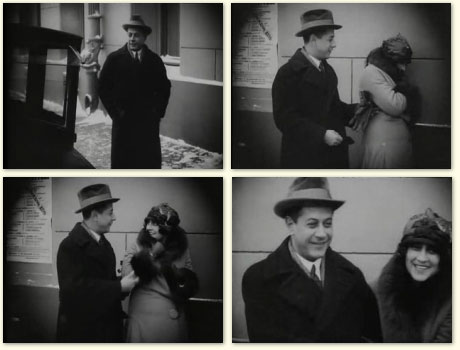 It's not just a curiosity though: it's actually a good, funny movie. You can watch it here.
Wednesday, December 20, 2006
The Tenth Annual ChessCafe Holiday Quiz
The hardest quiz in the world of chess made its annual appearance today*: scroll down for the questions. You'll have to scroll quite a way - the section describing the prizes is even longer than the quiz itself. Come to that, in this particular quiz the list of prizes is usually longer than the list of completely correct entries. Substantially longer.
So, while we could all pretend to have a go at it ourselves, and be lucky to get one or two correct, I would propose, in the spirit of the Kasparov v The World chess game, that we pool our resources and try and get as many answers as we can between us, much as people do with the King William's General Knowledge Paper. After which the only question will surely be - what to do with the prizes?
I would start off, but at first glance I don't think I know any of the answers at all.
So...who does?
[* = this link may become defunct in which case I'll try and update it]
Tuesday, December 19, 2006
You can't fail . . .

The open goal you can't miss - and bang, the ball is fifty foot up in the crowd. Six wickets in hand, three runs to win - and then, ouch: it's Shane Warne bowling, and the Ashes crumble in your fingers that very over. Or in chess terms, you're three rooks, five queens, twelve knights, and three hundred bishops ahead - and drat, his king's stalemated. You never even saw it coming.
Yep - we've all been there, ruining those certain wins. However, I promise you that you'll solve this puzzle by V. Röpke (Skakbladet, 1942) correctly. In fact, try not to.
(Of course - were it a game, you'd have lost on time.)
____________________________________________________
Oh - just one little thing extra. If you don't yet know your Kasparov Number, go work it out, and let us know in the comments. I've just remembered I beat Adam FF in the Portsmouth Major eleven years ago when we were both Juniors - so that increases mine to 5.
Monday, December 18, 2006
What's Your Kasparov Number?
 Bit of fun this.
So, one time you beat player A. Another time, A beat B - who also has beaten C. C beat D, D . . . How long is that chain until you reach Player Z who beat Kasparov? Well, how long is, in fact, your Kasparov Number. And this is the website that will work it out for you.
For instance, Adam FF beat David Howell in 2001. Two years later, Howell beat Speelman - who had in 1996 beat Yermolinksy. And way back in 1975, Yermolinsky beat Kasparov. So Adam has a Kasparov Number of 4. Impressive!
Of course, not every Streatham & Brixton Chess Club player will be on Chessbase Megabase 2005, which IBeatGarry.com use to work out these degrees of separation. I'm not, for instance. But then I beat Antony Cullen earlier this year - and he's there, with a Kasparov Number of 6. So, my Kasparov Number is 7. Dang, I need to work on that!
What's your Kasparov Number?
Sunday, December 17, 2006
Team Updates: London League 1, Croydon League 2

"Was it Wimbledon v Streatham, Wimbledon v Watford, Watford v Streatham, or Watford v Watford?" writes Martin about our London League Division 1 match on 30th November. "It was impossible to tell. Everyone seemed to know everyone else and had played each other a hundred times before - all very convivial, but it didn't stop the slugfest."
Well, I'll solve the mystery. It was Streatham 1 versus Wimbledon 1. And, indeed a slugfest it was. The score of that match currently stands at 5½-5½ - with only three draws amongst all that. I blogged the finish of my game from the evening here - while the match will be decided by Adam W's adjourned game.
The above position is taken from Adam F-F's game on the evening. He had black against Mark J Dubey on board 5, and describes the action as follows:
After a dull ‘strategic’ game we were both down to around 15 minutes left to complete the game. I made an error on my previous move, leaving us in the above position. Can you spot White’s move?
36. Nxd6! Losing concentration can be costly! I decided I didn’t fancy being a routine pawn down, so tried to mix it up by taking the knight (36. … Bxb3 37. Ncxb5! achieves little). 36. … Rxd6?! 37. Rxd6 Now 37. … Rxd6 38 Nxb5 is horrible, so sadly the queen has to go. 37. … Qxd6 38. Rxd6 Rxd6. Despite the material deficit Black has some open lines and threats. Unfortunately, White has another trick up his sleeve that I had missed 39. Nxb5 cxb5 40. Qc8+ Bb8 41. Qxg8 Rd2+ 42. Kc3 Rxg2

Now the smoke has cleared and White has a winning endgame, but with little time and an annoying passed h-pawn to deal with, can he convert it? If there were one more pair of pieces on the board he could ‘play for mate’, but the queen can’t do it alone. At least he has a draw ‘in hand’…
43. Qd5+ Ka7 44. Qf7+ Ka8 45. Qxf6 h3 White needs to somehow combine pushing his e-pawn, disrupting Black’s h-pawn’s progress and even bringing up his king to help in the mating attack. 46. Qa6+, 46. e5 or 46. Kb4 looked good to me, but instead he chose 46. Qh8? (this wasted move probably throws away the win) 46. … h2 47. Qh7? losing to the simple 47. … Rg1. It transpires that White had missed the fact that the bishop on b8 covers the pawn on h2, and thought Black was just tied down!! Unfortunately, White cannot give any checks and his unfortunate king position means there is no perpetual as Black can bring his rook back.48. Qd7 Rc1+ 49. Kb4 h1=Q 50. Qd5+ Ka7 51. Qd4+ Ka6 52. Qf6+ Kb7 53. Qf7+ Rc7 54. Qd5+ Ka7 55. Qd4+ Ka8 56. Qd5+ Rb7 Despite having no more checks, White plays on in the time scramble. 57. Ka5 Qa1 58. a4 bxa4 59. bxa4 Qf1 60. e5 Bc7 mate. I expect White had nightmares about that one!
And that's what we mean by slugfest . . .
Meanwhile, Richard sent me a brief note about our Croydon League Second Team: "We lost night’s match at Dulwich. It stands 3-0 to them, but hopefully we will avoid the whitewash as Jonathan has much the better of things in his adjourned position."
So, that's two adjournments to wish Streatham & Brixton Chess Club players good luck in. Good luck!
Saturday, December 16, 2006
The Clockwork Ending
Click here: piece originally posted on A Few Words Before We Go.
(Diagram shows position after Black's move 43.)

(Some Streatham and Brixton members may remember this ending being demonstrated at the club one evening a couple of years ago!)
(Diagram shows position after Black's move 43.)

(Some Streatham and Brixton members may remember this ending being demonstrated at the club one evening a couple of years ago!)
Friday, December 15, 2006
White's Move

"Perhaps I should just give up with puzzles altogether?" commented an exasperated Jonathan, after being stumped by Justin's very tricky post. Well, we wouldn't want that.
So - here's a brief, witty little number, that hopefully won't hurt the brain cells too much, and will entertain to boot. It was composed by puzzle-legend Sam Loyd in 1858 - although I encountered it just the other day in the ChessWorld Chess Forum.
Previous puzzles are indexed here btw. And if you fancy something different, don't forget our growing collection of Ultimate Blunders.
Thursday, December 14, 2006
January Rapid Play

What does January mean to you?
As a child, I would have said snowball fights in the back garden, a new BMX to race across the fields, to the mirror magic of an ice pond; or spotting a bird's nest amongst white branches, the glimpse of a wing lifting through frozen morning. Now it's more likely to mean a new pile of books I don't want to read, an emptied overdraft, and a barely-functioning liver.
Still, this January offers something different from either of those. Yes, that's right. The 69th Richmond Rapidplay has just been announced, and it will take place on Sunday 7th January. There are four sections - an Open, an under 160 Major, under 120 Intermediate, and an under 80 Minor. Rather nicely, this tournament has an excellent 4½ point rule: "if you score 4½ or more out of 6 you are GUARANTEED A PRIZE."
Oh - and it's organised by Streatham & Brixton Chess Club members Angus & Sue, amongst others, to boot. Personally, I can't think of a reason not to go. So click the above link to find out more - or go straight to the entry form here (PDF file), and I hope to see you there.
Wednesday, December 13, 2006
World Championship Quality Blunders II

Do you recognise this position?
I’m betting that a fair few people will know it’s taken from the first game of the Fischer – Spassky match in 1972.
Spassky, playing White, had just exchanged a pair of knights on d6 and after Fischer recaptured with the bishop, pushed his pawn to b5. What happened next was so shocking that journalists still wanted to ask Fischer about it 20 years later.
The genius that is Bobby came up with …
29 … Bxh2 ??
and after Spassky replied with the far from difficult to spot
30. g3
the bishop was trapped.
What’s so incredible about this blunder is that it’s exactly the sort of move an early chess computer would play. It sees the bishop will be trapped but the number of moves it takes to actually capture it is beyond the machine’s ability to calculate (the ‘horizon effect’) and as a result evaluates the position as better for Black because he will be material up as far as the computer can reach in its analysis.
But Fischer was no silicon muppet so what happened?
It seems he’d expected
30. … h5
31. Ke2 h4
32. gxh4
(leaving the pawn isolated and weak)
on the grounds that
32. Kf3 h3
33. Kg4 Bg1
34. Kxh3 Bxf2
leaves Black a pawn up. Unfortunately for Fischer, 35. Bd2 traps the bishop for real.
In the game after 32. Kf3 Bobby tried …Ke7 and apparently this position is still just about drawn but he blundered again the move before the time control and eventually resigned on move 56.
So … Bxh2 turned a certain draw into a very difficult one. Although it had a significant effect on the game the same can’t really be said about the match. Fischer famously failed to turn up for the next game so he effectively gave Spassky a two point head start. Nevertheless by game 6 Fischer was already in front and by game 13 he had stretched his advantage to 6-3. Several draws followed before Fischer wrapped the match up with victory in game 21. There was no way Fischer was ever going to lose to Spassky regardless of how many points he blundered away.
Not much value there then but the real genius behind the blunder is finding it in the first place. It’s just so completely unnecessary it’s beautiful. I’d love to know how long Fischer thought before moving. You might have thought that, playing in his first title match, Fischer would have paused to check whether the World Champion really had just left a pawn en prise – but we can all be grateful that he didn’t.
Effect on the Game: 3.5/5
Effect on the Match: 0/5
Degree of Difficulty: 4/5
Artistic Merit: 4/5
That gives Fischer an Ultimate Blunder Rating of 11.5 and leaves him comfortably ahead of Topalov, which is probably as it should be. There are still plenty more blunders to work through though.
Next time … double trouble.
Name that Position
 I came across this somewhat random position earlier today (Black to play).
Who's playing?
What's the objective assessment of this position?
How did the game actually end?
Clue:
it's from a World Championship match.
Streatham 2 versus Wimbledon 2
On Thursday last week Streatham 2 faced what looked like a tough fixture in Division 3 of the London League against fellow promotees Wimbledon 2. Yet, we romped home to an astounding 8-2 victory. The team now has 3 wins out of 5 this season - currently a mid-table performance. But with much canibalisation going on - and Albany currently the only undefeated team - it's too soon to say that another promotion is out of the question.
Unfortunately, I recently played my fifth game this season for Streatham & Brixton Chess Club's First Team. This means, I won't be able to play for the second team again this season. But at least I went out with a good result against Wimbledon 2 - winning this game against Chris RA Clegg as black on board 1.
1. e4 c5 2. Nc3 Nc6 3. g3 g6 4. Bg2 Bg7 5. d3 e6 6. Be3 d6 7. Nge2 Nge7 8. Qd2 h5 9. O-O O-O 10. Bh6 Nd4 11. Bxg7 Kxg7 12. Nd1 f5 13. f4 fxe4 14. dxe4 Nec6 15. c3 Nxe2+ 16. Qxe2 d5 17. f5 (Total confusion now!)

17. ... d4 18. fxg6 Rxf1+ 19. Bxf1 Qg5 20. Nf2 h4 21. Qg4 Qxg4 22. Nxg4 e5 23. Nf2 hxg3 24. hxg3 Be6 25. c4 (25. Bb5 - threatening Nd3 - is met by 25. ... c4, so it's now obvious white was not correct to head to this endgame.) 25. ... Kxg6 26. Rc1 b6 27. Kg2 a5 28. Be2 (28. a4 white still might draw.) 28. ... a4 29. Kg1 (29. a3 was absolutely essential.) 29. ... a3 30. b3 Nb4 31. Ra1 Rf8 32. Ng4 Bxg4 33. Bxg4 Kg5 34. Be2 d3 35. Bd1 Rf7 36. Kg2 Rf6 37. Kg1 Rf8 (The rook moves were just to reach the time control.) 38. Kg2 d2 39. Be2 Nc2 40. Rh1 Ne3+, and white resigned.
Tuesday, December 12, 2006
Four thought

Here's a puzzle I saw in a chess encylopaedia the other day.
Give the line of play, from the normal starting position, which leads to this position after exactly four moves by both sides.
London League One: versus Hackney
As Martin put it, Streatham & Brixton Chess Club's First Team got hacked up by Hackney last night in the London League Division One. Whilst Andrew won a messy game, and Adam W neatly took apart his opponent's defences, and Robin sacrificed pawns for open lines which he made decisive use of, and Angus & I drew - the tide of the evening turned in their favour on the other boards. 8-4 to them over all.
To add to the misery, I had a winning position in my game on move 14, but didn't find either of the two sequences which would have won. Here's the position.

To add to the misery, I had a winning position in my game on move 14, but didn't find either of the two sequences which would have won. Here's the position.

I played 14. ... dxe4 after a long think, having rejected 14. ... Nxe4 on account of 15. Qxd5, eg 15. ... Nxc3 16. Qxf5 Nxb1 17. Qxc2 Bb4 18. Be3, when the b1 knight is doomed and white wins. Instead, after the mass-liquidation with 15. Qxc2 exf3 16. Qxf5 fxg2+, we agreed a draw. See if you can spot the winning sequences I should have played, without a computer or moving the pieces around.
Monday, December 11, 2006
First Team - Update!
Well, I wasn't looking forward to searching through my 125 unread emails to update you on how Streatham & Brixton Chess Club's First Team has been getting on. And fortunately, now I don't have to! Martin just emailed this summary around: "Thanks to a win in extra time by Alan we have stolen the match against Ilford 6.5/5.5, in spite of playing with 11 men. Well done all. So we have 2 match points from 3 finished matches. The match v Wimbledon is still in the balance 5.5/5.5 with Adam W’s game outstanding."
Here is the position Alan won his adjourned position from:


Here is the position Alan won his adjourned position from:

I know what you're thinking - that Alan was white and a win looks fairly likely. But, no. Alan was black. Rook endgames are a bit of a mystery to me, this one more than most. So here are the moves that completed the game, with the final position below: 1. g3 Rf5 2. Rxf5 gxf5 3. Rxb5 Rxd7 4. b4 Rc7 5. Rxa5 Rxc3 6. a4 Kg7 7. Rb5 Kf6 8. a5 Ra3 9. Rb6 Kg5 10. a6 Kg4 11. Kf2 e5 12. b5 Ra2+ 13. Ke3 f4+ 14. gxf4 exf4+ 15. Ke4 f5+ 16. Ke5 f3 17. Rc6 f2 18. Rc1 Re2+ 19. Kd6 Re1 20. Rc4+ f4 21. h3+ Kg3 22. Rc3+ f3, and white resigned.

Amazing stuff! A big Congratulations to Alan. And also a big Thank You to Bob, who apparently provided three pages of analysis of the adjourned position - which at the very least changed Alan's mind in favour of 1. ... Rf5.
Tonight we face Hackney, who were a considerable force last year in Division 1 of the London League. Good luck everyone.
Tonight we face Hackney, who were a considerable force last year in Division 1 of the London League. Good luck everyone.
Sunday, December 10, 2006
Missed Move

So (since moving house last Monday) this weekend I finally drilled back together my bed, solved a jigsaw puzzle of wood to make three book-cases, and reclaimed the floor from an expanse of my stuff. Amidst which, I rediscovered an old charity-shop-find I'd almost forgotten about: the book World Cup Chess by Lubomir Kavalek.
The what by who? Well: The Chess World Cup was a series of tournaments in the late 80s, which no longer exist anymore. They were organised by the Grandmasters Association, which also doesn't seem to exist anymore. As for Lubomir Kavalek, you can read about him here; he is retired now.
Not everything in life and chess is temporary and full of change of course. In chess, tournaments and organisations come and go, but we remember the brilliancies like immortal works of art - and humans will do so in awe and admiration until the game is no longer played. And the big big blunders live on indefinitely as well - albeit recalled in a somewhat different mood.
But here, there is an intermediary category too: the overlooked instant wins, but the player won later on anyhow. These slip out of memory. Do not find a place in the anthology, or biography. I found the diagram position on page 168 of the book I mentioned, and it's an example of this. It's from a game between Belyavsky and Ljubojevic. The latter played black, and chose 32. ... Bd4 here, and went on to win on move 61. But he overlooked a sequence that would have made the game unforgettable.
Have fun spotting it - and better luck with your own moves!
Saturday, December 09, 2006
The J'adoubies

Long-time chess blogger Megaskins has created his own awards for the chess world. Presenting, The J'adoubies. For a while, I was sadly quite stuck for a nomination for the "J'adore" category:
This is the Romance category. Since chess geeks are notoriously untalented, unattractive and unskilled in the ways of love, it's hard to find someone to award this to. Generally it goes to the chess geek most in love with himself,
But that changed when I found out I could nominate Kramnik.
Alright, alright. "Kramnik?" I hear you say. "Dry, technical, boring - that's how most describe Kramnik. Romantic? Hardly!" But, according to Goran Urosevic, this translates as: "Vladimir Kramnik and his girlfriend Maria will get married in Paris on December 30th or 31st. The two have met when Kramnik played world chess championship against Peter Leko and Maria came to interview him." Although, Kramnik's homepage is mysteriously silent on the subject.
Anyhow - congratulations go to Kramnik. And I hope you Streatham & Brixton Chess Club enjoy the fun of The J'ahaha, The J'adore, The J'adoubie-doo-bee-doo, The J'ahad, J'aDOH!, The J'aDamn!, The J'adEGO, and The J'adELO - which collectively make up The J'adoubies.
Friday, December 08, 2006
Friday Puzzle

If - like me - your week was as busy as it gets, then I hope that - also like me - you'll be spending the rest of this Friday afternoon with your feet up on a desk.
In which case, you might want to take a few moments to solve this puzzle. It's in memory of David Bronstein, who was playing black (to move) in the diagram position, in 1965 against Vladas I Mikenas.
And if that was too easy - or you've seen it before - don't forget there are other chess puzzles scattered about the blog, too. Here, here, here, here, and here, in fact.
Don't think, incidentally, that there isn't any news about Streatham & Brixton Chess Club. There are first team and second team results to report - but all that over the weekend, and early next week. For right now, my hands are leaving the desk, to be replaced by my feet.
Thursday, December 07, 2006
David Bronstein, 1924–2006

David Bronstein died on Tuesday. I am not really knowledgable enough to write much about this sad news, or about his remarkable life and chess career. So instead, here are some quotes and links:
"David Bronstein was both an outstanding chess player and an excellent writer. Furthermore he was one of the most beautiful players of the twentieth century, always looking for the beauty in chess. Where Botwinnik saw chess as science, Bronstein considered it to be art. And of course it was Bronstein who wrote one of the true classics in chess literature: Zurich International Chess Tournament 1953. Enough reasons to pay tribute to David Ionovich Bronstein." - Doggers-Schaak in memoriam.
"He came within one draw of becoming world champion, and was one of the strongest players in history to not win the title. David Ionovich Bronstein was a remarkable creative genius and a master of scintillating tactics that enthralled the chess world for many decades." - Frederic Friedel, ChessBase obituary.
"In the year's I have been compiling TWIC there has only been one death of comparible stature, that of Mikhail Botvinnik in 1995. I have raked over his [Bronstein's] results and achievements without I think quite getting to the essence of why the man was so important and great. When he emerged he was to that generation as Tal and Fischer were to the next or the young Kasparov was to me. He brought something new and exciting to the game and he took that ability right to the very top and in doing so he actually influenced how a generation played." - Mark Crowther's appreciation of Bronstein.
See also: Brief Wikipedia biography, and the ChessGames page.
"Chess is imagination." - David Bronstein.
Wednesday, December 06, 2006
Tonight!

After winning the World Chess Championship against Topalov in October, Kramnik declared he was going to celebrate by getting drunk with his friends. I imagine that - having lost his match 4-2 against Deep Fritz yesterday - his commiseratory tipple last night and tonight will look a somewhat lonelier picture.
Oh well. At least Streatham & Brixton Chess Club will be having a better time of it, since it's our club night tonight, down at the The Priory Arms (click for details.) And if you've got a bit of time to spare today before then, you might want to take a look at the interesting final game of Kramnik - Fritz, where Kramnik played black: 1.e4 c5 2.Nf3 d6 3.d4 cxd4 4.Nxd4 Nf6 5.Nc3 a6 6.Bc4 e6 7.0-0 Be7 8.Bb3 Qc7 9.Re1 Nc6 10.Re3 0-0 11.Rg3 Kh8 12.Nxc6 bxc6 13.Qe2 a5 14.Bg5 Ba6 15.Qf3 Rab8 16.Re1 c5 17.Bf4 Qb7 18.Bc1 Ng8 19.Nb1 Bf6 20.c3 g6 21.Na3 Qc6 22.Rh3 Bg7 23.Qg3 a4 24.Bc2 Rb6 25.e5 dxe5 26.Rxe5 Nf6 27.Qh4 Qb7 28.Re1 h5 29.Rf3 Nh7 30.Qxa4 Qc6 31.Qxc6 Rxc6 32.Ba4 Rb6 33.b3 Kg8 34.c4 Rd8 35.Nb5 Bb7 36.Rfe3 Bh6 37.Re5 Bxc1 38.Rxc1 Rc6 39.Nc3 Rc7 40.Bb5 Nf8 41.Na4 Rdc8 42.Rd1 Kg7 43.Rd6 f6 44.Re2 e5 45.Red2 g5 46.Nb6 Rb8 47.a4 1-0.
Game 5 was pretty interesting too, where Kramnik was white: 1.d4 Nf6 2.c4 e6 3.Nf3 d5 4.Nc3 Bb4 5.e3 O-O 6.a3 Bxc3+ 7.bxc3 c5 8.Bb2 Nc6 9.Rc1 Re8 10.Bd3 dxc4 11.Bxc4 e5 12.dxe5 Qxd1+ 13.Rxd1 Nxe5 14.Nxe5 Rxe5 15.Be2 Bd7 16.c4 Re7 17.h4 Ne4 18.h5 Ba4 19.Rd3 b5 20.cxb5 Bxb5 21.Rd1 Bxe2 22.Kxe2 Rb8 23.Ba1 f5 24.Rd5 Rb3 25.Rxf5 Rxa3 26.Rb1 Re8 27.Rf4 Ra2+ 28.Ke1 h6 29.Rg4 g5 30.hxg6 Nxf2 31.Rh4 Rf8 32.Kf1 Nh3+ 33.Ke1 Nf2 34.Kf1 Nh3+ 35.Ke1 1/2-1/2, and you can find the rest of the games by looking through our Archives (link in sidebar on the left.)
See you tonight!
Tuesday, December 05, 2006
Tomorrow!

Tomorrow is the first Wednesday of the month - and that of course means our chess club evening at The Priory Arms.
I say 'of course' - but all that will in fact change in January, when the pub converts their upstairs into some flats.
As Angus said in the last newsletter, "We have done fantastically well out of the Priory Arms who have provided us with an excellent venue (enjoyed by our opponents also) at no cost for five years."
So, whilst I hope to say 'hello' to many of you there tomorrow - it will also be a little bit of a 'goodbye' too.
Monday, December 04, 2006
Puzzle

Well Streatham & Brixton Chess Club, I've been up for an hour and a half, and whilst I'd like to say 'Good Morning' to you, the truth is we're moving house today, half-packed, have to rush out for a van, then traverse London a few times, in order to trudge all our stuff up four flights of stairs. At times like this I start to puzzle over why I've never won the lottery, or why someone isn't paying me half a million dollars to lose to Fritz. I can easily do that any day of the week. Lose to Fritz, I mean, not win the lottery.
Still, at least Bob sent me a fabulous puzzle to solve, saying: "You asked for remarkable positions, well here's one from an Andersson game v anonymous. I found it in a book printed 1944. I have my suspicions about it's authenticity, but it's a great position. Don't you dare use a chess engine on this!"
It's white to play - and indeed, I think I just solved it without assistance. Enjoy doing the same.
Sunday, December 03, 2006
Chessabit Second Rapidplay Tournament
The second chessabit rapidplay tournament was held yesterday, and three Streatham & Brixton Chess Club players took part - James, Adam W and myself. A full report will follow later, since I am somewhat unclear on a few decisions the organisers made, and will be emailing them to clarify.
But, some interesting chess was played. Many of my games got very messy - especially the one that started with the wild 1. e4 e5 2. Nf3 Nc6 3. Bb5 f5 4. Nc3 Nd4 5. Bc4 c6 6. Nxe5 Qe7 7. Qh5+ etc - and in a few games I was lucky to salvage draws from outright lost positions. I guess that's the nature of chess when the time limit is fifteen minutes each for all your moves.
Still, I managed a couple of very clean wins with white (all my black games were drawn) and here is one from the first round that shows the importance of getting 'your' opening in at this time-limit. 1. e4 d5 2. exd5 Qxd5 3. Nc3 Qa5 4. Nf3 Bg4 5. b4!!

Undoubtedly the best move in this position at this time limit. The point is 5. ... Qxb4 6. Rb1 with 7. Rxb7. 5. ... Qf5 6. Be2 c6 7. b5 Qc8 8.O-O Nf6 9. Bc4 e6 10. a4 Be7 11. Ba3 Bxa3 12. Rxa3 c5 13. h3 Bxf3 14. Qxf3 O-O 15. Ne4 Nxe4 16. Qxe4 Nd7 17. Rg3 Nf6 18. Qe5 Clearly, black has played somewhat submissively and white now has the makings of a huge attack on the kingside. But after 18. ... b6?? 19. Qxf6 my opponent resigned straight away.
Btw, my preview of the event can be found here.
Btw, my preview of the event can be found here.
Man versus Machine

If Fritz-Kramnik was a Human-Human contest, then game 4 would register as a distinct improvement for that first human (ie Mister Fritz). We would say that first human was lucky not to be behind - and let alone especially lucky to be a game in front - but that in game 4, he at least knew how to get a better endgame and apply pressure throughout. And whilst he must be a touch disappointed with the draw, at least he showed some subtle class that had been missing from his play in certain previous games.
Of course such descriptions make no sense with Fritz, who - unlike its sponspors - couldn't care less, whatever passionate remarks its display says. Fritz was white yesterday, and here are the moves of the game: 1.e4 e5 2.Nf3 Nf6 3.d4 Nxe4 4.Bd3 d5 5.Nxe5 Nd7 6.Nxd7 Bxd7 7.0-0 Bd6 8.Qh5 Qf6 9.Nc3 Qxd4 10.Nxd5 Bc6 11.Ne3 g6 12.Qh3 Ng5 13.Qg4 Qf4 14.Qxf4 Bxf4 15.Nc4 Ne6 16.Bxf4 Nxf4 17.Rfe1+ Kf8 18.Bf1 Bb5 19.a4 Ba6 20.b4 Bxc4 21.Bxc4 Rd8 22.Re4 Nh5 23.Rae1 Rd7 24.h3 Ng7 25.Re5 Nf5 26.Bb5 c6 27.Bd3 Nd6 28.g4 Kg7 29.f4 Rhd8 30.Kg2 Nc8 31.a5 Rd4 32.R5e4 Kf8 33.Kf3 h6 34.Rxd4 Rxd4 35.Re4 Rd6 36.Ke3 g5 37.Rd4 Ke7 38.c4 Rxd4 39.Kxd4 gxf4 40.Ke4 Kf6 41.Kxf4 Ne7 42.Be4 b6 43.c5 bxc5 44.bxc5 Ng6+ 45.Ke3 Ne7 46.Kd4 Ke6 47.Bf3 f5 48.Bd1 Kf6 49.Bc2 fxg4 50.hxg4 Ke6 51.Bb1 Kf6 52.Be4 Ke6 53.Bh1 Kf6 54.Bf3 Ke6 1/2-1/2. I have a strong hunch if Kramnik had had white, the result of that endgame may have been different.
Tomorrow (Sunday) is the fifth game of this six-game match. Kramnik has white; he surely must go for the win in an attempt to draw the match. You can keep track of it via one of the ten live feeds here. Kramnik, meanwhile, ought at least watch out for those mates in one.
Friday, December 01, 2006
Second Team versus Albany
Streatham & Brixton Chess Club's second team faced a tough London League third division match against Albany on the 23rd. On the night the score was 5-3 to them with two adjournments. But when I spoke to my opponent on the phone to arrange a resumption date, he told me that his sealed move was 37. Ne2. That was enough for me to resign, since five minutes with Fritz had confirmed to me already the impression I had on the night: his attack would then cost me a rook. So, we lost the match. Congratulations to Albany though, who have been fielding a consistently strong team this year and are currently unbeaten. They look hot favourites for promotion, as can be seen from the Division Three Table.
I had more luck for the first team last night in our match against Wimbledon - luck being the operative word. After a completely unclear middle-game, we reached this position:

I had more luck for the first team last night in our match against Wimbledon - luck being the operative word. After a completely unclear middle-game, we reached this position:

Here my opponent blundered with 33. R2c2?? I'm sure you can spot the instant win I had then. A full report on that match will follow later, in a separate post.
Oh, btw. If you're tired of seeing little incidents from my games (how dare you!) then feel free to send me your games for publication - or interesting positions from them.
Oh, btw. If you're tired of seeing little incidents from my games (how dare you!) then feel free to send me your games for publication - or interesting positions from them.
Subscribe to:
Posts (Atom)